
Contact strain measurement
Clip-On Extensometers
An activation force under 60 g leaves the specimen unaffected.
Cross-flexure gauges for metals, wood, composites, rigid plastics, polymers and rubber — materials of both very low and very high strength, at high and low strain alike. Axial and transverse units clip on directly and can be run together.
Built around the measurement
What the datasheet says about the clip-on gauges, and why each part of it matters to a result.
The cross-flexure body
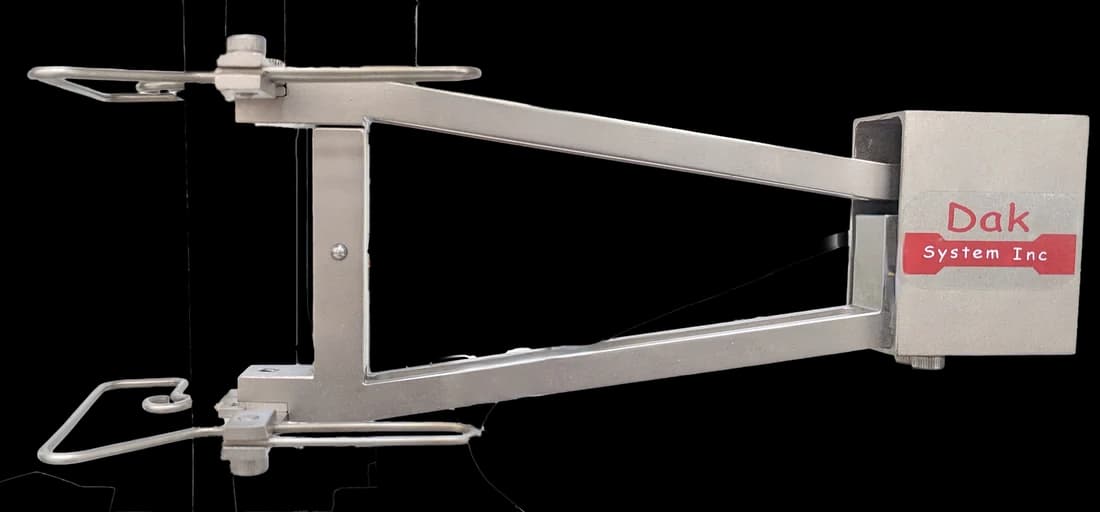
The gauge is built around a cross-flexure rather than a pivot, which gives true centre-point bending. That is what holds the linearity through zero travel, where a hinged design is at its least predictable, and it is the reason the same instrument can be trusted at very low strain and at full extension.
Light enough to leave the result alone
Activation force is typically under 60 g and can be as low as 30 g, and most units weigh under 70 g. On a compliant specimen the difference between a gauge that reads the material and one that stiffens it is exactly this figure.
Transverse measurement
The transverse gauge is self-supporting: it clips onto the sample, is held by an integral spring, and its rounded contact edges keep it in position. It works on any specimen of width or diameter from 0 to 1 inch (25 mm), and is used for Poisson's ratio, for anisotropic materials such as composites, and for sheet metal testing and r-value determination — usually running at the same time as the axial gauge.
Key features
- True centre-point bending from a cross-flexure design
- Low activation force, typically under 60 g and as low as 30 g
- Small and light — most units under 70 g
- Low hysteresis, typically under 0.1%
- Exceptional linearity, especially through zero travel
- Extended travel capability, up to 1 inch (25 mm)
- Axial and transverse units run simultaneously
The published figures
- Gauge length
- 10 to 50 mm
- Extension range
- 4 to 25 mm
- Resolution
- 0.001 mm
- Travel
- +10 mm (+40% strain)
- Hysteresis
- 0.10%
- Weight
- 70 g
- Standard range
- −10 °C to +65 °C
- High-temperature build
- −20 °C to +200 °C
- Specimen width or diameter
- 0 to 1 inch (25 mm)
- Mounting
- Self-supporting, integral spring
- Applications
- Poisson's ratio, composites, sheet metal, r-value
The other extensometers
Strain measured a different way, for a different specimen.