
Moving Die Rheometer (MDR)
Understand the cure. Control compound quality.
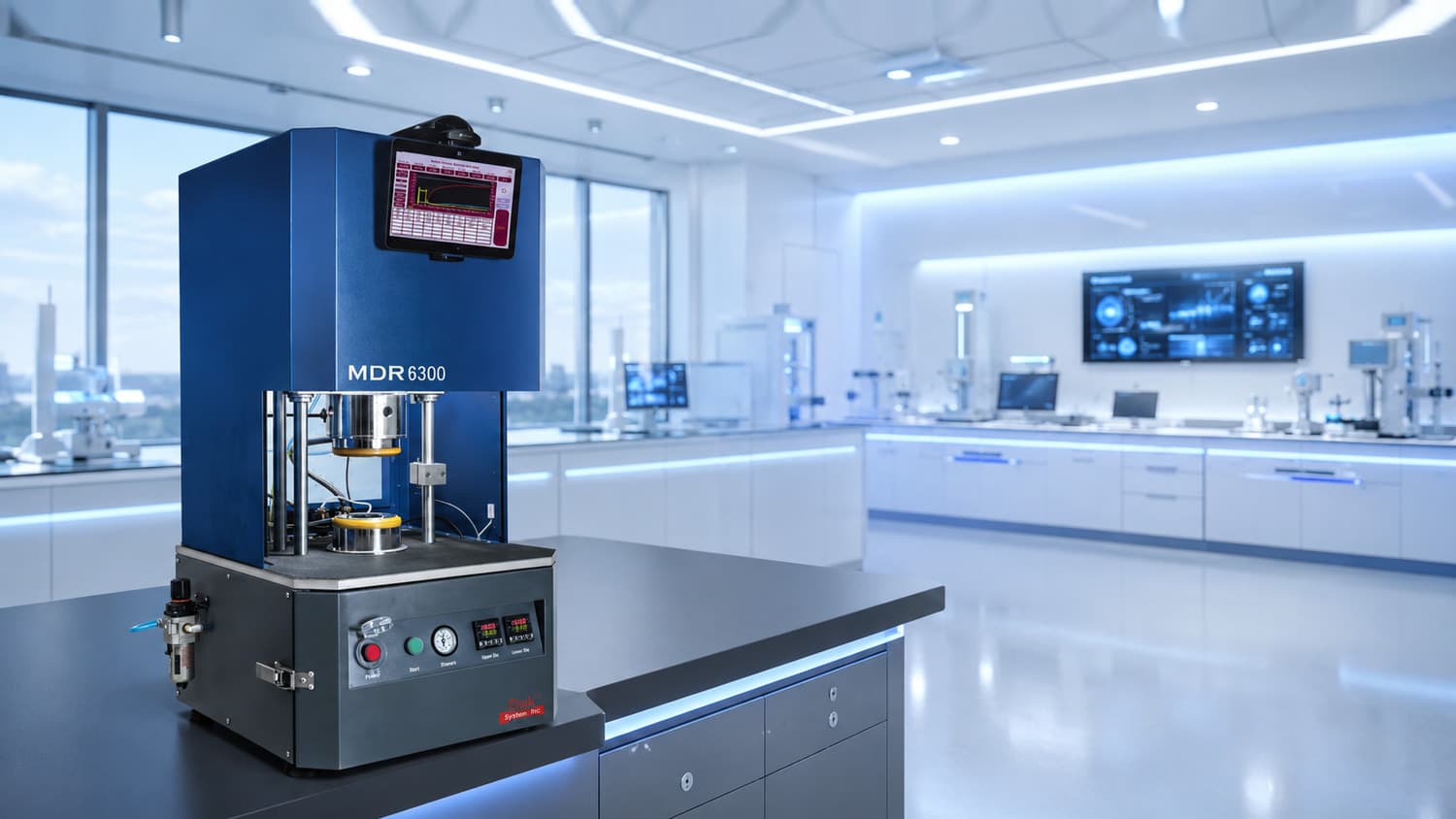
The MDR Elite-6300 measures how rubber compounds cure under controlled oscillation and temperature. Direct drive, film heaters and temperature-compensated torque cells support cure testing for compound development and production quality control.
- Torque
- up to20 N·m
- Temperature
- up to230 °C
Precision begins before the curve appears.
Controlled deformation, carefully managed heat and stable torque measurement work together throughout the test.
Direct-drive oscillation
DAK’s motor applies the oscillation directly, without an intermediate drive linkage. This removes that linkage as a source of mechanical play. Dyna Pro controls angle selection without changing mechanical spacers.
Why it matters: joints in a mechanical linkage can develop clearance as they wear. Direct drive avoids that particular source of lost motion, supporting consistent specimen deformation over repeated tests.
Film heaters and responsive temperature recovery
Film heaters provide a thin heating layer closely coupled to the dies. Working with independent upper and lower die control, they support responsive heating and recovery after a fresh rubber specimen is loaded.
Why it matters: cooler rubber draws heat from the dies. Fast, consistent recovery limits changes in the specimen’s early heating history, supporting repeatable scorch-time results such as ts1 and ts2. Recovery consistency matters alongside speed.
Temperature-compensated torque measurement
The high-stiffness torque measurement system uses temperature-compensated torque cells to account for the influence of sensor temperature on measurement.
Why it matters: the instrument must distinguish the specimen’s changing response from temperature effects within the measurement system.
The complete test system
Rigid four-post construction
The symmetric upper crosshead and rigid four-post frame provide a stable mechanical foundation for controlled oscillation and torque measurement.
Sealed under pneumatic load
A high-pressure pneumatic sealing system with locking cylinders holds the rubber specimen in a sealed, pressurised cavity.
Grooved biconical dies
Cruciform-less dies with an optimised groove profile maintain specimen contact and minimise slippage during testing.
Live cure information
Dyna Pro displays elastic torque, viscous torque and tan δ together as the test runs.
Constant or programmed temperature
Run isothermal cure tests. With the cooling option, the system also supports non-isothermal testing with individually controlled air cooling at both dies.
Practical maintenance
User-replaceable seals and user calibration support routine laboratory maintenance. Optional film between the specimen and dies can assist sample handling.
Use the curves to understand your compound.
Cure time tells you when a defined point is reached. S′, S″ and tan δ help explain how the rubber behaves along the way. Together, they give compounders more information for formulation trials and batch comparison.
The spring-like response
S′ shows the spring-like resistance of the rubber during the test. Following it through cure helps you compare how formulations develop their elastic response. Comparing production batches with an approved reference helps reveal a change in that response.
The damping response
S″ shows the energy-dissipating part of the rubber’s response. At the same oscillation angle and test conditions, a higher S″ means more energy is lost in each cycle. It helps you spot differences between recipes or batches that may look similar on the elastic cure curve.
The balance between the two
Tan δ tells you how much damping response the compound has relative to its spring-like response. Use it to compare a trial recipe with your current formulation, or a production batch with an approved reference. A change flags a different balance worth investigating, even when the usual cure-time result looks similar.
A practical example: similar elasticity, different energy loss
Imagine two formulations tested under identical conditions at the same cure stage. Both have S′ = 5, but S″ is 1 for formulation A and 1.5 for B, using the same torque units. Their tan δ values are 0.20 and 0.30. B has the larger energy-loss response, even though their elastic torque is the same.
What should the compounder do with that information?
In a formulation trial, use the difference to assess how your planned change in polymer, filler, oil or cure package affected the response. In routine QC, a repeatable departure from the approved batch is a reason to review raw materials, weighing, mixing and curing behaviour. The result guides the investigation; it does not identify the cause on its own.
Illustrative numbers, not DAK test data. Compare at the same temperature, angle, frequency and defined cure stage. Select the desired balance for the application: a larger or smaller tan δ is not universally better. Service-temperature damping, heat build-up and tyre performance need suitable follow-on tests.
Dyna Pro reports ML, MH, MH−ML, scorch and cure times, maximum cure rate and the time at which it occurs, alongside over 100 process parameters. Compare compounds using consistent test conditions.
Specifications for your laboratory.
Review the measurement range, test conditions, data and site requirements. Standard and optional configurations are identified separately.
Torque & strain
- Torque range
- up to 20 N·m
- Torque transducer
- High stiffness
- Torque units
- dN·m, lbf·in, kgf·cm or N·m
- Oscillation amplitude
- ±0.5°, 1.0°, 2.0°, 3.0° arc standard
- Oscillation amplitude (optional)
- ±0.1°, 0.2°, 0.3°, 5.0° arc
- Oscillation frequency
- 1.667 Hz (100 cpm), fixed
- Drive
- Direct drive motor, middle inertia
Temperature & test conditions
- Temperature range
- Room temperature to 230 °C
- Temperature units
- °C or °F
- Die control
- Upper and lower dies controlled independently
- Maximum heating ramp
- 1 °C/s
- Maximum cooling rate
- 0.5 °C/s
- Cooling system
- Optional — air on both die cavities, individual control per die
- Test conditions
- Isothermal; non-isothermal with the cooling option
Measured & calculated data
- Measured data
- Torque, temperature, strain
- Cure parameters
- ML, MH, MH−ML, S″ at ML, tan δ at ML and MH, ts1, ts2, tc10, tc50, tc90, max cure rate, time at max cure rate
- Process parameters
- Over 100, including scorch time and cure rate
- Software
- Dyna Pro control and analysis, multiple languages
- Reports & export
- Numerous formats
Dies, sealing & frame
- Die design
- Sealed biconical, cruciform-less, optimised groove profile
- Cavity
- Sealed and pressurised
- Sealing
- High-pressure pneumatic sealing system with locking cylinders
- Seals
- User-replaceable
- Calibration
- User calibration
- Sample handling
- Optional film between sample and die
- Test frame
- Four-post, symmetric upper crosshead, compliance-free
Physical & installation
- Weight
- 180 kg
- Dimensions
- 32 × 32 × 43 in
- Air supply
- 80 psi (5.6 kg/cm², 551 kPa) minimum
- Electrical supply
- 220/240 Vac ±10%, 60 ±3 Hz, 20 A three phase, or 440/480 Vac ±10%, 50 ±3 Hz, 10 A three phase
- Console
- Optional touch console
How to choose an MDR for dependable quality control
Look beyond the purchase price. Evaluate the consistency of the test, the quality of the data and the support behind the machine.
Confidence in every batch
Cure testing is an early checkpoint for incoming compounds and production batches. Choose a system that helps distinguish a genuine compound change from variation introduced by the instrument.
Consistent heat. Comparable scorch times.
Look at temperature recovery after each sample is loaded, not only the maximum temperature. Film heaters and independent die control support the consistent heating history needed for repeatable ts1 and ts2 results.
Controlled motion. Meaningful measurements.
Evaluate the drive and sensing system together. Direct drive removes intermediate-linkage play; temperature-compensated torque cells address thermal influence on the measurement. Review repeated curves as well as the specification sheet.
Value throughout the machine’s life
Include calibration, seals, maintenance, spare parts and technical support in the comparison. The initial quotation is only one part of keeping quality-control decisions dependable over time.
Compare a test series, not a single curve
Request 5–10 successive tests on fresh specimens from one compound batch. Review every curve and the spread of the results.
Put repeatability at the centre of your MDR demonstration.
Use the same agreed protocol with every supplier. A useful demonstration shows how the machine performs through repeated loading and testing, as it will in your laboratory.
Keep the compound and preparation consistent
Use fresh specimens from one well-mixed batch. Keep specimen preparation, quantity, storage, conditioning and any sample-handling film consistent. Record the temperature, oscillation angle, frequency, duration and calculation settings.
Run 5–10 tests in sequence
After the normal warm-up, repeat the loading and testing cycle. Retain every run and record any interruption or excluded result with its reason. Do not repeatedly test the same cured specimen.
Watch recovery after each loading
Loading cooler rubber changes the thermal conditions. Review how consistently both dies return to the test temperature, alongside the early cure curve and ts1/ts2 results. The maximum temperature rating alone does not show recovery performance.
Compare the spread, not only the average
Overlay the cure curves and tabulate each run’s ML, MH, ts1, ts2 and tc90, together with the mean, range and standard deviation. Compare tan δ at the same defined time or cure condition. Agree acceptable variation for your compound and method before judging the results.
Look beyond a smooth graph
Review S′, S″ and tan δ together. Investigate unexplained spikes or run-to-run changes, and ask how data filtering or smoothing is applied. Request the underlying recorded data and settings: a polished curve alone cannot establish measurement quality.
Include calibration and lifetime support
Review torque and temperature checks, phase-measurement checks where applicable, seals, maintenance, spare parts and technical support. Repeatability and accuracy are different: a machine can repeat a biased result. Include the ongoing cost of keeping the system dependable.
This is a practical buying demonstration, not a prescribed ASTM sample count or a substitute for method validation. Compare repeatability within each machine; differences in absolute values between instruments require method and design context.
MDR vs ODR: why choose a moving die rheometer?
For a new rubber cure-testing investment, we recommend MDR. Its rotorless design removes the embedded disc used in an ODR, enabling faster, more uniform specimen heating and simpler specimen removal. These are practical advantages for laboratories developing compounds and checking production batches.
| Why move to MDR? | The ODR arrangement | The MDR advantage |
|---|---|---|
| Faster specimen heating | The embedded, unheated disc acts as an additional heat sink within the specimen. | Removing that disc allows faster specimen heating, helping the rubber reach the intended test conditions more efficiently. |
| More uniform thermal conditions | The disc introduces another thermal influence into the rubber during heating. | The rotorless arrangement promotes more uniform specimen heating, an important foundation for meaningful cure comparisons. |
| Simpler specimen removal | The cured specimen must be removed from around the embedded disc. | There is no embedded rotor to extract from the cured specimen. DAK also offers optional sample-handling film between the rubber and dies. |
| Rotorless cure-test workflow | The procedure is built around an oscillating-disc curemeter. | MDR provides the rotorless test arrangement used for ASTM D5289 and ISO 6502-3, connecting equipment selection directly to these laboratory methods. |
| A practical basis for a new investment | The embedded-disc arrangement remains part of the laboratory's testing and handling process. | Choose a rotorless platform for its thermal and handling advantages, then evaluate the drive, sensing and software that make the complete MDR system. |
Choose MDR for the rotorless advantage. Choose DAK for the complete engineering behind it.
The MDR Elite-6300 builds on rotorless cure testing with direct-drive oscillation, software-controlled angle selection, film heaters and temperature-compensated torque cells. Live S′, S″ and tan δ, a rigid four-post frame and a sealed biconical cavity bring the test conditions and compound response together in one system.
Moving from an existing ODR? Establish the relationship between the old and new results for your compounds before transferring quality limits. If a customer specifically requires an ODR method, agree the method change first.
Method background: ASTM D5289 official public page · ISO 6502-3
Need a broader dynamic testing programme?
For DAK characterisation across strain, frequency and temperature, explore the RPA 4500. The MDR Elite-6300 already provides live S′, S″ and tan δ for its cure-testing programme.
Explore the RPA 4500From compound development to production control.
Production quality control
Compare batch cure profiles, scorch and cure times under a consistent method. Investigate unexpected differences before making a production decision.
Compound development
Assess how formulation and mixing changes affect the cure response, then connect those findings with the mechanical tests relevant to the finished product.
Tyres, hoses, seals and gaskets
Support compound testing for rubber products with different processing and service requirements. Select the method and test conditions around the compound.
Moving Die Rheometer | MDR Elite-6300
Watch on YouTubeDyna Pro brings control, live curves, calculated results and report preparation into the test workflow. Explore control and analysis software
Everything we film, on YouTubeRubber cure testing to established methods.
Discuss cure characterisation, scorch and cure-time reporting against the methods used by your laboratory.
Windows 11, 64-bit · Explore the standards library
Answers before you choose.
What is a Moving Die Rheometer used for?
An MDR measures the cure behaviour of rubber compounds under controlled test conditions. Laboratories use cure curves and calculated parameters in compound development, batch comparison and production quality control.
What is the difference between MDR and ODR?
MDR removes the embedded disc used in an ODR. That rotorless arrangement improves specimen heating and simplifies removal of the cured sample, making MDR our recommended starting point for a new rubber cure-testing investment.
Why consider an MDR when replacing an ODR?
An MDR upgrade brings faster, more uniform specimen heating and removes the task of extracting an embedded rotor from the cured sample. DAK adds direct drive, film heaters, temperature-compensated torque cells and live cure information, giving the laboratory a clearly defined engineering platform for its next investment.
Can existing ODR quality limits be transferred directly to an MDR?
Upgrade with a defined correlation plan. Compare the relevant compounds under documented conditions and establish the MDR acceptance limits from those results, rather than simply copying the old ODR numbers. This lets the laboratory adopt the new platform with a controlled changeover.
Does every MDR have direct drive?
The MDR Elite-6300 uses direct drive, with Dyna Pro controlling angle selection without changing mechanical spacers. This is a specific DAK design advantage to look for when selecting an MDR: the MDR label alone does not establish the drive type.
How does tan delta help with rubber compounding?
Tan δ helps you see whether a recipe change shifts the rubber towards more energy loss or more spring-like behaviour, relative to each other. Compare a trial recipe with your established compound under the same test conditions and cure stage. In QC, compare each batch with an approved reference: a repeatable shift can flag a change that the cure time alone does not reveal. Read S′ and S″ as well, because tan δ can rise when S″ increases, S′ decreases, or both change. The ratio is S″/S′; the useful part is understanding what changed and whether it suits your application.
What does S″ tell a rubber compounder?
S″ (S-double-prime) is the energy-loss part of the torque response. Under the same test conditions and oscillation angle, a higher S″ means more energy is dissipated per cycle. Two recipes can have similar S′, the spring-like response, but different S″. Looking at both helps you distinguish formulations and check batch consistency. If a batch differs repeatedly from the reference, investigate the formulation, materials and mixing history. S″ supplies a useful clue, not a diagnosis of one particular ingredient or a direct prediction of finished-product heating.
Must tan delta stay between 0 and 1?
No. A value below 1 means the elastic component is larger; above 1 means the viscous component is larger. At 1 they are equal. A value above 1 is not, by itself, evidence of a faulty instrument. Interpret the result for the compound and test conditions.
Does a tan-delta graph alone establish measurement quality?
No. Smoothness is useful to inspect, but software smoothing can hide variation. Review the recorded S′ and S″ data, the filtering settings, calibration and repeated tests under the same conditions. The stronger evidence is a consistent, traceable set of results, not simply an attractive line.
Why does temperature compensation matter in a torque cell?
DAK’s temperature-compensated torque cells address the influence of sensor temperature on measurement. Alongside controlled die heating, this helps the system distinguish the compound’s changing response from thermal influences within the sensing system.
What are ts1 and ts2?
These are early-cure timing markers: the time taken for torque to rise by the specified amount above its minimum. They help compare how quickly compounds begin to cure. Consistent heating after loading helps make these timings comparable. Use the same method definitions and units across reports.
What does tc90 mean?
It is the time associated with the defined 90% torque-rise criterion in the cure analysis. It is a laboratory cure parameter, not an automatic instruction to use the same duration for every moulded component.
How should repeated cure tests be evaluated?
For a buying demonstration, request 5–10 successive tests on fresh specimens from the same batch using consistent preparation and settings. Keep every curve and compare the spread of ML, MH, scorch times, cure time and tan δ at a matched condition. This is a practical screening exercise, not a universal acceptance limit or a prescribed standard sample count.
Can the MDR Elite-6300 run non-isothermal tests?
Yes, with the cooling option. The upper and lower dies are controlled independently; the published maximum heating ramp is 1 °C/s and the maximum cooling rate is 0.5 °C/s.
Should my laboratory choose MDR or RPA?
Choose around the testing programme. The MDR Elite-6300 focuses on cure testing at a fixed frequency. The RPA 4500 supports broader characterisation across strain, frequency and temperature. RPA is not required merely to obtain the live tan-delta curve already provided by the MDR.
What affects an MDR quotation?
The required configuration, cooling, selected options, software/reporting scope, installation location and support requirements shape the quotation. Share the test method and laboratory needs so the offer can describe the complete system.
Evaluate the complete MDR system.
A useful discussion starts with the test, the results you need and the way your laboratory works.
Test conditions
Compound, method, temperature, oscillation angle and required outputs.
Measurement and curves
Live S′, S″ and tan δ, plus the cure results your laboratory reports.
Repeat testing
Repeated specimens under the same documented conditions, including the full curves rather than only selected end points.
Calibration and upkeep
Torque and temperature checks, seal replacement and a practical maintenance plan.
Configuration
Standard and optional angles, cooling, console and software/reporting requirements.
Installation and support
Laboratory location, site utilities, demonstration, commissioning and ongoing technical assistance.
Manufactured in India. Supporting laboratories internationally.
Explore the machine and software through an online demonstration when a visit is not practical. DAK provides site and power requirements, documentation and installation support. Where no local partner or agent is available, our team travels from Mumbai for commissioning and operator training.
Remote technical assistance, spares and accessories are available through our Mumbai team.