
Testing standard
ISO 4074 Natural Rubber Latex Condom Testing
Natural rubber latex male condoms — Requirements and test methods
Written and technically reviewed by Dak System Inc. engineeringLast reviewed
ISO 4074 is the product specification for natural rubber latex male condoms, current as the 2026 edition. It sets requirements for freedom from holes, package integrity, dimensions and shelf life, and the airburst test that characterises the film: inflation to burst, recording both volume and pressure, against minima that step with nominal width.
At a glance
- Test type
- Puncture & burst
- Published by
- ISO
- Edition
- ISO 4074:2026
- Material
- Rubber, elastomers & foams
- Runs on
- Series 7200 and Series 9000
From the test method to your testing system
Explore DAK equipment for ISO 4074, then review the specimen and setup requirements below.
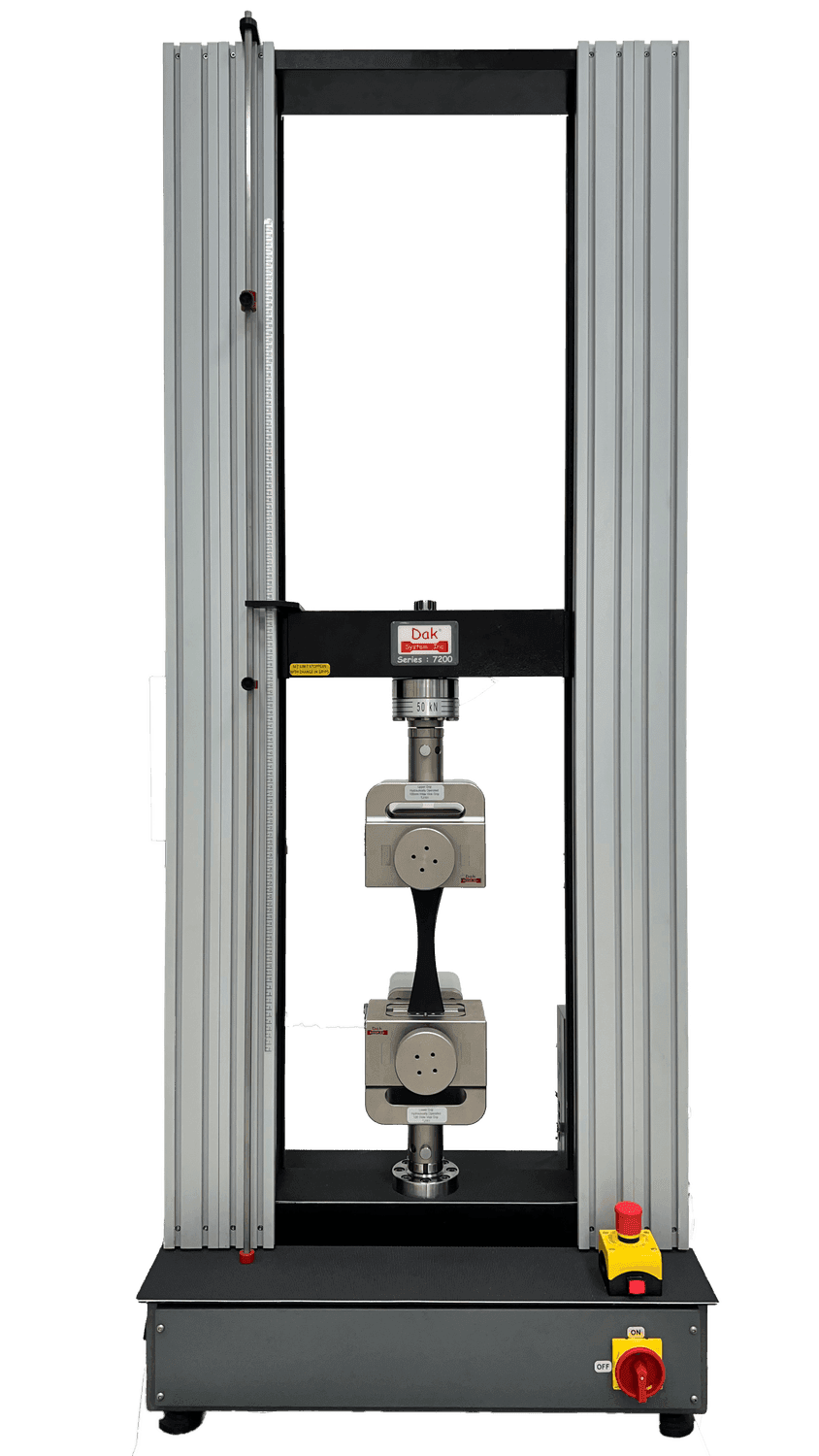 Universal Testing MachineSeries 7200Explore the machine →
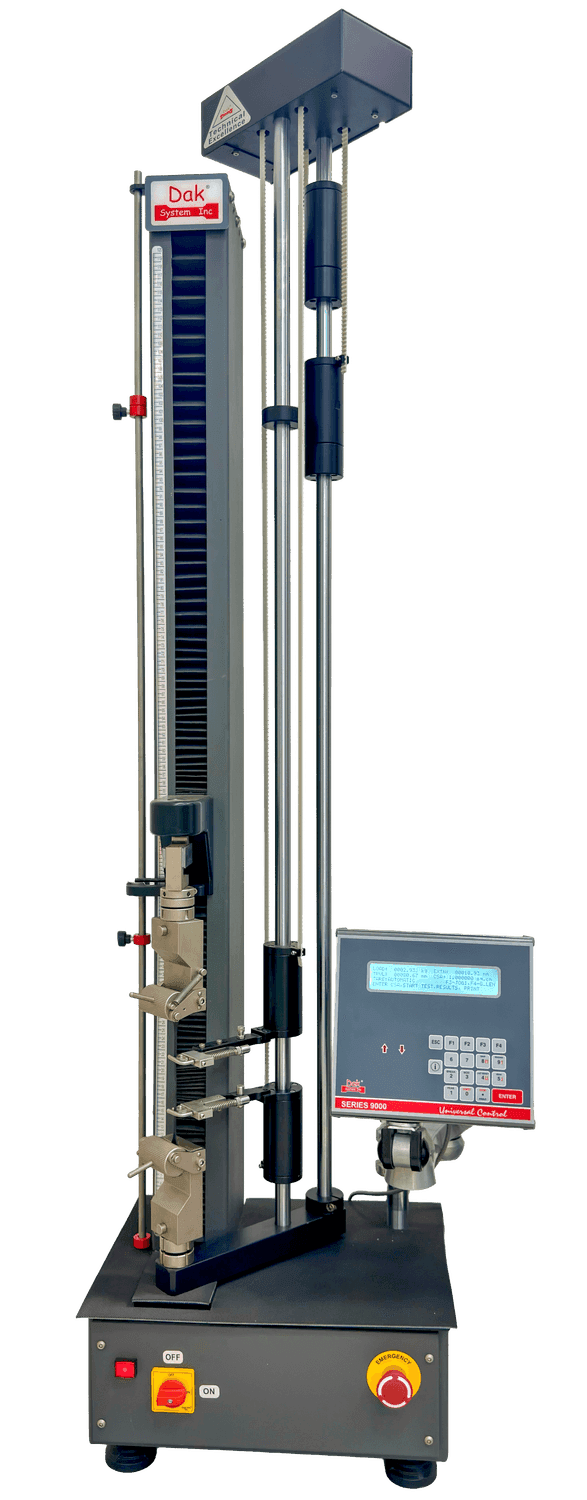 Universal Testing MachineSeries 9000Explore the machine →
Jump to a specific section
01Understand the method
What the test does
ISO 4074 is a product specification with its test methods attached — 95 pages of requirements, sampling and the laboratory methods that verify each one. Its scope is precise about a boundary: it covers male condoms made from natural rubber latex, and not any medicinal substance applied to or delivered by the condom.
Three tests carry most of the weight. Freedom from holes is checked by a water leak or electrical method. Package integrity is verified separately, because a sound condom in a failed pack is a failed product. And the airburst test inflates the unit until it bursts, recording both volume and pressure at burst.
Airburst is the characteristic test and its requirements scale with size. For condoms of nominal length 160 mm or more, the minimum bursting volume and pressure by nominal width are 16.0 dm³ at 1.0 kPa for 45.0 to 49.5 mm, 18.0 dm³ at 1.0 kPa for 50.0 to 55.5 mm, 22.0 dm³ at 1.0 kPa for 56.0 to 64.5 mm, and 28.0 dm³ at 0.8 kPa for 65.0 to 75.0 mm.
The standard also carries dimensional requirements — length, width and thickness — along with stability and shelf-life testing, and sampling plans for both continuing production and isolated lots.
What it measures, and why it matters
Pressure and volume together describe what neither says alone. Volume measures how far the rubber stretches before failing; pressure measures how strongly it resists while doing so. A unit can meet the volume requirement and fail on pressure — latex that is extensible but weak, a film that stretches obligingly and then tears.
The width bands are the reason the requirements are tiered rather than fixed. A wider condom encloses more volume at the same wall stress, so holding every size to one volume figure would be lenient on small sizes and punitive on large ones. The largest band drops to 0.8 kPa for the same reason in reverse.
Shelf life is the requirement with the longest reach. Latex oxidises and its properties drift, so a pass at manufacture is not evidence about the same unit two years later in a warm warehouse. The stability programme converts a batch release into a dated claim, and no amount of process control shortcuts it.
For an Indian manufacturer this is a working standard, not an academic one. India is among the world's largest producers, and airburst and leak testing run continuously on the production floor.
02Prepare the specimen and test settings
Specimen and sampling
A product specification, so the specimen is the article as it will be sold — lubricant, packaging and all.
- Article
- Finished condoms, sampled from the lotNot a cast latex sheet. The property measured is that of the film as it was actually formed and cured.
- Sampling
- Defined plans, continuing series and isolated lotsThe plans are part of the requirement, not guidance. A lot judged on a convenient sample has not been judged.
- Tensile pieces
- Cut from the article itself where requiredWhich is why the tensile work needs grips that hold thin extensible rubber without cutting or slipping.
Test speed
For condoms of nominal length 160 mm or more, the minima step with nominal width. Inflation rate is controlled because latex is rate-sensitive.
- 45.0 – 49.5 mm width
- 16.0 dm³ at 1.0 kPa minimumBoth must be met. Volume without pressure means extensible but weak.
- 50.0 – 55.5 mm width
- 18.0 dm³ at 1.0 kPa minimumThe most common width band in production.
- 56.0 – 64.5 mm width
- 22.0 dm³ at 1.0 kPa minimumA wider article encloses more volume at the same wall stress, which is why the volume minimum rises.
- 65.0 – 75.0 mm width
- 28.0 dm³ at 0.8 kPa minimumThe pressure minimum drops in the widest band for the same geometric reason the volume minimum rises.
- Inflation rate
- ControlledLatex is rate-sensitive: a fast inflation reads high and flatters the result.
03Build the test setup on a DAK machine
What the machine must be capable of
The airburst apparatus is the specialised item: a chamber that inflates the condom at a controlled rate while recording volume and pressure to burst, with the resolution to resolve 0.8 kPa meaningfully. Rate control matters, because latex is rate-sensitive and a fast inflation reads high.
Leak testing needs a water-fill arrangement or an electrical conductivity test. Dimensional work needs a way to measure width and length on an article that will not hold a shape, and thickness on a film under light contact — a gauge that presses hard reads latex thinner than it is.
Tensile work on cut pieces runs on a low-force frame with grips that will hold thin, extensible rubber without cutting or slipping.
Running ISO 4074 on the Series 7200 and Series 9000
Dak verifies against whichever standard the method names, and where a class applies our frames sit a class tighter than it asks.
| The method asks for | Dak supplies | |
|---|---|---|
| Capacity | Not a force test: the airburst apparatus records inflation volume in cubic decimetres and pressure in kilopascals | Load cells from 1 kg to 60 ton on the Series 7200, and 0.5 to 100 kN on the Series 9000 |
| Force accuracy | unknown — the requirements are expressed as burst minima rather than a machine accuracy class | ISO 7500-1 Class 0.5 — the method sets no class of its own |
| Gripping | Airburst chamber inflating the article at a controlled rate; separate water-leak or electrical leak apparatus | Our a fixture built for this method, built to the specimen |
04Run the test
How the testing runs
- Draw the sample according to the plan for the lot type — continuing series or isolated.
- Test freedom from holes by the water leak or electrical method.
- Verify package integrity separately from the article itself.
- Measure length, width and thickness, taking thickness under light contact.
- Inflate to burst at a controlled rate, recording both volume and pressure.
- Compare against the minima for that nominal width band.
- Run the stability programme separately to support any shelf-life claim.
05Report and interpret
What travels with an ISO 4074 result
The width band decides which minima apply, so a burst figure without it cannot be assessed.
- Nominal width and length, since the minima step with width.
- Burst volume and burst pressure, both.
- The leak method used — water or electrical.
- The sampling plan applied and the lot type.
- The shelf-life claim and the stability data supporting it.
- The edition tested to; the 2026 edition replaced the 2015 one.
What goes wrong in practice
Inflating too quickly in airburst is the commonest, and it inflates the result along with the condom.
Thickness measured under too much contact force is the second, and it biases every dimensional result low.
Sampling outside the defined plan is the third. The plans are part of the requirement, not guidance, and a lot judged on a convenient sample has not been judged.
Finally, treating a pass at manufacture as a pass for the shelf life. Only the stability programme supports a dated claim, and it is the requirement most often deferred.
06Compare methods and find answers
Volume or pressure
The airburst test returns two numbers because either alone can be passed by a bad film.
| Burst volume | Burst pressure | |
|---|---|---|
| What it measures | How far the film stretches before failing | How strongly it resists while stretching |
| A pass on this alone means | The latex is extensible | The latex is strong |
| The failure it hides | A weak film that stretches then tears | A stiff film that will not accommodate |
| Steps with width | Yes — 16 to 28 dm³ across the bands | Yes, downward — 1.0 kPa, then 0.8 kPa in the widest band |
Both minima must be met. A unit meeting volume and failing pressure is extensible but weak, and that combination is the one a single-figure test would pass.
Related and equivalent standards
ISO 23409 covers synthetic condoms, where the material is not natural rubber latex and the requirements differ. WHO and UNFPA publish a prequalification scheme referencing ISO 4074 and adding its own sampling and inspection on top — the framework most public-sector procurement runs on.
Questions we are asked about this test
What is ISO 4074?
It is the international specification for natural rubber latex male condoms, setting both the requirements and the test methods that verify them. The current edition is ISO 4074:2026, published on 11 June 2026, replacing the 2015 edition which is withdrawn.
What are the airburst requirements?
For condoms of nominal length 160 mm or more, the minima step with nominal width: 16.0 dm³ at 1.0 kPa for 45.0 to 49.5 mm, 18.0 dm³ at 1.0 kPa for 50.0 to 55.5 mm, 22.0 dm³ at 1.0 kPa for 56.0 to 64.5 mm, and 28.0 dm³ at 0.8 kPa for 65.0 to 75.0 mm.
Why are both volume and pressure required?
Because either alone can be passed by a bad film. Volume measures how far the rubber stretches before failing; pressure measures how strongly it resists while doing so. A unit that meets volume and fails pressure is extensible but weak — a film that stretches obligingly and then tears.
Why do the minima change with width?
A wider article encloses more volume at the same wall stress, so a single volume figure would be lenient on small sizes and punitive on large ones. The widest band drops to 0.8 kPa for the same geometric reason its volume minimum rises.
How is freedom from holes tested?
By a water leak test or an electrical method. Package integrity is verified separately, because a sound condom in a failed pack is a failed product.
Does ISO 4074 cover the lubricant?
No. The scope is explicit that the standard does not specify requirements related to any medicinal substance applied to or delivered by the condom.
What about synthetic condoms?
ISO 23409 covers those. The material is not natural rubber latex and the requirements differ accordingly.
Can Dak supply testing equipment for ISO 4074?
Tell us which tests you need on the line — airburst, leak, dimensional, tensile on cut pieces — and your throughput, and we will answer with the equipment and a quotation.
Related
Materials tested to it
The test it standardises
Industries that test to it
Other standards explained
Planning ISO 4074 testing?
Discuss your specimen, test requirements and reporting needs with DAK engineering.
This page describes the method as practised. The governing text is the current edition from the issuing body. Tell us what you are testing and we will answer with the machine, the fixture and a quotation.