
Testing standard
ISO 13145 Rubber Viscosity and Stress Relaxation Testing
Rubber — Determination of viscosity and stress relaxation using a rotorless sealed shear rheometer
Written and technically reviewed by Dak System Inc. engineeringLast reviewed
ISO 13145 shears a rubber blank in a sealed rotorless cavity to characterise the uncured compound. Two determinations run on one machine: viscosity, taken at constant strain, temperature and frequency and resolved into the elastic and loss components of the complex shear modulus; and stress relaxation, taken by holding a static strain and recording how the torque decays. It is the processing counterpart to cure testing, not a cure test itself.
At a glance
- Test type
- Shear
- Published by
- ISO
- Edition
- ISO 13145:2023
- Material
- Rubber, elastomers & foams
- Runs on
- MDR
From the test method to your testing system
Explore DAK equipment for ISO 13145, then review the specimen and setup requirements below.
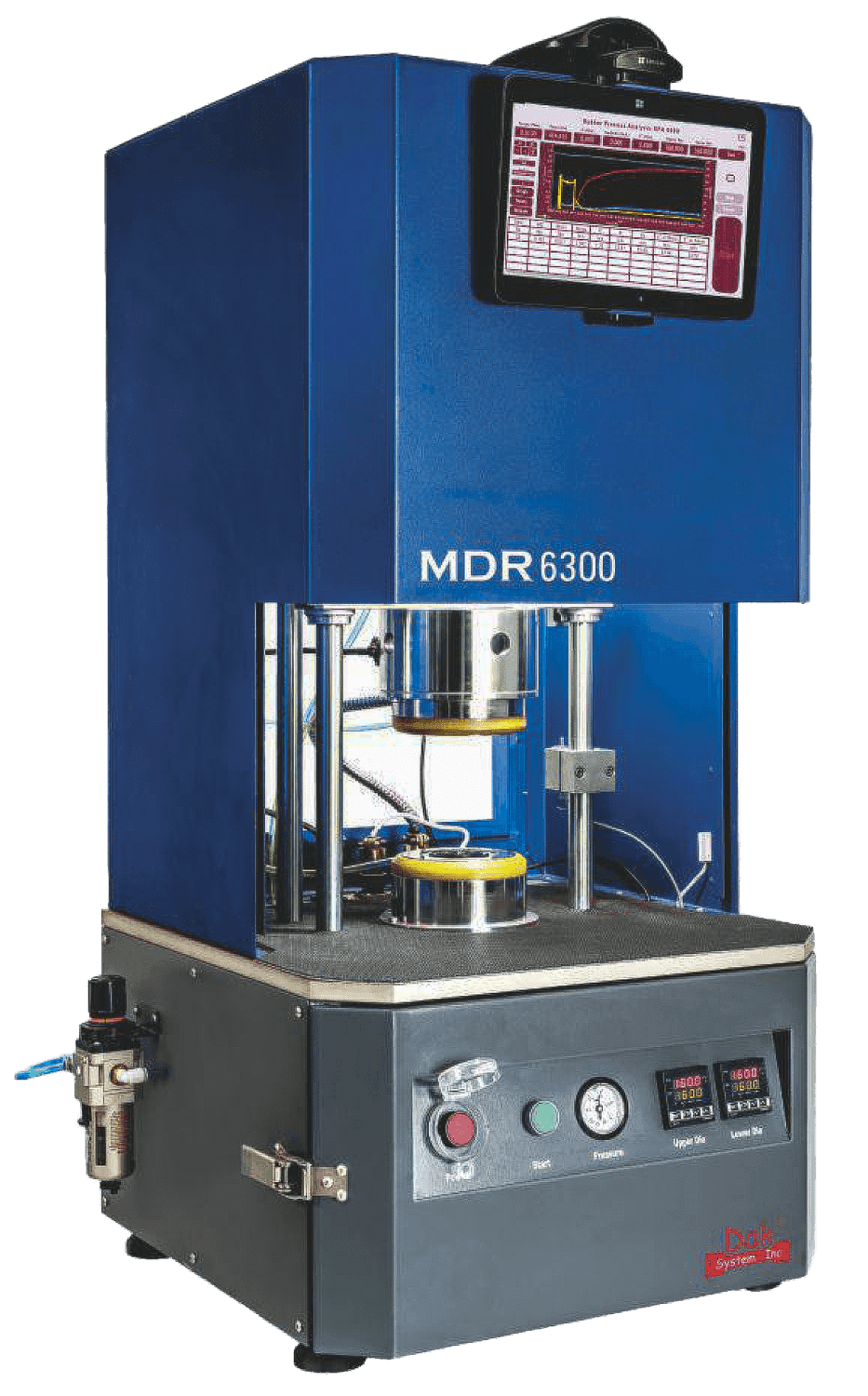 Moving Die RheometerMDRExplore the machine →
Jump to a specific section
01Understand the method
What the test does
A test piece of raw or compounded rubber is enclosed in a sealed cavity between two dies and sheared, with no rotor inside the sample. The instrument is the same class of machine used for cure testing, but the question it answers is different: instead of following a compound as it crosslinks, ISO 13145 characterises the uncured material — how stiff it is when worked, and how quickly the stress in it decays when the working stops.
Two measurements sit in the one method. The viscosity determination holds strain, temperature and frequency constant and resolves the complex shear modulus into its elastic and loss components, so the compound's stored and dissipated response are reported separately rather than as a single lumped number. The stress relaxation determination then holds a constant static strain at constant temperature and records how the torque falls away with time.
The sealed cavity is the point of the design. An unsealed rotor test lets compound creep out of the gap under pressure, and material that has escaped is no longer being sheared. Sealing keeps the whole test piece under load throughout, which is what makes the two components comparable between laboratories.
What it measures, and why it matters
Viscosity governs everything that happens to a compound before it is cured: the pressure needed to fill a mould, whether a thin section fills at all, how much heat the material generates as it is worked, and how much an extrudate swells leaving the die. A batch with the right cure characteristics and the wrong viscosity will still process badly.
Stress relaxation is the quieter and more diagnostic of the two. The rate at which torque decays after a step strain is sensitive to the compound's molecular structure — chain length distribution, branching, filler network and how well the filler has been dispersed. Two batches can sit within tolerance on a single-point viscosity reading and relax at visibly different rates, and that difference will usually show up later as inconsistent extrusion or inconsistent mould fill. Relaxation is often the earliest available warning that a mix has drifted.
Because both determinations run on one instrument and one test piece, a laboratory already running sealed-cavity rheometry for cure work can add processing characterisation without a second machine.
02Prepare the specimen and test settings
Specimen and cavity
Raw or compounded rubber, cut as a blank that fills the cavity with a small excess so the dies close on material rather than on air.
- Material
- Raw or compounded rubberThe scope covers both, which is what lets the method be used on incoming polymer and on a finished mix.
- Blank mass
- Sized to fill the cavity with a small excessThe excess is the point: it guarantees the dies close on material rather than on air. A cavity that is not full reads low, and nothing on the trace shows it.
- Cavity
- Sealed, rotorlessSealing keeps the whole test piece under load. An unsealed arrangement lets compound creep out of the gap, and material that has escaped is no longer being sheared.
Test speed
The method fixes strain, temperature and frequency and holds them constant for the viscosity determination; the relaxation determination holds a static strain instead.
- Oscillation frequency
- Constant, set for the compound and held through the runThe method does not fix one frequency for all rubbers. What it fixes is that strain, temperature and frequency are held constant while the measurement is taken — a viscosity read at drifting frequency is not comparable with anything.
- Strain
- Constant for viscosity; constant static strain for relaxationThe two determinations differ in control mode, not only in what is reported — which is why one instrument has to do both.
- Temperature
- Constant, set for the testHeld constant throughout. Rubber viscosity falls steeply with temperature, so a die running warm reports a compound as softer than it is, systematically rather than noisily.
03Build the test setup on a DAK instrument
What the machine must be capable of
A rotorless sealed shear rheometer: two directly heated dies forming a closed cavity, one of them oscillating, with torque measured on the fixed die. The machine must hold the cavity at a controlled temperature and hold a set strain amplitude and frequency steady through the measurement, and it must also be able to apply and then hold a static strain while recording torque decay — the relaxation half of the method needs a different control mode from the oscillatory half.
Temperature control matters more than it looks: rubber viscosity falls steeply with temperature, so a die running warm reports a compound as softer than it is, systematically rather than noisily.
Running ISO 13145 on the MDR
Both instruments run a sealed, pressurised cavity that prevents compound extrusion and holds the test volume exactly, so the torque trace reflects the material.
| The method asks for | Dak supplies | |
|---|---|---|
| Torque & frequency | Not a force test: the instrument records reaction torque in the sealed die cavity | Torque up to 20 N·m; the RPA Ultimo measures from 0.0001 N·m. MDR: ±0.5° arc as standard, at a fixed 1.667 Hz. RPA Ultimo: 0.0016–50 Hz, 0.05–90° arc. |
| Test cavity | Sealed rotorless shear rheometer cavity, one die oscillating | MDR: sealed biconical rotorless dies, closed pneumatically. RPA: a sealed, pressurised cavity |
04Run the test
How the test runs
- Cut a blank that fills the cavity with a small excess.
- Close the dies and allow the sample to reach the set die temperature.
- For viscosity: oscillate at the set strain and frequency and record the elastic and loss components of the complex shear modulus.
- For stress relaxation: apply the specified static strain, hold it, and record the decay of torque with time.
- Clean the die faces before the next test — cured residue changes the effective cavity.
05Report and interpret
What travels with an ISO 13145 result
The conditions are chosen rather than fixed, so a result is only comparable when they travel with it.
- Which determination was run — viscosity, stress relaxation, or both.
- The die temperature.
- The elastic and loss components separately, not a single combined stiffness.
- For relaxation, the torque decay against time rather than a single end value.
- The material state: raw polymer or compounded, and how long after mixing it was tested.
What goes wrong in practice
An underfilled cavity is the most common fault and the hardest to spot, because the trace is a perfectly plausible curve at a slightly low torque.
Contamination of the die faces is the second. Cured residue from earlier work changes the effective cavity and can grip the sample unevenly.
Letting the sample rest too long between mixing and testing is the third, and it matters much more for relaxation than for viscosity: a compound continues to change after mixing, and a relaxation curve is sensitive to exactly the structural features that change.
Finally, the two determinations are sometimes read as interchangeable measures of stiffness. They are not — a compound can be unremarkable on viscosity and clearly abnormal on relaxation, which is why the method carries both.
06Compare methods and find answers
ISO 13145 or a cure test
The same machine class runs both, which is the source of a common confusion. They answer opposite questions about the same compound.
| ISO 13145 | ISO 6502-3 / ASTM D5289 | |
|---|---|---|
| What it characterises | The uncured compound as it processes | The compound as it crosslinks |
| Controlled variable | Strain, temperature, frequency held constant | Die held at the cure temperature |
| Output | Complex shear modulus split into elastic and loss components; torque decay under held strain | A cure curve: scorch, cure rate, torque rise |
| Answers | Will this mix process — fill, extrude, swell — predictably | Will this mix cure to the right state in the right time |
A compound can be entirely normal on cure and abnormal on viscosity or relaxation, which is exactly why running one is not a substitute for running the other.
Related and equivalent standards
ISO 6502-3 uses the same class of sealed rotorless instrument to follow vulcanisation rather than to characterise the uncured compound, and ASTM D5289 is the ASTM cure method on that machine class. ISO 289 covers Mooney viscosity, the older single-point measurement this method gives a fuller alternative to.
Questions we are asked about this test
What is ISO 13145?
It is the ISO method for determining the viscosity and stress relaxation of raw or compounded rubber using a rotorless sealed shear rheometer. The second edition was published on 26 July 2023 and replaces the 2012 first edition.
Is ISO 13145 a cure test?
No, and this is the most common misreading of it. It runs on the same class of sealed rotorless instrument used for cure work, but it characterises the compound before it crosslinks rather than following the crosslinking. If you want a cure curve, ISO 6502-3 or ASTM D5289 is the method.
What is the difference between the viscosity and stress relaxation determinations?
The viscosity determination holds strain, temperature and frequency constant and resolves the complex shear modulus into its elastic and loss components. The stress relaxation determination holds a constant static strain at constant temperature and records how the torque falls away with time. Different control modes, different information.
Why does stress relaxation matter if viscosity is already measured?
Because relaxation is sensitive to structural features that a single stiffness reading averages over — chain length distribution, branching, filler network and dispersion. Two batches can be within tolerance on viscosity and relax at visibly different rates, and that difference tends to show up later as inconsistent extrusion or mould fill.
Why does the cavity have to be sealed?
So the whole test piece stays under load. In an unsealed arrangement compound creeps out of the gap under pressure, and material that has escaped is no longer being sheared. Sealing is what makes the elastic and loss components comparable between laboratories.
What is the most common source of a wrong result?
An underfilled cavity. The trace looks like a perfectly plausible curve, just at a slightly low torque, so there is nothing on the output to tell you the reading is wrong. Cutting the blank with a deliberate small excess is what prevents it.
Does the sample need to be tested straight after mixing?
It should be tested to a consistent schedule, and this matters more for relaxation than for viscosity. A compound keeps changing after mixing, and a relaxation curve is sensitive to exactly the structural features that change, so an inconsistent delay between mixing and testing shows up as scatter that has nothing to do with the material.
Can Dak supply a machine for this test?
Yes — it runs on the same sealed rotorless rheometer class as our cure testing. Tell us the compounds and the determinations you need and we will answer with the machine, the cavity and a quotation.
Related
Materials tested to it
The test it standardises
Industries that test to it
Other standards explained
Planning ISO 13145 testing?
Discuss your specimen, test requirements and reporting needs with DAK engineering.
This page describes the method as practised. The governing text is the current edition from the issuing body. Tell us what you are testing and we will answer with the machine, the fixture and a quotation.