
Testing standard
ASTM D5289 Rubber Cure Testing with a Rotorless Cure Meter
Standard Test Method for Rubber Property—Vulcanization Using Rotorless Cure Meters
Written and technically reviewed by Dak System Inc. engineeringLast reviewed
ASTM D5289 is the rotorless cure meter test for rubber. A small blank of uncured compound is sealed between two heated dies; one die oscillates through a small arc while the torque transmitted through the rubber is recorded as it vulcanises. The rising torque trace is the cure curve, and from it come the scorch time, the cure times and the minimum and maximum torque that release a batch for production.
At a glance
- Test type
- Cure & rheology — how a rubber compound cures is tracked as it happens
- Published by
- ASTM
- Edition
- D5289-19a(2026)
- Material
- Rubber, elastomers & foams
From the test method to your testing system
Explore DAK equipment for ASTM D5289, then review the specimen and setup requirements below.
 Moving Die RheometerMDRExplore the machine →
 Rubber Process AnalyserRPAExplore the machine →
Jump to a specific section
01Understand the method
What the test does
A small blank of uncured rubber compound is enclosed between two heated dies rather than gripped. One die oscillates through a small rotary arc while the reaction torque transmitted through the rubber is recorded continuously; as the compound vulcanises and stiffens in shear, torque rises, and the torque-versus-time trace is the cure curve. The method covers sealed and unsealed rotorless instruments — the sealed-die type is the familiar moving die rheometer.
What it measures, and why it matters
Minimum torque (ML) reflects the viscosity of the uncured stock and warns of flow problems or an ageing batch. Scorch time (ts1 or ts2) marks the onset of cure at the test temperature and guides mould-filling and press-cycle limits; extrusion and calendering safety is normally established separately by Mooney scorch (ASTM D1646). Cure times such as t50 and t90 set the moulding cycle — demoulding before t90 risks an undercured part. Maximum torque (MH) tracks final crosslink density and hence in-service stiffness, and the cure rate between these points shows how forgiving the compound is to production temperature swings. Together these form the standard batch-acceptance test for rubber compounds.
02Prepare the specimen, oscillation and temperature
The specimen
There is almost nothing to prepare, which is part of the method's appeal — the closing dies form the final geometry, so no cutting to dimension is involved.
- Blank mass
- About 5 to 6 gPracticeVaries with compound density. It must slightly overfill the cavity so the dies close on rubber rather than on air.
- Preparation
- Cut from a milled sheetNo precision dimensions needed — the die cavity defines the shape.
- Specimens per test
- One curve per blankRoutine quality control usually runs duplicates.
- Rest period after mixing
- Fix it and keep to itDakThe compound is reactive. Time and temperature between mixing and testing shift scorch, so a laboratory that varies the wait is measuring the wait as well as the compound.
An underfilled cavity is the commonest specimen fault and gives low, unstable torque. It looks like a soft compound rather than a small blank.
Oscillation and temperature
There is no crosshead and no test speed here. What has to be held instead is the oscillation and, above all, the die temperature.
- Oscillation frequency
- 1.667 Hz (100 cycles per minute)100 cpm exactly, which is 1.667 Hz — the preferred value. Results are sensitive to it, so it is reported with them.
- Arc amplitude
- ±0.5° typical, within a permitted range of small arcsAlso reported. A curve run at a different arc is not comparable with one run at ±0.5°.
- Die temperature
- Typically 100 °C to 200 °CSet from the compound and the intended moulding cycle.
- Temperature control
- Within about ±0.3 °CThis is the heart of the method. Cure rate roughly doubles for every 10 °C, so a die that is a degree out moves every time on the curve.
- Recovery after loading
- As fast as the instrument allowsWith no unheated rotor the specimen reaches temperature quickly, which is the main advantage of the rotorless design.
- Verify the die thermocouple
- On a schedule, not on suspicionDakAn uncalibrated thermocouple drifts slowly and shifts t90 for months before anyone questions the numbers.
03Build the test setup on a DAK instrument
What the machine must be capable of
The instrument is a torsion-shear rheometer, not a universal testing machine. The method fixes the operating window: 1.667 Hz — one hundred cycles per minute — is the preferred oscillation frequency, ±0.5° of arc the usual amplitude within a permitted range of small arcs; results are sensitive to both, so both must be held and reported. Torque measurement must resolve small values cleanly — ML for a soft compound is a small fraction of full scale.
Die temperature is the heart of the method: control within about ±0.3 °C at set points typically between 100 °C and 200 °C, with fast recovery after loading (no unheated rotor means the specimen reaches temperature quickly). Sealed dies need a pneumatic closing system to keep the specimen under pressure; data capture must define the steep part of the cure curve. Exact tolerances belong to the standard's current text.
The instrument this method needs
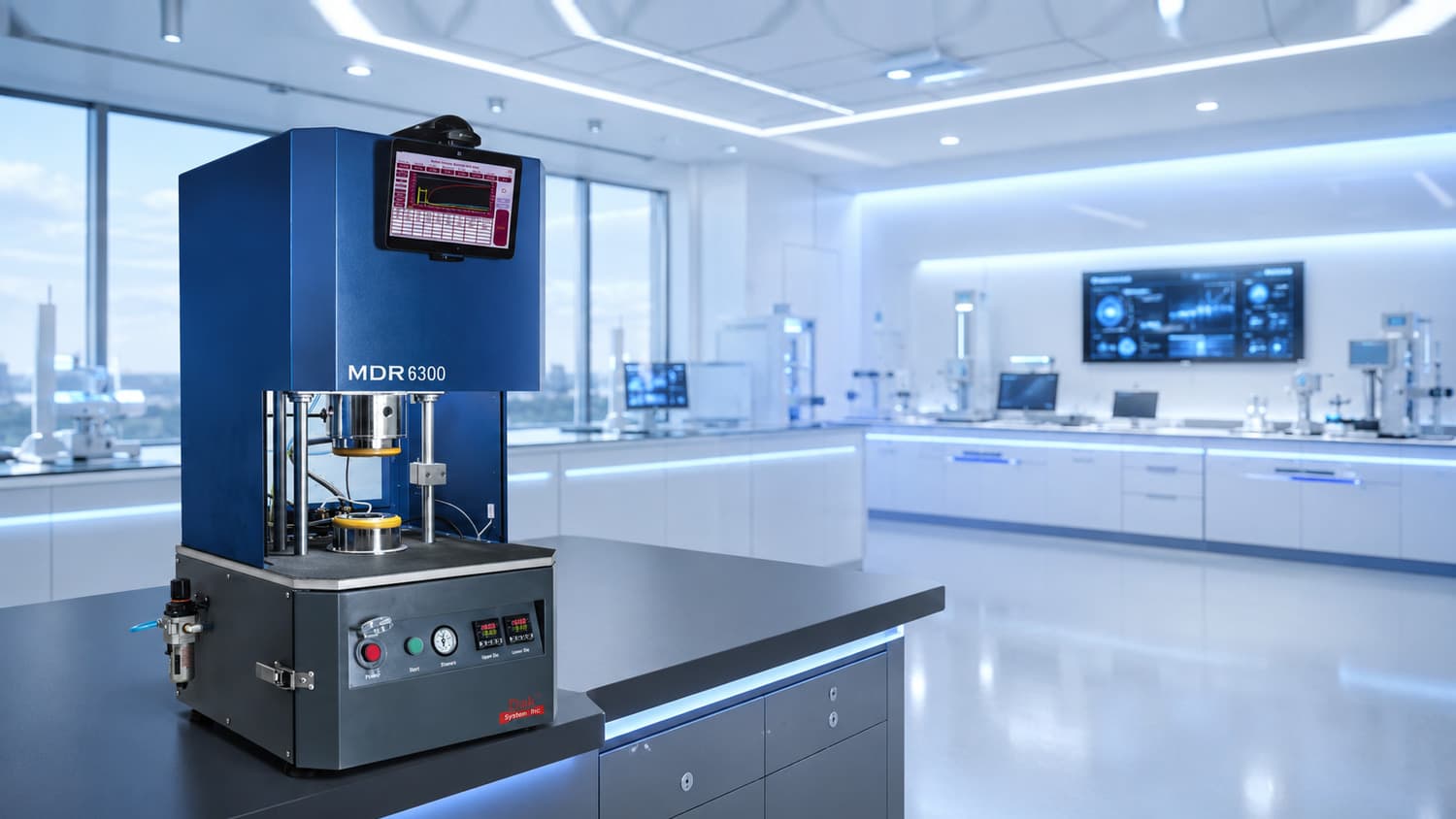
Running ASTM D5289 on the MDR and RPA
Both instruments run a sealed, pressurised cavity that prevents compound extrusion and holds the test volume exactly, so the torque trace reflects the material.
| The method asks for | Dak supplies | |
|---|---|---|
| Torque & frequency | Not a force test: the instrument records reaction torque in decinewton-metres, from the minimum ML through the maximum MH of the cure curve — no load cell or force range applies. | Torque up to 20 N·m; the RPA Ultimo measures from 0.0001 N·m. MDR: ±0.5° arc as standard, at a fixed 1.667 Hz. RPA Ultimo: 0.0016–50 Hz, 0.05–90° arc. |
| Test cavity | Sealed biconical die cavity, lower die oscillating | MDR: sealed biconical rotorless dies, closed pneumatically. RPA: a sealed, pressurised cavity |
| Temperature | Die set point is the compound's cure temperature — the method fixes no range; temperature control within ±0.3 °C; no humidity conditioning | Room temperature to 230 °C; on the MDR, upper and lower dies are controlled separately |
04Run the test
How the test runs
- Bring the dies to the set temperature and let them stabilise.
- Cut a blank from milled sheet, sized to slightly overfill the cavity.
- Observe the laboratory's fixed rest period between mixing and testing.
- Load the blank and close the dies, which seals and pressurises the cavity.
- Start the oscillation at the set frequency and arc, and begin recording torque against time.
- Watch the torque fall to its minimum as the stock warms and softens — this is ML.
- Continue as crosslinking raises the torque through the scorch point and up the steep part of the curve.
- Run until the torque plateaus, or reverts, or the set time expires.
- Read ML, MH, ts1 or ts2, t50 and t90 from the trace.
- Calculate the cure rate index from ts2 and t90.
- Run a duplicate where the result releases a batch.
Torque that never plateaus is not necessarily an undercured compound. Some compounds revert and others continue to rise; the shape of the tail is information, and truncating the run too early discards it.
See the instrument
05Calculate, report and interpret
Reading the cure curve
The outputs are points read off the torque trace rather than quantities derived from a formula. One index is calculated, and it is the one that tells you how forgiving the compound will be in production.
CRI = 100 / (t90 − ts2)
- t90
- time to reach 90 % of the torque rise, minutes
- ts2
- scorch time — time for torque to rise 2 units above ML, minutes
A high index means a fast cure with a narrow processing window. It is the figure that predicts whether a compound will tolerate a press running a few degrees hot.
ΔM = MH − ML
- MH
- maximum torque, dN·m — tracks final crosslink density
- ML
- minimum torque, dN·m — reflects the viscosity of the uncured stock
The height of the curve. A drifting ΔM across weeks usually means worn or fouled die seals leaking stock rather than a change in the compound.
What the report has to contain
- Full designation and edition, and the instrument type — sealed or unsealed dies
- Compound identification, batch, and the time between mixing and testing
- Die temperature
- Oscillation frequency and arc amplitude
- Minimum torque ML and maximum torque MH
- Scorch time, stating whether ts1 or ts2
- Cure times reported — t50, t90, or others required by the specification
- Cure rate index where required
- Total test duration, and whether the curve plateaued or reverted
- Number of specimens run
What goes wrong in practice
Temperature is the classic error: an uncalibrated die thermocouple or slow recovery after loading shifts t90 markedly, since cure rate roughly doubles per 10 °C. Underfilled cavities from an undersized blank give low, unstable torque; worn or fouled die seals leak stock and drift MH downwards over weeks. Inconsistent rest times between mixing and testing scatter scorch results. Comparing rotorless results with oscillating-disc history is a recurring trap: the two instrument classes do not give the same numbers.
06Compare methods and find answers
How it differs from the standards nearest to it
Several documents describe cure meters, and their results are not interchangeable across instrument classes.
| ASTM D5289 | ASTM D2084 | ASTM D6204 | |
|---|---|---|---|
| Instrument | Rotorless, sealed or unsealed dies | Oscillating disc, with rotor | Rotorless, same family |
| Measures | Cure curve during vulcanisation | Cure curve during vulcanisation | Processability of uncured stock |
| Specimen heating | Fast — no unheated rotor | Slower — the rotor must heat too | Fast |
| Current status | The routine batch-acceptance test | Largely displaced | Complementary, not a replacement |
Rotorless and rotor-type instruments do not give the same numbers, so a specification written against historical oscillating-disc data cannot simply be applied to a rotorless curve. ISO 6502-3 covers the same rotorless instruments and is routinely cited alongside this method.
Questions we are asked about this test
What is ASTM D5289?
It is the ASTM method for measuring the vulcanisation characteristics of rubber using a rotorless cure meter. A blank of uncured compound is sealed between two heated dies, one of which oscillates through a small arc, and the torque transmitted through the rubber is recorded as it cures. The resulting cure curve is the standard batch-acceptance test for rubber compounds.
What does ASTM D5289 measure?
Five things read from one curve. Minimum torque reflects the viscosity of the uncured stock. Scorch time marks the onset of cure at the test temperature. Cure times such as t50 and t90 set the moulding cycle. Maximum torque tracks final crosslink density and therefore in-service stiffness. The cure rate between those points shows how tolerant the compound will be of temperature swings in production.
What is t90 and why does it matter?
It is the time to reach 90 % of the torque rise, and it is the number that sets the press cycle. Demoulding before t90 risks an undercured part whose properties will not match the specification, so the moulding time is normally set from t90 at the moulding temperature with an allowance on top.
What is the difference between a rotorless cure meter and an oscillating disc?
The rotor. An oscillating-disc instrument has a metal disc embedded in the specimen that must be heated along with the rubber, so the compound reaches test temperature more slowly. A rotorless instrument seals the compound directly between heated dies, so it heats fast and the early part of the curve is far better defined. The two classes do not give the same numbers and their results cannot be pooled.
Why is die temperature so critical in ASTM D5289?
Because cure rate roughly doubles for every 10 °C. A die running a single degree away from its set point moves every time on the curve, and the shift is systematic rather than random, so it will not average out across repeats. Control within about ±0.3 °C is what the method asks for, and a drifting thermocouple is the commonest cause of results that slowly stop agreeing with production.
How much compound does the test need?
About 5 to 6 g, depending on density, cut from a milled sheet so it slightly overfills the die cavity. No precision preparation is needed because the closing dies form the geometry. An undersized blank is the fault to watch for — it gives low, unstable torque that reads like a soft compound rather than a small specimen.
Does ASTM D5289 run on a universal testing machine?
No. It needs a torsion-shear rheometer with heated dies, a pneumatic closing system and fine torque resolution — a different instrument class entirely from the frames used for tensile and flexural work. A rubber laboratory typically runs both: the rheometer for cure characteristics and a universal frame for the ASTM D412 tensile properties of the cured compound.
Why does my maximum torque keep drifting downwards?
Over weeks rather than days, that usually points at the die seals rather than at the compound. Worn or fouled seals let stock escape from the cavity under pressure, so less rubber carries the torque and the maximum falls gradually. Because the change is slow, it is often blamed on the raw materials before anyone inspects the dies.
Related
Materials tested to it
Industries that test to it
Other standards explained
Planning ASTM D5289 testing?
Discuss your specimen, test requirements and reporting needs with DAK engineering.
This page describes the method as practised. The governing text is the current edition from the issuing body. Tell us what you are testing and we will answer with the machine, the fixture and a quotation.