
Testing standard
ASTM D6484 Open-Hole Compression Testing of Composite Laminates
Standard Test Method for Open-Hole Compressive Strength of Polymer Matrix Composite Laminates
Written and technically reviewed by Dak System Inc. engineeringLast reviewed
ASTM D6484 measures the open-hole compressive strength of a composite laminate. A coupon with a precisely machined central hole is compressed inside a support fixture that stops it buckling, and the strength is calculated on the gross cross-section as though the hole were not there. It is usually the more critical of the two notched allowables.
At a glance
- Test type
- Compression — the specimen is squeezed
- Published by
- ASTM
- Edition
- D6484/D6484M-23
- Material
- Composites & sandwich structures
- Runs on
- Series 7200 and Series 9000
From the test method to your testing system
Explore DAK equipment for ASTM D6484, then review the specimen and setup requirements below.
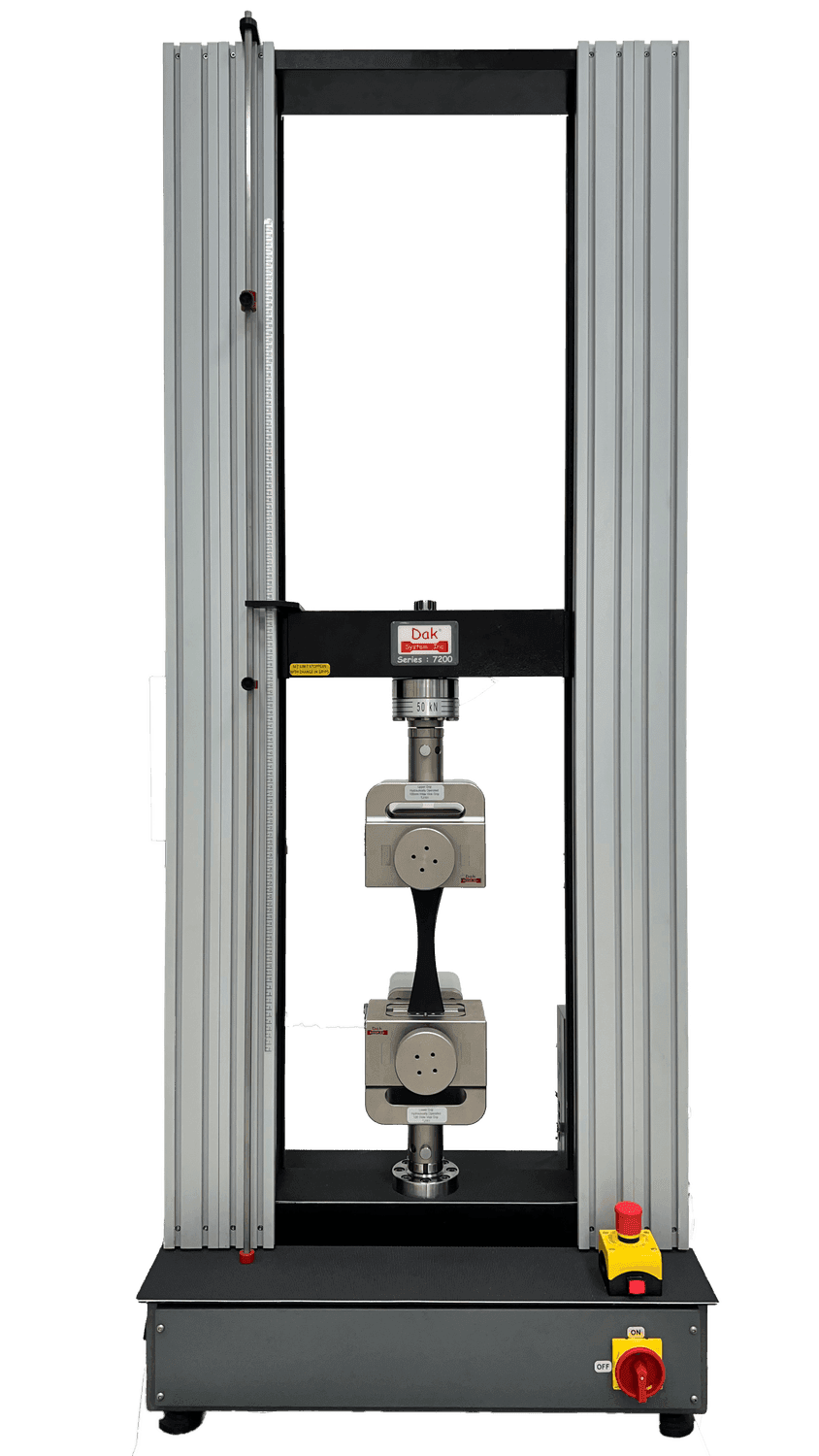 Universal Testing MachineSeries 7200Explore the machine →
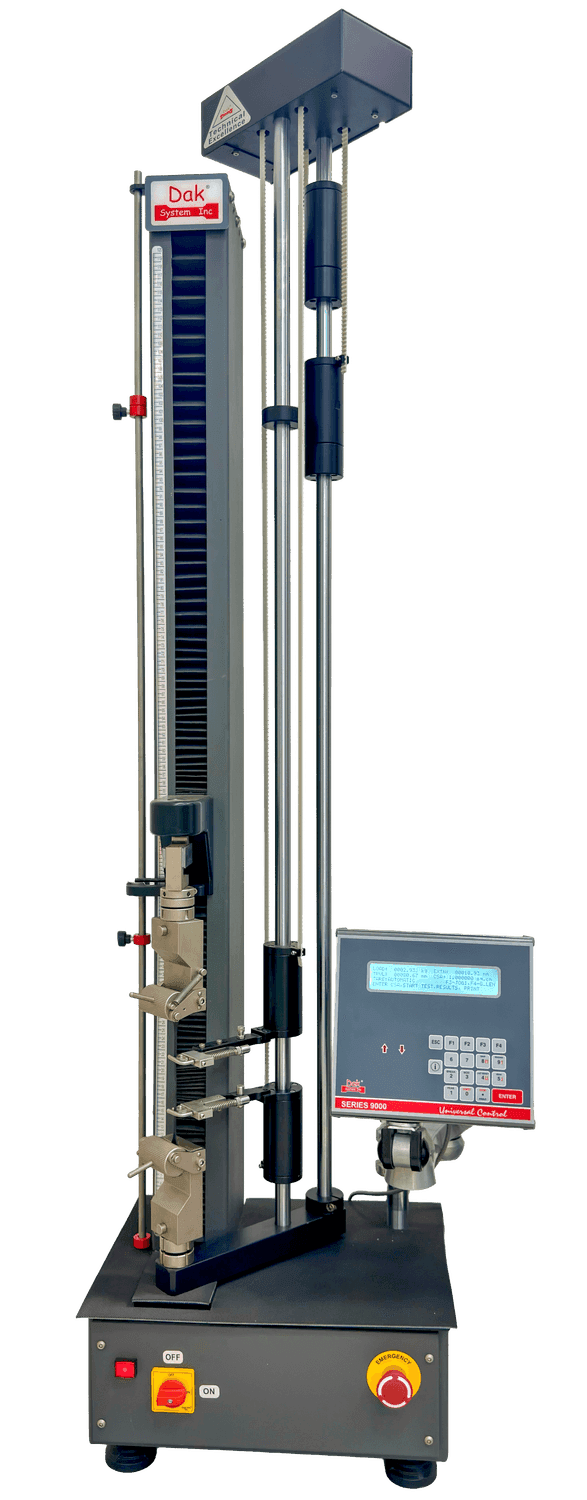 Universal Testing MachineSeries 9000Explore the machine →
Jump to a specific section
01Understand the method
What the test does
A flat coupon is cut from a balanced, symmetric laminate and a hole is machined precisely at its centre, with the width set at six times the hole diameter — commonly 36 mm wide with a 6 mm hole, the same proportions as the open-hole tension method. The coupon is then assembled into a support fixture whose faces clamp it against buckling, bolted to a specified torque, and the assembly is compressed between the machine platens at about 2 mm/min. The failure is expected to run through the hole, across the reduced net section. Strength is calculated by dividing the maximum force by the gross cross-sectional area, with no allowance made for the material the hole removed.
What it measures, and why it matters
The result is the notched compressive allowable, and for most composite structures it is the number that governs. Two effects compound: composites are inherently weaker in compression than in tension, and a hole in a compression member removes the material that would otherwise stabilise the region around it. Since real structures are full of fastener holes, access panels and cut-outs, and since compression is usually the critical direction, a programme that generates only the open-hole tensile allowable has left the sizing case unmeasured. Expressing the result on gross area folds the hole's effect into the allowable so a designer can apply it directly.
02Prepare the specimen and test settings
Specimen and support fixture
A notched compression coupon has two ways to fail and only one of them is the material. The fixture exists to prevent the other.
- Width-to-diameter ratio
- 6 : 1The same ratio as the tension method, so the two allowables describe comparable stress fields.
- Common geometry
- 36 mm wide with a 6 mm hole
- Support fixture
- Clamps the faces to restrain bucklingWithout it a thin coupon buckles well below its compressive strength and reports a stability load.
- Hole machining
- Drilled and reamed, backed against breakoutDelamination at the hole wall lowers the result before any load is applied.
- Lay-up
- Balanced and symmetric
- Inspect every hole before testing
- Under magnificationDakA hole with visible delamination has already decided the result and wastes an expensive coupon.
Strength is calculated on the GROSS cross-section, ignoring the hole — the same convention as the tension method. Recalculating on the net area produces a different quantity that no published allowable is expressed in.
Test speed
- Crosshead speed
- 2 mm/min nominal
- Valid failure
- Through the hole, across the net section
- Check the fixture bolts
- Before each specimenDakAn under-clamped fixture lets the coupon buckle; an over-clamped one carries load itself.
- Watch for end crushing
- It invalidates the couponDak
03Build the test setup on a DAK machine
What the machine must be capable of
Force measurement to ASTM E4 at loads reaching several tens of kilonewtons, a crosshead holding 2 mm/min, and platens flat and parallel enough that the fixture body is loaded squarely — any tilt there passes straight into the coupon. The distinguishing requirement is the support fixture itself and the discipline around its bolt torque, because load reaches the coupon through a combination of end loading and face restraint. The frame needs the daylight to take the fixture, and where conditioned or elevated-temperature testing is specified, the fixture must reach temperature with the coupon rather than merely sit in warm air.
Running ASTM D6484 on the Series 7200 and Series 9000
Dak verifies against whichever standard the method names, and where a class applies our frames sit a class tighter than it asks.
| The method asks for | Dak supplies | |
|---|---|---|
| Capacity | High — a 36 mm wide carbon coupon commonly fails between 20 and 60 kN | Load cells from 1 kg to 60 ton on the Series 7200, and 0.5 to 100 kN on the Series 9000 |
| Force accuracy | ASTM E4 | Verified to ASTM E4, and to ISO 7500-1 Class 0.5 |
| Gripping | A support fixture that clamps the coupon faces to prevent buckling while the ends are loaded | Our compression anvils, built to the specimen |
| Environment | 23 ± 2 °C standard laboratory atmosphere | 3009 series chambers, −150 °C to +400 °C — temperature only |
04Run the test
How the test runs
- Cut coupons from a balanced, symmetric laminate to the specified width.
- Back the laminate and drill the central hole; ream to size.
- Inspect each hole under magnification.
- Measure width and thickness away from the hole.
- Check the hole is centred on the coupon axis.
- Condition to the specification.
- Assemble the coupon into the support fixture and torque the bolts evenly.
- Place the assembly between the platens and check alignment.
- Compress at 2 mm/min to failure.
- Confirm the failure ran through the hole rather than at the ends.
- Calculate strength on the gross cross-section.
05Calculate, report and interpret
Calculations
σᴼᴴᶜ = Pmax / (w × h)
- Pmax
- maximum force, N
- w
- coupon width, mm
- h
- coupon thickness, mm
Gross area — width times thickness, with no allowance for the hole. The convention is what makes notched allowables comparable and usable.
What the report has to contain
- Reference to ASTM D6484 and the edition
- Material, lay-up and cure schedule
- Coupon width, thickness and hole diameter
- Width-to-diameter ratio
- How the hole was machined and inspected
- Support fixture and bolt torque
- Conditioning and test temperature
- Crosshead speed
- Open-hole compressive strength on gross area
- Failure location and mode
- Coupons rejected, with the reason
- Mean, standard deviation and coefficient of variation
What goes wrong in practice
Failures that are not through the hole are the recurring problem, and each points somewhere different: end crushing means the coupon ends took the load first, buckling means the fixture was not restraining properly, and a failure at the fixture edge means the clamping was wrong. All are rejections rather than low results. Bolt torque is the variable behind most of them — too little and the coupon buckles, too much and the fixture carries load or crushes the laminate. Away from the bench, the most consequential error is recalculating on net area, which produces a number that cannot be compared with any published allowable.
06Compare methods and find answers
ASTM D6484 or ASTM D5766
| D6484 open-hole compression | D5766 open-hole tension | |
|---|---|---|
| Loading | Compression, in a support fixture | Tension, in wedge grips |
| Usual criticality | Higher — usually the sizing case | Lower |
| Extra failure mode | Buckling, and end crushing | Grip failure |
| Strength basis | Gross area | Gross area |
These are generated as a pair and neither substitutes for the other. Compression is normally the more critical, because composites are weaker in compression and a hole removes support as well as material.
Questions we are asked about this test
What is ASTM D6484?
It is the ASTM method for the open-hole compressive strength of a composite laminate. A coupon with a precisely machined central hole is compressed inside a support fixture that prevents buckling, and the strength is calculated on the gross cross-section as though the hole were not there.
Why does the coupon need a support fixture?
Because a thin composite plate in compression is a panel looking for a way to buckle, and a hole in the middle of it removes support as well as material. Without face restraint the coupon buckles well below its compressive strength, and the recorded load describes its stability rather than the laminate. The fixture is not a convenience — it is what makes the test measure a material property.
Why is this usually more critical than open-hole tension?
Two reasons together. Composites are inherently weaker in compression than in tension, and a hole in a compression member removes the material that would otherwise stabilise the region around it. So the notched compressive allowable is typically the number that sizes a composite structure, and generating only the tensile one leaves the governing case unmeasured.
Why calculate on gross area when there is a hole?
Because it is the design convention that makes the figure usable. Calculating on gross area folds the effect of the hole into the allowable itself, so a designer can compare laminates and apply the number without recomputing a stress concentration. Every published open-hole allowable is expressed this way, and a net-section value cannot be compared with any of them.
What invalidates a specimen?
Failure anywhere other than through the hole. End crushing means the coupon ends took the load before the net section did; buckling means the fixture was not restraining it properly; a failure at the fixture edge means the clamping was wrong. All three are rejections rather than low results, and the failure location is recorded precisely so that judgement can be made.
How much does hole quality matter?
Substantially, as in the tension method. Composites delaminate readily at a drilled hole, especially at the exit face, and a ring of delamination at the hole wall lowers the strength before any load is applied. Backing the laminate with a sacrificial board, using a drill intended for composites, and inspecting every hole under magnification are the practical controls.
Does the fixture bolt torque matter?
Yes, and in both directions. Too little and the faces do not restrain the coupon, so it buckles. Too much and the fixture carries load that should be going through the coupon, and it can crush the laminate where it clamps. Torque is specified, applied evenly, recorded, and worth re-checking between specimens as the faces bed in.
Related
Materials tested to it
The test it standardises
Industries that test to it
Other standards explained
Planning ASTM D6484 testing?
Discuss your specimen, test requirements and reporting needs with DAK engineering.
This page describes the method as practised. The governing text is the current edition from the issuing body. Tell us what you are testing and we will answer with the machine, the fixture and a quotation.