ISO 13954/13955 — read the full explanation
Peel & adhesionPE electrofusion assemblies — peel decohesion and crushing decohesion tests.

From pipeline welds to the composite materials used in wind energy, mechanical testing helps engineers evaluate strength, deformation and joint performance. DAK testing systems connect these material questions with the specimen handling, measurement and test control your laboratory needs.
Assess the tensile behaviour of base metal, weld metal or a specimen taken across a joint. Weld location and specimen orientation determine which region is evaluated. Bend testing provides a different view of a welded joint under deformation.
Tensile, compression, flexural and shear tests characterise laminate specimens used in blade-material development. Fibre direction, laminate construction and loading arrangement are central to comparing results between material systems.
Evaluate the bond between selected substrates using a loading arrangement suited to the joint. Lap-shear, peel and fracture tests answer different questions about strength and how a bonded assembly separates.
Pipe-wall specimens and specimens containing a fused joint address different properties. Identify the pipe material, wall geometry and joint type so the test loads the region that matters to your quality or development programme.
Compression, recovery and relaxation studies describe different aspects of sealing-material behaviour. Start with whether the result concerns deformation under load, recovery after unloading or the change in force over time.
A material that meets a single-load strength requirement may also need evaluation under repeated loading. Define the loading pattern, required cycles and measured response when discussing fatigue studies for energy-sector materials and components.
Include the specimen drawing, gripping length and any weld, tab or bonded region. Tensile grips, compression fixtures and bend supports must introduce load in the intended direction without substituting a different test arrangement.
Metal yield, laminate strain and joint movement are different measurement requirements. Choose the measurement location and range alongside the grips; crosshead movement is not interchangeable with strain measured on the specimen.
State whether specimens are tested at room temperature, after conditioning or during controlled-temperature testing. Long-duration loading also brings test-control, fixture and measurement requirements that should be included in the configuration discussion.
A universal testing machine supports a range of material and joint tests through the appropriate grips, fixtures and measurement. Select the machine and accessories together for the methods your laboratory will run.
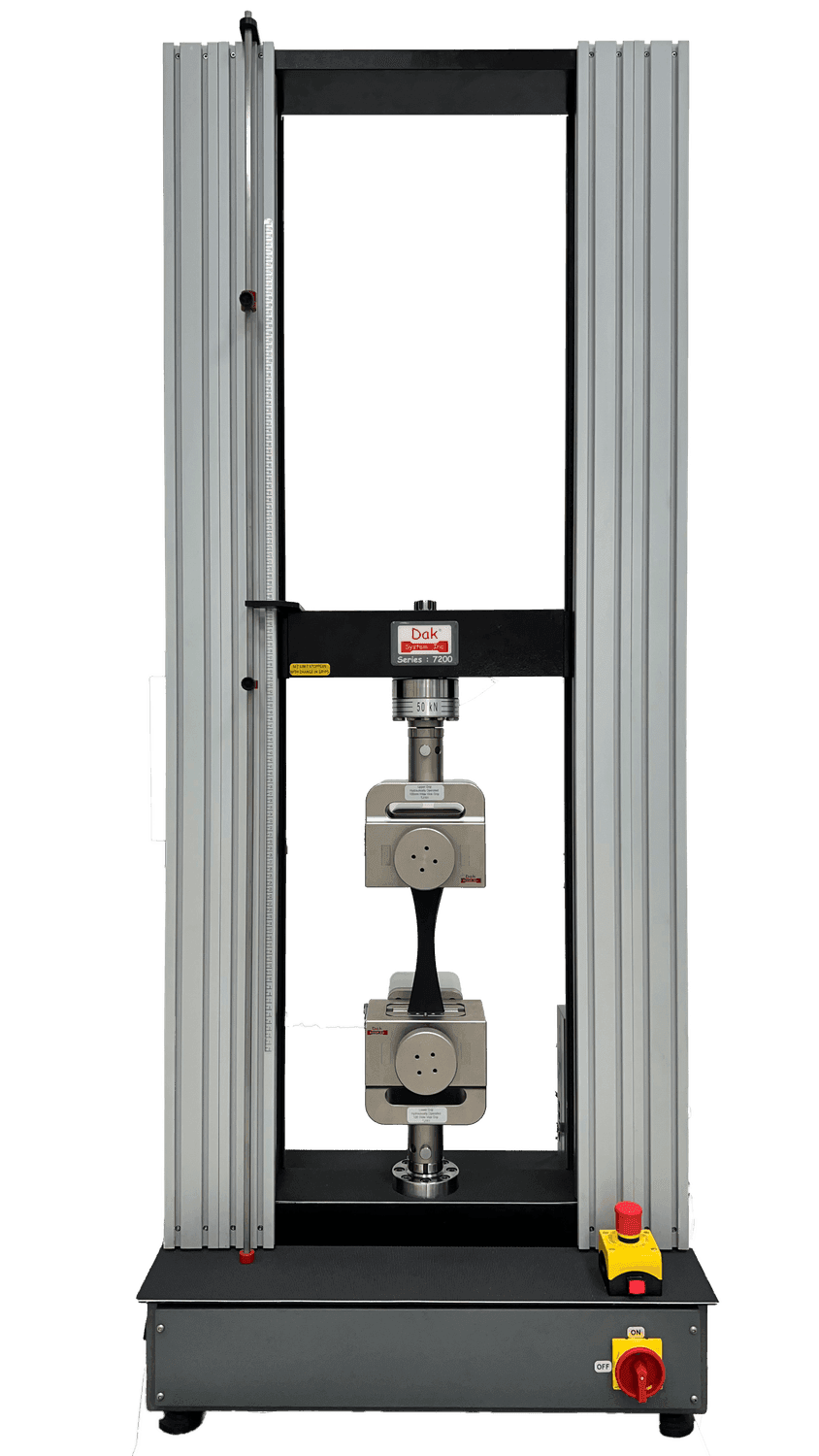
DAK flagship
Our flagship universal testing platform brings flexible test programming, specimen setup and measurement together for laboratories working across metals, polymers, composites and bonded materials.
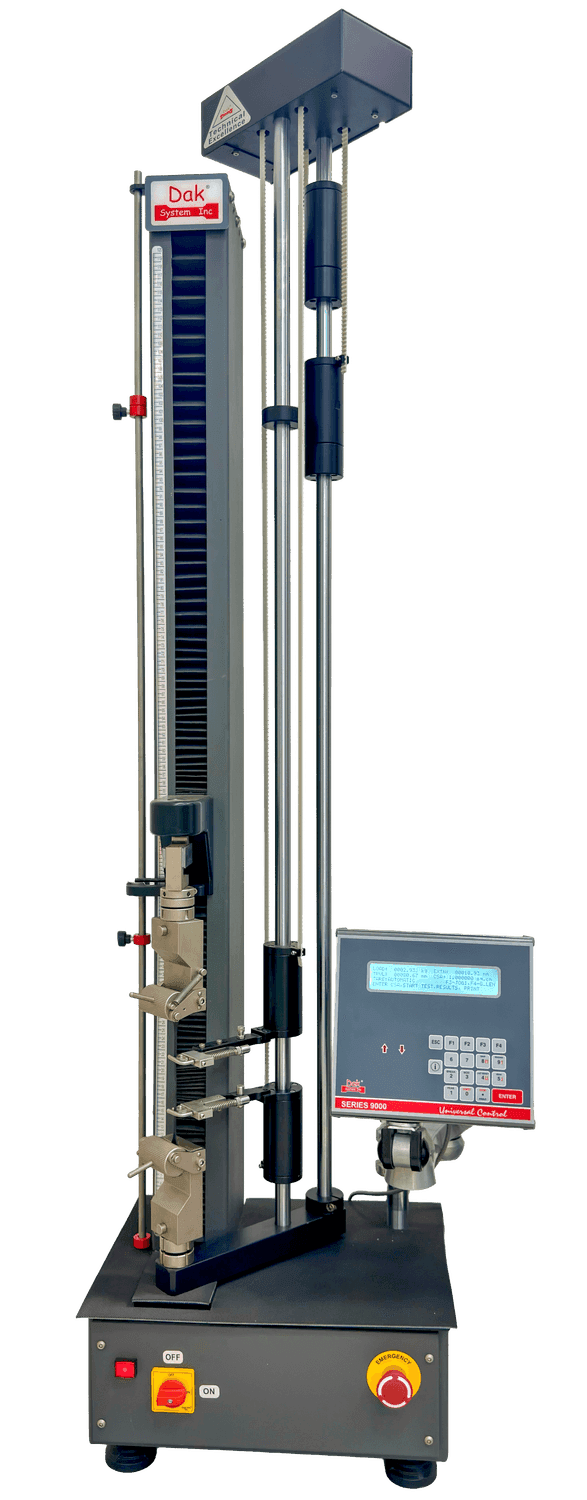
A universal testing option for established tensile, compression, flexural and related methods. Compare its published working space, force range and control approach with your laboratory requirements.
Fatigue, sustained loading and temperature-dependent studies have distinct requirements. Share the intended loading history and environment so the complete system can be discussed alongside your routine material tests.
Use these shortcuts for common material questions, or explore the full energy-sector library below. Select the method for the actual specimen and loading mode, then connect it to your equipment specification.
PE electrofusion assemblies — peel decohesion and crushing decohesion tests.
Creep relaxation of a gasket material — the sealing load retained over time.
Compressibility and recovery of gasket materials under a specified compressive load.
Structural and pipeline welding codes — mechanical acceptance testing of weld coupons.
Torsion testing of wire — twists to fracture, counting turns, for ductility and surface soundness. Equivalent to: ISO 7800
Adhesion or cohesion strength of thermal spray coatings (tension pull-off).
Short-beam strength — interlaminar shear strength of composite laminates.
Tensile properties of polymer matrix composite materials (straight-sided tabbed coupons).
Lap-shear strength of adhesively bonded plastic and FRP joints.
Compressive properties of composites by shear loading (IITRI fixture).
In-plane shear response by tensile test of a ±45° laminate.
In-plane shear properties by rail shear method. Withdrawn 2025 — replaced by ASTM D7078.
Pull-off strength of coatings (adhesion testers; also performed on UTM with suitable fixtures).
Tensile properties of reinforced thermosetting plastics using straight-sided specimens.
Shear properties by V-notched beam (Iosipescu) method.
Mode I interlaminar fracture toughness (GIc) — double cantilever beam (DCB).
Open-hole tensile strength of polymer matrix composite laminates.
Bearing response of polymer matrix composite laminates (bolted-joint design data).
Open-hole compressive strength of composite laminates.
Compressive properties of polymer matrix composites — Combined Loading Compression (CLC) fixture.
Mixed-Mode I/II interlaminar fracture toughness — MMB fixture.
Shear properties by V-notched rail shear method.
Compressive residual strength of damaged composite plates — Compression After Impact.
Mode II interlaminar fracture toughness (GIIc) — end-notched flexure (ENF).
Creep, creep-rupture and stress-rupture tests of metallic materials.
Guided bend test for ductility of welds.
Force-controlled constant-amplitude axial fatigue tests of metallic materials (servo-hydraulic UTM).
Line pipe and casing — tensile qualification of pipe body and weld.
Mechanical failing load of insulators (large-capacity tensile frames).
PV ribbon solder-joint peel and backsheet adhesion testing.
Indian Standard — tensile strength and elongation of cable insulation and sheath.
Cable insulation and sheath — tensile and elongation. Equivalent to: IEC 60811-501
Longitudinal tensile test on weld metal in fusion welded joints.
Tensile test on welded cruciform and lapped joints.
PE butt-fusion pipe joints — tensile strength and failure mode of test specimens.
PE electrofusion assemblies — peel decohesion and crushing decohesion tests.
Flexural properties of fibre-reinforced plastic composites.
In-plane compressive properties of fibre-reinforced plastic composites.
Apparent interlaminar shear strength by short-beam method.
Tensile testing of metallic materials at low temperature (sub-ambient chambers).
Uninterrupted uniaxial creep testing of metallic materials in tension.
Transverse tensile test of butt-welded joints in metallic materials.
Bend tests on welds in metallic materials (root, face and side bend).
Wind turbine blade laminate coupon qualification.
Tensile properties of thermoplastics pipes (PE, PP, PVC pipe specimens).
Showing 1–8 of 45 standards
A laminate coupon, bonded subassembly and complete wind-turbine blade have different loading and space requirements. Tell us which scale you are testing so the discussion starts with the right machine configuration.
Peak force alone does not describe stiffness, fatigue response or load retention. Specify which results support your engineering decision and whether the programme includes cycling, holds or temperature control.
Send the information you already have. A specimen drawing and the intended test result provide a useful starting point for a focused technical discussion.