
Testing standard
ASTM F543 Metallic Medical Bone Screw Testing
Standard Specification and Test Methods for Metallic Medical Bone Screws
Written and technically reviewed by Dak System Inc. engineeringLast reviewed
ASTM F543 is four mechanical tests for metallic medical bone screws under one designation, three of them rotary: torsional yield and breaking, driving torque, pull-out and self-tapping performance. Together they answer whether a screw can be driven, will hold, and will not twist off in the surgeon's hand.
At a glance
- Test type
- Load–deflection & proof load
- Published by
- ASTM
- Edition
- F543-23
- Runs on
- Series 7200, Torsion Tester and Series 9000
From the test method to your testing system
Explore DAK equipment for ASTM F543, then review the specimen and setup requirements below.
 Universal Testing MachineSeries 7200Explore the machine →
 Torsion Testing MachineTorsion TesterExplore the machine →
 Universal Testing MachineSeries 9000Explore the machine →
Jump to a specific section
01Understand the method
What the test does
F543 is four mechanical tests under one designation, three of them rotary. In the torsion annex the screw shank is clamped with roughly five threads left exposed, a driver is engaged coaxially in the drive recess, and rotation continues until the screw twists off, torque and angle recorded past the breaking angle. The other three use a rigid foam block: driving torque records what it takes to advance a screw under a very light axial load, pullout extracts a seated screw until it strips or breaks, and self-tapping drives a screw against a ramped axial force to see how readily it cuts its own thread.
What it measures, and why it matters
The torsion annex reports breaking torque, torsional yield strength and breaking angle, the screw being turned through to fracture. Breaking torque is the margin a surgeon has before shearing the screw off in the patient; too small a margin means a broken fragment in a hole that must then be revised. Breaking angle separates a screw that yields visibly, warning the hand, from one that fails abruptly. Torsional yield strength is the point past which the screw does not spring back: driven beyond it, a screw stays permanently wound up in the bone with nothing visibly failed, which is why insertion instruments are set against the yield figure rather than the fracture figure. Driving torque relates to insertion feel, and pullout force to how well the thread form holds in a substrate of known density.
02Prepare the specimen and test settings
The screw as supplied
- Torsion annex
- Shank clamped, about five threads exposedA driver engaged coaxially in the drive recess, rotated until the screw twists off.
- Driving torque
- Into a rigid foam blockUnder a very light axial load, recording what it takes to advance.
- Pull-out
- A seated screw extracted until it strips or breaks
- Self-tapping
- Driven against a ramped axial forceTo see how readily it cuts its own thread.
- Test medium
- Rigid foam block of specified densityA repeatable stand-in for bone. Real bone varies far too much to compare screws in.
- Record angle past the break
- In the torsion testBreaking angle distinguishes a ductile screw from a brittle one at the same breaking torque.
Rotation and rate
- Torsion
- Controlled rotation to fractureTorque and angle recorded past the breaking point.
- Driving torque
- Four revolutions, recorded throughout
- Pull-out
- Constant axial rate to extraction
- Foam density
- Specified and reportedIt governs both driving torque and pull-out, so a result without it is not comparable.
03Build the test setup on a DAK machine
What the machine must be capable of
The governing instrument is a torsion machine, not an axial frame. The torsion and driving-torque annexes turn the screw at single-figure revolutions per minute, the self-tapping annex considerably faster, and both driving cases hold a controlled axial force alongside the rotation — light and constant in one, steadily ramped in the other. Only pullout is conventional axial work: the screw is seated by rotation, then extracted at a slow crosshead rate. The annexes give the values. An axial-torsion frame covers all four; a single-axis frame covers one.
No capacity is prescribed, so equipment is sized from practice. The torque annexes sit well below 20 N·m — published insertion torques in low-density foam blocks run to a couple of newton-metres — while pullout from the same blocks is commonly a few hundred newtons, rising into the low kilonewtons in cortical bone. Resolution at the bottom of the range matters more than capacity at the top: a torque cell sized for a large frame will not resolve a sub-newton-metre trace.
The torsion annex fixes measurement quality instead: angular accuracy in both directions of rotation, torque resolution referred to the torsional yield strength, and an angular scale fine enough to resolve the small offset by which torsional yield is defined — so the rotary channel, not the force channel, is the one to specify carefully. No force- or torque-verification accuracy class could be confirmed, so none is quoted.
The machine this method needs
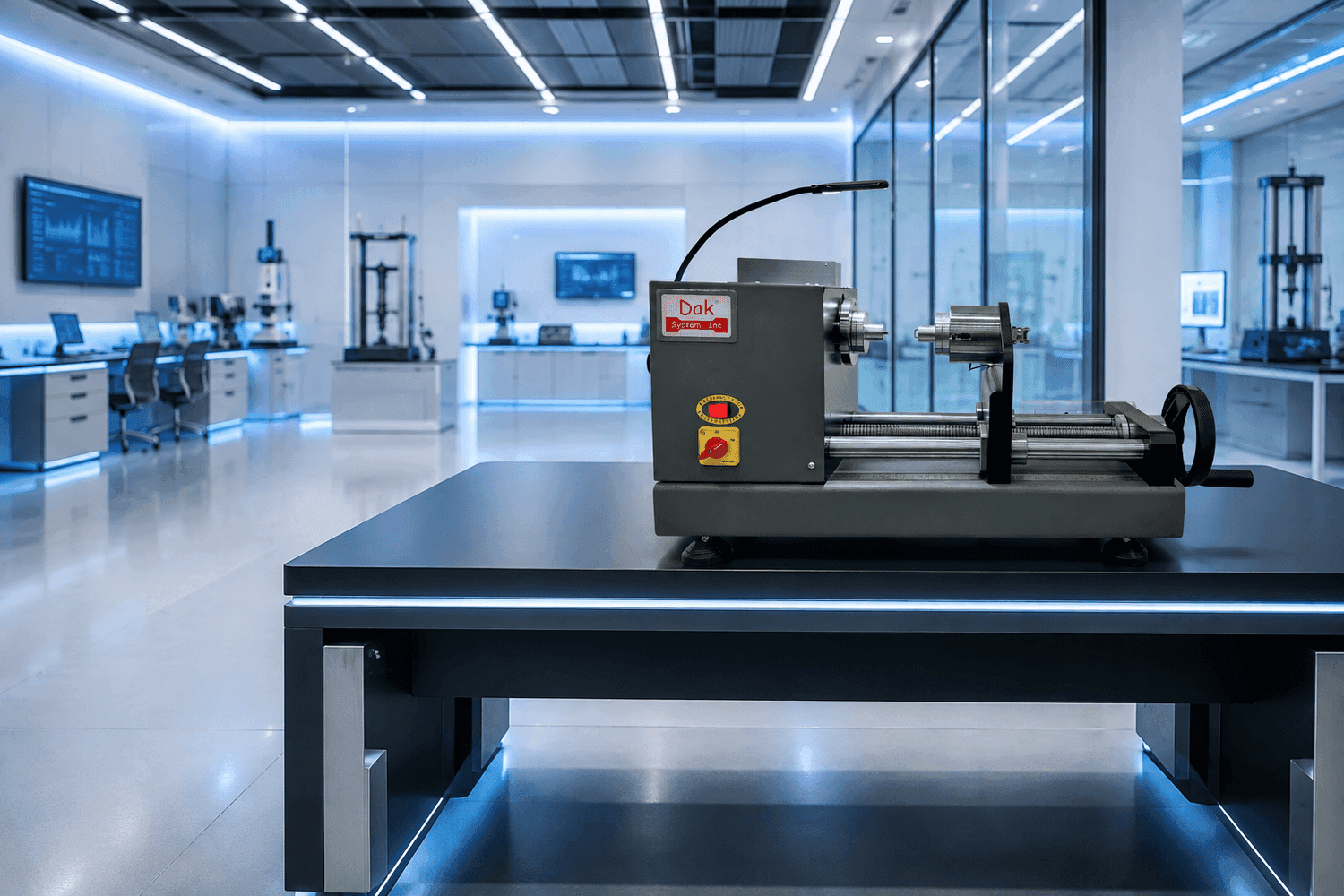
Running ASTM F543 on the Series 7200
Dak verifies against whichever standard the method names, and where a class applies our frames sit a class tighter than it asks.
| The method asks for | Dak supplies | |
|---|---|---|
| Capacity | F543 prescribes no force or torque capacity, only measurement resolution, so equipment is sized from practice: the torque annexes sit well below 20 N·m (published insertion torques in 10-20 pcf foam run from roughly 0.4 to 2.5 N·m), while Annex A3 pullout from the same foam blocks is commonly a few hundred newtons, rising to a few kilonewtons in cortical bone — a low-capacity axial-torsion frame with fine resolution at the bottom of the range, not a large frame. | Load cells from 1 kg to 60 ton on the Series 7200, and 0.5 to 100 kN on the Series 9000 |
| Force accuracy | unknown | ISO 7500-1 Class 0.5 — the method sets no class of its own |
| Gripping | Torsion fixture clamping the screw shank coaxially with a matching driver engaging the drive recess, plus a rigid polyurethane foam test block and an axial pullout fixture for the force annexes | Our chuck grips or a fixture built for this method, built to the specimen |
| Environment | Ambient laboratory air; the method sets no temperature or humidity limits | 3009 series chambers, −150 °C to +400 °C — temperature only |
04Run the test
How the tests run
- Select the foam block density the specification requires and record it.
- For torsion: clamp the shank leaving about five threads exposed, engage the driver coaxially.
- Rotate to fracture, recording torque and angle past the break.
- For driving torque: advance the screw four revolutions into the block under light axial load.
- For pull-out: seat the screw, then extract axially at a constant rate to stripping or fracture.
- For self-tapping: drive against a ramped axial force and record how readily the thread cuts.
- Report every result against the foam density and the screw geometry.
See the machine
05Calculate, report and interpret
What comes out
Read from the torque–angle curve
With the breaking ANGLE reported alongside. Two screws can break at the same torque and one turn differently before it — which is the difference between a surgeon feeling a warning and not.
Peak axial force to extract the seated screw
In the specified foam. It ranks thread forms; it is not a prediction of holding power in a particular patient's bone.
Torque recorded over four revolutions into the block
What the report has to contain
- Reference to ASTM F543 and which annexes were run
- Screw identification, material, diameter, thread form and length
- FOAM BLOCK DENSITY
- Number of threads exposed in the torsion test
- Torsional yield torque, breaking torque and BREAKING ANGLE
- Driving torque over four revolutions
- Pull-out strength
- Self-tapping performance where run
- Number of screws tested per annex
What goes wrong in practice
Cam-out is the classic. A worn, undersized or slightly skewed driver rides out of the recess and deforms it, and the torque trace then shows a rounded peak that is the recess failing, not the shank.
Off-axis clamping is the quiet one. A screw held slightly out of alignment sees bending superimposed on torsion, which lowers the measured breaking torque and scatters the angle, so check runout at the driver against the clamp.
Backlash matters more here than elsewhere, because torsional yield is defined at a small angular offset: lost motion in the drive train — a loose coupling, a compliant driver, a slack recess fit — inflates the measured angle and pushes the yield figure the wrong way. Measure the machine's own angular compliance with a dummy shaft and subtract it.
Foam is the last. Reusing a hole, pre-drilling wrongly, or trusting an assumed block density strips the thread early and gives pullout figures nobody can compare against.
06Compare methods and find answers
What each annex answers
| Torsion | Driving torque | Pull-out | |
|---|---|---|---|
| Question | Will it twist off? | How hard is it to drive? | Will it hold? |
| Failure risk it addresses | In the surgeon's hand | Surgeon fatigue, stripped recess | Loss of fixation |
| Reported with | Breaking angle | Foam density | Foam density |
A screw strong in torsion but hard to drive is a poor screw, and so is one that drives easily and pulls out. The annexes are meant to be read together — a single figure from one of them characterises nothing.
Questions we are asked about this test
What is ASTM F543?
It is the ASTM specification and test methods for metallic medical bone screws. It carries four mechanical tests: torsional yield and breaking properties, driving torque, axial pull-out strength, and self-tapping performance — three of them rotary and all performed on the screw as supplied.
Why is the breaking angle reported as well as the torque?
Because it distinguishes a ductile screw from a brittle one. Two screws can break at the same torque while one turns considerably further first — and that extra rotation is what gives a surgeon a feel that the screw is about to fail. A high breaking torque with a very small breaking angle is a screw that will snap without warning.
Why test in foam rather than bone?
Because real bone varies enormously between donors, sites and ages, so it cannot support a comparison between screw designs. A rigid foam block of specified density is a repeatable substrate: it does not predict holding power in a patient, but it does let two thread forms be ranked against each other, which is what the test is for.
Why does foam density have to be reported?
Because it governs both driving torque and pull-out strength directly. A pull-out figure measured in a denser block is higher for the same screw, so a result quoted without its foam density cannot be compared with anything — it is the equivalent of quoting an elongation without a gauge length.
What does the self-tapping test tell you?
How readily the screw cuts its own thread rather than requiring a pre-tapped hole. A screw that taps poorly demands more axial force from the surgeon, which is both tiring and a risk to the recess and the surrounding bone. It matters clinically in a way that torsional strength alone does not capture.
Why is torsional testing so central to a bone screw?
Because insertion is where most screws are damaged or destroyed. A surgeon drives the screw against increasing resistance, and if the torque needed to seat it approaches the torque that breaks it, the margin is too small. Measuring torsional yield, breaking torque and driving torque separately is what establishes that margin, and it is why three of the four F543 tests are rotary.
What does axial pullout strength actually depend on?
Thread geometry, the material it is anchored in, and the depth of engagement — considerably more than on the screw's own strength. That is why the test medium is specified so tightly: a pullout figure is a property of the screw-and-substrate pair, not of the screw. Comparing a value obtained in one foam density with one obtained in another is not a comparison of the screws.
Related
The test it standardises
Industries that test to it
Other standards explained
Planning ASTM F543 testing?
Discuss your specimen, test requirements and reporting needs with DAK engineering.
This page describes the method as practised. The governing text is the current edition from the issuing body. Tell us what you are testing and we will answer with the machine, the fixture and a quotation.