5 to 400 kNTJ-125
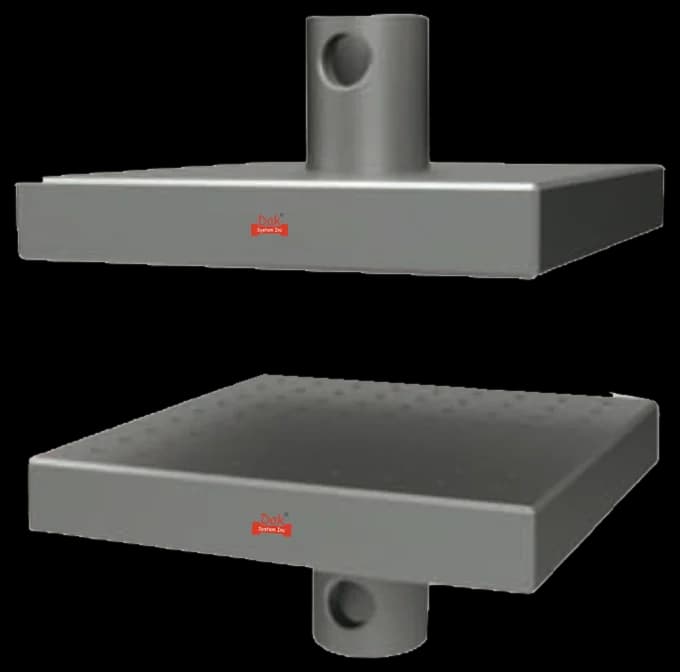
Direct Compression Fixture
Flat parallel platens with enough bearing area for the coil diameter, and enough travel to close the spring completely to solid.
Specifications
Testing standard
Standard Specification for Steel Springs, Helical, Heat-Treated
Written and technically reviewed by Dak System Inc. engineeringLast reviewed
ASTM A125 is a specification for hot-coiled, heat-treated helical compression springs rather than a test method. At its centre is a compression to solid height: the spring is pressed until every coil closes on its neighbour, released, and its free height re-measured. Permanent set is the acceptance quantity, alongside dimensions, hardness and end construction.
From the test method to your testing system
Explore the DAK machines already listed for ASTM A125, then review the grips, measurement and setup requirements below.
 Universal Testing MachineSeries 7200Explore the machine →
 Universal Testing MachineSeries 9000Explore the machine →
01Understand the method
A125 is a specification rather than a test method: it fixes what a hot-coiled, heat-treated helical compression spring must achieve and leaves the choice of instrument to the laboratory. At its centre is a solid-height compression. A finished spring, its ends tapered, closed, squared and ground, is stood between flat parallel platens and pressed along its own axis until every adjacent coil closes on its neighbour and it can shorten no further. Load is released, the spring recovers, and the free height is measured again.
The specification governs permanent set after compression to solid, the dimensional set of free height, loaded height, solid height, outside diameter and uniformity of pitch, the quenched and tempered condition of the steel including Brinell hardness limits, end construction, and the calculated solid capacity and uncorrected solid stress.
Permanent set is the property that separates a properly heat-treated spring from an under-tempered or overstressed one. A spring that shortens on its first closure has lost preload for good, and every assembly it goes into afterwards carries less load than the designer intended. Loaded height ties the spring to the force it must actually produce where it sits. Hardness confirms the condition of the finished coil rather than of the bar it came from; solid capacity and uncorrected solid stress are calculated from geometry, not measured. Supplementary requirements exist but bind only when a purchaser calls them up.
02Prepare the specimen and test settings
A125 fixes no rate of loading and no dwell. What it fixes is the closure itself, how many closures the set is measured over, and the two deflections at which the spring is looked at.
03Build the test setup on a DAK machine
A125 sets no machine capacity. The demand is whatever load closes the spring solid, read from the solid capacity of the largest spring on the order rather than from the standard. A spring wound from bar at the 9.5 mm bottom of the scope closes at of the order of ten kilonewtons; large hot-coiled suspension springs run into the hundreds, and no single frame covers both.
A125 sets no rate of traverse and no dwell. It controls the closure and how often it is repeated: solid height is read with the spring compressed solid under the specified test load, free height after that load is released, and the permanent set is the difference between that free height and the height after three further closures solid under the same load. Uniformity of pitch is checked elsewhere on the curve — compressed without lateral support to 85 % of the nominal total travel, where no active coils may touch and no gap between adjacent active coils may exceed 40 % of the nominal free coil spacing. Four closures and those two deflection points, not a speed, are what govern; the closure is quasi-static, and the laboratory sets a rate slow enough for the load reading to settle at solid.
No force-verification class could be confirmed from any public description of A125; absent one, the laboratory's own calibration regime governs the force channel. No extensometer is involved — heights are measured on the spring, so frame and platen compliance must not masquerade as spring travel.
The fixture is a pair of flat, parallel, hardened platens large enough to seat the ground end coil across its whole bearing surface; platens smaller than the coil, or out of parallel, load the spring eccentrically and both the set and the loaded height come out wrong. A large spring holds a great deal of energy at solid height, so a guarded compression space is normal practice. Ambient air is the only environment required.
Flat parallel platens with enough bearing area for the coil diameter, and enough travel to close the spring completely to solid.
Specifications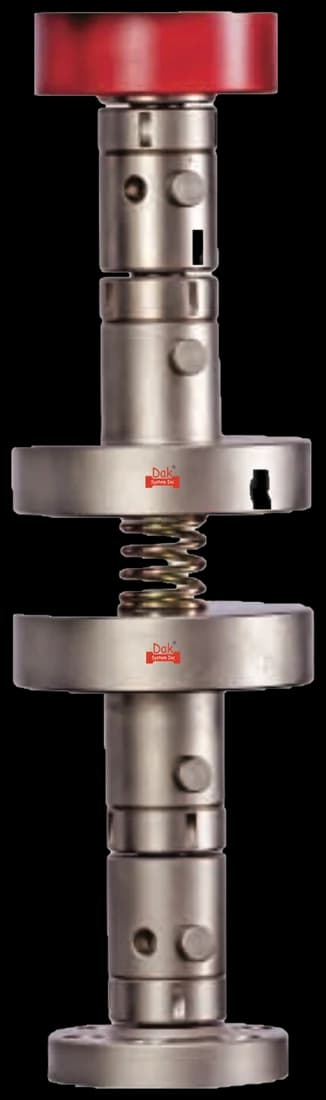
Rigidly fixed hardened anvils, which hold the load path established at set-up rather than self-aligning — a spring that finds its own alignment as it closes has moved off axis.
SpecificationsDak verifies against whichever standard the method names, and where a class applies our frames sit a class tighter than it asks.
| The method asks for | Dak supplies | |
|---|---|---|
| Capacity | A125 sets no machine capacity; the demand is simply whatever load closes the spring solid, which for the 9.5 mm bar at the bottom of the scope is of the order of ten kilonewtons and for large hot-coiled suspension springs runs into the hundreds of kilonewtons — so capacity is chosen from the tabulated solid capacity of the largest spring on the order, not from the standard. | Load cells from 1 kg to 60 ton on the Series 7200, and 0.5 to 100 kN on the Series 9000 |
| Force accuracy | unknown | ISO 7500-1 Class 0.5 — the method sets no class of its own |
| Gripping | Flat parallel compression platens on a high-capacity frame or dedicated spring tester, inside a guard | Our compression anvils, built to the specimen |
| Environment | Ambient workshop or laboratory air; no temperature or humidity limits are set | 3009 series chambers, −150 °C to +400 °C — temperature only |
04Run the test
05Calculate, report and interpret
Free height before − free height after compression to solid
The acceptance quantity. A spring that has taken a set has yielded, which means it will not return the force the design assumed.
The load at solid height
Calculated, and stated in the specification alongside the uncorrected solid stress.
Ejection is the hazard everyone remembers. A spring sitting slightly skewed under a platen can be thrown out of the frame as it approaches solid, which is why a crooked spring is reseated rather than pushed through.
Buckling is the commoner nuisance. A slender spring bows sideways before it reaches solid, the load curve flattens early, the coil rubs a platen, and the figure recorded is not a solid-height load at all. Springs above a certain slenderness need guiding on an arbor or in a nest.
Free height read too soon exaggerates the set. Recovery after release is not instantaneous, and a measurement taken straight off the platen condemns springs that would have passed an hour later; the waiting interval has to be consistent within the laboratory.
Surface decarburisation from hot coiling and heat treatment leaves no trace in the compression result. A spring can meet every dimensional and set requirement and still fail early in service because its surface layer has lost carbon, which is why the metallurgical checks sit alongside the mechanical ones rather than behind them.
06Compare methods and find answers
| ASTM A125 | A test method standard | |
|---|---|---|
| Defines | What the spring must achieve | How to measure something |
| Instrument | Left to the laboratory | Specified |
| Output | Pass or fail against limits | A measured value |
| Acceptance | In the document itself | In a separate product standard |
Because A125 fixes the requirement and leaves the instrument to the laboratory, two laboratories can both comply while measuring rather differently. Agreeing the compression fixture and the height measurement between supplier and purchaser is worth doing before a dispute rather than after.
It is the ASTM specification for hot-coiled, heat-treated helical compression springs. It is a specification rather than a test method: it fixes what the spring must achieve — permanent set after compression to solid, dimensional limits, the quenched and tempered condition with Brinell hardness limits, and end construction — and leaves the choice of instrument to the laboratory.
Pressing the spring along its axis until every adjacent coil closes on its neighbour and it can shorten no further. It is a definite, repeatable condition rather than a chosen load, which is what makes it a good acceptance test — two laboratories reach the same state without needing to agree a force.
Because a spring that takes a set has yielded, and a yielded spring no longer returns the force the design assumed. A125 measures it over a defined number of closures rather than a defined time: free height is read after the first compression solid, then again after three further compressions solid under the same load, and the difference is the set. That is why the specification fixes no rate — nothing in the quantity depends on how fast the platen travels.
Because it decides how the load enters the spring. Ends that are tapered, closed, squared and ground seat flat and load the coils evenly; ends that are not make the spring bow and load one side. The specification fixes the construction for that reason rather than as a cosmetic requirement.
Because a long spring wants to buckle sideways as it closes, and a bowed spring is not being compressed to solid — it is being bent. Guiding or restraining it keeps the compression axial so the test measures what it is meant to.
No, and that is the most important thing to understand about it. A125 is a material and workmanship specification centred on a static compression to solid and the permanent set it leaves. A spring that passes has adequate material, heat treatment and end preparation, but nothing in the specification addresses how many cycles it will survive. A spring in cyclic service needs fatigue testing in addition, not instead.
Because compressing to solid takes the wire close to its elastic limit everywhere at once, which is the most searching static check available. An under-tempered or wrongly quenched spring yields at that point and does not come back to its free length. The permanent set therefore reports on the heat treatment of the whole coil rather than on a sample of the wire, which is why it is the acceptance quantity.
Discuss your specimen, test requirements and reporting needs with DAK engineering.
This page describes the method as practised. The governing text is the current edition from the issuing body. Tell us what you are testing and we will answer with the machine, the fixture and a quotation.