Heavy dutyTJ-531
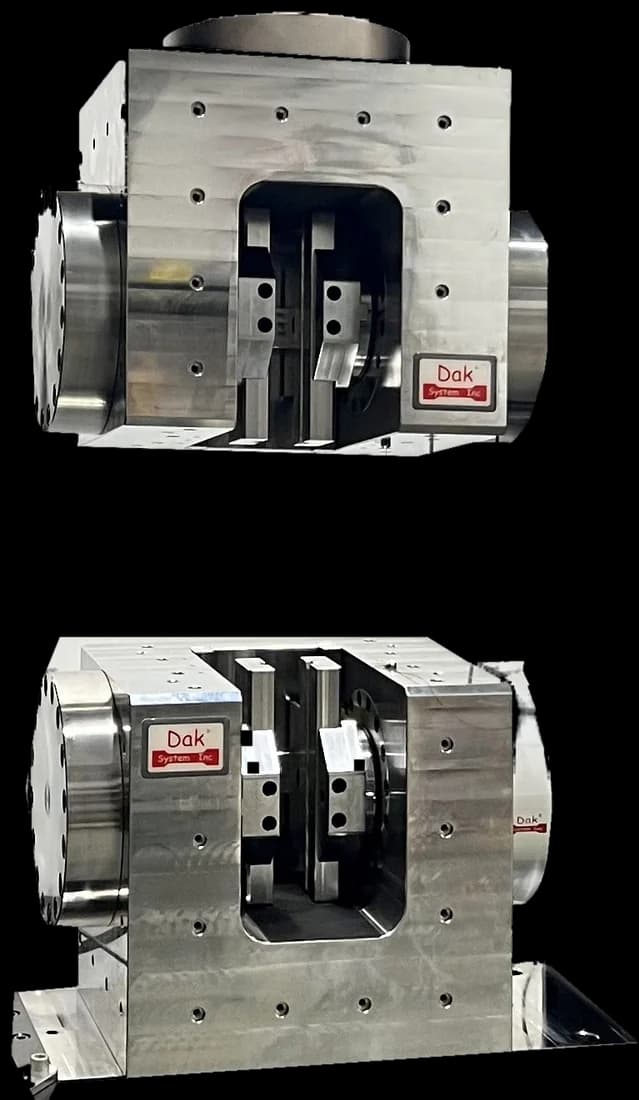
Twin Side Acting Hydraulic Grips
The clamping force a rubber-covered carcass needs, spread widely enough that the plies are held rather than crushed.
Specifications
Testing standard
Conveyor belts with textile plies for bulk goods (Textil-Fördergurte für Schüttgüter) — Part 1: Dimensions, specifications, marking; Part 2: Testing; Part 3: Permanent joints
Written and technically reviewed by Dak System Inc. engineeringLast reviewed
DIN 22102 covers textile conveyor belting for general use. A full-thickness strip is pulled until the carcass ruptures, giving stretch at a working load and breaking force from a single pull; adhesion is measured separately by peeling the layers apart; and cover abrasion and troughability complete the set. The series is not fully readable from public sources, so parts of this page are necessarily general.
From the test method to your testing system
Explore the DAK machines already listed for DIN 22102, then review the grips, measurement and setup requirements below.
 Universal Testing MachineSeries 7200Explore the machine →
 Universal Testing MachineSeries 9000Explore the machine →
01Understand the method
A full-thickness strip is cut from a finished belt, clear of the edge and containing no ply joint, then clamped at both ends in a tensile machine. The crosshead pulls along the belt until the carcass ruptures, force and extension recorded throughout, so stretch at a working load and the breaking force come from one pull. Adhesion works differently: a strip is started at the interface and its two arms drawn apart in a peel jig, so separation travels along the bond instead of breaking it at once. Cover abrasion runs on a rotating drum, and troughability on a freely hanging length of belt.
The requirements cover elongation under a reference load taken as a tenth of nominal breaking strength, tensile strength and elongation at break, abrasive wear of the covers, and resistance to separation between plies and between cover and carcass. Elongation under the reference load is used directly by the conveyor designer: it fixes how much take-up travel the installation needs and how far the belt creeps before it settles. Breaking strength sets the margin on the drive and the splice. Separation resistance decides whether the carcass survives years of flexing over pulleys: a belt that delaminates loses its load path long before the fabric is near failing. Cover abrasion predicts how long the rubber keeps bulk material off the carcass. The 2020 revision added an ageing step before the cover tensile determination, so covers are judged after heat exposure rather than fresh.
02Prepare the specimen and test settings
This page is deliberately less specific than the others in this library. The DIN 22102 series is not publicly readable in the detail the ISO belting standards are, and stating a tolerance we cannot source would be worse than leaving it out.
03Build the test setup on a DAK machine
The test speed is settled, though not inside DIN 22102 itself. Part 2 is a routing document: it names each property and the aligned method that determines it, and the procedure detail lives there. Full-thickness tensile goes to DIN EN ISO 283, which extends the test piece at a constant, uninterrupted (100 ± 10) mm/min; ply and cover adhesion goes to DIN EN ISO 252, whose driven grip peels at the same rate. So 100 mm/min is the figure to set for both pulls, and the force-accuracy and extensometer classes come from those methods too.
Capacity follows from arithmetic on the belt rather than from a clause: a full-thickness strip carries rated carcass strength times specimen width, so a 50 mm strip from a belt rated at 160 N/mm needs roughly 8 kN, the same strip from a 1000 N/mm belt about 50 kN, and textile classes here reach 3150 N/mm. Laboratories either cut narrow specimens to bring the load inside a general-purpose frame or run a dedicated belt frame. Adhesion peel sits at the other extreme, in the tens to low hundreds of newtons — a second, much smaller load cell.
One measurement must cover two strain regimes. Elongation under the reference load falls in the first few per cent — around one and a half to three for common polyester–polyamide constructions — so resolution at small extension decides whether the figure means anything, while elongation at break is far larger and the device must survive to rupture. Grips must be serrated wedge or vice clamps able to hold a thick, resilient section without letting it draw out; peel needs a jig holding a controlled separation angle, and troughability a free-hanging rig rather than a frame.
The clamping force a rubber-covered carcass needs, spread widely enough that the plies are held rather than crushed.
Specifications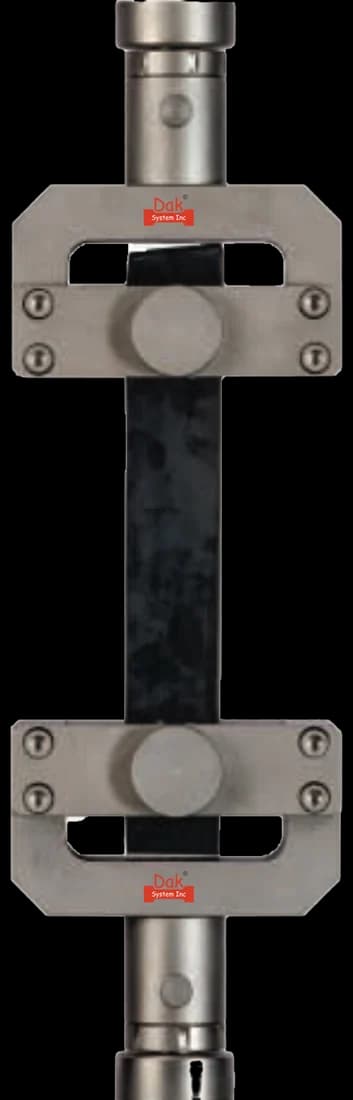
Wide jaws for full-thickness strips, sized so the carcass fails before the grip does.
SpecificationsDak verifies against whichever standard the method names, and where a class applies our frames sit a class tighter than it asks.
| The method asks for | Dak supplies | |
|---|---|---|
| Capacity | No machine capacity is prescribed in the publicly readable part of the series, and no force-accuracy class could be verified — but the belts themselves are the largest specimens in this batch. A full-thickness specimen carries the belt's rated strength times its width, so a 50 mm strip from a 160 N/mm textile carcass needs about 8 kN, the same strip from a 1000 N/mm belt about 50 kN, and DIN-range textile classes reach 3150 N/mm. Laboratories therefore either cut narrow specimens or run a dedicated high-capacity belt frame; adhesion peel by contrast sits in the tens to low hundreds of newtons. | Load cells from 1 kg to 60 ton on the Series 7200, and 0.5 to 100 kN on the Series 9000 |
| Force accuracy | unknown | ISO 7500-1 Class 0.5 — the method sets no class of its own |
| Gripping | Serrated wedge or vice clamps for full-thickness tension, a peel jig for ply-to-ply and cover-to-ply separation, a free-hanging clamp rig for troughability and an abrasion drum for cover wear. | Our self-tightening serrated wedge grips, with V-jaws for round specimens or peel and adhesion fixtures, built to the specimen |
04Run the test
05Calculate, report and interpret
k = F_max / w
Newtons per millimetre, the rating unit — DIN belt designations carry this figure directly.
ε = extension at the reference load / reference length × 100
The take-up sizing figure, as in the ISO cluster.
Slippage is the standing problem. A rubber-covered strip under tens of kilonewtons creeps out of clamps that are not aggressive enough, and the record shows a falsely compliant curve before anyone sees the belt move. Over-clamping fails the other way: crushed covers start the fabric failing at the jaw line, so the figure reported belongs to a damaged belt. Internal delamination during a pull is a real result rather than a fault, but it changes what the break load means. A specimen that quietly includes a joint reports the joint. And a belt is thick and slow to equilibrate, so short conditioning shifts behaviour with no sign of it in the data.
06Compare methods and find answers
| DIN 22102 | ISO 283 | ISO 9856 | |
|---|---|---|---|
| Scope | A series covering the belt | Full-thickness tension | Elongation behaviour |
| Rating unit | N/mm | N/mm | N/mm |
| Public availability | Limited | Good | Good |
| Covers abrasion | Yes | No | No |
European belt designations are frequently written to DIN while testing is done to ISO, and the two are close but not identical. Where a contract names DIN 22102, the DIN text is what governs — an ISO result is evidence rather than compliance.
It is the German standard series for textile conveyor belts for general use. It covers full-thickness tensile strength and elongation, ply and cover adhesion, cover abrasion and troughability — broadly the same ground the ISO belting cluster covers, gathered under one series number.
They cover the same properties and use the same rating unit, newtons per millimetre of width, but they are not identical documents. European belt designations are often written to DIN while testing is done to ISO. Where a contract names DIN, the DIN text governs, and an ISO result is supporting evidence rather than compliance.
Because the DIN 22102 series is not publicly readable in the detail the ISO standards are. Where Part 2 routes a property to an aligned method the figure is firm — the tensile and adhesion pulls both run at (100 ± 10) mm/min, from DIN EN ISO 283 and DIN EN ISO 252 — but tolerances and specimen counts held in the DIN text itself are marked as needing the current edition rather than guessed. An encyclopedia that invents the parts it cannot check is worse than one that admits the gap.
How long the top cover will last in service. A belt carrying abrasive material loses cover thickness steadily, and once the carcass is exposed the belt is finished regardless of its remaining strength. Abrasion resistance is therefore a life property rather than a strength one, and it is often what actually determines replacement interval.
Chiefly in German and central European projects, and in tenders written from an established plant specification rather than from current international practice. Many operators have moved to the EN and ISO belting standards, but a plant with decades of DIN-referenced documentation will keep citing it, and belt suppliers into those markets continue to certify against it.
By carcass strength and cover grade together — a designation carries the nominal breaking strength per unit width and the cover quality on both the carrying and running sides. That combination matters because the two are chosen for different reasons: the carcass for tension and the covers for abrasion, impact and the material being conveyed. A belt is under-specified if only one of them is quoted.
Which edition the specification means, and whether the plant will accept an equivalent EN or ISO result instead. Because the DIN belting standards have been partly superseded by the European ones, a modern laboratory report may be issued against EN or ISO methods, and agreeing that equivalence in advance avoids a certificate being rejected after the belt has been made.
Discuss your specimen, test requirements and reporting needs with DAK engineering.
This page describes the method as practised. The governing text is the current edition from the issuing body. Tell us what you are testing and we will answer with the machine, the fixture and a quotation.