
Testing standard
ASTM A938 Torsion Testing of Wire
Standard Test Method for Torsion Testing of Wire
Written and technically reviewed by Dak System Inc. engineeringLast reviewed
ASTM A938 twists a length of wire in one direction until it fractures, and counts the turns. The count and the appearance of the break carry the acceptance decision — torque is measured but is secondary. It is a soundness screen: drawn wire can meet its tensile specification and still carry seams, laps or a decarburised skin, and twisting finds them where a tensile test walks past.
At a glance
- Test type
- Torsion — the specimen is twisted
- Published by
- ASTM
- Edition
- A938-18(2024)
- Materials
- Springs & spring wire, Metals, alloys & welds
- Runs on
- Torsion Tester
From the test method to your testing system
Explore DAK equipment for ASTM A938, then review the specimen and setup requirements below.
 Torsion Testing MachineTorsion TesterExplore the machine →
Jump to a specific section
01Understand the method
What the test does
A straight length of wire is clamped between two coaxial chucks a stated free length apart, one fixed and one driven, with a light dead weight hanging on it to keep it straight. The driven chuck rotates in one direction only — no reversal — while a counter records each complete 360° turn, until the wire fractures or a pass count set by the product specification is reached. The result is a number of turns and a fracture to look at, not a curve.
What it measures, and why it matters
The headline output is the count of complete twists the wire survives. Torque is measured too but is secondary; the count and the appearance of the break carry the acceptance decision.
Torsion is sensitive to what a tensile test walks past. Drawn wire can meet its tensile specification and still carry seams, laps or a decarburised skin, and twisting concentrates shear at the surface where those defects live. Sound wire fractures on a plane square to its axis with no longitudinal splitting; defective wire splits along its length or breaks on a helix, and the count collapses. That matters for spring wire because the flaw which shortens a torsion count is where a fatigue crack starts once the wire is coiled and cycled; it is a soundness screen on incoming coil more than a design property.
02Prepare the specimen and test settings
Wire and free length
- Specimen
- A straight length of wireHeld between two coaxial chucks at a stated free length.
- Free length
- From the product specificationCommonly expressed as a multiple of the diameter. It sets how much wire shares the twist, so it changes the count directly.
- Dead weight
- Light, hung on the wireJust enough to keep it straight. Too much adds a tensile component the method does not intend.
- Rotation
- One direction only, no reversal
- Pass count
- Set by the product specificationTesting stops at fracture or at that count, whichever comes first.
- Keep the wire straight, not tensioned
- The weight is a straightenerDakA wire under real tension twists differently, and the count falls.
Rotation rate
- Rate
- From the product specificationSlow enough that heating does not affect the result.
- Counted quantity
- Complete 360° turns
- End of test
- Fracture, or the specified pass count
03Build the test setup on a DAK machine
What the machine must be capable of
This is a torsion machine, not an axial frame: a uni-directional rotary head driving one chuck against a fixed opposing chuck, with a counter registering each complete 360° turn. No fixturing turns a plain tensile machine into one.
Torque capacity is not prescribed — the method rates the test in rotations, not newton metres — so the requirement is enough torque to fracture the coarsest wire on the schedule, with headroom. No accuracy class is stated for the torque channel, and no extensometer is involved.
Speed is where the method does bind. Twisting must be uniform and slow enough that the wire does not warm: A938 is explicit that the operator watches specimen temperature and reduces speed if it heats, because running too fast depresses the result. The permitted speeds themselves are not published in any corroborated form: a table of maxima by diameter circulates in secondary summaries, but it is unverified and not repeated here.
The chucks must hold without slipping and without crushing, a genuine tension in fine sizes. A light dead-weight tensioner keeps the specimen straight; A938 prescribes no capacity for it. Testing is at room temperature, which the method does not define numerically.
The machine this method needs
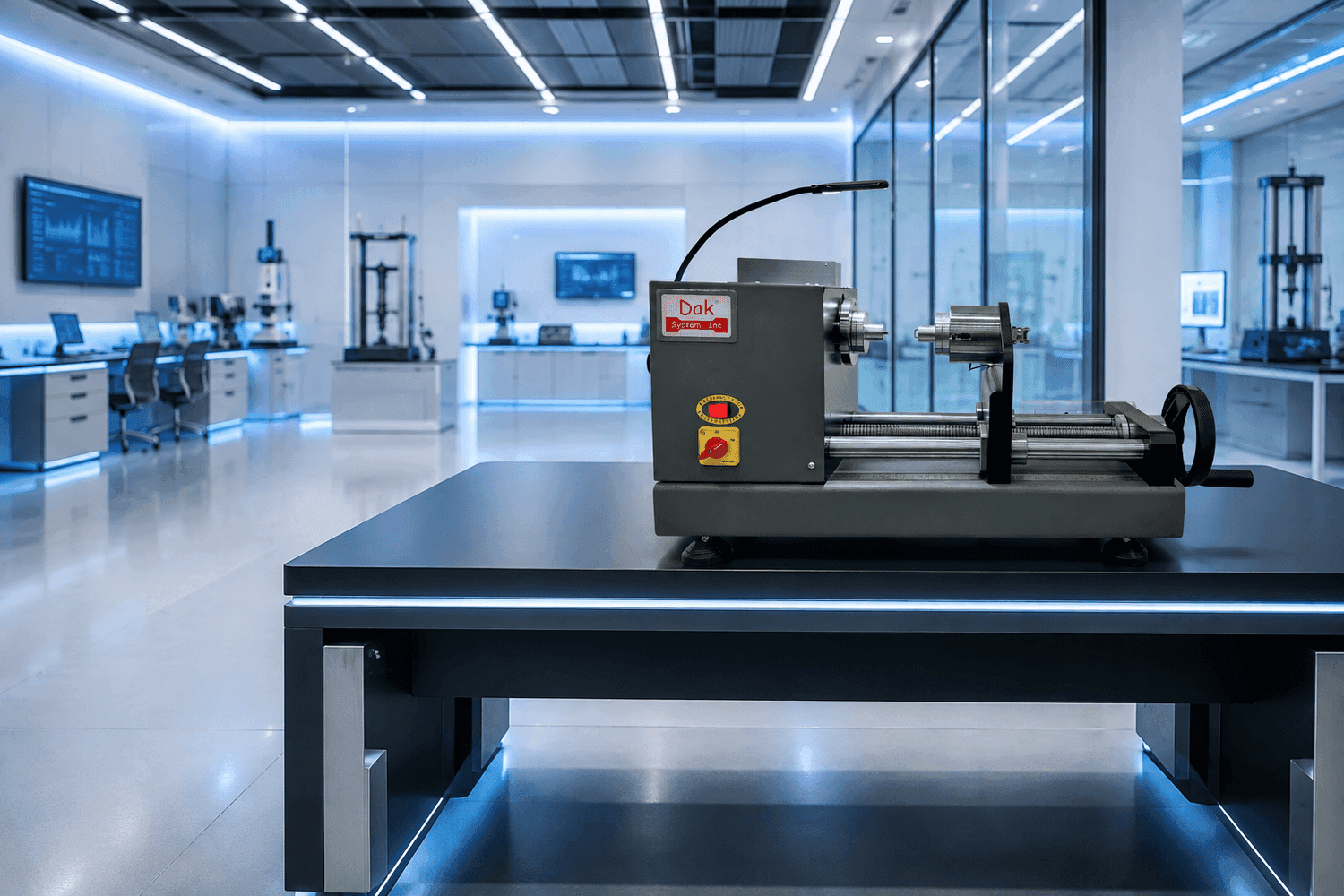
Running ASTM A938 on the Torsion Tester
A torsion frame answers in torque and angle. Rotation is measured rather than inferred from the motor, so the reading is the specimen and not the drive.
| The method asks for | Dak supplies | |
|---|---|---|
| Torque & rotation | n/a for force: the machine twists rather than pulls, so it is rated in torque and rotations, not kilonewtons. The only axial load in the test is a small dead-weight tension applied to keep the wire straight, and A938 prescribes no capacity for it. | Torque 0.2 – 5000 N·m, rotation 0.036 – 18000 °/min, angle resolution 0.1°, ±360° continuous both directions |
| Gripping | A pair of coaxial wire chucks — one driven, one fixed — on a torsion drive with a revolution counter, plus a light dead-weight tensioner | Chuck and specimen holders built to the section under test |
04Run the test
How the test runs
- Cut a straight length of wire without nicking it — a nick is exactly the defect this test is looking for.
- Set the chucks to the free length the product specification requires.
- Clamp the wire in both chucks, coaxially.
- Hang the light dead weight to keep it straight.
- Zero the turn counter.
- Rotate the driven chuck in one direction only, at the specified rate.
- Count complete 360° turns until the wire fractures or the pass count is reached.
- Examine the fracture surface and the wire along its length.
- Record the count, and whether the break was square or helical, and whether the wire split longitudinally.
The fracture is half the result. Sound wire breaks on a plane square to its axis with no longitudinal splitting; defective wire splits along its length or breaks on a helix. A count recorded without describing the break has thrown away the diagnosis.
See the machine
05Report and interpret
What the report has to contain
- Reference to ASTM A938 and the product specification
- Wire identification, grade, diameter and coil
- Free length between chucks
- Rotation rate
- Number of complete turns to fracture, or the pass count reached
- Description of the fracture — square, helical, or split longitudinally
- Torque where recorded
- Number of specimens tested
What goes wrong in practice
Slipping chucks are the first suspect when a count comes out high: the head turns, the wire does not follow for a revolution or two, and the number is inflated by whatever slip occurred before the grip bit.
The opposite error is worse. Jaws that bite too hard leave a notch, the wire fractures at the chuck face rather than in the free length, and the count is short for reasons nothing to do with the wire. A break at a chuck is not a valid result.
Without adequate dead-weight tension the specimen bows and whips, twist localises in the bow rather than distributing along the free length, and neither the count nor the fracture is representative.
Speed creep is the quiet one: an operator running a long batch drifts the head faster, the wire warms, counts fall, and a sound coil is rejected. Recoil can also throw a second break further along the wire; only the primary fracture is assessed.
06Compare methods and find answers
What torsion finds that tension does not
| ASTM A938 torsion | Tensile test | |
|---|---|---|
| Stress concentrated | At the surface, in shear | Through the section, in tension |
| Finds | Seams, laps, decarburised skin | Bulk strength and ductility |
| Output | A turn count and a fracture appearance | A stress-strain curve |
| Sensitive to surface defects | Very | Averages them away |
| Used for | Soundness screening on incoming coil | Acceptance against strength limits |
The two answer different questions and neither substitutes for the other. A wire that passes tension and fails torsion has a surface problem — and for spring wire that is the flaw where a fatigue crack starts once the wire is coiled and cycled.
Questions we are asked about this test
What is ASTM A938?
It is the ASTM method for torsion testing of wire. A straight length is clamped between two coaxial chucks and twisted in one direction until it fractures, and the number of complete turns it survives is the reported result. Torque is measured but the count and the appearance of the break carry the acceptance decision.
Why twist wire when a tensile test already exists?
Because torsion concentrates shear at the surface, which is where drawn-wire defects live. Seams, laps and a decarburised skin can leave a wire fully compliant on tensile strength while collapsing its torsion count. For spring wire that matters directly: the flaw that shortens the count is where a fatigue crack starts once the wire is coiled and cycled.
What does the fracture appearance tell me?
As much as the count. Sound wire fractures on a plane square to its axis with no longitudinal splitting. Wire that splits along its length, or breaks on a helix, is telling you there is a longitudinal defect — a seam or a lap — running through it. Recording only the number throws away that diagnosis.
Why is the free length specified?
Because it sets how much wire shares the twist. A longer free length distributes the same total rotation over more material, so the count changes with it. That is why the free length comes from the product specification rather than from the operator, and why it belongs on the report.
Why only one direction of rotation?
Because reversing would work the surface in both senses and change what the test is measuring. A938 is a soundness screen based on accumulating shear strain at the surface in one sense until a defect opens up — reversing partially undoes that, and the count would no longer mean the same thing.
Does this run on a universal testing machine?
No. It needs a torsion machine — two coaxial chucks, a single-direction drive and a turn counter. A universal frame pulls along an axis and has no way to rotate one end relative to the other, so the two machines sit side by side in a wire laboratory rather than substituting for one another.
Related
Materials tested to it
Industries that test to it
Other standards explained
Planning ASTM A938 testing?
Discuss your specimen, test requirements and reporting needs with DAK engineering.
This page describes the method as practised. The governing text is the current edition from the issuing body. Tell us what you are testing and we will answer with the machine, the fixture and a quotation.