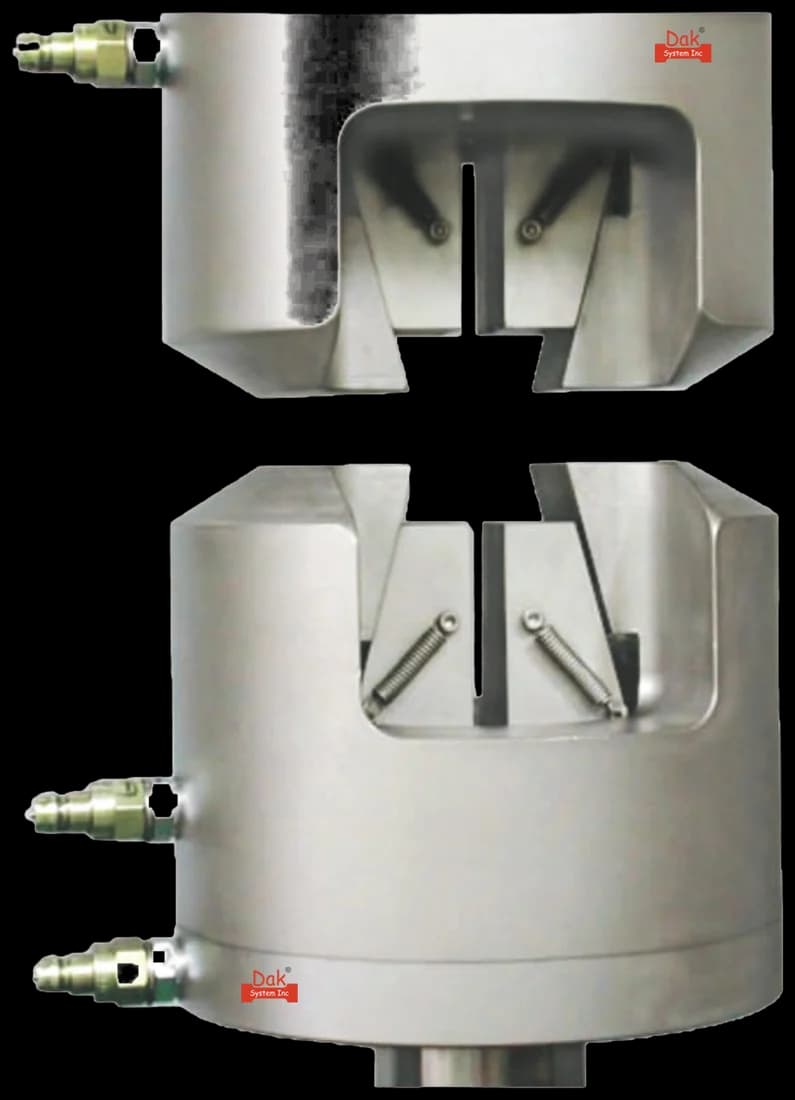
Universal Parallel Wedge Grips
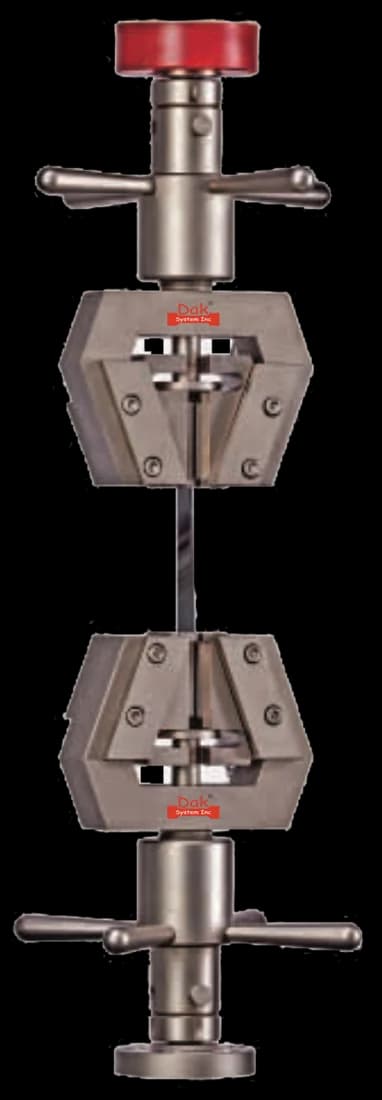
Parallel-closing wedges with serrated faces suit flat sheet coupons in these alloys, taking flat specimens up to 25 mm wide and 5 mm thick. Closing square is what keeps the break in the reduced section.
SpecificationsTesting standard
Standard Test Methods for Tension Testing Wrought and Cast Aluminum- and Magnesium-Alloy Products; and Standard Test Methods for Tension Testing Wrought and Cast Aluminum- and Magnesium-Alloy Products (Metric)
Written and technically reviewed by Dak System Inc. engineeringLast reviewed
ASTM B557 and B557M are the tension test methods for wrought and cast aluminium- and magnesium-alloy products. A machined coupon is pulled along its axis to fracture and the methods report tensile strength, yield strength, elongation and reduction of area. They are derived from Test Methods E8/E8M, so the mechanics are the general metals tension test; what they add is the light-alloy context, including an explicit exclusion of aluminium foil. B557 is inch-pound and B557M is its complete metric companion.
A machined coupon of aluminium or magnesium alloy is gripped at both ends and pulled along its axis until it fractures, with force and extension recorded throughout. The methods are derived from Test Methods E8, which covers tension testing of all metallic materials, so the mechanics are the general metals tension test; what B557 and B557M add is the light-alloy context — the product forms, the exclusions and the practices that the aluminium and magnesium specifications call up when they cite a tensile requirement.
Strength and ductility under uniaxial tensile stress. The standard states its own claim carefully: the information is useful in comparisons of materials, in alloy development, in quality control and in design under certain circumstances, and the methods are considered satisfactory for acceptance testing of commercial shipments. It is equally careful about the limit — results from specimens machined to standardised dimensions out of selected portions of a part may not totally represent the strength and ductility of the whole end product, nor its behaviour in service in a different environment.
That matters more for light alloys than the wording suggests. An extrusion, a rolled plate and a sand casting in the same alloy and temper are three different materials mechanically, and where the coupon was taken from decides what the number describes.
Specimen geometry comes from Test Methods E8/E8M. What these methods settle is which products they cover, and one form they deliberately do not.
The methods state their own limit plainly: results from specimens machined to standardised dimensions out of selected portions of a part may not totally represent the strength and ductility of the whole end product, nor its behaviour in a different service environment.
These methods are derived from Test Methods E8/E8M, and the scope of each says so in as many words. Rate control follows that parent method, and the numeric limits are deliberately not reproduced on this page: work to the ones the edition of E8/E8M in force sets out.
TS = F_max / A₀
YS = stress at a specified offset from the elastic line, conventionally 0.2 % strain
Aluminium and magnesium alloys generally show no sharp yield point, so an offset yield strength is the normal reported value. It is read at a small offset strain and is only as good as the strain measurement beneath it — which is why an extensometer, not crosshead travel, decides whether this number is right.
A = ((L_u − L₀) / L₀) × 100
Elongation depends on gauge length, so the gauge length is part of the result and not an incidental detail.
Z = ((A₀ − A_u) / A₀) × 100

Parallel-closing wedges with serrated faces suit flat sheet coupons in these alloys, taking flat specimens up to 25 mm wide and 5 mm thick. Closing square is what keeps the break in the reduced section.
Specifications
Heavy duty manual wedges with interchangeable faces — serrated V-jaws for machined round coupons taken from plate, bar and castings.
Specifications
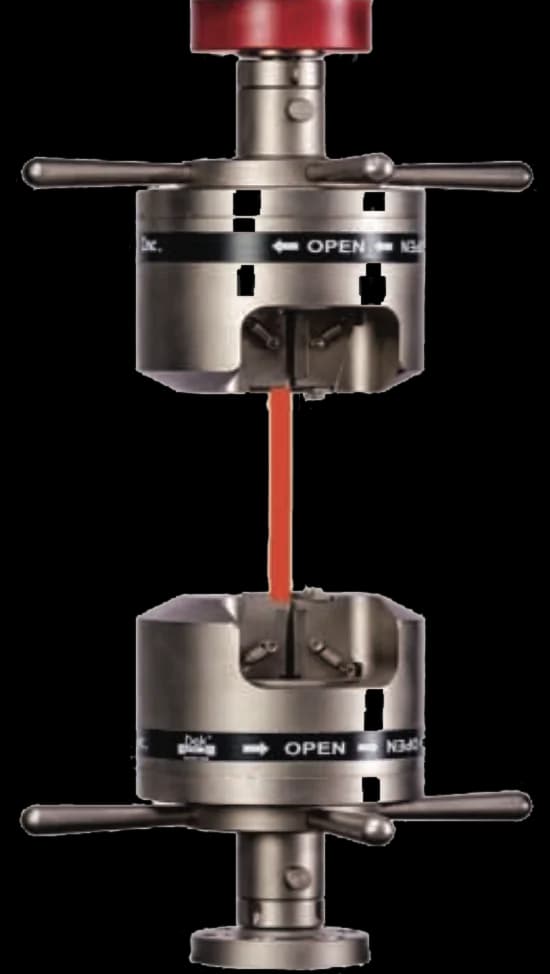
Fluid pressure holds the closing force steady between tests, which matters on soft tempers where a hand-tightened grip is easy to overdo and start a crack at the jaw line.
Specifications
Offset yield strength on a light alloy is read at a small offset strain. Taken from crosshead travel it reads badly low, because the compliance of the load train is added to the specimen's own extension.
SpecificationsModest force and careful gripping. Aluminium and magnesium alloys are not the strongest metals a tension frame sees, and sheet and small round coupons in them sit comfortably inside a mid-range frame; heavy plate and full-section coupons set the capacity. Rate control follows the two-stage pattern of E8, slower through the yield region than through the tensile-strength portion, and the extensometer classification E8 calls up applies for the same reason: proof strength on a light alloy is read at a small offset strain and is only as good as the strain measurement under it.
Gripping deserves the attention. These alloys are softer than steel, and serrated wedge faces set for steel bite deep enough to start a crack at the jaw line. Faces sized and dressed for the coupon, closed square, are what keeps a break in the reduced section. Non-proportional sub-size coupons cut from thin sheet make this worse rather than better, since the tab is thinner and the load path shorter.
Testing foil to these methods, which is outside the stated scope and gives tab failures rather than data. Jaw breaks on soft tempers from grip pressure chosen for steel. Reading proof strength from crosshead travel, which on a low-modulus alloy in a compliant load train reads badly low. Quoting a result without the alloy, temper, product form and direction. And mixing the two documents in one certificate — B557 is inch-pound and B557M is SI, and a tolerance converted between them is not the tolerance either document wrote.
| ASTM B557-15(2023) | ASTM B557M-15(2023) | |
|---|---|---|
| Units | Inch-pound | SI |
| Metric equivalents | None presented | The document is metric throughout |
| Foil definition | Less than 0.0079 in. | Less than 0.20 mm |
| Overlap band | 0.006 to 0.0079 in. | 0.15 to 0.20 mm |
| Derived from | Test Methods E8 | Test Methods E8M |
| Subcommittee | B07.05 | B07.05 |
They are two separate documents, not one dual-unit designation. Mixing them in a single certificate is a real error: a tolerance converted between them is not the tolerance either document wrote.
| Material | Role | |
|---|---|---|
| ASTM E8/E8M | All metallic materials | The parent method — geometry, rate control, reporting |
| ASTM B557 / B557M | Aluminium and magnesium alloys | Light-alloy context, product forms and exclusions |
| ASTM A370 | Steel products | The equivalent umbrella for steel |
| ASTM E345 | Metallic foil | Where the material excluded from B557 goes |
| ISO 6892-1 | Metallic materials | The international room-temperature counterpart |
It is the ASTM tension test method for wrought and cast aluminium- and magnesium-alloy products, covering tensile strength, yield strength, elongation and reduction of area. It is derived from Test Methods E8, so the mechanics are the general metals tension test; what B557 adds is the light-alloy context — the product forms it covers, the exclusions it makes, and the practices the aluminium and magnesium specifications call up.
Units, and they are two separate documents rather than one dual-unit standard. B557 states its values in inch-pound units and presents no metric equivalents; B557M is the complete metric companion, stated in SI throughout. Both are 2015 editions reapproved in 2023 and both are maintained by Subcommittee B07.05. A certificate should name which one was used.
No. Foil is explicitly excluded, and the methods define it as sheet metal less than 0.0079 in. (0.20 mm) thick. There is an overlap band from 0.006 to 0.0079 in. (0.15 to 0.20 mm) where the same thickness may be supplied to either a sheet or a foil specification — sheet products there follow sheet specifications, foil products follow foil specifications. Metallic foil is tested to ASTM E345 instead.
Yes. The methods state that they are considered satisfactory for acceptance testing of commercial shipments. They are equally explicit about the limit: results from specimens machined to standardised dimensions out of selected portions of a part may not totally represent the strength and ductility of the whole end product, nor its behaviour in a different service environment.
Usually grip pressure or alignment. These alloys are softer than steel, and serrated faces set for steel bite deep enough to start a crack at the jaw line. A coupon clamped out of square carries bending on top of tension and fails at the edge taking most of it. Non-proportional sub-size coupons cut from thin sheet make it worse, since the tab is thinner and the load path shorter. A break at or inside the grip is not a valid result.
For yield strength and accurate elongation, yes — the extensometer classification Test Methods E8/E8M calls up applies here for the same reason. Aluminium and magnesium alloys generally show no sharp yield point, so the reported value is an offset yield strength read at a small offset strain. Taken from crosshead travel on a low-modulus alloy in a compliant load train, it reads badly low.
Less than steel work of the same section. Aluminium and magnesium alloys are not the strongest metals a tension frame sees, and sheet and small round coupons sit comfortably inside a mid-range frame; heavy plate and full-section coupons are what set the capacity. Clean resolution at the bottom of the load range matters more than headline capacity for thin sheet in soft tempers.
They answer the same question with different conventions. ISO 6892-1 is the international room-temperature tension method for metallic materials and is what an export customer is more likely to cite; B557 and B557M are the ASTM light-alloy methods derived from E8 and E8M. Specimen geometries, rate control and reporting conventions differ, so the certificate should name the method rather than leaving it to be inferred.
B557-15(2023) and B557M-15(2023) — both 2015 editions reapproved in 2023, both active on the ASTM catalogue, and both maintained by Subcommittee B07.05. Open revision work items are registered against B557M, so the edition in force is worth confirming before quoting results against a purchase specification.
Dak verifies against whichever standard the method names, and where a class applies our frames sit a class tighter than it asks.
| The method asks for | Dak supplies | |
|---|---|---|
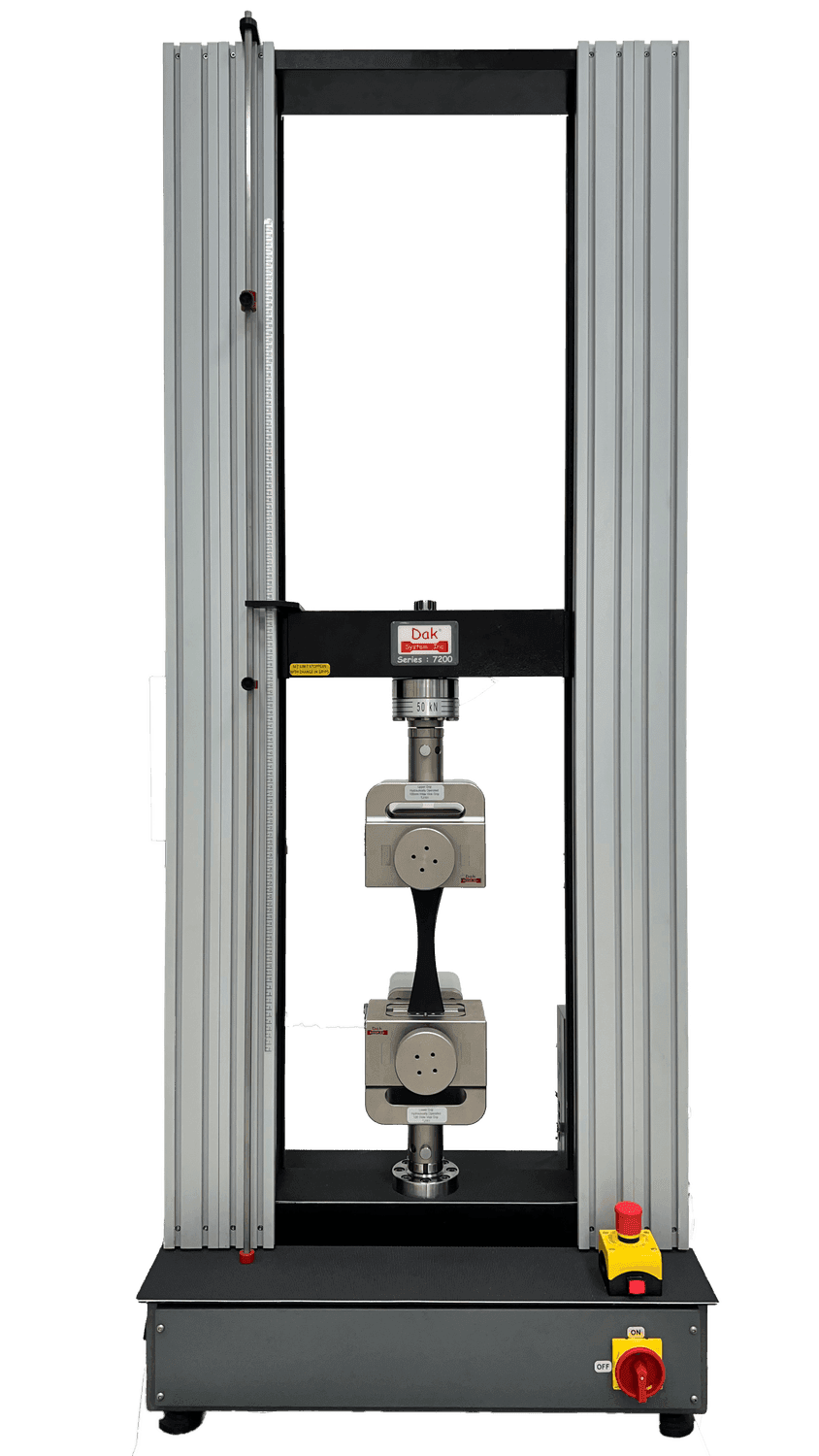
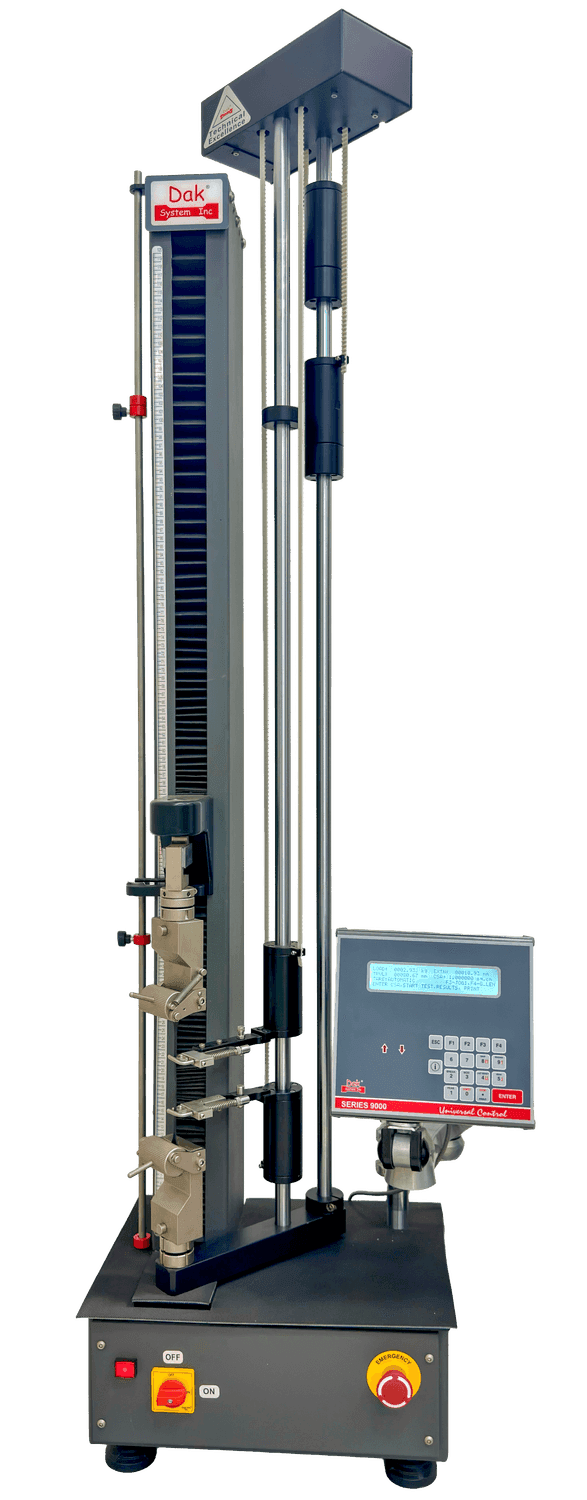
| Capacity | Moderate — sheet and small machined round coupons in these alloys sit comfortably inside a mid-range frame; heavy plate and full-section coupons set the capacity. | Load cells from 1 kg to 60 ton on the Series 7200, and 0.5 to 100 kN on the Series 9000 |
| Force accuracy | unknown — the force-verification class is not stated on the ASTM catalogue record; rate control and specimen geometry are taken from Test Methods E8/E8M, from which these methods are derived | ISO 7500-1 Class 0.5, verified to ASTM E4, DIN 51221 and BS 1610 |
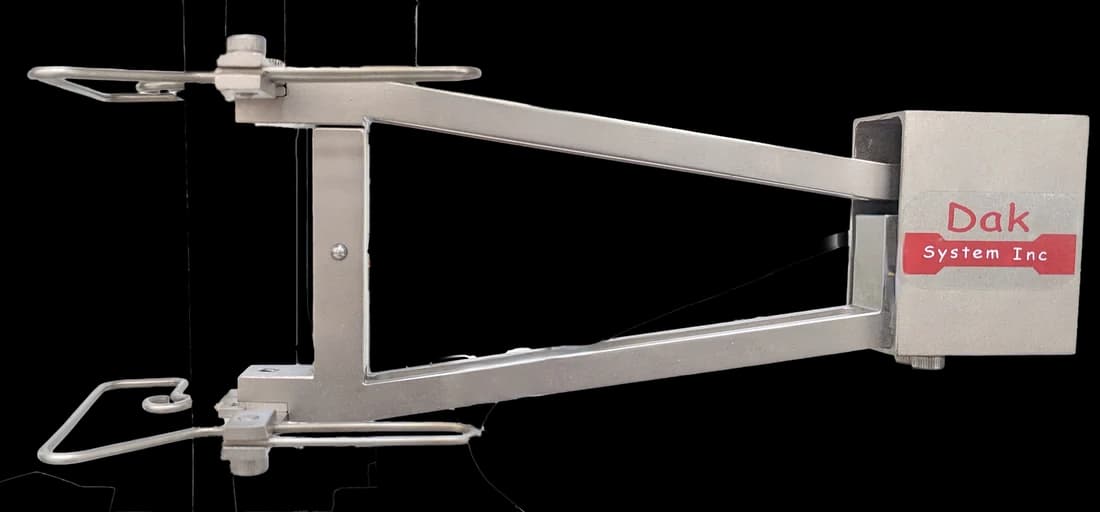
| Strain measurement | An extensometer to The class Test Methods E8/E8M calls up, applied for the same reason: offset yield strength on a light alloy is read at a small offset strain and is only as good as the strain measurement beneath it, gauge length The E8/E8M specimen family — rectangular sheet-type coupons, machined rounds and pin-loaded specimens, with sub-size geometries where the product will not yield a full-size one. B557M requires longer gauge lengths for round specimens than B557 does. | Certified to ISO 9513 Class 1 and ASTM E83 — non-contact video, clip-on and high-elongation |
| Gripping | serrated wedge grips sized and dressed for the coupon, with threaded or shouldered holders for machined rounds | Our self-tightening serrated wedge grips, with V-jaws for round specimens, built to the specimen |
| Environment | Ambient laboratory conditions; no conditioning atmosphere is specified | 3009 series chambers, −150 °C to +400 °C — temperature only |
This page describes the method as practised. The governing text is the current edition from the issuing body. Tell us what you are testing and we will answer with the machine, the fixture and a quotation.