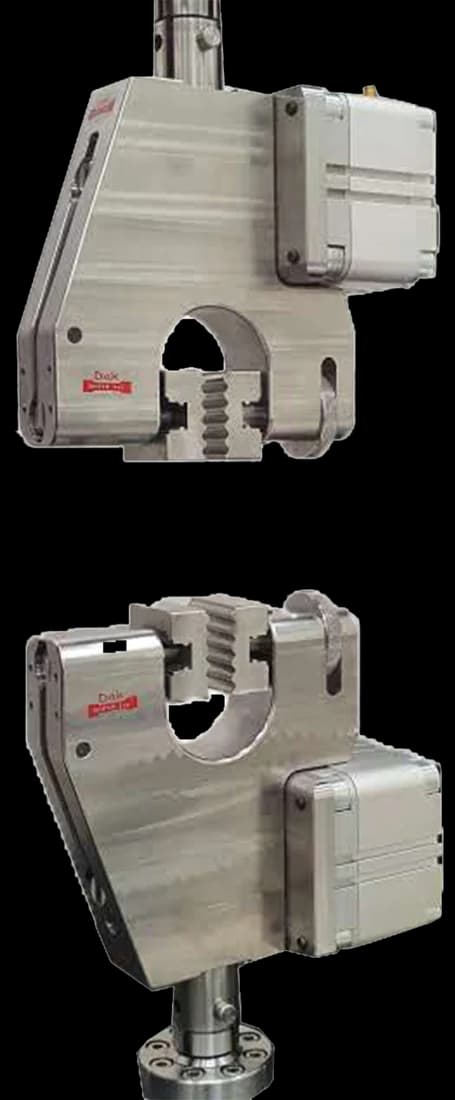
Standard 25 mm
Pneumatic Vice Action Grip
Pneumatic vice action grips clamp the full specimen width at a constant, even pressure — which is what stops one side slipping or tearing before the other.
Specifications
Testing standard
Standard Test Method for Failure in Sewn Seams of Woven Fabrics
Written and technically reviewed by Dak System Inc. engineeringLast reviewed
ASTM D1683/D1683M pulls a sewn seam apart perpendicular to the stitch line and records the maximum force together with how it failed. The failure mode is the practical output: broken stitching can be re-sewn, while displaced or severed fabric yarns cannot, so the two outcomes have entirely different consequences.
From the test method to your testing system
Explore the DAK machines already listed for ASTM D1683/D1683M, then review the grips, measurement and setup requirements below.
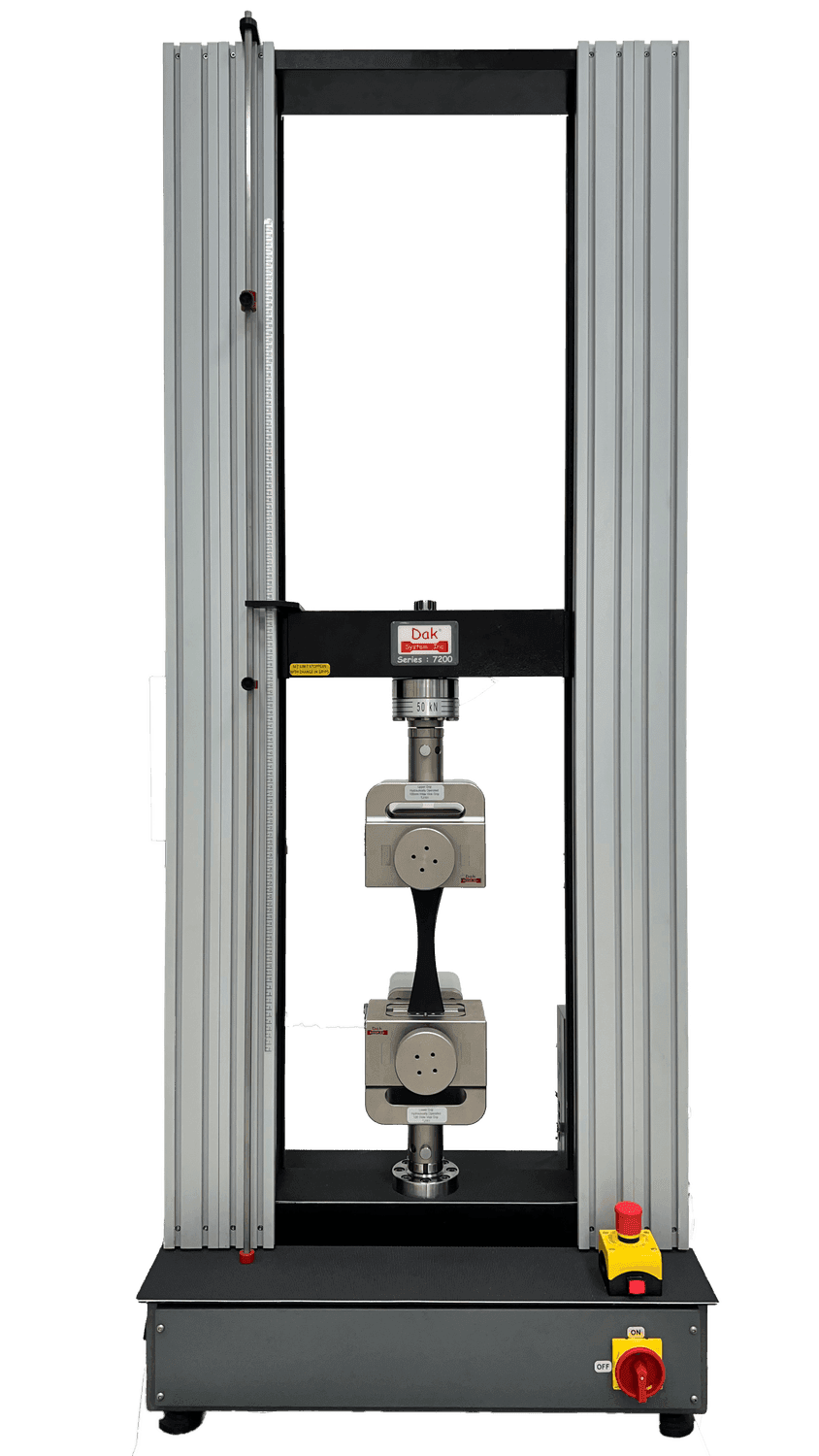 Universal Testing MachineSeries 7200Explore the machine →
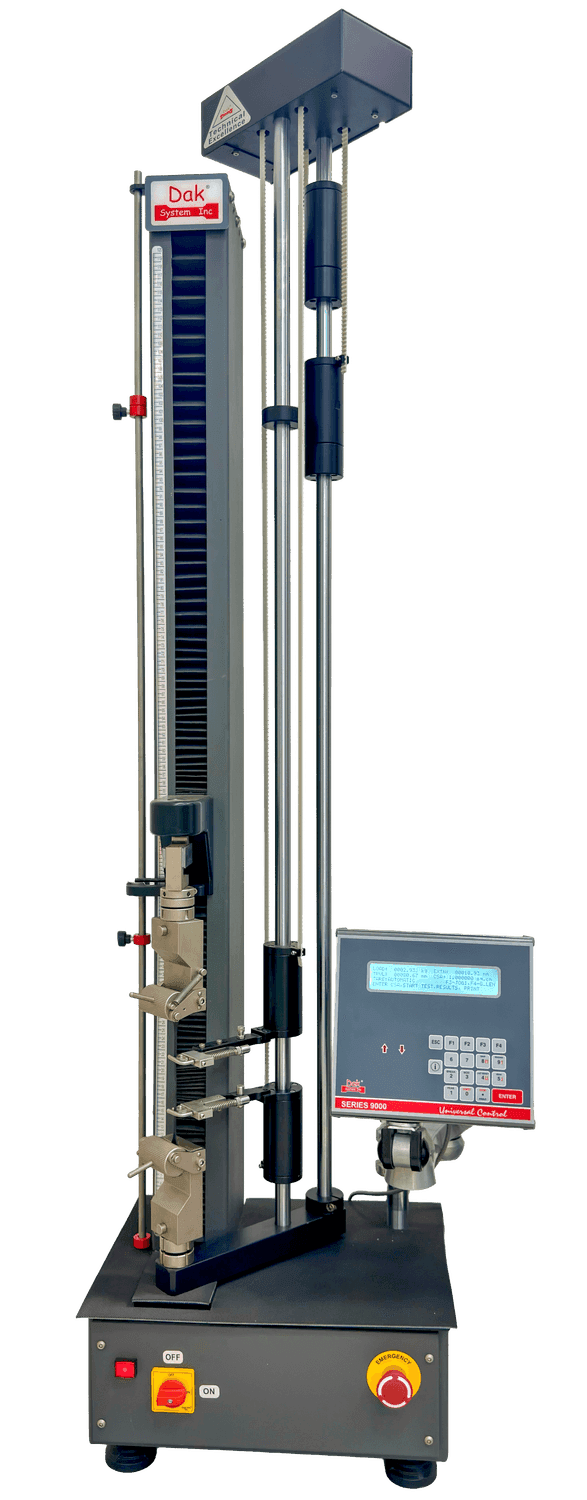 Universal Testing MachineSeries 9000Explore the machine →
01Understand the method
A specimen containing a sewn seam, either cut from a finished article or made up as one of the standard seam assemblies the method defines, is conditioned and clamped in wide-faced grips so that the seam lies centrally between them and runs across the specimen. It is then pulled at a jaw separation rate of 305 ± 10 mm/min (12.0 ± 0.5 in./min) until the seam gives way. The figure is fixed outright rather than derived from a gauge length, and it is the grab-test rate the parent fabric methods use, so a seam and the cloth it was sewn into are pulled at the same speed and their strengths can be compared directly. Two things are recorded: the maximum force, and which of three things failed — the sewing thread, the fabric yarns at the stitch line, or the grip of the seam on the cloth as yarns slide out of the weave.
Nominally the strength of a seam; practically, what to do about it. The failure mode carries the commercial consequence. A thread rupture with the fabric intact means the article can be re-sewn and returned to stock. Severed fabric yarns or slippage mean the cloth itself has been compromised, a new seam would go into damaged fabric, and the article is scrap. Two garments can post identical seam strengths and have opposite outcomes, which is why a force reported without a mode tells a manufacturer nothing about whether to change the thread, the needle, the stitch density or the fabric.
02Prepare the specimen and test settings
Three things can give way — the thread, the fabric yarns, or the grip of the seam on the cloth — and only one of them is repairable.
Record the mode on every specimen. A seam strength quoted without it cannot tell a manufacturer whether to change the thread, the needle, the stitch density, or the cloth.
03Build the test setup on a DAK machine
Modest force — sewn seam strengths in woven fabrics run from tens to a few hundred newtons — with grips wide enough to hold the full specimen width at an even pressure. Even clamping is the requirement that matters: if one side of the specimen is held more firmly than the other, that end of the seam takes load first and the failure runs from there rather than from the weakest stitch, which changes both the force and the mode. Pneumatic vice action grips deliver a constant pressure across the face, which mechanical screw grips do not. The speed itself asks nothing of the frame — 305 mm/min is well within any textile machine — but it must be held to the tolerance, because a seam that fails by slippage does so at a rate-dependent load.
Pneumatic vice action grips clamp the full specimen width at a constant, even pressure — which is what stops one side slipping or tearing before the other.
SpecificationsDak verifies against whichever standard the method names, and where a class applies our frames sit a class tighter than it asks.
| The method asks for | Dak supplies | |
|---|---|---|
| Capacity | Low — sewn seam strengths in woven fabrics are typically tens to a few hundred newtons | Load cells from 1 kg to 60 ton on the Series 7200, and 0.5 to 100 kN on the Series 9000 |
| Force accuracy | ASTM D76 requirements for textile testing machines | ISO 7500-1 Class 0.5, verified to ASTM E4, DIN 51221 and BS 1610 |
| Gripping | Wide-faced grips clamping the fabric each side of the seam, with the seam central and perpendicular to the pull | Wedge, vice-action, pneumatic and hydraulic grips, built to the specimen |
| Environment | 23 ± 2 °C standard laboratory atmosphere | 3009 series chambers, −150 °C to +400 °C — temperature only |
04Run the test
05Calculate, report and interpret
The maximum force recorded before the seam fails
A force, not a stress. The seam has no meaningful cross-sectional area, so nothing is normalised.
E = (seam strength / fabric strength) × 100
Only meaningful when both are measured on the same fabric in the same direction, so the fabric has to be tested too.
Reporting a force without a failure mode, which discards the half of the result that determines the response. Mixing seams cut from articles with laboratory-sewn assemblies within one data set, so that production variation and fabric differences are confounded. Uneven grip pressure, which biases where the failure starts. And missing needle damage: a blunt or oversized needle severs yarns during sewing, and under magnification those severed yarns line up with the needle holes rather than with the point of maximum load — the difference between changing needles and changing supplier.
06Compare methods and find answers
| ASTM D1683/D1683M | ISO 13935 | |
|---|---|---|
| Family | ASTM | ISO |
| Scope | Sewn seams in woven fabrics | Seam tensile properties, strip and grab methods |
| Failure mode | Classified and reported | Recorded |
| Efficiency | Calculated against fabric strength | Comparable approach |
Both pull a seam perpendicular to the stitch line and both treat the failure mode as part of the result. Specify which was used, because the specimen widths and clamping arrangements differ enough to shift the force.
It is the ASTM test method for failure in sewn seams of woven fabrics. A specimen containing a seam is pulled perpendicular to the stitch line at 305 ± 10 mm/min (12.0 ± 0.5 in./min) until the seam fails, and both the maximum force and the way it failed are recorded. Earlier editions were titled for apparel fabrics; the current designation covers woven fabrics generally.
Because it decides what happens to the product. If the sewing thread ruptured and the fabric is intact, the article can be re-sewn and sold. If fabric yarns were severed or pulled out of the weave, the cloth itself is damaged, re-sewing puts a new seam into damaged fabric, and the article is scrap. Two garments can record the same seam strength and have entirely different commercial outcomes.
Yarns sliding out of the weave beside the stitching rather than breaking, so a hole opens next to an intact seam. It reads as a sewing fault and is usually a fabric one — a low yarn count, a slippery filament yarn or an open construction lets the yarns move under load. Increasing stitch density does not fix it, and that is precisely why the mode is reported.
The seam strength expressed as a proportion of the strength of the same fabric without a seam, tested in the same direction. It answers how much of the cloth's own capability the seam preserves, which is more useful for comparing constructions than an absolute force. It requires the unseamed fabric to be tested as well, so it is not available from the seam specimens alone.
It depends on the question. A seam cut from a finished article measures what was actually produced, including whatever the production line did on the day. A standard seam assembly sewn to the method holds thread, needle and stitch density constant so that fabrics can be compared with each other. Using one where the other was intended is a common source of arguments about results.
Because a blunt or oversized needle cuts fabric yarns as it sews, and the seam then fails at a load the cloth should have carried comfortably. Under magnification the severed yarns line up with the needle holes rather than with the point of maximum load, which distinguishes a sewing-room problem from a fabric one. It is the difference between changing needles and changing supplier.
No, it is a force. A seam has no meaningful cross-sectional area to divide by — its strength depends on stitch type, stitch density, thread and fabric all at once — so nothing is normalised. That is why seam efficiency exists as a second figure: it gives a dimensionless way to compare seams across fabrics of different weights.
Discuss your specimen, test requirements and reporting needs with DAK engineering.
This page describes the method as practised. The governing text is the current edition from the issuing body. Tell us what you are testing and we will answer with the machine, the fixture and a quotation.