Testing standard

ASTM D4632

Standard Test Method for Grab Breaking Load and Elongation of Geotextiles

Written and technically reviewed by Dak System Inc. engineeringLast reviewed

ASTM D4632 measures the grab breaking load and elongation of a geotextile. Jaw faces of at least 25.4 × 50.8 mm grip the centre of a 100 mm wide specimen and pull at 300 mm/min. Because the fabric either side of the jaws helps carry load, the result is higher than a wide-width test — which is why it is an index property for acceptance rather than a design value.

At a glance

Test type
Tensilethe specimen is pulled apart
Published by
ASTM
Edition
D4632/D4632M-15a

What the test does

A specimen 100 mm wide is clamped between jaws whose faces are at least 25.4 × 50.8 mm, centred on the specimen so that roughly 37 mm of material extends beyond the jaw on each side. The gauge length is 75 mm. The crosshead separates at 300 ± 10 mm/min and the specimen is pulled to failure, with force recorded against grip separation. Machine and cross-machine directions are tested and reported separately. The fabric outside the jaws is not clamped but is not idle either — it assists the gripped yarns through the fabric structure, which is the defining feature of the grab geometry.

What it measures, and why it matters

The result is grab breaking load in newtons, together with elongation at maximum load. It is an index property: quick, repeatable, and widely written into geotextile specifications for acceptance and quality control. On a construction site it answers the practical question of whether the roll delivered matches the roll specified, and it does so in minutes with a small specimen. What it is not is a design value. Because the surrounding fabric contributes an amount that depends on construction, the grab load cannot be expressed per unit width or used to size a reinforcement application — that requires wide-width testing.

Specimen and jaws

The whole method rests on one geometric relationship: a narrow jaw gripping a wide specimen. Change either dimension and you have changed the test.

Specimen width
100 mm
Jaw face
At least 25.4 × 50.8 mm (1 × 2 in), centredThe 25.4 mm dimension across the specimen is the defining one: it leaves roughly 37 mm of fabric either side of the jaw, and that unclamped material is what assists the gripped yarns and makes grab values exceed strip values. The face is a rectangle, not a square.
Gauge length
75 mm
Directions
Machine and cross-machine, tested separately
Conditioning
21 ± 1 °C and 65 ± 2 % RH
Jaw alignment
The two jaws exactly opposite one anotherAn offset pair shears the specimen instead of pulling it.
Mark the jaw position on the specimen
Before clampingDakCentring by eye drifts across a set of ten, and an off-centre grab gives more assistance on one side than the other.

A grab breaking load is an INDEX property. It cannot be converted to a strength per unit width, and it must not be used as a design value — wide-width tensile testing to ISO 10319 or ASTM D4595 is what design uses.

Test speed

Crosshead speed
300 ± 10 mm/minA fixed speed, unlike most textile methods, which makes the test quick and consistent for site acceptance work.
Elongation
From grip separation over the 75 mm gauge
Valid failure
Within the gauge, not at the jaw edge
Expect a stepped curve on wovens
It is normal hereDakYarns at the jaw edge break first and load transfers outward, so a saw-toothed trace is characteristic of the grab geometry rather than a fault.

Calculations

Grab breaking loadF

The maximum force recorded, in N

Reported as a force for the defined jaw size on a 100 mm specimen. It is not divided by any width — doing so would imply a strength per unit width the test does not measure.

Elongation at maximum loadε

ε = ΔL / L₀ × 100

ΔL
increase in grip separation, mm
L₀
gauge length, 75 mm

How the test runs

  1. 01Cut 100 mm wide specimens in both machine and cross-machine directions.
  2. 02Mark the jaw position centrally on each specimen.
  3. 03Condition at 21 ± 1 °C and 65 ± 2 % RH.
  4. 04Fit grab jaws of at least 25.4 × 50.8 mm and check they are exactly opposite one another.
  5. 05Set the gauge length to 75 mm.
  6. 06Clamp the specimen with the marks aligned to the jaw edges.
  7. 07Pull at 300 mm/min, recording force and grip separation.
  8. 08Record the maximum force and the elongation at it.
  9. 09Reject specimens that slipped or failed at the jaw edge.
  10. 10Repeat for the required number of specimens.
  11. 11Report machine and cross-machine results separately.

Grips and fixtures for this method

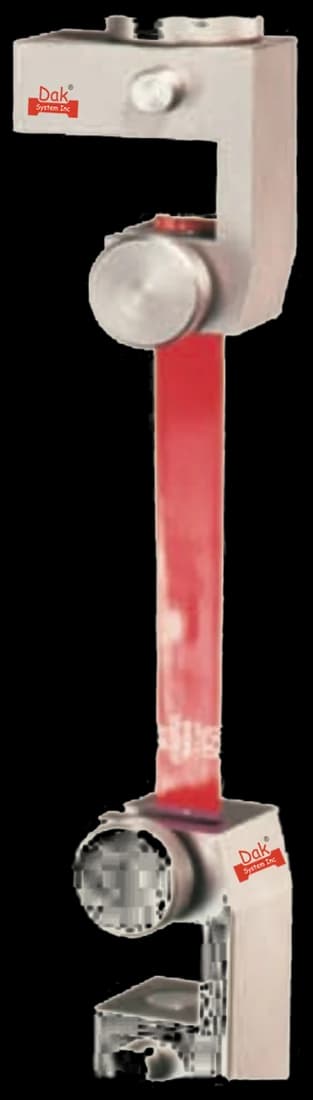
25 mm square vice action grip clamping a red film specimen
Rubber facedTJ-34

25mm Square Vice Action Grip

A vice action grip of this size covers the 25.4 mm across-specimen dimension the method calls for. Check the face against the standard before a certification run: D4632 asks for at least 25.4 × 50.8 mm, so the jaw must be rectangular rather than square, and the across-specimen dimension is part of the test definition rather than a matter of convenience.

Specifications
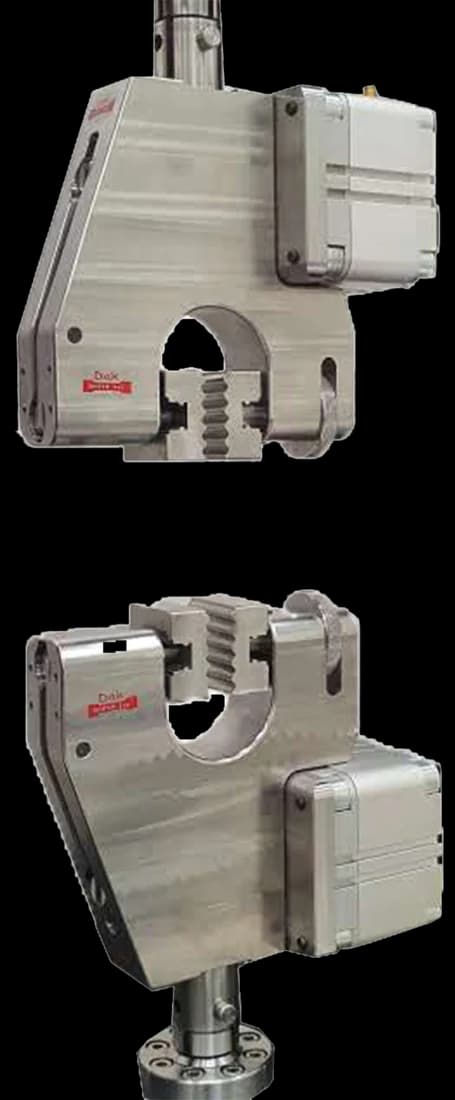
Pneumatic vice action grips with 25 mm square jaw faces
Standard 25 mm

Pneumatic Vice Action Grip

Pneumatic actuation gives the same across-specimen jaw dimension with a constant clamping force, which matters on a compressible nonwoven that a screw grip would keep bedding into.

Specifications

What the report has to contain

  • Reference to ASTM D4632 and the edition
  • Geotextile identification — polymer, construction and mass per unit area
  • Specimen width, jaw size and gauge length
  • Direction for each result set
  • Conditioning atmosphere and duration
  • Crosshead speed
  • Grab breaking load and elongation at maximum load for each specimen
  • Number rejected, and why
  • Mean, standard deviation and coefficient of variation
  • A statement that the result is an index property

What the machine must be capable of

Force measurement to ASTM E4 over a range from a few hundred newtons for light nonwovens to several kilonewtons for heavy woven geotextiles, and a crosshead holding 300 mm/min. That speed, combined with a 75 mm gauge, means tests are over in seconds, so the data acquisition rate must be high enough to catch the peak of a stepped trace rather than sampling past it. Grips must present a face of at least 25.4 × 50.8 mm — a rectangle rather than a square, and the across-specimen dimension is part of the method's definition rather than a convenience — and clamp evenly on a compressible nonwoven, which favours pneumatic actuation over screw tightening.

What goes wrong in practice

The most consequential error happens after the test, when a grab breaking load is divided by a width to produce an apparent strength per unit width and then used for design. There is no valid conversion, and the resulting figure overstates what the material can be relied on for. In the laboratory, poor jaw centring is the commonest source of scatter and is cured by marking the specimen. Slippage on slick nonwovens and jaw-edge failures both invalidate specimens. And a data acquisition rate too low for a 300 mm/min test can miss the true peak on a stepped woven trace.

Grab tensile or wide-width tensile

ASTM D4632 grabASTM D4595 / ISO 10319 wide-width
Specimen100 mm wide, jaw faces at least 25.4 × 50.8 mm200 mm wide, fully clamped
ResultBreaking load, in NStrength per unit width, in kN/m
Lateral contractionRestrained by surrounding fabricMinimal — the wide specimen restrains itself
UseIndex property, site acceptance, QCDesign value for reinforcement

Grab results cannot be converted to wide-width values. The grab test deliberately allows the surrounding fabric to assist, which is useful as a quick index but wrong as a design basis. Reinforcement design uses wide-width strength, without exception.

Questions we are asked about this test

What is ASTM D4632?

It is the ASTM grab tensile test for geotextiles. Jaw faces of at least 25.4 × 50.8 mm grip the centre of a 100 mm wide specimen over a 75 mm gauge length, and the specimen is pulled at 300 mm/min to failure. It reports grab breaking load in newtons and elongation at maximum load.

Why is the specimen wider than the jaws?

Deliberately, so that the fabric either side of the jaw can assist the clamped yarns through the fabric structure. This is meant to represent the way a geotextile is loaded in the ground, where the material around any loaded region helps carry load, rather than the idealised case of a strip loaded alone. It is also what makes the grab value higher than a strip or wide-width value on the same material.

Can I convert a grab load into a strength per unit width?

No, and it is one of the more common errors in geotextile specification. The grab test allows surrounding fabric to contribute an amount that depends on the fabric's construction and lateral stiffness, so there is no fixed relationship to divide out. Any strength per unit width derived from a grab result is arithmetic without meaning.

When should I use wide-width testing instead?

Whenever the number will be used for design. Reinforcement applications — retaining structures, basal reinforcement, steepened slopes — are designed on wide-width tensile strength from ASTM D4595 or ISO 10319, which uses a 200 mm specimen clamped across its full width and reports kN/m. Grab is an index property for acceptance and quality control, and it is used because it is quick, not because it is more representative.

Why is the speed fixed at 300 mm/min rather than a time to break?

Because the test is designed for throughput. Most textile methods set a time to break so that materials of very different extensibility are strained comparably, but D4632 is a site-acceptance and quality-control test where consistency and speed matter more than that refinement. A fixed rate makes every result directly comparable and lets a laboratory run large numbers of specimens quickly.

My force curve is saw-toothed. Is something wrong?

Not necessarily — on woven geotextiles it is characteristic of the grab geometry. Yarns at the jaw edge take the highest load and break first, load transfers outward to the next yarns, and the pattern repeats. The peak of that trace is still the grab breaking load. A smooth curve is more typical of nonwovens, where load is shared through a bonded structure rather than by discrete yarns.

Does jaw centring really matter?

Yes, and it drifts more than people expect across a set of ten specimens. An off-centre grab gives more assisting fabric on one side than the other, which loads the specimen asymmetrically and lowers the result. Marking the jaw position on each specimen before clamping takes seconds and removes a source of scatter that otherwise looks like material variability.

Running ASTM D4632 on the Series 7200 and Series 9000

Dak verifies against whichever standard the method names, and where a class applies our frames sit a class tighter than it asks.

The method asks forDak supplies
CapacityModerate — commonly 0.3 to 5 kN depending on geotextile mass and constructionLoad cells from 1 kg to 60 ton on the Series 7200, and 0.5 to 100 kN on the Series 9000
Force accuracyASTM E4Verified to ASTM E4, and to ISO 7500-1 Class 0.5
GrippingGrab jaws: 25 mm square clamping faces gripping the centre of a 100 mm wide specimenWedge, vice-action, pneumatic and hydraulic grips, built to the specimen
Environment21 ± 1 °C and 65 ± 2 % RH, the textile standard atmosphere3009 series chambers, −150 °C to +400 °C — temperature only

This page describes the method as practised. The governing text is the current edition from the issuing body. Tell us what you are testing and we will answer with the machine, the fixture and a quotation.