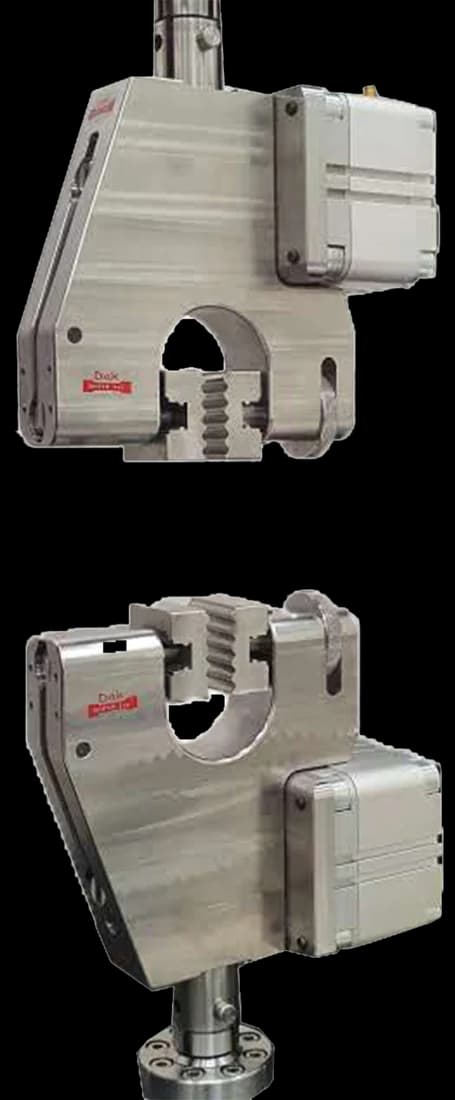
Standard 25 mm
Pneumatic Vice Action Grip
Pneumatic vice action grips clamp the full specimen width at a constant, even pressure — which is what stops one side slipping or tearing before the other.
Specifications
Testing standard
Standard Test Method for Tensile Properties of Geotextiles by the Wide-Width Method
Written and technically reviewed by Dak System Inc. engineeringLast reviewed
ASTM D4595/D4595M measures the tensile properties of geotextiles on a 200 mm wide specimen. Unlike the grab and strip index tests, it is written to supply design parameters for reinforcement applications — reinforced roadways, embankments over soft subgrade, retaining walls and slopes.
From the test method to your testing system
Explore the DAK machines already listed for ASTM D4595/D4595M, then review the grips, measurement and setup requirements below.
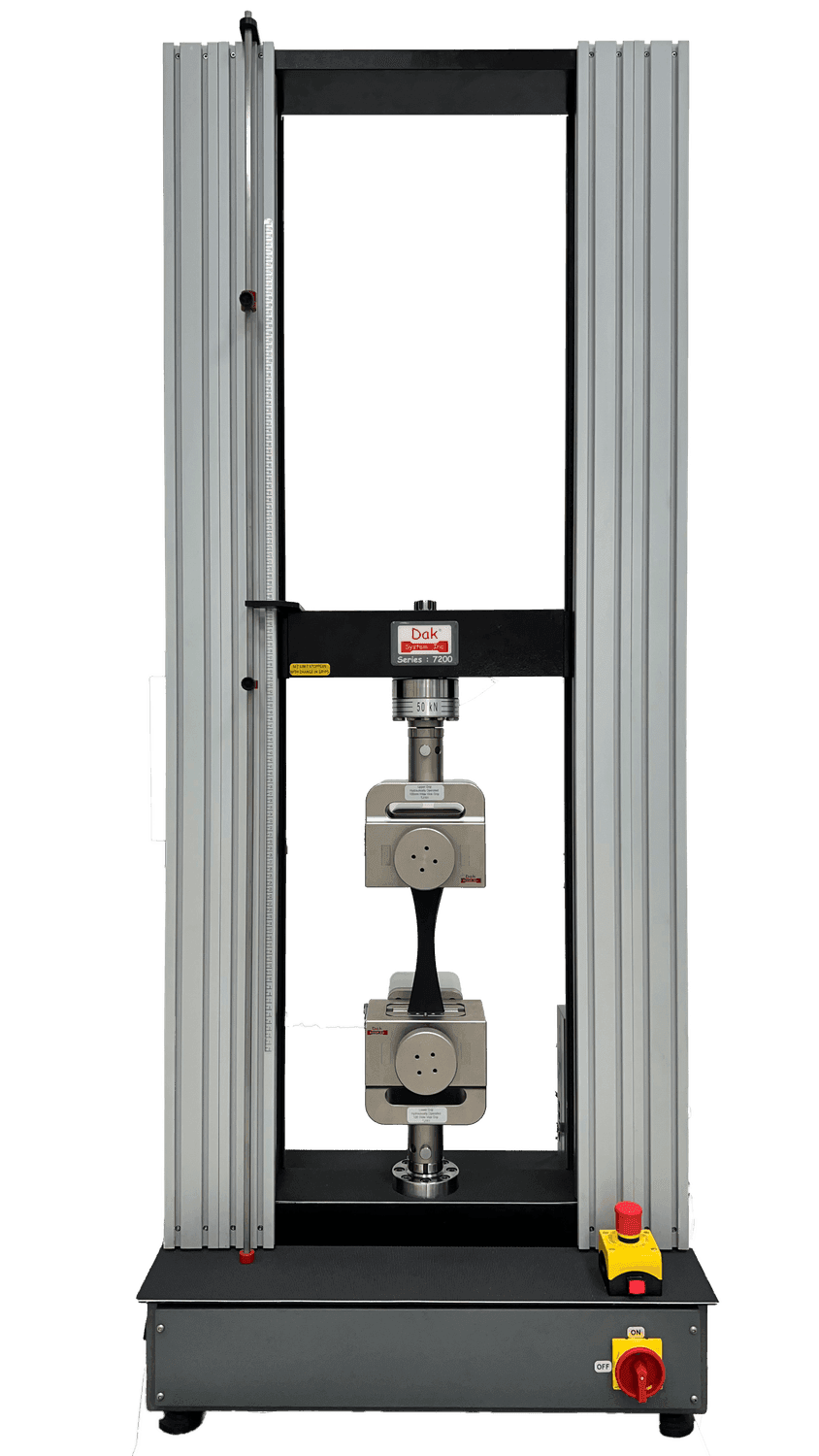 Universal Testing MachineSeries 7200Explore the machine →
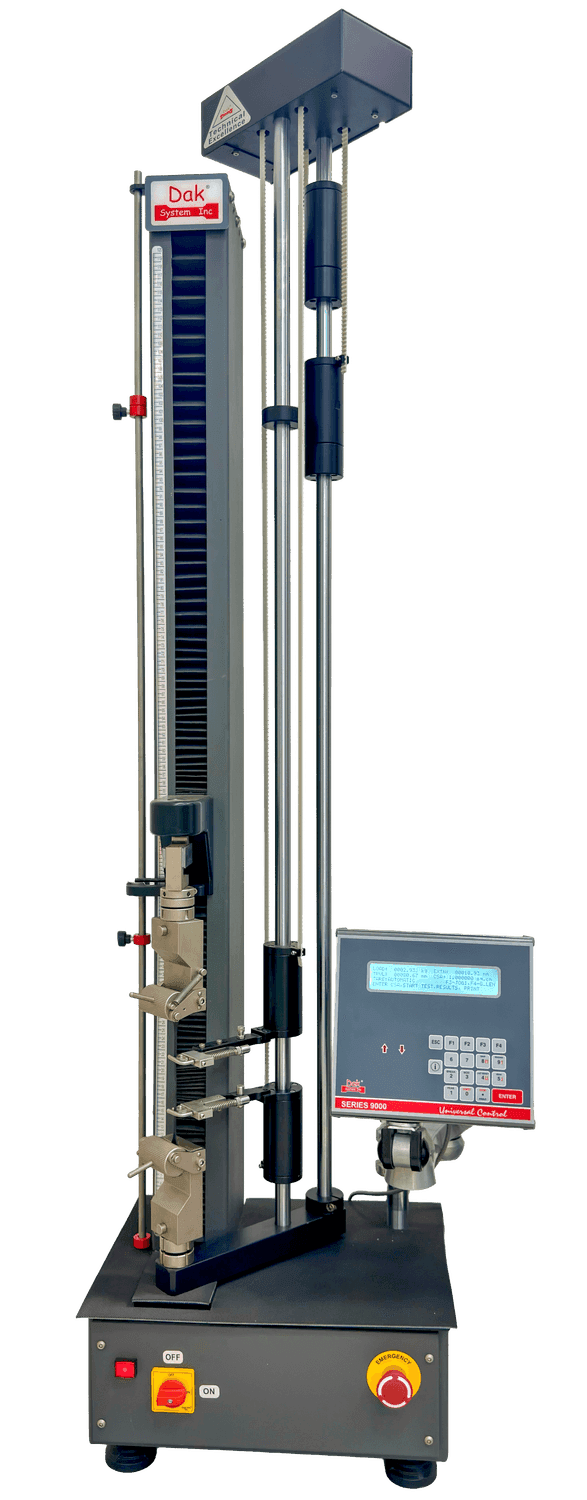 Universal Testing MachineSeries 9000Explore the machine →
01Understand the method
A geotextile specimen, recommended at 200 mm wide by at least 200 mm long, is conditioned, clamped across its full width and extended at a strain rate of 10 ± 3 %/min of the gauge length until it fails. With the clamps set at the 100 ± 3 mm (4 ± 0.1 in.) the method names, that is a crosshead speed of 10 mm/min (0.4 in./min), the tolerance band running from 7 to 13 mm/min. Where an extensometer obliges the clamps to sit further apart, the speed follows that larger separation at the same 10 %/min. A manually applied rate, which the method permits but does not prefer, is about 2 %/min. Force is recorded against elongation, with strain taken from the specimen wherever a modulus is to be reported. The outputs are force per unit width at maximum load, elongation at that load, and secant modulus at whatever elongation the specification names. Machine and cross-machine directions are tested and reported separately, in one unit system only.
The force-elongation behaviour that reinforcement design consumes directly. The method exists because designers of reinforced roadways and pavements, embankments over soft subgrade, retaining walls and reinforced slopes need a force per metre of width and a stiffness at working strain — quantities the quick grab index cannot supply. That is the practical division between this method and D4632: one is a quality check on a delivery, the other produces numbers that go into a calculation. A grab result cannot be converted into a wide-width one, and a specification asking for design values will not accept it.
02Prepare the specimen and test settings
Two hundred millimetres wide, and at least as long. The width is what stops the specimen contracting and reading low.
This method is written for design, not only for acceptance. That is what separates it from the grab test, and it is why the specimen is large and the strain measurement is taken seriously.
03Build the test setup on a DAK machine
Capacity set by the strongest product in the range, since reinforcement geotextiles are commonly specified above fifty kilonewtons per metre. Grips must hold the full 200 mm width at an even pressure, and for high-strength fabrics roller or capstan clamping is effectively required — a flat jaw clamped hard enough to hold the load crushes the yarns at the jaw line and moves the failure there. Where modulus is reported, an extensometer on the specimen is needed, because grip take-up is a large share of movement on a 100 mm gauge length. The crosshead itself is undemanding: 10 mm/min is slow, and the requirement is that the rate be held constant rather than that it be fast.
Pneumatic vice action grips clamp the full specimen width at a constant, even pressure — which is what stops one side slipping or tearing before the other.
SpecificationsDak verifies against whichever standard the method names, and where a class applies our frames sit a class tighter than it asks.
| The method asks for | Dak supplies | |
|---|---|---|
| Capacity | Moderate to high — reinforcement geotextiles are commonly specified above 50 kN/m | Load cells from 1 kg to 60 ton on the Series 7200, and 0.5 to 100 kN on the Series 9000 |
| Force accuracy | ASTM D76 requirements for textile testing machines | ISO 7500-1 Class 0.5, verified to ASTM E4, DIN 51221 and BS 1610 |
| Strain measurement | An extensometer of the class the method specifies | Certified to ISO 9513 Class 1 and ASTM E83 — non-contact video, clip-on and high-elongation |
| Gripping | Wide-width grips holding the full 200 mm specimen width; roller or capstan clamping for high-strength products | Our eccentric roller grips or split capstan grips, built to the specimen |
| Environment | 23 ± 2 °C standard laboratory atmosphere | 3009 series chambers, −150 °C to +400 °C — temperature only |
04Run the test
05Calculate, report and interpret
Tult = Fmax / B
Force per unit width, because geotextile thickness is compressible and gives no usable area.
ε = (ΔL / L₀) × 100
Crosshead-derived strain includes grip take-up, which is a large share of a short gauge length.
J = T / ε at a specified elongation
Always reported with the elongation it was taken at, since the curve is not linear.
Substituting a grab result where design values were asked for, which is not a shortcut but a different measurement. Mixing SI and inch-pound values within one report, which the dual designation exists specifically to warn against, since the two systems are used independently rather than converted. Quoting a secant modulus without the elongation it was evaluated at. Accepting jaw breaks. And skewed specimens, which fail early from one edge and produce scatter that looks like material variability. A subtler one is reporting a mean without saying how many specimens were rejected on the way to it: wide-width testing on strong fabrics can lose a substantial fraction of specimens to jaw breaks, and a mean drawn from the survivors of a difficult clamping arrangement is a different statistic from one drawn from a clean set. The rejection count belongs in the report for the same reason the grip type does.
06Compare methods and find answers
| ASTM D4595/D4595M | ASTM D4632 | |
|---|---|---|
| Specimen | 200 mm wide | Narrow, grabbed centrally |
| Purpose | Design parameters for reinforcement | Quality index and acceptance |
| Reported | Force per unit width | Grab breaking force |
| Substitutable | No | No |
These answer different questions and neither replaces the other. A grab result cannot be converted into a wide-width one, because the narrow specimen contracts and the wide one is prevented from doing so.
It is the ASTM wide-width tensile test for geotextiles, applicable to woven, nonwoven, layered and knit fabrics and to felts. A 200 mm wide specimen is pulled at a strain rate of 10 ± 3 %/min of the gauge length — 10 mm/min on the 100 mm clamp separation the method sets — and the force-elongation behaviour recorded, giving force per unit width, elongation at maximum force and secant modulus. The current designation is D4595/D4595M-24, and the title dropped the word Strip in a recent revision.
In purpose, not just in specimen size. D4632 grab strength is a quality index for acceptance — quick, cheap, and adequate for confirming a delivery matches what was ordered. D4595 is written to supply design parameters for reinforcement applications: reinforced roadways and pavements, embankments over soft subgrade, retaining walls and slope reinforcement. A grab result cannot be converted into a wide-width one, and specifications that call for design values will not accept it.
Because a narrow specimen contracts as it stretches. The edge yarns pull inwards, the specimen waists, and the recorded strength is well below what the fabric delivers in the ground, where it is continuous in every direction and cannot narrow. Two hundred millimetres of width, with a length that does not exceed it by much, suppresses that contraction so the measurement reflects the material rather than the specimen shape.
That the standard exists in two unit systems — SI and inch-pound — which are to be regarded separately and used independently. It is not a conversion. The two sets of values are not exact equivalents of each other, so a report must state which system was used and must not mix them. The dual designation is there specifically to prevent that mixing.
Because a geotextile's force-elongation curve is not a straight line, so the secant modulus depends on where along the curve it is taken. A modulus at 2 % elongation and one at 10 % are different numbers describing the same fabric. Specifications name the elongation, and a modulus reported without it cannot be checked against anything.
Because it reports the clamping rather than the fabric, and it always reads low. Wide-width specimens of high-strength reinforcement products are especially prone to it: a flat jaw clamped hard enough to hold fifty kilonewtons per metre crushes the yarns exactly where it grips. Roller or capstan clamping spreads the holding force along a curve instead of concentrating it at a line, which is why it is used on strong fabrics.
Yes, more than it looks. A specimen clamped a degree off square loads one edge before the other, so that edge reaches its limit first and failure propagates from it at a force below the fabric's real capacity. On a 200 mm width a small angular error puts a substantial length difference between the two edges, which is why squaring the specimen is a check rather than an assumption.
Discuss your specimen, test requirements and reporting needs with DAK engineering.
This page describes the method as practised. The governing text is the current edition from the issuing body. Tell us what you are testing and we will answer with the machine, the fixture and a quotation.