Testing standard

ASTM D2990

Standard Test Methods for Tensile, Compressive, and Flexural Creep and Creep-Rupture of Plastics

At a glance

Published by
ASTM
Edition
D2990-17(2025)

What the test does

A specimen is loaded to a fixed force and then left alone while its shape slowly changes. Three loading modes sit in the one document: a dumbbell bar gripped at both ends under a constant dead load, a short specimen squeezed between flat platens, and a bar on two supports carrying a weight at mid-span through a stirrup. The load comes on smoothly, within about five seconds, then holds — a thousand hours being the usual minimum. Deformation is read on a widening schedule: minutes, then hours, then hundreds of hours, then at least monthly.

What it measures, and why it matters

The primary output is a creep curve — strain, or mid-span deflection, against elapsed time at one stress and one temperature. From a family of such curves come creep modulus, isochronous stress-strain curves and, where the test runs to fracture, creep-rupture life.

A plastic under sustained load behaves nothing like the same plastic in a short tensile test. A snap-fit, a pressurised pipe wall, a bracket carrying its own equipment: each keeps deforming under a load it survived comfortably on day one. Creep modulus is what a designer substitutes for short-term modulus when the load is permanent, and it can be a small fraction of it. Creep-rupture data exposes stresses that look safe in a quick test and break the part after months; tension is the preferred mode where rupture life is the object.

Specimen

Geometry is borrowed rather than defined here: D638 dumbbells in tension, usually the Type I bar with its 50 mm gauge length or the Type IV at 25 mm; D695 specimens in compression; D790 bars in three-point bending, with four-point loading after D6272 as an option. One specimen yields one stress at one temperature, so design data needs a matrix of them — hence the multi-station rack.

Conditioning follows Practice D618, commonly forty hours at 23 °C and 50 % relative humidity or tested dry as moulded, and the state must be reported: moisture content shifts the creep behaviour of hygroscopic polymers substantially.

What the machine must be capable of

No capacity is prescribed. What the method demands is a load accurately known and genuinely constant for the whole run, which is why dead-weight and lever frames remain the standard tool: a hanging mass does not drift. Sizing follows the specimen. Flexural racks are commonly built for a few hundred newtons per station — of the order of 445 N on a 4:1 lever stand — and dead-load tensile stands for soft polymers work at tens of newtons, while a rigid Type I bar of roughly 40 mm² at 10 to 40 MPa needs about 0.4 to 1.6 kN. A 1 to 5 kN lever or servo frame covers most rigid grades.

There is no crosshead speed and no strain rate to control; time is the variable. Resolution near the origin governs data quality, since the creep strains of design interest are often below one or two per cent, while a rupture run on a ductile polyolefin may end at tens of per cent. No force accuracy class, strain-measurement precision or extensometer class is quoted here; those requirements are set out in the standard itself and should be read there before a frame is specified.

Environment is part of the test: 23 °C and 50 % relative humidity must hold for the entire run, which over a thousand hours means a room or chamber that survives weekends and power cuts. Elevated-temperature ranges quoted commercially, up to about 120 to 150 °C, are equipment capability rather than a method requirement.

What goes wrong in practice

Grip creep is the quiet one. A wedge or vice grip that holds a plastic tab well enough for a five-minute test beds into it over weeks, and the extra displacement reads as material creep unless strain is taken on the gauge section.

Conditioning drift is invisible in the data. A room that wanders off 50 % relative humidity changes the moisture content of a polyamide, and the curve stays smooth and plausible while being wrong.

In compression, a slender specimen or platens out of parallel give buckling rather than creep; the deflection accelerates and is easily mistaken for tertiary creep. The reading schedule can also hide the end — once observations are monthly, a specimen runs away and fractures between them, leaving rupture time known only to within the interval.

Related and equivalent standards

ISO 899 is the direct counterpart, split into ISO 899-1 for tensile creep and ISO 899-2 for flexural creep in three-point loading. Data is routinely read across the two, though specimen geometry and conditioning practice differ enough that results should not be pooled without checking.

Within ASTM the method is easily confused with the short-term tests it borrows its specimens from. D638, D695 and D790 measure response over minutes at a controlled rate; this one measures what happens over months at a fixed load. Same bar, different question.

Running ASTM D2990 on the Series 7200 and Series 9000

Dak verifies against whichever standard the method names, and where a class applies our frames sit a class tighter than it asks.

The method asks forDak supplies
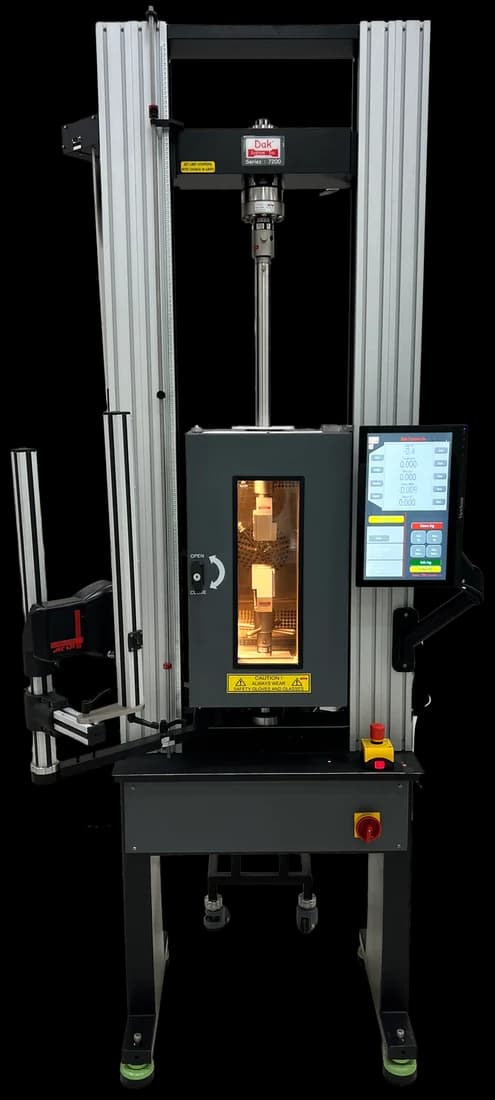
CapacityThe method fixes no capacity, only a constant and accurately known load. Dead-load flexural creep racks are built for a few hundred newtons per station — about 445 N on a 4:1 lever stand — and dead-load tensile stands for soft polymers and rubbers work at tens of newtons, while a rigid D638 Type I bar of roughly 40 mm² section at creep stresses of 10–40 MPa needs about 0.4–1.6 kN. A 1–5 kN lever or servo creep frame therefore covers most rigid grades.Load cells from 1 kg to 60 ton on the Series 7200, and 0.5 to 100 kN on the Series 9000
Force accuracyunknownISO 7500-1 Class 0.5, verified to ASTM E4, DIN 51221 and BS 1610
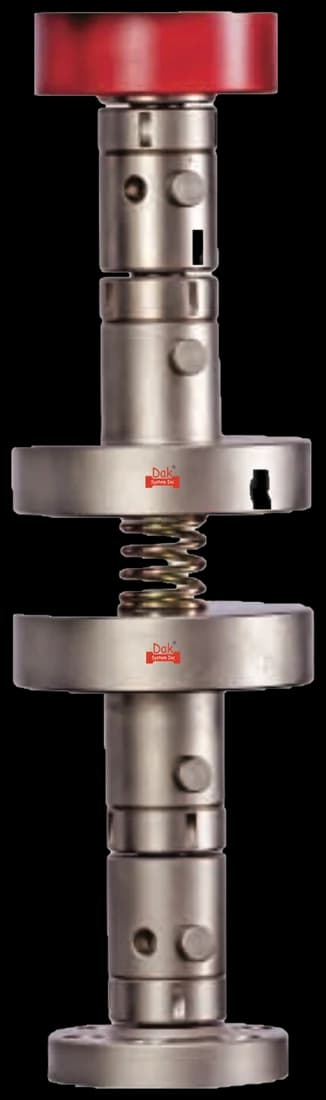
GrippingDead-weight or lever creep frame: tensile grips, compression platens, or a multi-station three-point flexural rack with mid-span stirrupOur self-tightening serrated wedge grips, with V-jaws for round specimens or compression anvils, built to the specimen
EnvironmentStandard laboratory atmosphere of 23 °C and 50 % RH after D618 conditioning, held for the whole run; elevated-temperature chambers (commercially to about 120–150 °C) and controlled humidity are used where the test plan calls for them3009 series chambers, −150 °C to +400 °C — temperature only

This page describes the method as practised. The governing text is the current edition from the issuing body. Tell us what you are testing and we will answer with the machine, the fixture and a quotation.