Self-identifying
Load Cells
A load cell able to hold a constant force for weeks or months without drifting, which is a different requirement from resolving one accurately for a few minutes.
Specifications
Testing standard
Plastics — Determination of creep behaviour — Part 1: Tensile creep
Written and technically reviewed by Dak System Inc. engineeringLast reviewed
ISO 899-1 determines the tensile creep of plastics under specified conditions of pre-treatment, temperature and humidity. Unlike most plastics methods it is intended to provide data for engineering design as well as research, which is why its conditioning requirements are so strict.
From the test method to your testing system
Explore the DAK machines already listed for ISO 899-1, then review the grips, measurement and setup requirements below.
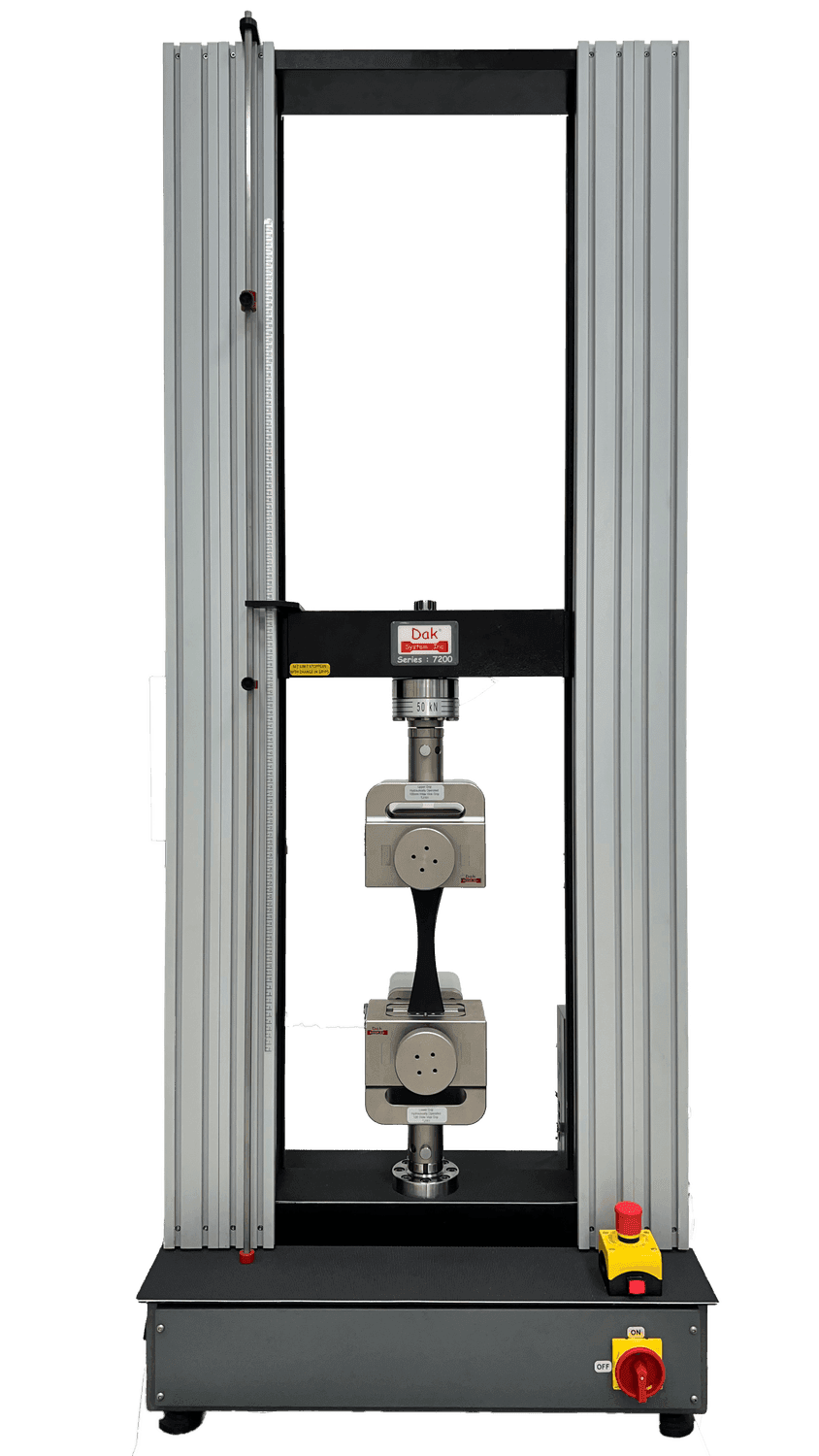 Universal Testing MachineSeries 7200Explore the machine →
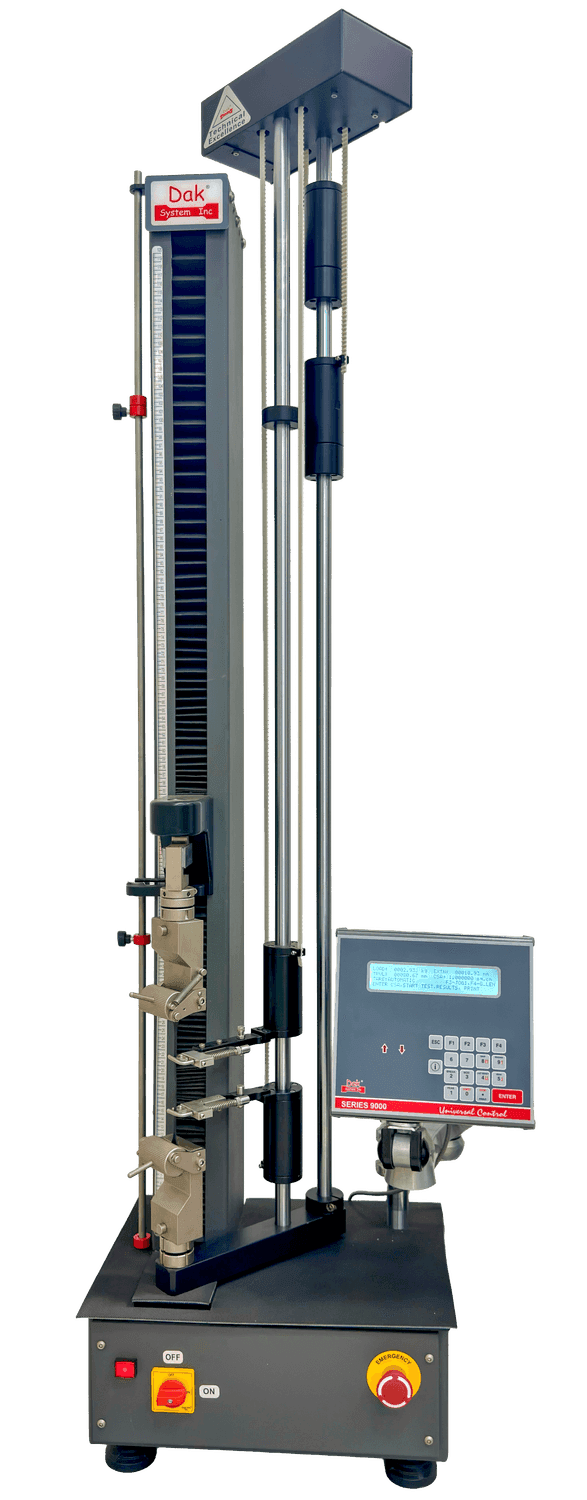 Universal Testing MachineSeries 9000Explore the machine →
01Understand the method
Dumb-bell specimens, moulded directly or machined from sheet or articles, are pre-treated and conditioned to a specified temperature and humidity, and their thermal history recorded. The method sets no rate of traverse; it fixes how fast the load arrives and how steadily it stays. Full load is reached between 1 s and 5 s after loading begins, at the same rate for every test in a series, and is then held to within ± 1 % for the duration. Worked through for an ordinary case — a 20 MPa test stress on the 10 mm × 4 mm gauge section of an ISO 527-2 type 1A dumb-bell is 800 N — that ramp is an average 160 N/s to 800 N/s. Strain is measured on the specimen and logged with temperature and humidity throughout — weeks or months, not minutes — on the preferred schedule of 1, 3, 6, 12 and 30 min followed by 1, 2, 5, 10, 20, 50, 100, 200, 500 and 1 000 h; elapsed time itself is measured to ± 0,1 % or ± 2 s, whichever is the less severe. Creep strain is reported at specified times, and creep modulus against the time at which it was evaluated.
How much a plastic keeps deforming under a load it has already survived. This is where polymers differ most consequentially from metals: a plastic creeps appreciably at room temperature under quite ordinary stresses, so a part that passes every short-duration test can still fail in service by slowly changing shape — the clip that loosens, the shelf that sags, the housing that stops sealing. Unusually among plastics methods, this one states that it is intended to provide data for engineering design as well as research, which is why its conditioning requirements are as strict as they are.
02Prepare the specimen and test settings
Everything that is negligible over a five-minute tensile test — grip relaxation, temperature drift, gauge slip — becomes the measurement over a month.
Creep is where a plastic's difference from a metal is most consequential. A polymer under constant load keeps deforming at room temperature, so a part that passed a tensile test can still fail in service by slowly changing shape.
03Build the test setup on a DAK machine
Holding still, accurately, for a very long time. The load must stay constant for weeks or months and the extensometer must remain attached and stable for the same period — which is a quite different requirement from resolving force or strain well for five minutes. A cell that drifts over a month and a gauge that slips imperceptibly both write their own behaviour into what is recorded as material creep, and nothing in the data separates them afterwards. The conditioned atmosphere has to hold for the duration too.
A load cell able to hold a constant force for weeks or months without drifting, which is a different requirement from resolving one accurately for a few minutes.
Specifications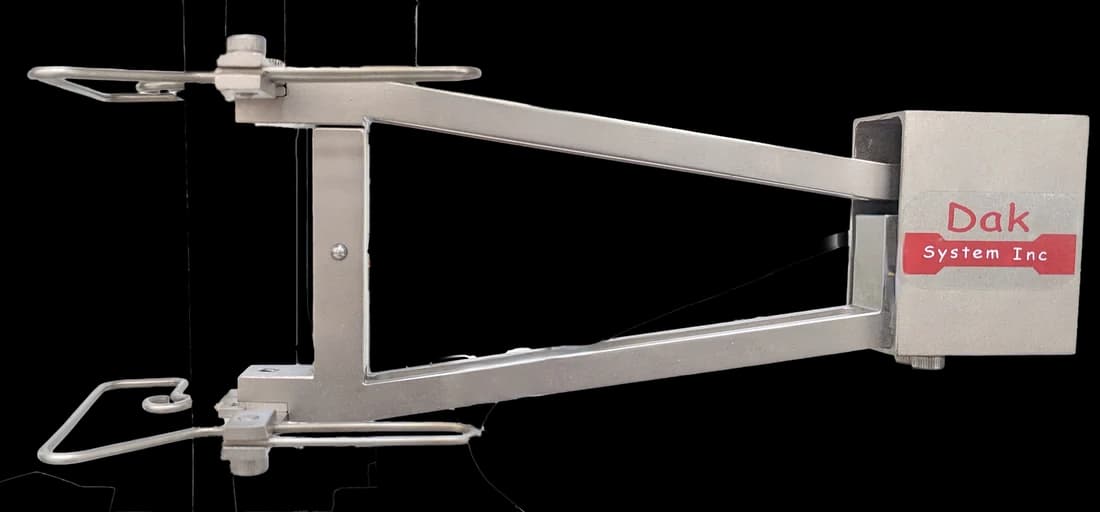
Extensometry that can stay attached for the whole duration; a gauge that creeps itself, or slips over a month, writes its own behaviour into the result.
SpecificationsDak verifies against whichever standard the method names, and where a class applies our frames sit a class tighter than it asks.
| The method asks for | Dak supplies | |
|---|---|---|
| Capacity | Low and, crucially, constant — held for weeks or months rather than minutes | Load cells from 1 kg to 60 ton on the Series 7200, and 0.5 to 100 kN on the Series 9000 |
| Force accuracy | ISO 7500-1 Class 1, with stability over the whole duration as the real requirement | ISO 7500-1 Class 0.5 — a class tighter than the method asks |
| Strain measurement | An extensometer of the class the method specifies | Certified to ISO 9513 Class 1 and ASTM E83 — non-contact video, clip-on and high-elongation |
| Gripping | Dead-weight or servo-held loading with grips that will not relax, in a controlled atmosphere | Wedge, vice-action, pneumatic and hydraulic grips, built to the specimen |
| Environment | 23 ± 2 °C standard laboratory atmosphere | 3009 series chambers, −150 °C to +400 °C — temperature only |
04Run the test
05Calculate, report and interpret
ε(t) = ΔL(t) / L₀
Measured on the specimen throughout the test, not inferred from crosshead position.
Ec(t) = σ / ε(t)
A modulus that falls with time. Quoting one without the time it belongs to is meaningless, which is the single commonest misuse of creep data.
Stress is held; strain is observed
The inverse of a tensile test, where strain rate is held and stress is observed. Reading creep data as though it were tensile data is a category error.
Quoting a creep modulus without the time it belongs to, which is the commonest misuse of creep data and always flatters the material, since the modulus falls continuously. Omitting the thermal history. Logging conditions only at the start, so an overnight drift of a couple of degrees goes unrecorded. Reading a creep curve as though it were a tensile curve, when the variables are swapped. And using flexural creep data where tensile design values were needed — flexural rigs are cheaper and more numerous, which is why so much published data is flexural and why a designer working in tension is so often handed the wrong curve.
06Compare methods and find answers
| Part 1 — tensile creep | Part 2 — flexural creep | |
|---|---|---|
| Loading | Constant tensile load | Constant flexural load |
| Specimen | Dumb-bell | Bar in bending |
| Practicality | Needs a dead-weight or servo frame per specimen | Simple rigs, many specimens at once |
| Data | Directly usable for tensile design | Convenient, but bending mixes tension and compression |
Flexural creep rigs are cheaper and easier to run in numbers, which is why much published creep data is flexural. Tensile creep is harder to obtain and is the cleaner input for a design in tension.
It is the ISO method for the tensile creep of plastics — the slow deformation of a polymer held under a constant load. Specimens are dumb-bells, moulded directly or machined from sheet or articles, and it suits rigid and semi-rigid materials whether unfilled, filled or fibre-reinforced. The current edition is ISO 899-1:2017, the third.
The variables are swapped. A tensile test holds a strain rate and observes the stress; a creep test holds the stress and observes the strain as time passes. That makes time the independent variable, and it is why the outputs are a strain-versus-time curve and a modulus that falls as the test runs. Reading creep data as though it were tensile data is a category error rather than an approximation.
Because a polymer creeps appreciably at room temperature under quite ordinary loads, while a metal generally does not until it is hot. A plastic bracket that passed its tensile test can still fail in service by slowly changing shape under a load it comfortably survives — the clip that loosens, the shelf that sags, the housing that no longer seals. That failure mode is invisible to every short-duration test.
Because it falls continuously as the test runs. A creep modulus is the constant applied stress divided by the strain reached at a particular moment, so a hundred-hour value and a thousand-hour value for the same material are different numbers and both are correct. Quoting one without its time is the commonest misuse of creep data, and it always flatters the material.
The standard states that it can have profound effects on creep behaviour. Moulding conditions and any subsequent annealing set the polymer's internal stress state and crystallinity, and creep is exquisitely sensitive to both. Two specimens of nominally the same grade, moulded differently, will creep differently — so how the specimen was produced belongs in the report as firmly as the material name does.
Duration. The load has to stay constant for weeks or months, and the extensometer has to stay attached and stable for the same period. A load cell that resolves force beautifully for five minutes may drift over a month; a gauge that grips well initially may slip imperceptibly. Both write their own behaviour into what is recorded as material creep, and nothing in the data separates them afterwards.
Because creep data is what a plastic part is actually designed against, and there is no shortcut to it. Most plastics test methods disclaim design use and offer comparison instead; this one states that it is intended to provide data for engineering design as well as research. That is also why its conditioning and reporting requirements are stricter than a comparative method would need.
Discuss your specimen, test requirements and reporting needs with DAK engineering.
This page describes the method as practised. The governing text is the current edition from the issuing body. Tell us what you are testing and we will answer with the machine, the fixture and a quotation.