
Testing standard
ASTM D6204 Unvulcanised Rubber Rheology Testing
Standard Test Method for Rubber—Measurement of Unvulcanized Rheological Properties Using Rotorless Shear Rheometers
Written and technically reviewed by Dak System Inc. engineeringLast reviewed
ASTM D6204 measures the processability of uncured rubber in a rotorless shear rheometer. A few grams of compound is sealed between heated dies and taken through three parts — a small-strain frequency sweep, a large-strain sweep and a temperature ramp — so one loaded cavity yields flow, filler dispersion and scorch information in sequence.
At a glance
- Test type
- Cure & rheology — how a rubber compound cures is tracked as it happens
- Published by
- ASTM
- Edition
- D6204-26
- Material
- Rubber, elastomers & foams
- Runs on
- RPA
From the test method to your testing system
Explore DAK equipment for ASTM D6204, then review the specimen and setup requirements below.
 Rubber Process AnalyserRPAExplore the machine →
Jump to a specific section
01Understand the method
What the test does
A few grams of uncured rubber compound is sealed between two heated biconical dies rather than gripped. One die oscillates through a programmable rotary arc and the reaction torque transmitted through the compound is recorded. The method runs in three parts: a small-strain frequency sweep, a large-strain sweep, and a temperature ramp — so one loaded cavity yields flow, filler and scorch information in sequence.
What it measures, and why it matters
The method reports complex shear modulus (G\*) and its elastic and viscous components (G′ and G″), tan delta, and shear viscosity, each against frequency, strain amplitude or temperature. The small-strain sweep predicts how a compound will mix, extrude and calender. The large-strain results expose the Payne effect, so a mixing room reads filler dispersion from the fall in G′ rather than from a cut sample. The temperature ramp shows how much processing heat the stock tolerates before scorch. Together they carry raw-material acceptance and batch-to-batch release.
02Prepare the specimen and test settings
The specimen
- Blank
- A few grams of uncured compoundSealed between biconical dies; the cavity forms the geometry.
- One cavity, three parts
- Frequency, strain and temperatureRun in sequence on the same loaded specimen, which is what makes the method efficient for raw-material acceptance.
- Rest period since mixing
- Fixed and observedDakThe compound is reactive; a varying wait shows up in the scorch portion.
The three sweeps
- Small-strain frequency sweep
- Predicts mixing, extrusion and calendering
- Large-strain sweep
- Exposes the Payne effectThe fall in G′ with strain amplitude is a filler-dispersion reading — a mixing room gets it from the curve rather than from cutting a sample.
- Temperature ramp
- Shows the processing heat the stock tolerates before scorch
- Arc
- ProgrammableWhich is what separates this instrument from a cure meter — the arc is a variable rather than a fixed setting.
- Report every setting
- Frequency, strain and temperatureAll three move the moduli, so a result without them describes nothing.
03Build the test setup on a DAK instrument
What the machine must be capable of
This is a rotorless shear rheometer of the RPA class, not a load frame, so no force capacity or force-accuracy class applies. The demand is torque resolution at the bottom of the scale: uncured stock at ±7 % strain sits near the floor, usually well under a few dNm, and only climbs meaningfully when the large-strain part drives ±100 % or ±200 %, or when the ramp carries the compound into scorch. Instrument spans quoted for the method run from about 0.001 to 250 dNm.
Strain amplitude must be programmable across that whole span — ±7 % (±0.5 degree arc) to hold the linear viscoelastic region, then ±100 % and ±200 % deliberately outside it — which is why a fixed-arc cure meter cannot run this method. Frequency coverage of roughly 0.001 Hz to 33 Hz supports a sweep taken at one point per logarithmic decade, commonly expanded to three per decade, and a two-point sweep at 0.1 Hz and 1 Hz.
The cavity is sealed under positive pressure with grooved die faces. Temperature control must hold 100 °C isothermally, then execute a linear ramp to 180–190 °C in roughly 2 to 8 minutes. Humidity is not controlled.
The instrument this method needs
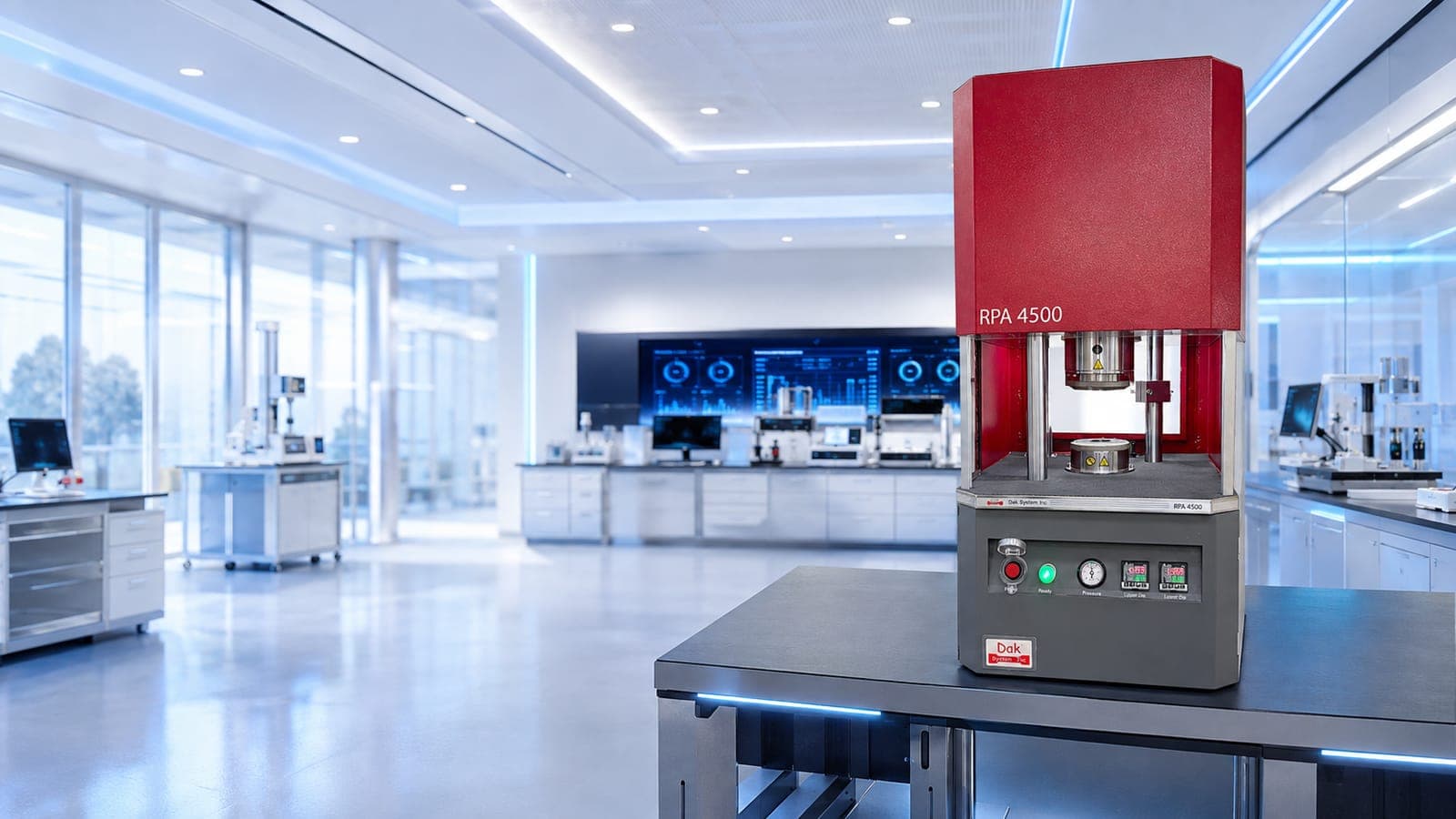
Running ASTM D6204 on the RPA
Both instruments run a sealed, pressurised cavity that prevents compound extrusion and holds the test volume exactly, so the torque trace reflects the material.
| The method asks for | Dak supplies | |
|---|---|---|
| Torque & frequency | Torque only, and low — uncured stock at ±7 % strain sits near the bottom of the scale, usually well under a few dNm, and only climbs meaningfully when Part B drives ±100 % or ±200 % strain or when Part C's ramp carries the compound into scorch; instrument spans quoted for the method run from about 0.001 to 250 dNm. | Torque up to 20 N·m; the RPA Ultimo measures from 0.0001 N·m. MDR: ±0.5° arc as standard, at a fixed 1.667 Hz. RPA Ultimo: 0.0016–50 Hz, 0.05–90° arc. |
| Test cavity | Sealed biconical die cavity of a rotorless shear rheometer (RPA class), programmable amplitude | MDR: sealed biconical rotorless dies, closed pneumatically. RPA: a sealed, pressurised cavity |
| Temperature | Isothermal 100 °C for Parts A and B; programmed thermal ramp to 180-190 °C for Part C | Room temperature to 230 °C; on the MDR, upper and lower dies are controlled separately |
04Run the test
How the test runs
- Bring the dies to the starting temperature.
- Cut a blank of a few grams from milled sheet.
- Observe the laboratory's fixed rest period since mixing.
- Load and close the dies, sealing the cavity.
- Run the small-strain frequency sweep and record G′, G″ and η* against frequency.
- Run the large-strain sweep at fixed frequency and record the fall in G′ with amplitude.
- Run the temperature ramp and watch for the torque rise that marks scorch.
- Report each result against the frequency, strain and temperature it was measured at.
See the instrument
05Calculate, report and interpret
What comes out
G* = √(G′² + G″²)
- G′
- storage modulus — the elastic component
- G″
- loss modulus — the viscous component
tan δ = G″ / G′
The balance between viscous and elastic response. It rises as a compound flows more readily and falls as it develops structure.
η* = G* / ω
- ω
- angular frequency, rad/s
What the report has to contain
- Reference to ASTM D6204
- Compound identification, batch and time since mixing
- Die temperature for each part of the run
- Frequency and strain ranges swept
- G′, G″, G* and tan δ against the swept variable
- Shear viscosity where reported
- The Payne-effect fall in G′ across the large-strain sweep
- Onset of scorch from the temperature ramp
- Number of specimens
What goes wrong in practice
Die slippage is the characteristic fault: at ±100 % and ±200 % the compound can slide against the die faces instead of shearing, which depresses G′ and overstates the Payne effect. Premature scorch during the 100 °C parts stiffens the stock mid-sweep, so late frequency points read high and the sweep is no longer comparable. An underfilled cavity gives low, drifting torque. Strain-history carryover is the subtlest — a broken filler network does not fully recover, so a small-strain measurement run after a large-strain one reads low unless test order and rest time are fixed.
06Compare methods and find answers
Processability against cure
| ASTM D6204 | ASTM D5289 | ASTM D6601 | |
|---|---|---|---|
| Measures | How the UNCURED stock behaves | How the compound cures | Cured dynamic properties after cure |
| Arc | Programmable, swept | Small and fixed | Swept after cure |
| Answers | Will it process? | How long in the press? | How will the part behave dynamically? |
| Run on | The same instrument family | The same instrument family | The same instrument family |
Three questions, one machine class. A compound can cure perfectly to D5289 and still be unusable on the extruder, which is what D6204 exists to catch before the material reaches production rather than after.
Questions we are asked about this test
What is ASTM D6204?
It is the ASTM method for measuring the processability of unvulcanised rubber using a rotorless shear rheometer. A small blank is sealed between heated dies and taken through a small-strain frequency sweep, a large-strain sweep and a temperature ramp, giving complex shear modulus, tan delta and viscosity against each swept variable.
What is the Payne effect and why does it matter?
It is the fall in storage modulus as strain amplitude increases, caused by the filler network breaking down. The size of that fall is a direct reading of how well the filler is dispersed — so a mixing room can judge dispersion from the curve rather than by cutting and examining a sample, which is faster and considerably more objective.
How is this different from a cure meter test?
The question. A cure meter asks how the compound vulcanises — scorch, cure time, crosslink density. This asks how the uncured stock will behave in the mixer, the extruder and the calender before it ever reaches the press. A compound can cure perfectly and still be unusable on the line, and only one of the two tests will tell you.
Why must frequency, strain and temperature all be reported?
Because every one of them moves the moduli. G′ measured at one frequency and strain is not comparable with G′ at another, so a value quoted alone describes nothing. This is the same discipline as reporting the arc on a cure meter, applied to an instrument where all three are deliberately variable.
Can D6204 predict how a compound will behave in a mixer or extruder?
It indicates rather than predicts. The rheometer applies a controlled oscillatory shear at known frequency, strain and temperature, while a mixer or extruder applies a complicated and largely unknown deformation history. What D6204 does reliably is rank compounds and detect change: a batch whose viscous response has shifted will process differently, and this test sees that before the factory does.
Why does strain amplitude have to be held so carefully?
Because filled rubber is strongly strain-dependent — the Payne effect means modulus falls as strain amplitude rises, sometimes by a large factor. A measurement taken at a different amplitude is a different measurement, not a noisier one. This is why frequency, strain and temperature are all reported with every result and why comparing figures taken at different settings is meaningless.
Does D6204 tell me anything about cure?
Not directly, and that is the point of the method. D6204 is run on uncured compound at temperatures and times chosen to avoid curing it, so that processability is characterised before the crosslinking reaction interferes. Cure behaviour is what ASTM D5289 measures. The two are commonly run on the same instrument and on the same compound, and they answer different questions.
Related
Materials tested to it
Industries that test to it
Other standards explained
Planning ASTM D6204 testing?
Discuss your specimen, test requirements and reporting needs with DAK engineering.
This page describes the method as practised. The governing text is the current edition from the issuing body. Tell us what you are testing and we will answer with the machine, the fixture and a quotation.