
Testing standard
ASTM D6601 Rubber Cure and After-Cure Dynamic Property Testing
Standard Test Method for Rubber Properties—Measurement of Cure and After-Cure Dynamic Properties Using a Rotorless Shear Rheometer
Written and technically reviewed by Dak System Inc. engineeringLast reviewed
ASTM D6601 cures a rubber compound in place and then measures the dynamic properties of the cured material without ever opening the cavity. The dies oscillate while the compound vulcanises, then the specimen is cooled in situ and the oscillation amplitude swept upwards, giving stiffness and damping across strain on a specimen that has never been handled.
At a glance
- Test type
- Cure & rheology — how a rubber compound cures is tracked as it happens
- Published by
- ASTM
- Edition
- D6601-19
- Material
- Rubber, elastomers & foams
- Runs on
- RPA
From the test method to your testing system
Explore DAK equipment for ASTM D6601, then review the specimen and setup requirements below.
 Rubber Process AnalyserRPAExplore the machine →
Jump to a specific section
01Understand the method
What the test does
A blank of uncured compound is sealed inside a heated biconical die cavity rather than gripped. One die oscillates through a small rotary arc while the compound vulcanises in place, and the reaction torque is recorded. The dies are then cooled, with the specimen still enclosed, and the oscillation amplitude is swept upwards. Stiffness and damping are recorded across that sweep.
What it measures, and why it matters
The cure stage yields the familiar torque-versus-time curve; the after-cure stage yields storage and loss moduli as a function of strain amplitude, at a service-like temperature. The fall in storage modulus with rising strain is the Payne effect, which reads out filler dispersion and filler-network structure directly, so it is used to compare carbon black grades, silica loadings and mixing schedules. The softening between successive sweeps is a modified Mullins effect. Compounders use both to rank mixes for damping in tyres, mounts and bushings without moulding parts.
02Prepare the specimen and test settings
One specimen, two states
The distinctive idea is that the cure and the dynamic characterisation happen to the same piece of rubber, in the same cavity, without it being removed.
- Blank
- Uncured compound, sealed in the die cavity
- Cure
- In place, oscillatingThe cure curve is obtained on the way, as in a cure meter.
- Cool
- With the specimen still enclosedNo demoulding, no handling, no relaxation on a bench — the state the dynamic sweep measures is the state cure left behind.
- Then sweep
- Oscillation amplitude increased
- The advantage
- No specimen preparation between the twoDakCutting a cured specimen for a separate dynamic test introduces edges, handling and a delay — all of which move the answer.
Cure then sweep
- Cure phase
- Small fixed arc at cure temperature
- Cooling
- In the closed cavity
- Sweep phase
- Amplitude increased across a range
- Report both phases
- Cure conditions and sweep conditionsThe dynamic result belongs to the cure state that produced it.
03Build the test setup on a DAK instrument
What the machine must be capable of
The instrument is a rotorless shear rheometer of the sealed-die class, not a universal testing machine. Torque is the only measured force, and it climbs twice: once as the compound crosslinks at the cure temperature, then again on cooling, because the same vulcanizate is markedly stiffer at 60 to 100 °C than at 140 to 180 °C. After-cure readings therefore sit well above the maximum torque the cure stage recorded, inside an instrument span of roughly 0.001 to 250 dNm. No extensometer is involved; strain is the die arc itself, and the drive must deliver programmable amplitude from the low, cure-safe setting used during vulcanization through to amplitudes well inside the non-linear region, at a fixed frequency held constant across the sweep. The defining requirement is thermal: in-situ cure at 140, 160 or 180 °C followed by forced cooling of the dies to 100 °C or 60 °C, with the cavity sealed and pressurised throughout. Without forced cooling the cavity equilibrates too slowly and the vulcanizate ages further before the sweep begins. Grooved, sealed dies are load-bearing, since the cooled specimen must stay coupled to both faces.
The instrument this method needs
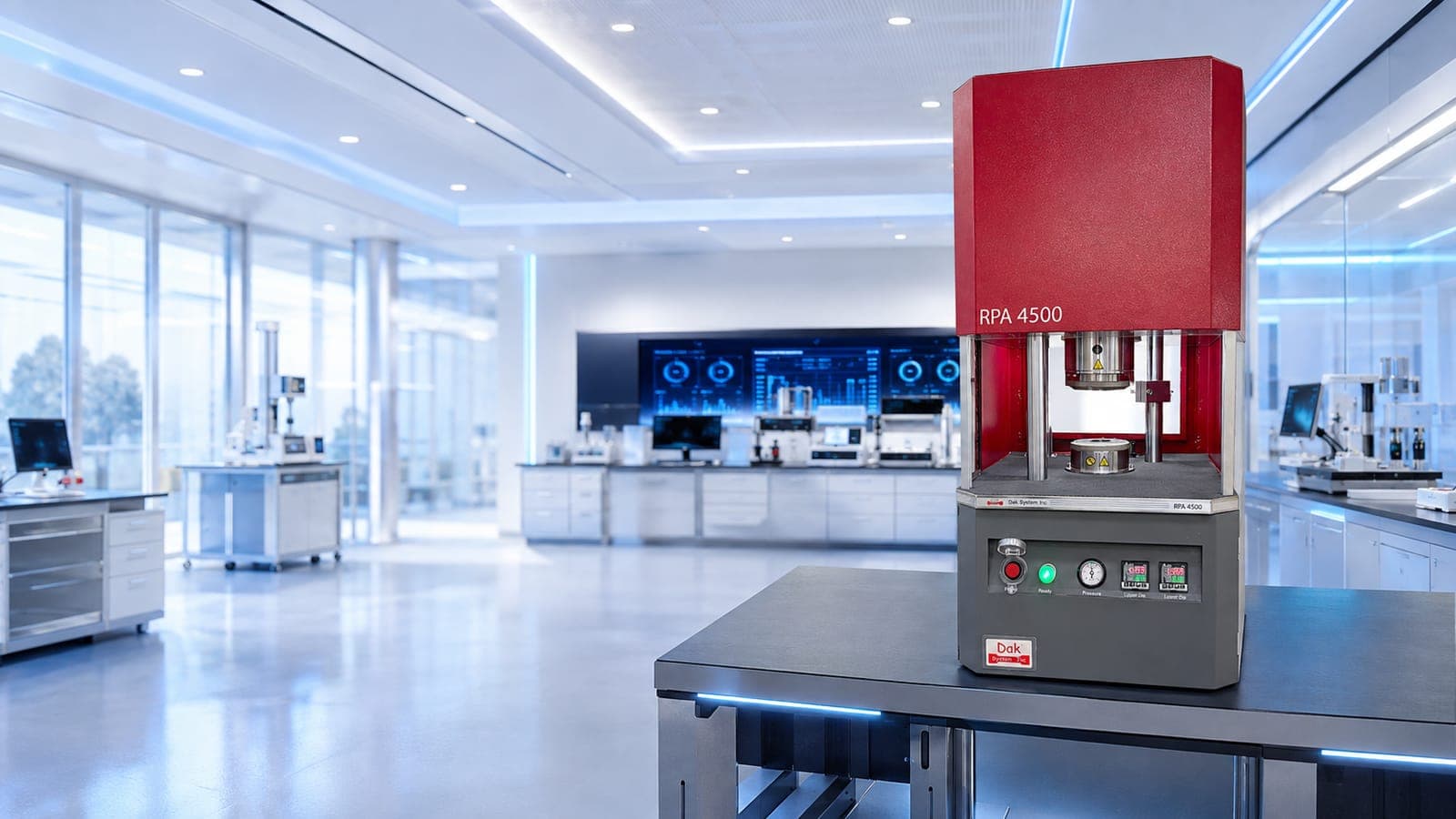
Running ASTM D6601 on the RPA
Both instruments run a sealed, pressurised cavity that prevents compound extrusion and holds the test volume exactly, so the torque trace reflects the material.
| The method asks for | Dak supplies | |
|---|---|---|
| Torque & frequency | Torque only, and it climbs twice: once as the compound crosslinks at the cure temperature, then again on cooling, because the same vulcanizate is markedly stiffer at 60-100 °C than at 140-180 °C — after-cure readings therefore sit well above the MH the cure stage recorded, inside an instrument span quoted from about 0.001 to 250 dNm. | Torque up to 20 N·m; the RPA Ultimo measures from 0.0001 N·m. MDR: ±0.5° arc as standard, at a fixed 1.667 Hz. RPA Ultimo: 0.0016–50 Hz, 0.05–90° arc. |
| Test cavity | Sealed biconical die cavity with forced die cooling, rotorless shear rheometer (RPA class) | MDR: sealed biconical rotorless dies, closed pneumatically. RPA: a sealed, pressurised cavity |
| Temperature | In-situ cure at 140, 160 or 180 °C, then forced cooling in the same cavity to 100 °C or 60 °C for the strain sweeps | Room temperature to 230 °C; on the MDR, upper and lower dies are controlled separately |
04Run the test
How the test runs
- Load a blank of uncured compound and close the dies.
- Oscillate at a small fixed arc while the compound vulcanises, recording the cure curve.
- Confirm the cure has reached the intended state from that curve.
- Cool the dies with the specimen still sealed inside.
- Sweep the oscillation amplitude upwards, recording stiffness and damping.
- Report the dynamic results together with the cure conditions that produced them.
See the instrument
05Calculate, report and interpret
What comes out
Recorded against strain amplitude after cure
Stiffness and damping of the cured compound, as a function of how hard it is worked.
tan δ = G″ / G′
The damping figure that predicts heat build-up in a part that flexes in service — a tyre sidewall, an engine mount, a conveyor cover.
What the report has to contain
- Reference to ASTM D6601
- Compound identification and batch
- Cure temperature, arc and duration
- The cure curve obtained during the cure phase
- Cooling schedule
- Sweep temperature, frequency and amplitude range
- G′, G″ and tan δ against amplitude
- Number of specimens
What goes wrong in practice
Thermal contraction on cooling is the characteristic failure: silicone and fluoroelastomer compounds shrink hard or bond poorly to the dies, then slip during the sweeps, so measured torque understates true stiffness. Die slippage from a worn or fouled cavity does the same to any compound. Strain history carries over — a first sweep softens the vulcanizate, so a repeat sweep is a different material. Cure-state drift from an uncalibrated die thermocouple moves the crosslink density that everything downstream is measured on.
06Compare methods and find answers
Where D6601 sits
| ASTM D5289 | ASTM D6204 | ASTM D6601 | |
|---|---|---|---|
| State measured | Curing | Uncured | Cured, in situ |
| Specimen handled between? | n/a | n/a | No — that is the point |
| Answers | Press cycle | Processability | Dynamic behaviour in service |
None of the three replaces another. This one adds the after-cure dynamic properties to the same instrument family, on a specimen that has never been cut or handled — which removes a real source of scatter from dynamic rubber data.
Questions we are asked about this test
What is ASTM D6601?
It is the ASTM method for measuring the cure and after-cure dynamic properties of rubber in a rotorless shear rheometer. The compound is cured in the sealed die cavity, cooled without being removed, and then subjected to an increasing oscillation amplitude so stiffness and damping can be recorded across strain.
Why not cut a specimen and test it separately?
Because cutting and handling change the answer. A cured specimen removed from a mould has edges, has been handled, and has relaxed on a bench for some period — all of which affect dynamic stiffness and damping. Keeping the specimen sealed through cure, cooling and measurement removes that whole class of variability.
What does tan delta after cure tell me?
How much energy the compound will dissipate as heat when it flexes in service. That governs heat build-up in a tyre sidewall, an engine mount or a conveyor cover — and it is the property that decides whether a compound survives its duty cycle rather than merely passing a static test.
Does this replace a cure meter test?
No. It includes a cure curve on the way, but the cure phase is there to produce a known state for the dynamic measurement rather than to serve as the batch-acceptance test. Most laboratories run D5289 or ISO 6502-3 for release and reach for this when the question is how the cured material will behave dynamically.
Why does measuring in place matter so much?
Because opening the cavity to cut a specimen destroys the very thing being measured. A cured rubber's dynamic properties depend on its crosslink structure and on the strain history it has seen, and demoulding, cutting and re-clamping all impose a history of their own. Curing and then measuring without opening the dies means the material tested is the material that cured, in the geometry it cured in.
What is this used for in practice?
Chiefly for compounds where the dynamic behaviour is the product — tyre treads, engine mounts, bushes, anti-vibration parts. For those, a cure curve tells you when the part can come out of the mould, and this tells you what it will do once it is in service. Being able to get both from one charge of compound in one instrument is what makes it practical as a routine control.
Why is tan delta the headline number?
Because it is the ratio of the energy lost to the energy stored in each cycle, which is what governs both heat build-up and grip. A high tan delta means more energy dissipated as heat — bad for a bush that must not run hot, good for a tread that must grip a wet road. Reporting it at the frequency and temperature of interest matters, because it varies strongly with both.
Related
Materials tested to it
Industries that test to it
Other standards explained
Planning ASTM D6601 testing?
Discuss your specimen, test requirements and reporting needs with DAK engineering.
This page describes the method as practised. The governing text is the current edition from the issuing body. Tell us what you are testing and we will answer with the machine, the fixture and a quotation.