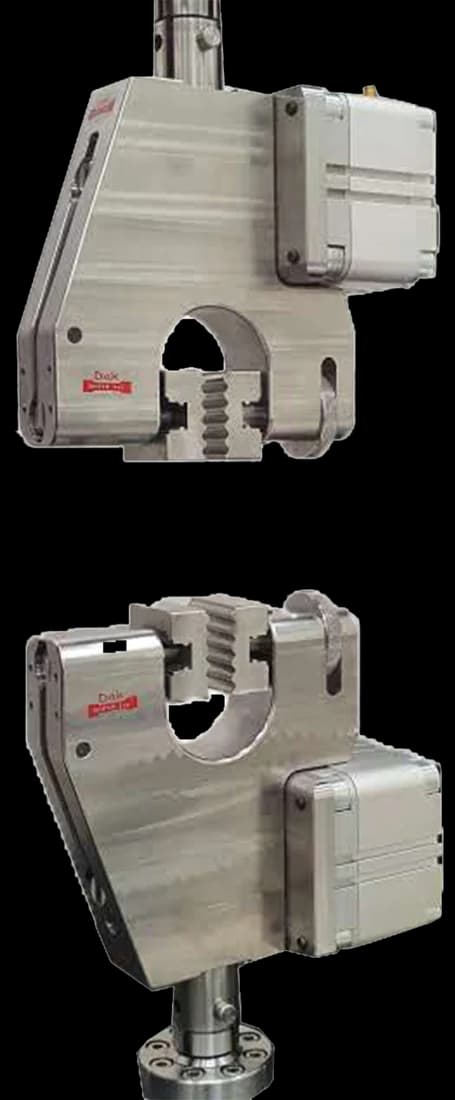
Standard 25 mm
Pneumatic Vice Action Grip
Pneumatic vice action grips clamp the full specimen width at a constant, even pressure — which is what stops one side slipping or tearing before the other.
Specifications
Testing standard
Textiles — Tensile Properties of Fabrics — Determination of Maximum Force and Elongation at Maximum Force — Part 1: Strip Method
Written and technically reviewed by Dak System Inc. engineeringLast reviewed
IS 1969 (Part 1) is the Indian Standard strip method for the tensile properties of fabrics, giving maximum force and elongation at maximum force. The strip is pulled at 20 mm/min or 100 mm/min, chosen from the fabric's own extensibility. It is identical with ISO 13934-1:1999, which the ISO parent has since replaced with its 2013 second edition.
From the test method to your testing system
Explore the DAK machines already listed for IS 1969 (Part 1), then review the grips, measurement and setup requirements below.
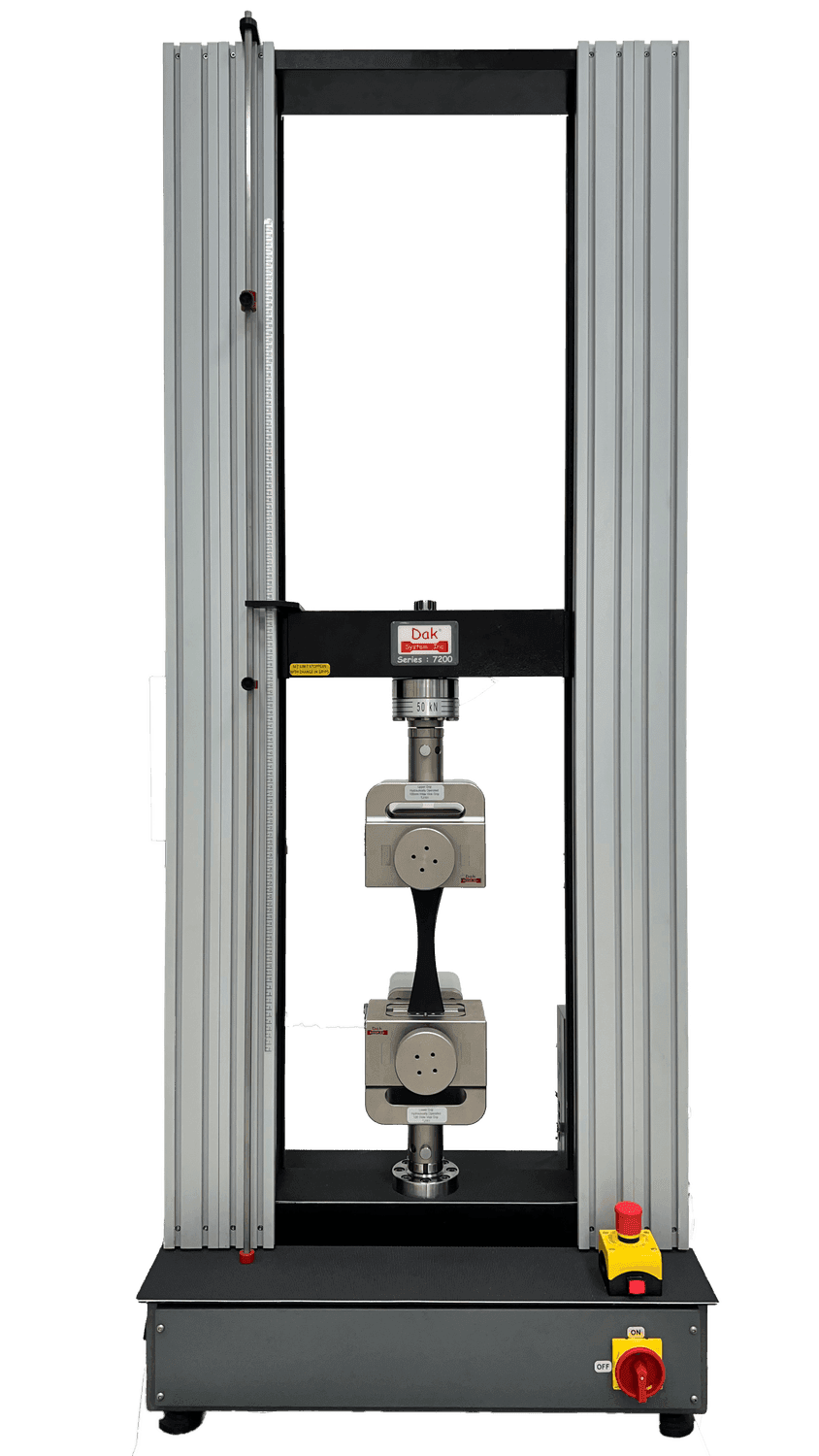 Universal Testing MachineSeries 7200Explore the machine →
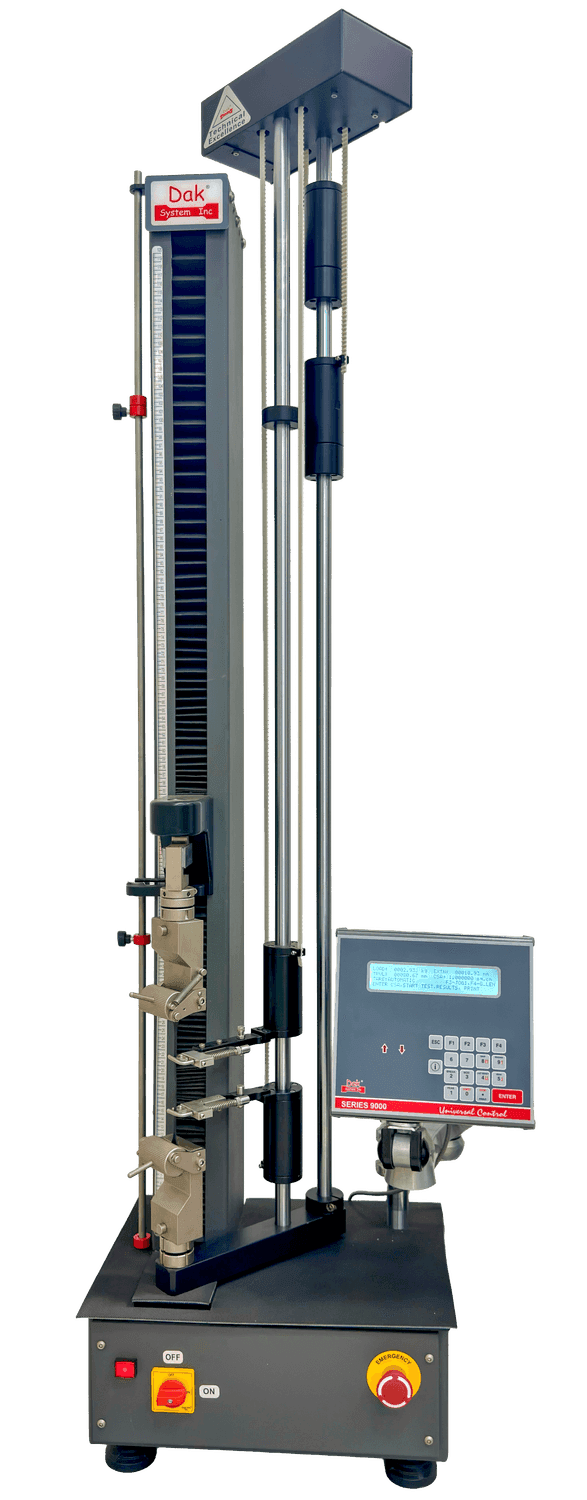 Universal Testing MachineSeries 9000Explore the machine →
01Understand the method
A strip of conditioned fabric is cut oversize and ravelled down to the specified width so that its edges are whole yarns, then clamped across its full width in wide grips. It is extended at 20 mm/min or 100 mm/min, chosen from the fabric's own extensibility, until the force passes its maximum. Two values are recorded: the maximum force, and the elongation at the point that maximum was reached. Warp and weft are tested and reported separately.
The load a fabric carries before it stops carrying more, and how far it has stretched by then. The distinction from elongation at break is real and often missed: a woven fabric commonly reaches its peak load with a proportion of yarns still intact, then holds together as those fail one after another, so rupture occurs some distance later. Elongation at maximum force describes the point at which the fabric ceased to gain load, which is the useful quantity. The result is a force for a stated strip width rather than a stress, because fabric thickness is not a usable area.
02Prepare the specimen and test settings
The full width of the strip is clamped, so every yarn in the section carries load. That is what separates it from Part 2.
Identical with ISO 13934-1:1999. The ISO method is now in its second edition, ISO 13934-1:2013, so the two designations no longer point at the same text.
03Build the test setup on a DAK machine
Modest capacity — most apparel and furnishing fabrics break between a hundred newtons and two kilonewtons — with grips wide enough for the full strip and an even clamping pressure across the face. Even pressure is what stops one edge of the strip taking load before the other, which on a strip specimen shows up directly in both the force and the failure position. Elongation is normally taken from grip separation, which the method accommodates. The frame has to hold 20 mm/min and 100 mm/min to within ±10 % and set a gauge length of either 100 mm or 200 mm to within ±1 mm, because Table 1 of the method picks the pair from the fabric's own extensibility: on a 200 mm gauge, 20 mm/min (10 %/min) where elongation at maximum force is below 8 %, and 100 mm/min (50 %/min) from 8 % to 75 %; above 75 % the gauge drops to 100 mm and the rate stays at 100 mm/min, which on the shorter gauge is 100 %/min.
Pneumatic vice action grips clamp the full specimen width at a constant, even pressure — which is what stops one side slipping or tearing before the other.
SpecificationsDak verifies against whichever standard the method names, and where a class applies our frames sit a class tighter than it asks.
| The method asks for | Dak supplies | |
|---|---|---|
| Capacity | Low to moderate — most apparel and furnishing fabrics break between 100 N and 2 kN | Load cells from 1 kg to 60 ton on the Series 7200, and 0.5 to 100 kN on the Series 9000 |
| Force accuracy | Class 1 of EN 10002-2 (clause 6.1.1) — indicated or recorded maximum force within ± 1 %, jaw separation within ± 1 mm; clause 6.1.2 permits a class 2 machine if the test report states it | ISO 7500-1 Class 0.5, verified to ASTM E4, DIN 51221 and BS 1610 |
| Gripping | Wide flat grips clamping the full strip width, with jaw faces suited to the fabric | Wedge, vice-action, pneumatic and hydraulic grips, built to the specimen |
| Environment | 27 ± 2 °C and 65 ± 2 % relative humidity, the IS 6359:1971 conditioning atmosphere; the IS 1969 (Part 1) National Foreword substitutes it for the 20 ± 2 °C of the international standards as unsuitable for Indian conditions | 3009 series chambers, −150 °C to +400 °C — temperature only |
04Run the test
05Calculate, report and interpret
The highest force recorded during the test
A force for the stated strip width, not a stress. Fabric thickness is not a usable area.
(ΔL / L₀) × 100 at the point of maximum force
At maximum force, not at rupture. Reporting elongation at break instead is a different quantity and a common substitution.
Treating this as interchangeable with ISO 13934-1 without checking editions — the Indian Standard is identical with the 1999 ISO text, and ISO has since issued a 2013 second edition, so the two designations no longer refer to the same method. Reporting elongation at break where elongation at maximum force was asked for. Cutting strips to width instead of ravelling them. Averaging warp and weft. And accepting jaw breaks, which on fabric usually mean the clamping pressure was cutting the yarns at the jaw line.
06Compare methods and find answers
| IS 1969 (Part 1) | ISO 13934-1 | |
|---|---|---|
| Published by | BIS | ISO |
| Relationship | Identical with ISO 13934-1:1999 | The parent method |
| Current text | IS 1969 (Part 1) : 2009 | ISO 13934-1:2013, second edition |
| Same text today | No | — |
This is the clearest example on the site of an adopted standard drifting from its parent. Both designations are current, and they no longer refer to the same text.
It is the Indian Standard strip method for the tensile properties of fabrics — the determination of maximum force and elongation at maximum force, with the full width of the strip clamped in the jaws. Part 2, published in 2010, covers the grab method. The current Part 1 is IS 1969 (Part 1) : 2009.
It was. IS 1969 (Part 1) : 2009 is identical with ISO 13934-1:1999. ISO has since published a second edition, ISO 13934-1:2013, so the two designations no longer point at the same text. Both remain current in their own systems, which means a report should name the designation and the edition rather than treating the two as one method under two numbers.
Because they are different points on many fabrics. A woven fabric often reaches its peak load while a proportion of yarns are still intact, then holds together as those yarns fail one after another, so rupture happens some distance further on. Elongation at maximum force describes the point at which the fabric stopped carrying more load, which is what a designer needs. Substituting elongation at break reports a larger number for a different event.
Because a cut edge leaves partial yarns that carry load until they slip out, contributing an amount that depends on how the cut fell. Ravelling an oversize strip down to the specified width leaves a section made of whole yarns, so the width genuinely corresponds to a countable number of load-bearing elements. It is the step that makes strip results repeatable between operators.
In what is clamped. The strip method holds the full width, so every yarn in the section is loaded directly. The grab method clamps only a central portion, and the fabric on either side shares some of the load through the weave, so the effective loaded width is larger than the clamped one. The grab test is quicker and more tolerant of specimen preparation; the strip test is the more analytically clean of the two. Neither converts into the other.
So that the time to reach maximum force stays comparable regardless of how stretchy the fabric is. Table 1 sets it in three bands, each held to ±10 %: on a 200 mm gauge, 20 mm/min where elongation at maximum force is below 8 %, and 100 mm/min from 8 % to 75 %; above 75 % the gauge is reduced to 100 mm and the rate stays at 100 mm/min, which is 100 %/min on the shorter length. A highly extensible knit pulled at the rate suited to a rigid canvas would take far too long, and textiles are rate-sensitive enough that the difference shows in the result.
Because they are built differently. Warp yarns are held under tension throughout weaving and are usually stronger and less extensible than weft, and the two can differ by a wide margin in the same cloth. An average describes neither, and a specification written against one would be met by fabric that is weak in the other direction.
Discuss your specimen, test requirements and reporting needs with DAK engineering.
This page describes the method as practised. The governing text is the current edition from the issuing body. Tell us what you are testing and we will answer with the machine, the fixture and a quotation.