Two face setsTJ-26
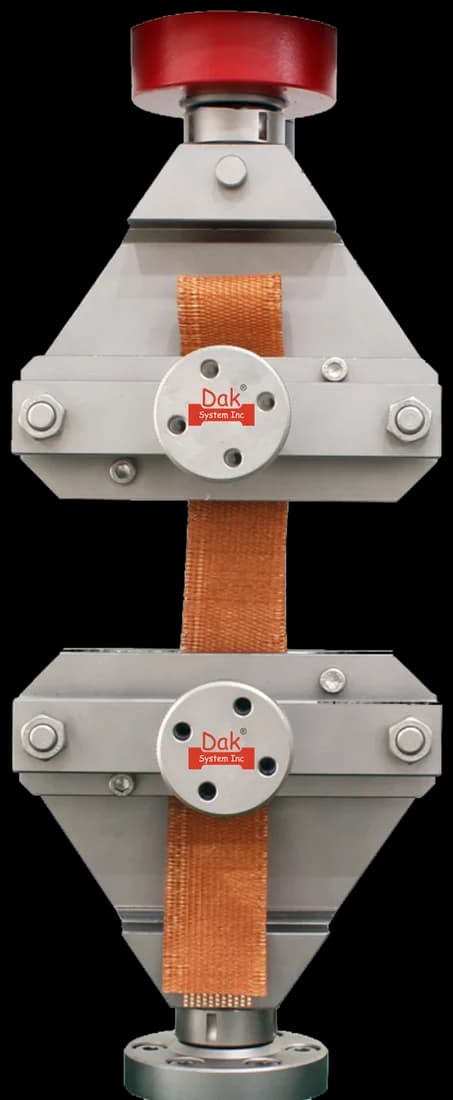
100mm Wide Vice Action Grips
Wide vice-action jaws hold a 50 mm strip across its whole width without skew — a strip gripped unevenly loads one edge first and breaks low.
Specifications
Testing standard
Textiles — Tensile properties of fabrics — Part 1: Determination of maximum force and elongation at maximum force using the strip method
Written and technically reviewed by Dak System Inc. engineeringLast reviewed
ISO 13934-1 is the strip tensile test for woven fabrics. A 50 mm wide strip is clamped across its full width and pulled until it ruptures, and the method reports maximum force in newtons and elongation at maximum force, separately for warp and weft — the figures written into purchase specifications for apparel, furnishing and technical wovens.
From the test method to your testing system
Explore the DAK machines already listed for ISO 13934-1, then review the grips, measurement and setup requirements below.
 Universal Testing MachineSeries 7200Explore the machine →
 Universal Testing MachineSeries 9000Explore the machine →
01Understand the method
A 50 mm wide strip of woven fabric is clamped across its entire width in two flat jaws set a fixed distance apart. One jaw travels away from the other at a constant speed until the strip ruptures, while force and jaw separation are recorded continuously. The peak of that curve, and the extension reached at the instant of the peak, are the two reported results.
The method reports maximum force in newtons and elongation at maximum force as a percentage, separately for the warp and the weft, because a woven fabric is anisotropic. Maximum force is the figure written into purchase specifications for apparel, furnishing and technical wovens, so it governs lot acceptance and supplier qualification. Elongation at maximum force distinguishes a stable construction from one that will distort under load, and both figures drop measurably after abrasion, laundering or UV exposure, which is what makes the pair useful in failure investigations.
02Prepare the specimen and test settings
03Build the test setup on a DAK machine
The method calls for a constant-rate-of-extension frame — the moving jaw holds its speed throughout, rather than tracking load. Most apparel and furnishing wovens break between roughly 100 N and 1.5 kN on a 50 mm strip, so a 5 kN load string covers the great majority of the work; heavy technical wovens such as sailcloth, airbag fabric and coated industrial cloth can push past 5 kN, which is why textile laboratories handling them specify 10 kN. Force indication must meet ISO 7500-1 Class 1.
Gauge length is 200 mm, reduced to 100 mm where elongation at maximum force is expected above 75 %. Speed is keyed to that expectation: on the 200 mm gauge, 20 mm/min below 8 % elongation and 100 mm/min from 8 % to 75 %; on the 100 mm gauge above 75 %, 100 mm/min. Rate must hold to ±10 %, because fabric strength is rate-sensitive.
No extensometer is required — elongation is taken from jaw separation, so every millimetre of grip slip or frame compliance is counted as fabric stretch. Jaws must be flat-faced and at least 60 mm wide so the full 50 mm of fringed width is clamped uniformly; narrower faces load the centre of the strip and force an early edge failure. Capstan jaws are the fallback for fabrics that slip or break at the clamp. A pretension is applied to straighten the strip and define the starting length. The laboratory itself is part of the instrument: testing is done in the same conditioned atmosphere, and the alternative 23 °C / 50 % RH atmosphere may be used only by agreement between the parties and must be reported.
Wide vice-action jaws hold a 50 mm strip across its whole width without skew — a strip gripped unevenly loads one edge first and breaks low.
Specifications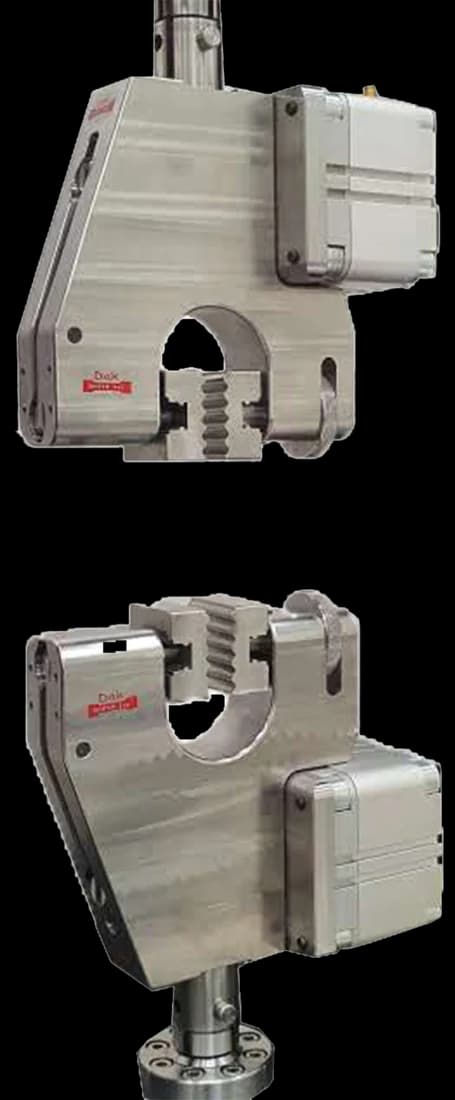
Constant air pressure keeps clamping identical between specimens, which matters over the replicate counts textile testing uses.
SpecificationsDak verifies against whichever standard the method names, and where a class applies our frames sit a class tighter than it asks.
| The method asks for | Dak supplies | |
|---|---|---|
| Capacity | Most apparel and furnishing wovens break between roughly 100 N and 1,5 kN on the 50 mm strip, so a 5 kN frame covers the great majority of work; heavy technical wovens (sailcloth, airbag, coated industrial fabric) can push past 5 kN and are the reason some textile labs specify a 10 kN load string. | Load cells from 1 kg to 60 ton on the Series 7200, and 0.5 to 100 kN on the Series 9000 |
| Force accuracy | ISO 7500-1 Class 1 | ISO 7500-1 Class 0.5 — a class tighter than the method asks |
| Gripping | Flat-faced pneumatic or mechanical textile jaws at least 60 mm wide, set to a 100 or 200 mm gauge; capstan jaws as the fallback for slipping or jaw-breaking fabrics | Our vice-action grips or split capstan grips, built to the specimen |
| Environment | Textile standard atmosphere per ISO 139 — 20 °C ±2 °C, 65 % ±4 % RH, recommended 24 h relaxed conditioning; a wet-state variant using Grade 3 water (ISO 3696) and a nonionic wetting agent needs no conditioning | 3009 series chambers, −150 °C to +400 °C — temperature only |
04Run the test
05Calculate, report and interpret
Fmax = peak force, in newtons
A force for the 50 mm strip, not a stress. The width is fixed by the method so the figures are comparable between fabrics without any area being involved.
E = (extension at Fmax / gauge length) × 100
Jaw breaks are the standard invalidation — the strip fails at the clamp line, reads low, and must be replaced. Slippage is harder to catch, because with no extensometer the fabric creeping out of the jaws is recorded as extension and inflates elongation. Fringing errors are specific to this method: one thread too many leaves under 50 mm carrying the load, and maximum force falls proportionately. Conditioning drift is invisible — hygroscopic fibres change strength with moisture regain, so a warm, dry laboratory produces a consistent offset.
06Compare methods and find answers
| ISO 13934-1 strip | ASTM D5034 grab | |
|---|---|---|
| Specimen width | 50 mm, frayed to a yarn count | 100 mm, cut |
| Held | Full width | 25 mm central band |
| Load path | Only the clamped yarns | Shared through the weave |
| Result on the same cloth | Lower | Higher |
| Edge preparation | Yarns removed to exact count | Cut only |
These give different numbers on the same fabric by design, and neither converts to the other. A specification that names a breaking force without naming the method has not specified anything a supplier can test against.
It is the international strip tensile test for woven fabrics. A 50 mm wide strip is clamped across its full width and pulled until it ruptures, and the method reports maximum force in newtons and elongation at maximum force, separately for the warp and weft directions.
So the width is an exact yarn count rather than a ruler measurement. Strips are cut wider than 50 mm and yarns are removed from each edge until precisely the right number remain. A cut edge leaves partial yarns that carry an unpredictable share of load, and fraying removes that variability.
The strip method clamps the full width, so only the clamped yarns carry the load. The grab method clamps a 25 mm band of a 100 mm strip, so surrounding fabric shares load through the weave and the figure comes out higher. They measure different things on purpose and cannot be converted between.
Because a woven fabric is anisotropic — the two directions rarely match, and often differ substantially. An average describes neither. Both figures are also useful diagnostically: they drop measurably after abrasion, laundering or UV exposure, which is what makes the pair valuable in failure investigations.
To take the slack out of the strip without stretching it. A fabric hangs loose between the jaws, and without a defined small pretension the early part of the curve records the strip straightening rather than the yarns loading — which corrupts the elongation figure while leaving the maximum force intact.
Because it is a grip failure rather than a fabric failure. The clamping compresses and abrades yarns at the jaw line, so a break within 5 mm of it reflects damage the test introduced. The standard requires the specimen to be discarded and replaced rather than the number recorded.
Discuss your specimen, test requirements and reporting needs with DAK engineering.
This page describes the method as practised. The governing text is the current edition from the issuing body. Tell us what you are testing and we will answer with the machine, the fixture and a quotation.