
Testing standard
ISO 2415 Forged Lifting Shackle Testing
Forged shackles for general lifting purposes — Dee shackles and bow shackles
Written and technically reviewed by Dak System Inc. engineeringLast reviewed
ISO 2415 specifies forged dee and bow shackles for general lifting: working load limits from 0,5 t to 120 t in grades 6, 8 and 10, rated for service between -20 C and 200 C. It gives both performance and the preferred dimensions that make one maker's shackle interchangeable with another's.
At a glance
- Test type
- Load–deflection & proof load
- Published by
- ISO
- Edition
- ISO 2415:2022
- Material
- Metals, alloys & welds
- Runs on
- Series 7200 and Series 9000
From the test method to your testing system
Explore DAK equipment for ISO 2415, then review the specimen and setup requirements below.
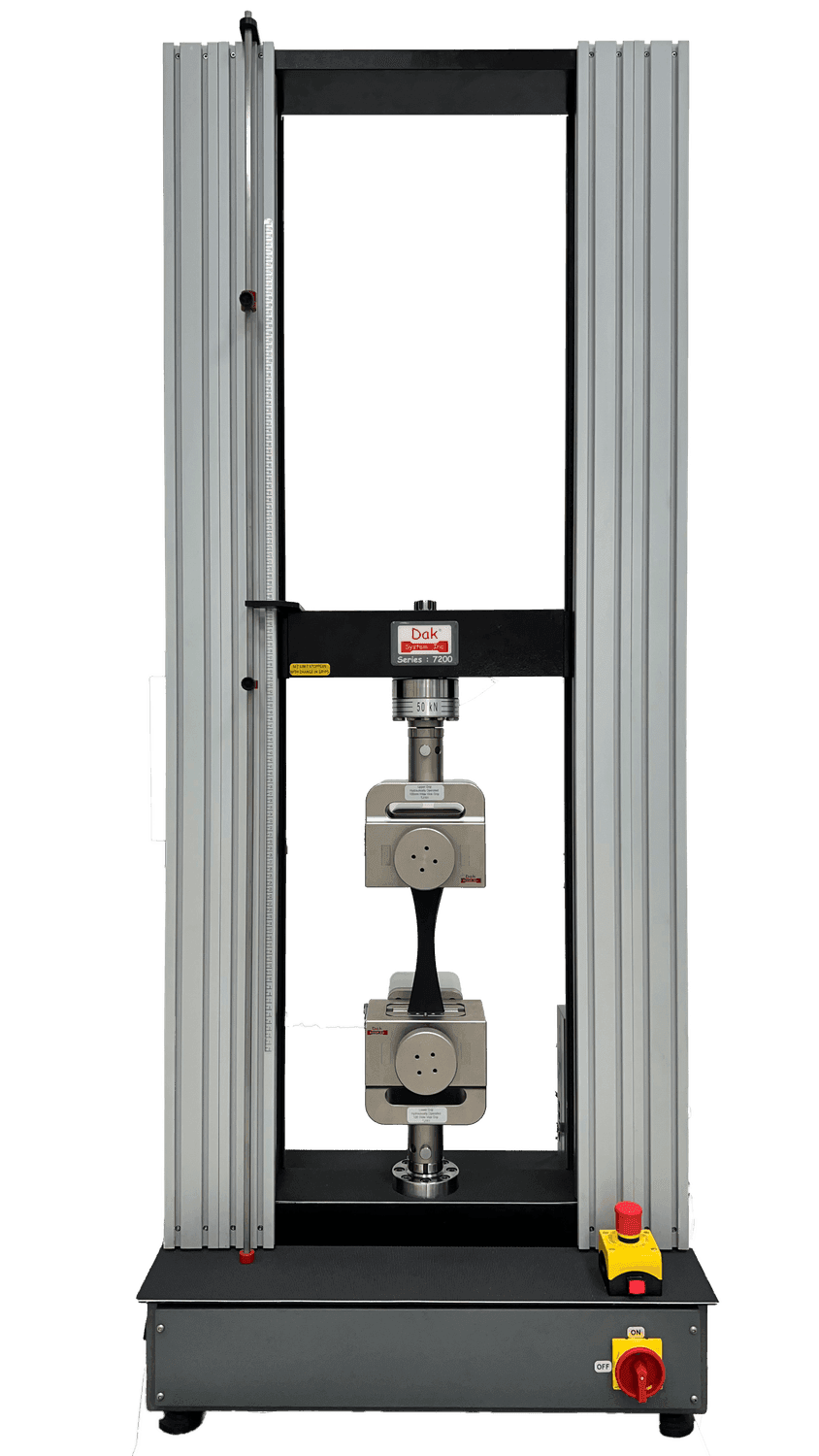 Universal Testing MachineSeries 7200Explore the machine →
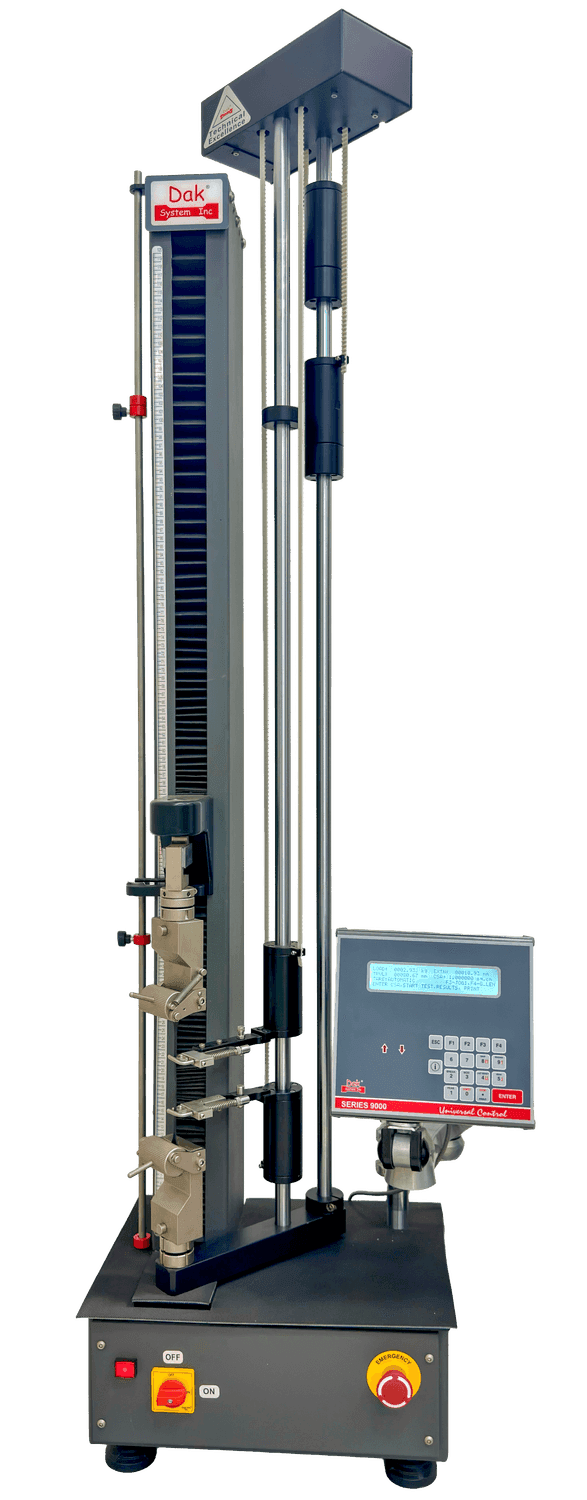 Universal Testing MachineSeries 9000Explore the machine →
Jump to a specific section
01Understand the method
What the test does
ISO 2415 specifies the general characteristics of forged dee and bow shackles and presents their performance and preferred dimensions — the dimensions that make one manufacturer's shackle interchangeable with another's and compatible with the rest of the rigging it will be used with.
The 2022 edition covers working load limits from 0,5 t to 120 t in Grades 6, 8 and 10, for service between −20 °C and 200 °C. That is a wider span than it first appears: the 2004 edition ran from 0,32 t to 100 t in Grades 4, 6 and 8, so the revision has dropped the lowest grade, added the highest, and extended the top of the range by twenty tonnes.
Performance is specified rather than described. A shackle of a given size and grade has a working load limit, a proof force applied in manufacture and a minimum breaking force it must reach, and the standard's tables are what a manufacturer certifies against and a purchaser checks.
The dimensional half matters as much as the strength half. A shackle meeting its breaking force but with a bow too narrow for its sling, or a pin that does not match the eye it passes through, is a compatibility failure rather than a strength one — and the more common problem in the field.
What it measures, and why it matters
Grade states compactly what the steel can do, and the difference between 6, 8 and 10 is not academic. A higher grade carries a higher working load limit at the same size, which is why a rigger reaches for it — lighter assembly, tighter spaces. It is also less tolerant: higher grades have less ductility to spare and are more sensitive to shock loading and to service notches.
The temperature range is the requirement most often forgotten in specification. Between −20 °C and 200 °C a Grade 6, 8 or 10 shackle behaves as rated. Outside it the rating does not simply degrade gracefully — steel toughness falls away below the transition and strength falls with sustained heat — so a shackle used in a furnace bay or a cold store needs an explicit derating rather than an assumption.
Interchangeability is the standard's quiet commercial value. A loft holding shackles from four suppliers can mix them because all are made to the same preferred dimensions, and a replacement bought anywhere will fit. That holds only while everyone certifies to the same document.
02Prepare the specimen and test settings
Specimen
The finished forged shackle as supplied. Body and pin are separate forgings and are treated as such.
- Range
- 0,5 t to 120 t working load limitThe 2004 edition ran 0,32 t to 100 t, so both ends moved.
- Grades
- 6, 8 and 10The 2004 edition covered 4, 6 and 8. Grade 4 is gone and grade 10 is new.
- Service temperature
- -20 °C to 200 °COutside that range the rating does not degrade gracefully — toughness falls away below the transition and strength falls with sustained heat.
- Dimensions
- Preferred dimensions for interchangeabilityThe quiet commercial value: a loft holding shackles from four suppliers can mix them because all are built to the same preferred sizes.
Test speed
Static verification against the tables for the size and grade. There is no rate to dial in; what is specified is the force and the geometry.
- Proof force
- Applied in manufacture, tabulated by size and gradeA production operation, not a rating.
- Minimum breaking force
- Tabulated by size and gradeWhat a manufacturer certifies against and a purchaser checks.
- Loading axis
- In line, through bow and pinThe rating assumes it. Anything else measures a different component.
03Build the test setup on a DAK machine
What the machine must be capable of
Force enough to break the largest shackle in the range, and a 120 t working load limit shackle taken to its minimum breaking force needs several meganewtons. Few laboratories test the top of the range, and those that do build for it specifically.
Proof loading is the everyday requirement and is far less demanding: proof force is a defined fraction of breaking force, and a purpose-built proof rig with fast cycle time serves production better than a universal frame.
Fixturing must load through the bow and the pin along the intended axis. A shackle is designed for in-line loading and its rating assumes it; anything else measures a different component.
Running ISO 2415 on the Series 7200 and Series 9000
Dak verifies against whichever standard the method names, and where a class applies our frames sit a class tighter than it asks.
| The method asks for | Dak supplies | |
|---|---|---|
| Capacity | Wide: working load limits from 0,5 t to 120 t, so the top of the range needs several meganewtons to reach minimum breaking force | Load cells from 1 kg to 60 ton on the Series 7200, and 0.5 to 100 kN on the Series 9000 |
| Force accuracy | unknown — the standard specifies performance and dimensions rather than a machine accuracy class | ISO 7500-1 Class 0.5 — the method sets no class of its own |
| Gripping | In-line loading through the bow and the pin, as the rating assumes | Our a fixture built for this method, built to the specimen |
| Environment | rated for service between −20 °C and 200 °C | 3009 series chambers, −150 °C to +400 °C — temperature only |
04Run the test
How the testing runs
- Identify size and grade, and read the working load limit, proof force and minimum breaking force from the tables.
- Proof load in manufacture.
- For destructive verification, take samples and load in line through bow and pin.
- Take samples to at least the tabulated minimum breaking force.
- Verify the preferred dimensions, not only the strength.
- Mark grade clearly — a grade 8 and a grade 10 shackle of the same size look alike.
05Report and interpret
What travels with an ISO 2415 result
Grade and edition both change what the figures mean, so neither can be left off.
- Size and grade together — the tables are indexed by both.
- Working load limit, proof force applied and breaking force reached.
- Dimensional conformity against the preferred dimensions.
- The edition tested to. The 2022 and 2004 editions differ in grades and in load range.
- The intended service temperature, if outside normal ambient.
What goes wrong in practice
Mixing grades within an assembly is the field error with the worst consequences, because the marking is small and a Grade 8 and Grade 10 shackle of the same size look alike.
Ignoring the temperature range is the second, and it is invisible until something breaks cold.
Side-loading in the fixture is the third, and it reads low for reasons that have nothing to do with the shackle.
Finally, treating the 2004 and 2022 editions as equivalent. Grade 4 was in the older edition and is not in the current one, and the load ranges differ at both ends.
06Compare methods and find answers
ISO 2415 or EN 13889
Both cover forged dee and bow shackles. Certification to one is not certification to the other.
| ISO 2415:2022 | EN 13889:2003+A1:2008 | |
|---|---|---|
| Grades | 6, 8 and 10 | 6 only |
| Working load limits | 0,5 t to 120 t | 0,5 t to 25 t |
| Pin types | Not restricted in the same way | Threaded pins only |
| Fatigue requirement | Not stated in the scope | At least 20 000 cycles |
| Impact requirement | Not stated in the scope | 27 J minimum average |
| Service temperature | -20 °C to 200 °C stated | Verified through impact testing |
EN 13889 is narrower in range and more explicit about fatigue and toughness. A shackle certified to ISO 2415 has not thereby met EN 13889's cycle and impact requirements.
Related and equivalent standards
EN 13889 is the European counterpart, restricted to Grade 6 forged steel shackles with threaded pins from 0,5 t to 25 t, and carrying explicit fatigue and impact requirements. Certification to one is not certification to the other. ISO 4344 covers wire rope for lifts and EN 1492 textile slings, which are the components a shackle most often connects.
Questions we are asked about this test
What is ISO 2415?
It is the international standard for forged dee and bow shackles for general lifting, current as ISO 2415:2022. It specifies their general characteristics and presents both performance and the preferred dimensions needed for interchangeability and compatibility with other rigging components.
What range does it cover?
Working load limits from 0,5 t to 120 t in grades 6, 8 and 10, for service between -20 °C and 200 °C.
How does the 2022 edition differ from 2004?
In four ways at once. The 2004 edition covered 0,32 t to 100 t in grades 4, 6 and 8; the 2022 edition covers 0,5 t to 120 t in grades 6, 8 and 10. So grade 4 has gone, grade 10 is new, and both ends of the load range have moved. Treating the editions as interchangeable would be wrong on every count.
What does the grade actually mean?
It states compactly what the steel can do. A higher grade carries a higher working load limit at the same physical size, which is why riggers reach for it — lighter assemblies, tighter spaces. It is also less tolerant: higher grades have less ductility to spare and are more sensitive to shock loading and to the notches service damage leaves.
Why does the temperature range matter?
Because outside -20 °C to 200 °C the rating does not degrade gracefully. Steel toughness falls away below the transition temperature and strength falls under sustained heat, so a shackle used in a furnace bay or a cold store needs an explicit derating rather than an assumption.
Why are dimensions part of the standard?
Because a shackle that meets its breaking force but has a bow too narrow for its sling, or a pin that does not match the eye it passes through, is a compatibility failure rather than a strength one — and that is the more common problem in the field. The preferred dimensions are what let a replacement bought anywhere fit the assembly it is going into.
How does it compare with EN 13889?
EN 13889 is narrower — Grade 6, threaded pins only, to 25 t — but carries explicit fatigue and impact requirements that ISO 2415's scope does not state: at least 20 000 cycles and a 27 J minimum average impact value. A shackle certified to one is not thereby certified to the other.
Can Dak supply shackle testing equipment?
Yes. Tell us the largest working load limit and grade you need to proof and to break, and we will answer with the frame, the in-line fixturing and a quotation.
Related
Materials tested to it
The test it standardises
Industries that test to it
Other standards explained
Planning ISO 2415 testing?
Discuss your specimen, test requirements and reporting needs with DAK engineering.
This page describes the method as practised. The governing text is the current edition from the issuing body. Tell us what you are testing and we will answer with the machine, the fixture and a quotation.