
Testing standard
EN 13889 Forged Steel Lifting Shackle Testing
Forged steel shackles for general lifting purposes — Dee shackles and bow shackles — Grade 6 — Safety
Written and technically reviewed by Dak System Inc. engineeringLast reviewed
EN 13889 is the European safety specification for Grade 6 forged steel dee and bow shackles with threaded pins, over working load limits from 0,5 t to 25 t. Every unit is proof loaded in manufacture; samples must reach a minimum breaking force, survive at least 20 000 cycles of a specified force range, and show a minimum average impact value of 27 J.
At a glance
- Test type
- Load–deflection & proof load
- Published by
- EN
- Edition
- EN 13889:2003
- Material
- Metals, alloys & welds
- Runs on
- Series 7200 and Series 9000
From the test method to your testing system
Explore DAK equipment for EN 13889, then review the specimen and setup requirements below.
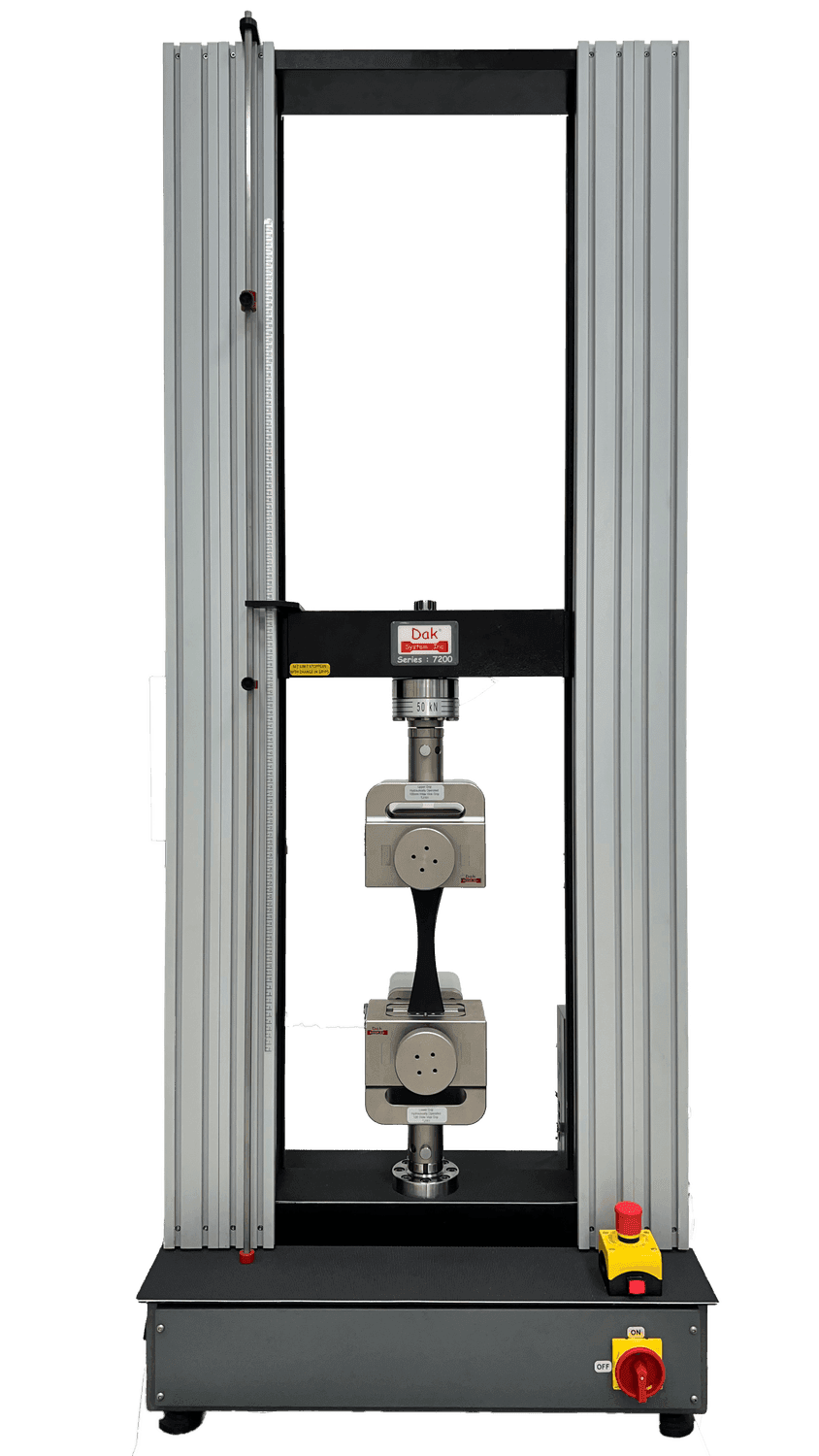 Universal Testing MachineSeries 7200Explore the machine →
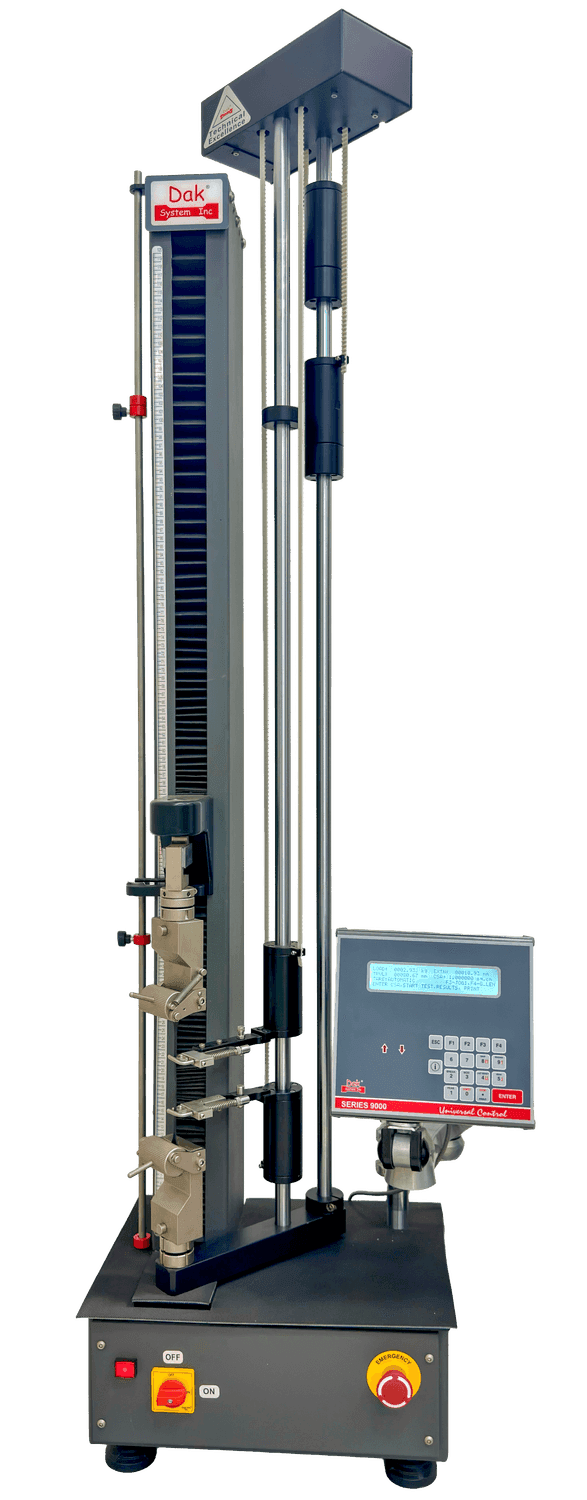 Universal Testing MachineSeries 9000Explore the machine →
Jump to a specific section
01Understand the method
What the test does
EN 13889 is a safety specification with its verification built in. It sets requirements for design, materials, manufacturing, testing, marking and documentation for forged steel shackles in Grade 6, over working load limits from 0,5 t to 25 t, and it applies only to shackles with threaded pins.
Three mechanical requirements do the real work, and they are different in kind.
Every shackle is proof loaded in manufacture. Table 4 gives the manufacturing proof force alongside the working load limit and minimum breaking force for each size, so proof testing is a production operation applied to the whole population rather than a sample.
Type testing then takes shackles to destruction: in the finished condition a shackle must reach at least the minimum breaking force in Table 4. And separately from static strength, shackles must withstand at least 20 000 cycles of the specified force range — a fatigue requirement, because lifting gear fails from repeated use far more often than from a single overload.
Material toughness is verified by impact testing on samples taken from both the pin and the body, with a minimum average impact value of 27 J.
What it measures, and why it matters
A shackle fails least often and matters most when it does. The standard's structure reflects that: proof load on every unit, breaking force, fatigue and toughness on samples. No one of those would be enough alone.
The 20 000 cycle requirement is the most overlooked and the one that reflects real service. A shackle in a rigging loft is picked up, loaded, unloaded and dropped hundreds of times a year. Static strength says nothing about whether the pin thread will gall or the bow crack at the shoulder after a few thousand cycles — and a shackle that meets its breaking force but fails in fatigue is dangerous precisely because it passes every test a user can perform.
The 27 J impact requirement is about brittleness. Grade 6 steel tough at 20 °C can be brittle when cold, and a shackle that shatters rather than deforms gives no warning. Deformation before failure is a safety property: a bent shackle is visible, a cracked one is not.
Restricting scope to threaded pins is deliberate. Shackles with captive or round pins behave differently, and the standard covers only what it has characterised.
02Prepare the specimen and test settings
Specimen
The finished forged shackle, with proof loading applied to every unit and destructive work to samples.
- Scope
- Grade 6, threaded pins only, 0,5 t to 25 tShackles with captive or round pins are outside the standard, and no result obtained on one is a compliance claim.
- Proof loading
- Every unit producedA production screening operation, not a rating — the commonest misunderstanding on a shop floor.
- Impact samples
- From both the pin and the bodyThey are separate forgings of potentially different heat treatment, and the pin carries the thread, the load path and the stress concentration.
- Minimum average impact
- 27 JToughness, not strength. A shackle that deforms before failing is visible; one that shatters gives no warning.
Test speed
Static verification against Table 4, plus a fatigue requirement that static testing cannot substitute for.
- Proof force
- Per Table 4, by sizeTabulated alongside working load limit and minimum breaking force for each size.
- Minimum breaking force
- Per Table 4, in the finished conditionType testing on samples, taken to destruction.
- Fatigue
- At least 20 000 cycles of the specified force rangeThe requirement most often overlooked, and the one that reflects real service. A shackle that meets its breaking force and fails in fatigue is dangerous precisely because it passes every test a user can perform.
03Build the test setup on a DAK machine
What the machine must be capable of
Force well beyond the breaking force of a 25 t shackle — the top of the range needs a frame in the meganewton class to reach destruction. Proof loading, which manufacturers do daily, needs far less: a dedicated proof-load rig is a different machine from a destructive frame.
Fatigue capability is the specialised requirement. Twenty thousand cycles at a specified force range needs a dynamic machine and enough throughput that a test does not occupy it for weeks.
Fixturing must load the shackle as it is used — through the bow and the pin, in line — because a shackle loaded off its intended axis fails at a load that says nothing about its rating.
Running EN 13889 on the Series 7200 and Series 9000
Dak verifies against whichever standard the method names, and where a class applies our frames sit a class tighter than it asks.
| The method asks for | Dak supplies | |
|---|---|---|
| Capacity | Set by size: proof force is a fraction of breaking force, and a 25 t working load limit shackle needs a meganewton-class frame to reach destruction | Load cells from 1 kg to 60 ton on the Series 7200, and 0.5 to 100 kN on the Series 9000 |
| Force accuracy | unknown — the standard specifies forces and cycle counts rather than a machine accuracy class | ISO 7500-1 Class 0.5 — the method sets no class of its own |
| Gripping | In-line loading through the bow and the pin; a shackle loaded off its intended axis measures a different component | Our a fixture built for this method, built to the specimen |
| Environment | impact testing verifies toughness; minimum average impact value 27 J on samples from pins and bodies | 3009 series chambers, −150 °C to +400 °C — temperature only |
04Run the test
How the testing runs
- Proof load every shackle in production to the Table 4 force for its size.
- Take samples for destructive verification.
- Load in line through the bow and the pin — never side-loaded.
- Take samples to at least the minimum breaking force in the finished condition.
- Run the fatigue samples to at least 20 000 cycles of the specified force range.
- Take impact specimens from both pin and body and confirm a minimum average of 27 J.
- Mark and document to the standard's requirements.
05Report and interpret
What travels with an EN 13889 result
Four different verifications, and a certificate that names only one of them is incomplete.
- Working load limit and size, and the Table 4 forces for it.
- Proof force applied, and that it was applied to every unit.
- Minimum breaking force reached, on samples in the finished condition.
- Cycles survived against the 20 000 requirement.
- Impact values from pin and body against the 27 J minimum.
- That the pin is threaded — the standard covers nothing else.
What goes wrong in practice
Treating proof load as strength is the commonest misunderstanding on the shop floor. It is a screening operation, not a rating.
Testing only static strength is the second, and it misses the fatigue requirement entirely.
Loading off-axis is the third. A shackle side-loaded in the fixture reads low, and the result is neither its rated capacity nor a fault.
Finally, applying the standard to a shackle without a threaded pin. It is outside the scope, and no result obtained is a compliance claim.
06Compare methods and find answers
Four requirements, four different questions
No single one of these would be enough, which is why the standard carries all four.
| Verification | Applied to | Answers |
|---|---|---|
| Proof force | Every unit | Is this individual shackle sound |
| Minimum breaking force | Samples | Is the design and material adequate |
| 20 000 cycles | Samples | Will it survive repeated service, not just one lift |
| 27 J impact | Pin and body samples | Will it deform before it fails, rather than shatter |
Static strength says nothing about whether the pin thread will gall or the bow crack at the shoulder after a few thousand cycles.
Related and equivalent standards
ISO 2415 is the international counterpart, covering a wider range of grades and working load limits. Both describe the same components; a shackle certified to one is not automatically compliant with the other. For the wider lifting assembly, EN 818 covers chain and EN 1492 covers textile slings.
Questions we are asked about this test
What is EN 13889?
It is the European safety specification for forged steel dee and bow shackles in Grade 6 for general lifting, current as EN 13889:2003+A1:2008. It covers design, materials, manufacturing, testing, marking and documentation for working load limits from 0,5 t to 25 t.
Does it cover all shackles?
No. It applies only to shackles with threaded pins. Shackles with captive or round pins behave differently and are outside the scope, so no result obtained on one is a compliance claim.
What is the difference between proof force and breaking force?
Proof force is applied to every shackle in production as a screening operation — it confirms the individual unit is sound and is well below destruction. Minimum breaking force is verified on samples taken to failure and confirms the design and material are adequate. Treating proof load as a strength rating is the commonest misunderstanding on a shop floor.
Why is there a fatigue requirement?
Because lifting gear fails from repeated use far more often than from a single overload. Shackles must withstand at least 20 000 cycles of the specified force range. A shackle in a rigging loft is picked up, loaded, unloaded and dropped hundreds of times a year, and static strength says nothing about whether the pin thread will gall or the bow crack at the shoulder.
What is the 27 J impact requirement for?
Toughness. Grade 6 steel that is tough at 20 °C can be brittle when cold, and a shackle that shatters rather than deforms gives no warning. Samples are taken from both the pin and the body, because they are separate forgings of potentially different heat treatment.
Why does side-loading invalidate a test?
Because a shackle is designed and rated for in-line loading through the bow and the pin. Loaded off that axis it fails at a load that says nothing about its rating — the result is neither its capacity nor evidence of a fault.
How does it compare with ISO 2415?
ISO 2415 is the international counterpart and covers a wider range: grades 6, 8 and 10 and working load limits to 120 t, with a stated service temperature range. EN 13889 is narrower — Grade 6, threaded pins, to 25 t — but carries explicit fatigue and impact requirements. Certification to one is not certification to the other.
Can Dak supply shackle testing equipment?
Yes. Tell us the largest working load limit you need to proof and to break, and whether you need the 20 000 cycle fatigue capability, and we will answer with the frame, the fixturing and a quotation.
Related
Materials tested to it
The test it standardises
Industries that test to it
Other standards explained
Planning EN 13889 testing?
Discuss your specimen, test requirements and reporting needs with DAK engineering.
This page describes the method as practised. The governing text is the current edition from the issuing body. Tell us what you are testing and we will answer with the machine, the fixture and a quotation.