ASTM A125 — read the full explanation
Load–deflection & proof loadHeat-treated helical steel springs — load and permanent-set requirements.

Breaking force, extension and load response help manufacturers evaluate the materials and components used in lifting and material handling. DAK testing systems bring controlled loading and measurement together with holding arrangements selected for the specimen, its terminations and the required test.
Wire-rope construction and end preparation influence the tensile test setup. Define the rope diameter, free test length and termination arrangement alongside the required breaking-force or extension result.
The behaviour of a woven strip, stitched connection and finished sling should be assessed at the appropriate level. Identify the width, construction and section being loaded before selecting grips and available test travel.
A fitting is loaded through its contact surfaces and connecting features. Include the component drawing and loading arrangement when specifying force measurement, fixture geometry and the required proof-load or failure test.
Rope type, construction and termination details help define a meaningful test. Laboratory results on a rope specimen support material and product evaluation; the complete elevator system has a separate assessment scope.
Load-deflection testing relates force to movement through the required working range. Identify the mounting arrangement and whether the result is a force at a specified position, spring stiffness or behaviour under repeated loading.
Separate testing of a material or connection from evaluation of an assembled fall-protection product. The loading direction, specimen arrangement and static or dynamic method determine the equipment required.
Cord, webbing and steel rope do not all use the same gripping approach. Share the prepared specimen and end fittings. DAK offers bollard, capstan and other grip arrangements for matching the holding method to the material.
The complete setup includes free specimen length, terminations, fixtures and movement during loading. Those dimensions matter alongside force capacity, particularly for long specimens and highly extensible textile materials.
A proof-load check, breaking-force test and extension measurement produce different results. Define the applied loading sequence, the required measuring range and the location where extension will be recorded.
For material specimens and components, compare the required load, working space and gripping arrangement against the published machine configurations. Complete assemblies should be specified with their actual dimensions and loading plan.
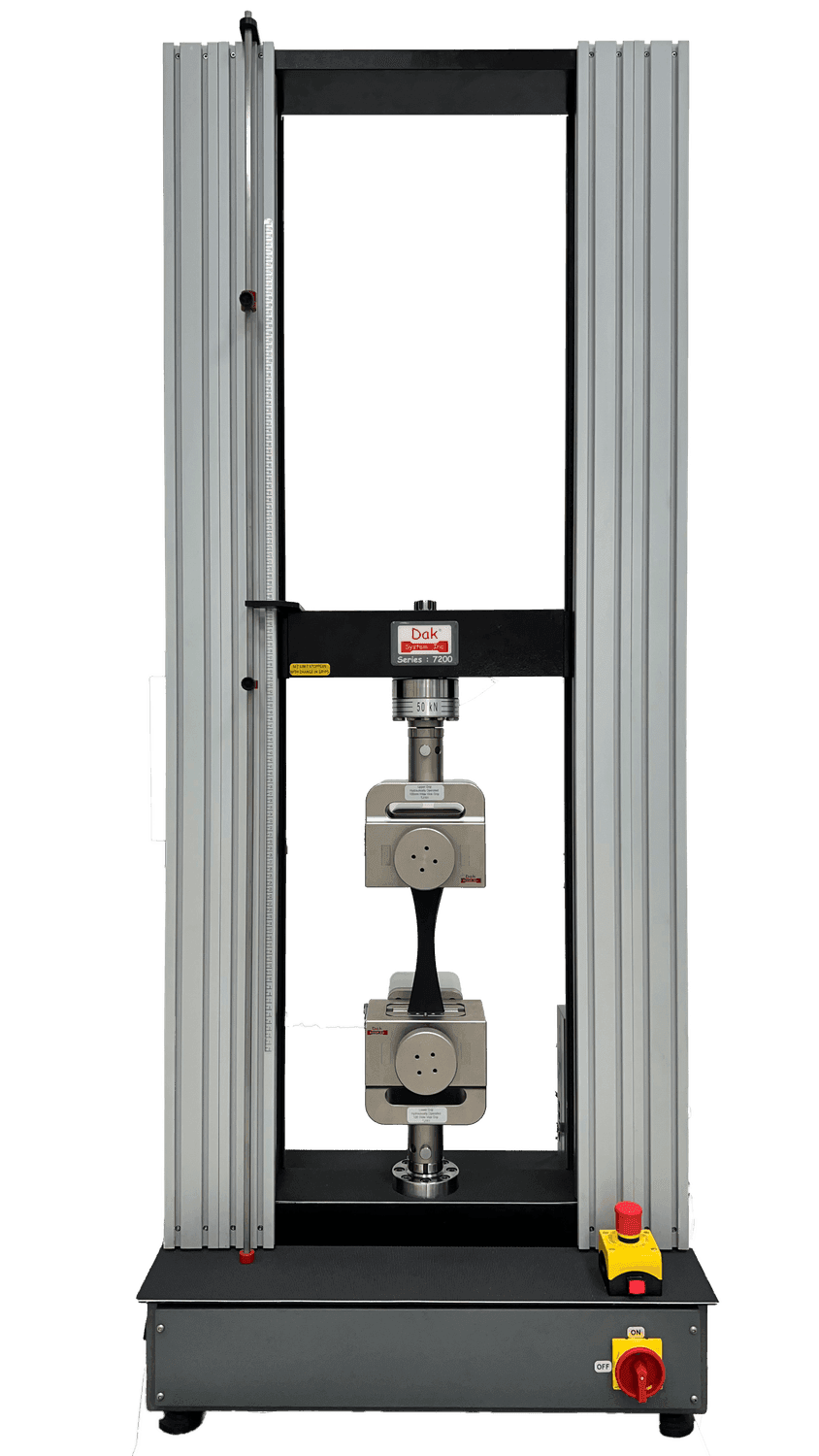
DAK flagship
DAK’s flagship platform combines flexible test programming and measurement with specimen-specific tooling. A strong starting point for laboratories evaluating different lifting materials and component geometries.
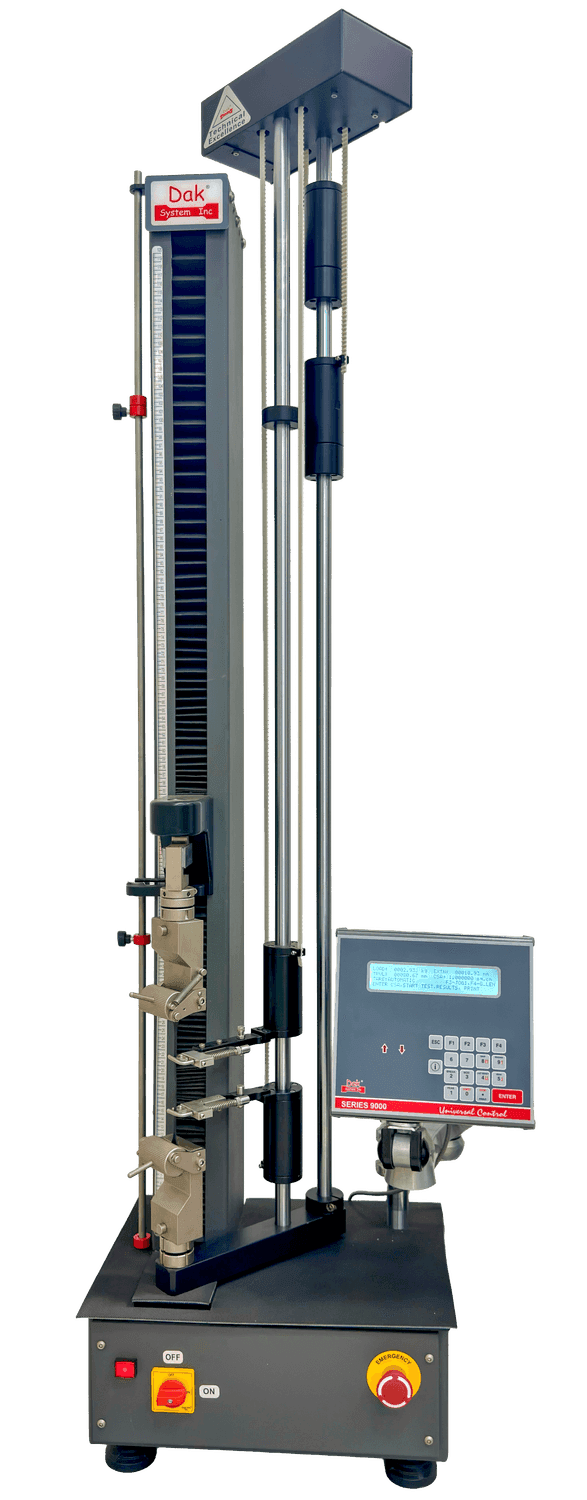
A universal testing alternative for defined force and movement requirements. Match its published configuration to the specimen, terminations and test method rather than choosing from load capacity alone.
A cyclic component programme is different from a static proof or breaking-force test. Include the waveform, force range and cycle requirements when discussing a fatigue-testing configuration.
The library brings together rope, component and measurement-related references. Use the designation relevant to your product and test; material testing and complete lifting-system assessment are different scopes.
Heat-treated helical steel springs — load and permanent-set requirements.
Stranded wire ropes for lifts (elevators) — breaking force and diameter verification.
Forged steel shackles — proof load and minimum breaking force.
Flat woven webbing slings and round slings — breaking force verification (7:1 safety factor validation).
Fall-arrest lanyards, harnesses and anchors — static strength verification.
Fall-arrest lanyards, harnesses and anchors — static strength verification.
Fall-arrest lanyards, harnesses and anchors — static strength verification.
Grade 80/100 alloy chain slings — proof and breaking force.
Indian Standard bend test for metallic materials. Equivalent to: ISO 7438
Steel wire for ropes and steel wire ropes for general engineering — breaking load verification. Equivalent to: ISO 2408 / 1835-adjacent
Grade 80/100 alloy chain slings — proof and breaking force.
Calibration and verification of a testing machine's force-measuring system.
Force calibration and verification of testing machines.
Calibration and classification of extensometer systems for uniaxial testing.
Verification of testing frame and specimen alignment by measured bending.
Measured breaking force of steel wire ropes by tensile test to destruction.
Steel wire ropes — minimum breaking force requirements and verification testing.
Forged steel shackles — proof load and minimum breaking force.
Stranded wire ropes for lifts (elevators) — breaking force and diameter verification.
Showing 1–8 of 19 standards
A proof test applies a defined load under the specified conditions; a breaking-force test continues to failure. State which is required, how deformation is assessed and how the specimen is held throughout the test.
Full-length ropes and assembled lifting products can need different space, terminations and protective arrangements from laboratory specimens. Provide the assembly drawing so these needs are part of the equipment discussion from the start.
Share the specimen and loading requirement to help us identify a suitable testing configuration.