Testing standard

ASTM D413

Standard Test Methods for Rubber Property—Adhesion to Flexible Substrate

Written and technically reviewed by Dak System Inc. engineeringLast reviewed

ASTM D413 measures how firmly vulcanised rubber is bonded to a flexible substrate — usually a textile ply. Two plies are separated at a controlled rate and the peel force per unit width is recorded. It is the property that decides whether a hose, a belt or a coated fabric holds together in service, because those articles fail between plies far more often than they fail in tension.

At a glance

Test type
Peel & adhesiona bonded joint is pulled apart
Published by
ASTM
Edition
D413-98

What the test does

Two bonded plies — vulcanised rubber against a flexible substrate, most often a textile — are separated at a controlled rate while the force is recorded. A short length is freed by hand to start the peel, then one ply is clamped in each grip and the crosshead separates them at about 50 mm/min. The force is averaged over a steady length, the run-in transient discarded, and divided by the measured bonded width. Where the specification calls for it, the strip arrangement holds one ply against a support instead, which is closer to how a ply lifts inside a hose wall.

What it measures, and why it matters

The result is ply adhesion in force per unit width, together with the mode of failure. It matters because laminated rubber articles almost never fail in tension. A hydraulic hose, a conveyor belt, a timing belt or a coated fabric is a laminate, and what actually happens in service is that plies separate — from repeated flexing, from heat, or from a defect in the cement layer laid down during manufacture. Once a ply lifts, the interaction that gave the construction its strength is gone, and the tensile figure on the datasheet is no longer available to it. Ply adhesion is the property that predicts that, and nothing else does.

Specimen

A flexible-to-flexible bond behaves differently from rubber on metal: both sides can stretch, so how the free ends are held changes what the peel front feels.

Bonded width
25 mm typicalThe peel force is divided by it, so it is measured on the specimen rather than assumed.
Ply separation
A short length freed to start the peel
Machine method
Both plies gripped, pulled apartSimple and repeatable, and the usual choice.
Strip method
One ply held against a supportCloser to how a ply separates in a hose wall.
Conditioning
Standard laboratory atmosphere
Keep the peel angle from drifting
Watch it through the runDakBoth plies stretch, so an unconstrained peel angle opens up as the test proceeds and the force falls for a geometric reason.

Report where the failure ran. Rubber tearing within itself means the bond beat the compound; fabric pulling apart means the textile did; a clean interface means the bond was the weak link. Only the last is a bonding problem.

Test speed

Rate of separation
Commonly 50 mm/min
Averaging
Over a steady length, run-in discarded
Record the trace shape
Not only the averageDakA peel force that falls steadily along the specimen usually means adhesive or cement applied unevenly across the ply.

Calculations

Ply adhesion

Adhesion = average peel force / bonded width

average peel force
mean over the steady region, N
bonded width
mm

Reported as force per unit width, in N/mm or kN/m. Never as a stress — there is no meaningful area at a peel front.

How the test runs

  1. 01Cut specimens to the specified bonded width and measure it.
  2. 02Free a short length of one ply to start the peel.
  3. 03Condition in the standard laboratory atmosphere.
  4. 04Fit flat grips and clamp one ply in each.
  5. 05Set the peel arrangement the specification requires.
  6. 06Separate at 50 mm/min, recording force.
  7. 07Discard the run-in and average over a steady length.
  8. 08Divide by the measured width.
  9. 09Examine the separated faces and classify where the failure ran.
  10. 10Report the arrangement used with the figure.

The fixture this method needs

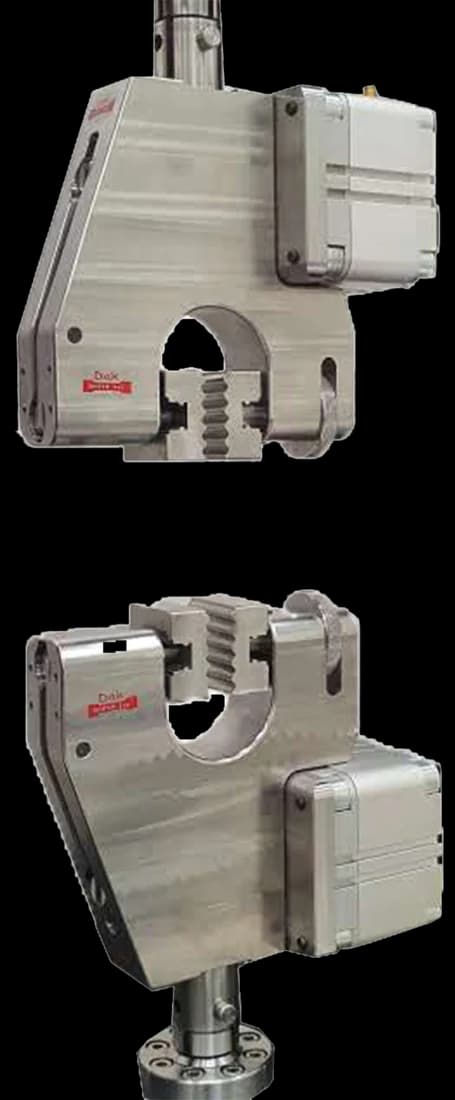
Pneumatic vice action grips with 25 mm square jaw faces
Standard 25 mm

Pneumatic Vice Action Grip

Pneumatic vice action grips hold a constant clamping force on two plies of quite different stiffness — a fabric ply and a rubber ply behave differently under a screw grip that keeps bedding in as the rubber relaxes.

Specifications

What the report has to contain

  • Reference to ASTM D413 and the edition
  • Which arrangement was used — machine or strip
  • Rubber compound and substrate identification
  • Bonded width
  • Conditioning and test temperature
  • Rate of separation
  • Average peel force and adhesion per unit width
  • Failure mode, classified
  • Any variation along the peel length
  • Number of specimens and the median

What the machine must be capable of

Low forces measured accurately: peel forces here commonly run from tens of newtons to a few hundred over a 25 mm width, so resolution at the bottom of the load cell's range matters far more than capacity. The crosshead must hold 50 mm/min steadily and have enough travel to peel a useful length after the run-in is discarded. The grips carry the awkward requirement, because they hold two materials of very different stiffness at once — a fabric ply and a rubber ply — and a screw grip keeps bedding in as the rubber relaxes beneath it. A constant-force pneumatic grip holds both without that drift.

What goes wrong in practice

The peel angle drifting is the characteristic problem, and it is specific to flexible-to-flexible bonds: both sides stretch under load, so an unconstrained peel opens up as the test proceeds and the force falls for a geometric reason that has nothing to do with the bond. Reporting only the average is the second: a trace that declines steadily along the specimen is telling you the cement was applied unevenly, which is a process finding an average discards. Omitting the failure mode is the third, since rubber tear, fabric tear and a clean interface point at three completely different causes. And using the cutter setting rather than the measured width puts a quiet systematic error into every figure.

ASTM D413 or ASTM D429

ASTM D413ASTM D429
SubstrateFlexible — fabric, cord, another rubber plyRigid — almost always metal
What can stretchBoth sidesOnly the rubber
Typical articleHose, belting, coated fabricMount, bush, roller
ResultForce per unit widthForce, or force per unit width by method

The two are not alternatives. A flexible-to-flexible peel and a rubber-to-metal peel are different mechanics, and a value from one says nothing about the other.

Questions we are asked about this test

What is ASTM D413?

It is the ASTM test method for the adhesion of vulcanised rubber to a flexible substrate, usually a textile ply. Two plies are separated at a controlled rate and the peel force per unit width is recorded, together with where the failure ran.

Why is ply adhesion so important for hoses and belts?

Because those articles almost never fail in tension. A hose or a conveyor belt is a laminate, and what actually happens in service is that the plies separate — from flexing, from heat, from a manufacturing defect in the cement layer. Once a ply lifts, the construction has lost the interaction that gave it strength, and the tensile figure that appears on the datasheet is no longer available.

What is the difference between D413 and D429?

The substrate, and therefore the mechanics. D429 bonds rubber to a rigid substrate, where only the rubber can stretch. D413 bonds it to a flexible one, where both sides deform and the peel geometry changes as the test proceeds. A value from one says nothing about the other.

Why does the peel angle drift?

Because both plies are flexible. On rubber-to-metal the substrate holds its shape and the angle stays where it was set; here, both sides stretch under load, so an unconstrained peel opens up as the test proceeds and the force falls for a purely geometric reason. Watching the angle through the run, and using the arrangement the specification names, keeps it comparable.

What does a falling peel trace mean?

Usually cement applied unevenly across the ply. A peel force that declines steadily along the specimen is telling you the bond varies down the length, which is a process finding rather than a material one. Averaging it into a single number hides exactly the information the trace is offering.

Which failure mode is the good one?

Rubber tearing within itself. That means the bond is stronger than the compound and there is nothing left to improve at the interface. Fabric pulling apart means the textile is the limit. A clean separation at the interface is the only outcome that points at the bonding process, and it is the only one worth chasing.

Does this apply to coated fabrics generally?

For the adhesion question, yes — it is the standard way of asking whether a coating will stay attached to its substrate. The wider set of properties for a coated fabric, including breaking strength and tearing strength, sits in ASTM D751, and the two are usually specified together.

Running ASTM D413 on the Series 7200 and Series 9000

Dak verifies against whichever standard the method names, and where a class applies our frames sit a class tighter than it asks.

The method asks forDak supplies
CapacityLow — commonly 20 N to 500 N over a 25 mm bonded widthLoad cells from 1 kg to 60 ton on the Series 7200, and 0.5 to 100 kN on the Series 9000
Force accuracyASTM E4Verified to ASTM E4, and to ISO 7500-1 Class 0.5
GrippingTensile grips holding the two plies; a machine-driven roller where the specification requires the 90° arrangementOur peel and adhesion fixtures, built to the specimen
Environment23 ± 2 °C standard laboratory atmosphere3009 series chambers, −150 °C to +400 °C — temperature only

This page describes the method as practised. The governing text is the current edition from the issuing body. Tell us what you are testing and we will answer with the machine, the fixture and a quotation.

Materials tested to it

The test it standardises

Other standards explained