Rubber, vulcanized or thermoplastic — Determination of adhesion to textile fabrics
Written and technically reviewed by Dak System Inc. engineering·Last reviewed
ISO 36 measures the adhesion between vulcanised or thermoplastic rubber and a textile fabric by peeling the two apart and recording the force per unit width. It is the international counterpart to ASTM D413, and it answers the question that decides whether a hose or a belt survives: not how strong the rubber is, but whether the plies stay together.
A specimen of rubber bonded to textile fabric is cut to a defined width, commonly 25 mm, along the ply direction rather than across the reinforcing cords. A short length is separated by hand to start the peel. The rubber ply is clamped in one grip and the fabric in the other, and the two are folded back on themselves so that they peel apart at 180°. The crosshead separates them at the rate the standard specifies, and force is recorded throughout. The run-in transient is discarded, the force averaged over a steady length, and the result divided by the measured bonded width.
What it measures, and why it matters
The result is adhesion in force per unit width, together with the failure mode. This is the property that governs whether a laminated rubber article holds together, and laminated rubber articles are almost everywhere load is carried flexibly — hydraulic and industrial hose, conveyor and transmission belting, diaphragms, expansion joints, inflatable structures. None of them fails in tension in normal service. What happens instead is that plies separate, from repeated flexing, from heat, or from a defect in the cement laid down during manufacture, and once a ply has lifted the construction no longer has the interaction that gave it its strength.
Specimen
The bond is built during manufacture. What the laboratory does is separate it in a controlled, repeatable way.
Bonded width
25 mm typicalMeasured on the specimen — the result is divided by it.
Geometry
180° strip peelThe two plies are pulled back on themselves in opposite directions.
Starting length
A short length separated by hand
Conditioning
Standard laboratory atmosphere
Cut cleanly along the ply
Not across the cordsDakA cut that severs reinforcing cords weakens the fabric ply and can make it tear before the bond does, which reports nothing about the adhesion.
Keep both plies fully gripped
Across the whole widthDak
Where the failure runs is the finding. Fabric tearing means the textile is the limit; rubber tearing means the compound is; a clean interface is the only outcome that points at the bonding process itself.
Test speed
Rate of separation
Commonly 100 mm/minConfirm against the edition in force — the rate is set by the standard rather than by convention.
Averaging
Over a steady length after the run-in
Watch for a stepped trace
It maps the cementDakRegular dips along the peel usually correspond to how the cement was laid down, which is a manufacturing finding.
Calculations
Adhesion strength—
Adhesion = average peel force / bonded width
average peel force
mean over the steady region, N
bonded width
mm
In N/mm or kN/m. There is no area at a peel front, so this is never expressed as a stress.
How the test runs
01Cut specimens along the ply direction, not across the cords.
02Measure the bonded width.
03Separate a short starting length by hand.
04Condition in the standard laboratory atmosphere.
05Clamp the rubber ply in one grip and the fabric in the other.
06Fold them back on themselves for a 180° peel.
07Separate at the specified rate, recording force.
08Discard the run-in and average over a steady length.
09Divide by the measured width.
10Examine the separated faces and classify the failure.
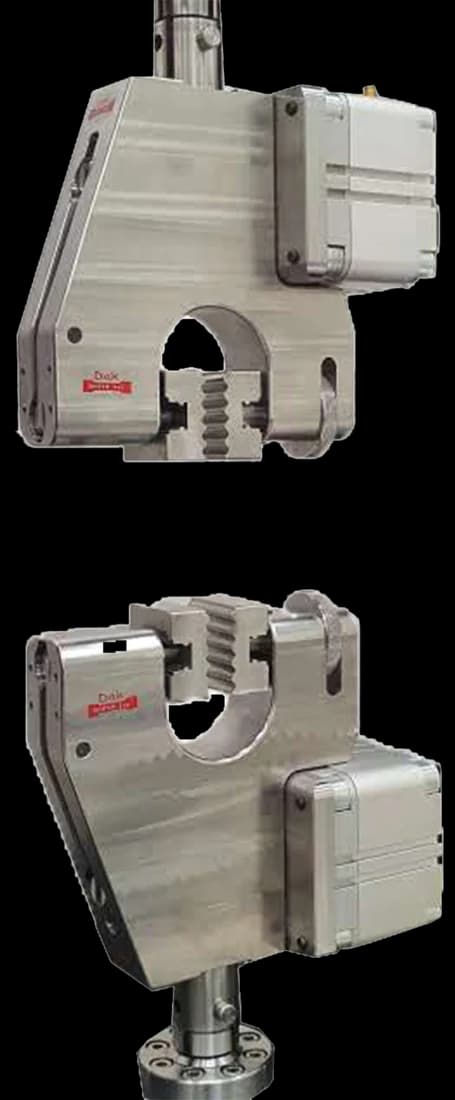
The fixture this method needs
Standard 25 mm
Pneumatic Vice Action Grip
Pneumatic vice action grips hold the fabric ply and the rubber ply at a constant, even clamping force across the full width — the two bed in at different rates under a screw grip, which shifts the peel line as the test proceeds.
Low forces measured well: peel forces commonly run from tens of newtons to a few hundred over a 25 mm width, so accuracy to ISO 7500-1 Class 1 at the bottom of the range matters far more than capacity. The crosshead must hold the specified rate steadily and offer enough travel to peel a useful length once the run-in has been discarded. The grips are the awkward part, because they hold two materials of very different stiffness at once and a screw grip beds into rubber at a different rate from fabric, shifting the peel line as the test proceeds. A constant-force pneumatic grip avoids that.
What goes wrong in practice
Cutting across the cords is the preparation error that most often invalidates a result, and it is easy to miss because the outcome looks like a real fabric failure. Reporting only the average is the most common analytical error: a trace with a repeating rhythm along its length is mapping how the cement was spread during manufacture, which is a process finding an average throws away. Omitting the failure mode loses the distinction between a bond stronger than the rubber and a bond that simply let go. And treating ISO 36 and ASTM D413 figures as interchangeable ignores a difference in rate that a rate-sensitive material does not.
ISO 36 or ASTM D413
ISO 36
ASTM D413
Geometry
180° strip peel
Machine or strip arrangement
Typical rate
100 mm/min
50 mm/min
Result
Force per unit width
Used by
International and European specifications
North American specifications
Close in intent and often quoted interchangeably, but the rates differ and rubber is rate-sensitive. A certificate should name the method actually run rather than the family.
Questions we are asked about this test
What is ISO 36?+
It is the ISO method for the adhesion between vulcanised or thermoplastic rubber and textile fabrics. The two are peeled apart at a controlled rate and the force per unit width is recorded, along with where the failure ran. It is the international counterpart to ASTM D413.
Why peel rather than pull?+
Because peel is how the joint actually fails. A laminated rubber article separates progressively from an edge or a defect, not by the whole bonded area letting go at once. A peel front also concentrates all the stress at a moving line, which makes it far more searching about bond consistency than any test that spreads load over an area.
Why does the specimen have to be cut along the ply?+
Because cutting across the reinforcing cords severs them, and a weakened fabric ply may tear before the bond does. When that happens the test has measured the damage done during preparation rather than the adhesion, and the result is not recoverable — it looks like a genuine fabric failure.
What does a stepped peel trace tell me?+
Usually how the cement was laid down. Regular dips along the peel length often correspond to the spread pattern during manufacture, so a trace with a repeating rhythm is a process finding rather than a material one. Reporting only the average discards exactly the information the trace is offering.
Which failure mode is best?+
Rubber tearing within itself. That means the bond is stronger than the compound, and no further work at the interface will help. Fabric tearing means the textile is the limit. A clean separation at the interface is the only outcome that points at the bonding process, and it is the one worth investigating.
Is ISO 36 the same as ASTM D413?+
Close in intent and often treated as interchangeable, but not identical. The rates differ, and rubber is rate-sensitive enough for that to matter. The certificate should name the method actually run rather than describing the family, because a customer specifying one will not accept a figure generated under the other without being told.
How does this relate to belt and hose standards?+
It is the underlying adhesion method those product standards call up or mirror. ISO 252 covers ply adhesion within conveyor belting, ASTM D378 and DIN 22102 do the same within their belt families, and hose standards specify adhesion between the tube, the reinforcement and the cover. All are asking the same question this method answers.
This page describes the method as practised. The governing text is the current edition from the issuing body. Tell us what you are testing and we will answer with the machine, the fixture and a quotation.