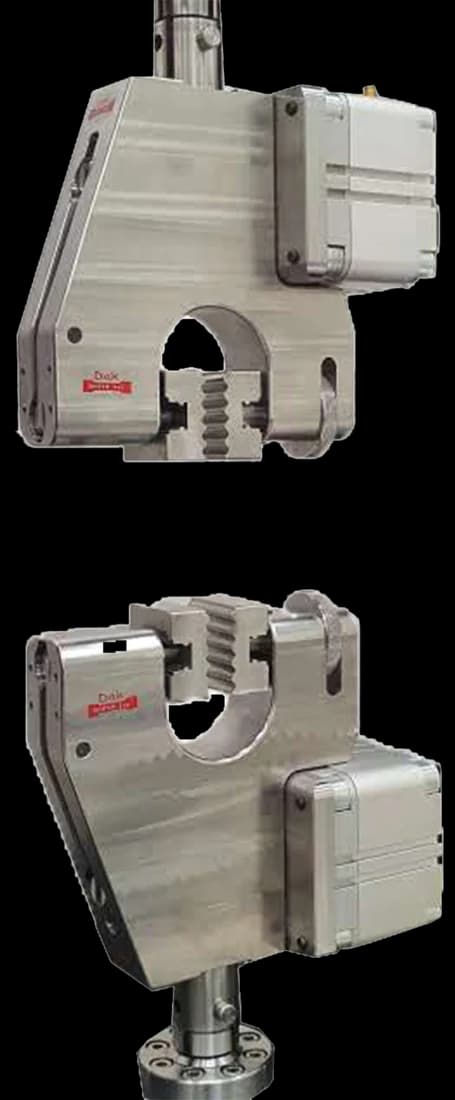
Standard 25 mm
Pneumatic Vice Action Grip
Pneumatic vice action grips hold a coated fabric at a constant even pressure, which is the practical answer to a material that slips under smooth faces and is cut by aggressive ones.
Specifications
Testing standard
Standard Test Methods for Coated Fabrics
Written and technically reviewed by Dak System Inc. engineeringLast reviewed
ASTM D751 is a collection of test methods for coated fabrics — materials with a polymer layer bonded to a textile substrate. It covers breaking strength by grab and strip procedures, tearing strength, coating adhesion, hydrostatic resistance and more, and it is the reference standard for tarpaulins, awnings, inflatables, conveyor belting and protective fabrics.
From the test method to your testing system
Explore the DAK machines already listed for ASTM D751, then review the grips, measurement and setup requirements below.
 Universal Testing MachineSeries 7200Explore the machine →
 Universal Testing MachineSeries 9000Explore the machine →
01Understand the method
For breaking strength — the most commonly cited part of the standard — a specimen of coated fabric is clamped in flat-faced grips and pulled to break, in either a grab geometry with 25 mm jaws on a wider specimen, or a strip geometry with the full width clamped. The grab procedure runs at 300 ± 10 mm/min over a 75 mm gauge. Warp and fill directions are tested separately. The standard also contains procedures for tearing strength, adhesion of the coating to the substrate, hydrostatic resistance and other properties, each with its own specimen and apparatus.
Coated fabrics are composite materials: a textile substrate carries the load while a polymer coating provides weatherproofing, abrasion resistance, air retention or chemical protection. The breaking strength procedures characterise what the substrate can carry, which decides whether a tarpaulin survives being tensioned, an awning holds up in wind, an inflatable structure retains its shape, or a protective fabric resists a snag. Because the coating and the substrate can fail independently, the standard's other procedures — particularly coating adhesion — often matter as much as strength, since a fabric whose coating delaminates has failed even with its substrate intact.
02Prepare the specimen and test settings
This is a family of methods rather than one, and the first decision is which procedure the specification actually calls for.
D751 contains many procedures and a bare reference to the standard is ambiguous. A certificate must name the procedure — grab or strip, and which of the tear, adhesion or burst methods — or it cannot be reproduced.
03Build the test setup on a DAK machine
Force measurement across a wide range — from a few hundred newtons for light coated cloth to well over ten kilonewtons for heavy industrial laminates — and a crosshead holding 300 mm/min for the grab procedure. At that speed over a 75 mm gauge, tests finish in seconds, so the data rate must be high enough to capture the peak and any two-stage behaviour. Grips must be wide enough for the specimen and must clamp evenly at a constant pressure, which favours pneumatic actuation. The retrievable ASTM record for D751 names no accuracy class and no machine specification, so none is quoted here. The laboratory needs the textile standard atmosphere.
Pneumatic vice action grips hold a coated fabric at a constant even pressure, which is the practical answer to a material that slips under smooth faces and is cut by aggressive ones.
Specifications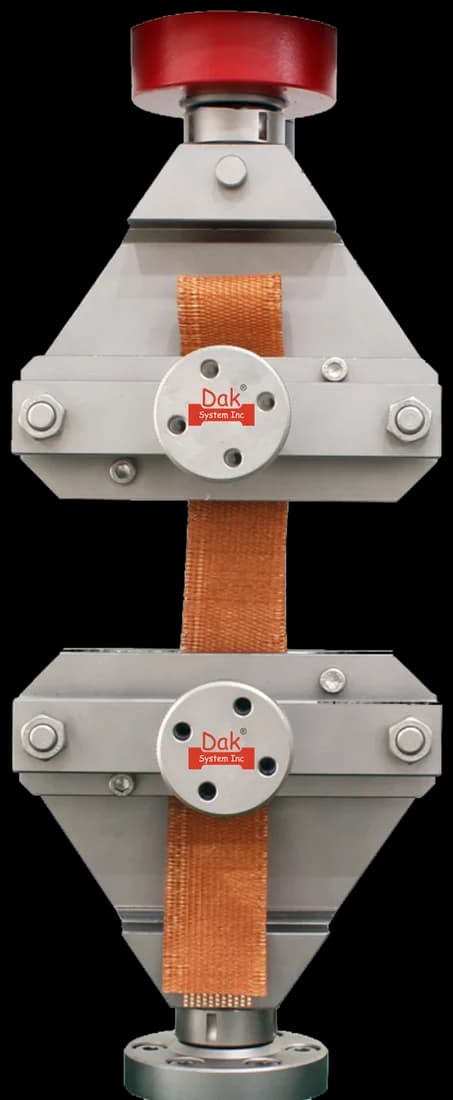
A 100 mm wide vice grip suits the strip procedure on heavier industrial coated fabrics, where the full specimen width has to be clamped.
SpecificationsDak verifies against whichever standard the method names, and where a class applies our frames sit a class tighter than it asks.
| The method asks for | Dak supplies | |
|---|---|---|
| Capacity | Moderate to high — from a few hundred newtons on light coated cloth to over 10 kN on heavy industrial laminates | Load cells from 1 kg to 60 ton on the Series 7200, and 0.5 to 100 kN on the Series 9000 |
| Force accuracy | unknown — the retrievable ASTM record for D751 names no accuracy class and no machine specification | ISO 7500-1 Class 0.5 — the method sets no class of its own |
| Gripping | Flat-faced grips wide enough for the specimen, with faces that hold a slick coated surface without cutting the substrate | Wedge, vice-action, pneumatic and hydraulic grips, built to the specimen |
| Environment | conditioned to Practice D1349, Rubber - Standard Conditions for Testing, named in this method's referenced documents; the retrievable D1349 record prints no figures, so none are quoted here | 3009 series chambers, −150 °C to +400 °C — temperature only |
04Run the test
05Calculate, report and interpret
The maximum force recorded, in N
Reported for the stated procedure and specimen geometry. Grab and strip figures are not comparable.
ε = ΔL / L₀ × 100
The most damaging error is a certificate that cites only ASTM D751 without naming the procedure, which leaves the result unreproducible — grab and strip give different numbers, and the tear, adhesion and burst methods measure different properties entirely. In the laboratory, grip problems dominate: slippage on the coating and cutting through it are opposite failures with the same cure, which is face selection rather than clamping pressure. Inconsistent specimen orientation on asymmetrically coated fabrics adds avoidable scatter. And a two-stage curve, where the coating fails before the substrate, needs a decision about which peak is being reported.
06Compare methods and find answers
| ASTM D751 | ISO 1421 | |
|---|---|---|
| Scope | A family covering strength, tear, adhesion, burst | Tensile strength and elongation specifically |
| Breaking strength procedures | Grab and strip | Strip method, with a defined width |
| Typical use | North American specifications | European and international specifications |
The conditioning atmospheres can differ between the two, and coated fabrics with hygroscopic substrates respond to that. Where both are quoted for one product, check which atmosphere each figure came from before comparing them.
It is a collection of ASTM test methods for coated fabrics — textiles with a bonded polymer layer. It covers breaking strength by grab and strip procedures, tearing strength, coating adhesion, hydrostatic resistance, blocking and other properties. It is the reference standard for tarpaulins, awnings, inflatable structures, conveyor belting and protective fabrics.
Because the standard contains many distinct procedures, and a bare reference does not say which was run. Grab and strip breaking strength give different numbers on the same material, and the tear, adhesion and burst methods measure entirely different things. A certificate that names only D751 cannot be reproduced or meaningfully compared, so the procedure has to be named explicitly.
Because the coating makes the surface slick while the substrate underneath is what carries the load. Smooth grip faces slide on the coating; aggressive serrated faces bite through the coating and into the textile, notching the specimen so it breaks at the jaw. The answer is face selection rather than more pressure — rubber-faced or lightly textured jaws usually work where neither extreme does.
Usually that the coating has failed before the substrate. On some laminates the polymer layer cracks at a lower elongation than the textile can reach, producing a shoulder in the trace, after which the substrate carries on to its own break. Which of the two the specification means by breaking strength is worth agreeing before testing, because they can differ substantially.
On an asymmetrically coated fabric, yes. One face is polymer and the other may be exposed textile or a different coating, and they grip quite differently. Keeping the orientation consistent across a set removes a source of scatter, and recording it means a later batch can be tested the same way. It is one of those details that costs nothing to control and is impossible to recover afterwards.
Whichever the specification names. Grab is quicker and is the more commonly specified for routine acceptance; strip is more representative of the material's intrinsic strength because every yarn carries load, and it gives lower numbers. As with uncoated fabrics, there is no conversion between them, so the two cannot be substituted for one another.
Coated fabric methods characterise the belt's carcass material, but a finished conveyor belt has its own standards — ASTM D378 and ISO 283 cover full-thickness belt tensile testing, and ISO 9856 covers elastic and permanent elongation. D751 is the right reference for the coated fabric as a material, and the belt standards for the assembled product.
Discuss your specimen, test requirements and reporting needs with DAK engineering.
This page describes the method as practised. The governing text is the current edition from the issuing body. Tell us what you are testing and we will answer with the machine, the fixture and a quotation.