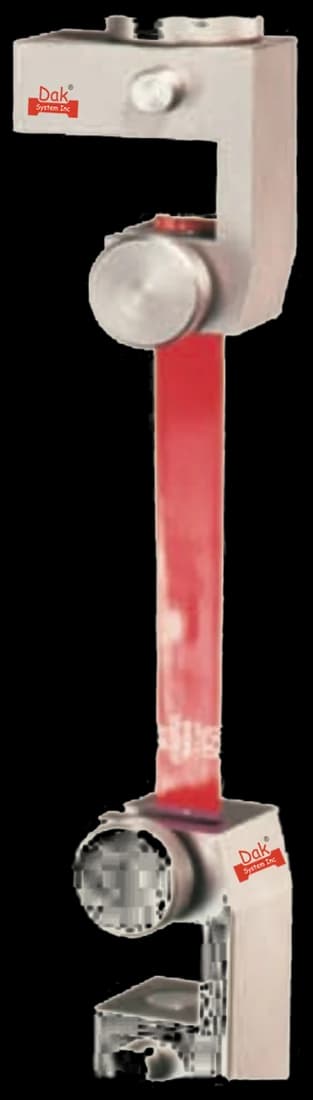
Rubber facedTJ-34
25mm Square Vice Action Grip
Square vice-action faces 25 mm wide — the exact jaw width the grab method defines, which is the geometry rather than a convenience.
Specifications
Testing standard
Standard Test Method for Breaking Strength and Elongation of Textile Fabrics (Grab Test)
Written and technically reviewed by Dak System Inc. engineeringLast reviewed
ASTM D5034 is the grab tensile test for fabrics. A 100 mm wide strip is clamped by jaw faces only 25 mm wide, so a central band carries the load while the fabric either side of it contributes through the weave. It reports grab breaking force and elongation, separately for warp and filling — the numbers written into apparel, upholstery and geotextile specifications.
From the test method to your testing system
Explore the DAK machines already listed for ASTM D5034, then review the grips, measurement and setup requirements below.
 Universal Testing MachineSeries 7200Explore the machine →
 Universal Testing MachineSeries 9000Explore the machine →
01Understand the method
A 100 mm wide fabric strip is clamped between two pairs of jaws set 75 mm apart, but the jaw faces are only 25 mm wide, so just a central band of the fabric is actually held. One clamp moves at constant speed until the fabric ruptures. Peak force and the extension at that point are recorded, giving grab breaking force and elongation.
The method reports breaking force in newtons and elongation at that force, separately for warp and filling directions because the two rarely match. Buyers write grab strength into apparel, upholstery, geotextile and protective-clothing specifications, so the number functions as a lot-release gate rather than a design constant. It also ranks candidate constructions during sourcing and diagnoses process faults — a filling-direction drop after a finishing change points at fibre damage in the range. Elongation flags fabrics too extensible for their intended seam or frame.
02Prepare the specimen and test settings
03Build the test setup on a DAK machine
The clamped band is narrow, so grab forces sit well below full-width strip values. Most apparel, upholstery and nonwoven fabrics break between roughly 100 N and 1,2 kN, and a 500 N to 1 kN capacity meets most buyer specifications; heavy coated and industrial fabrics push the demand towards 5 kN. The method calls for a constant-rate-of-extension frame at 300 mm/min ±10 mm/min unless a material specification says otherwise. Textiles are rate-sensitive, so a frame that overshoots on acceleration or cannot hold speed under falling load will bias the peak.
No extensometer is required — elongation is taken from crosshead travel over the 75 mm gauge separation, which is why that separation must be set accurately. The fixture is the method: grab clamps with unequal faces, 25 × 25 mm at the front and 25 × 50 mm behind, faced with rubber around 1,5 mm thick or similar so the fabric is held without being cut. Ordinary flat wedge grips clamp the full width and give strip results, not grab results, which are not comparable. Testing outside the standard atmosphere needs a conditioned room or chamber; wet testing needs immersion facilities beside the frame.
Square vice-action faces 25 mm wide — the exact jaw width the grab method defines, which is the geometry rather than a convenience.
Specifications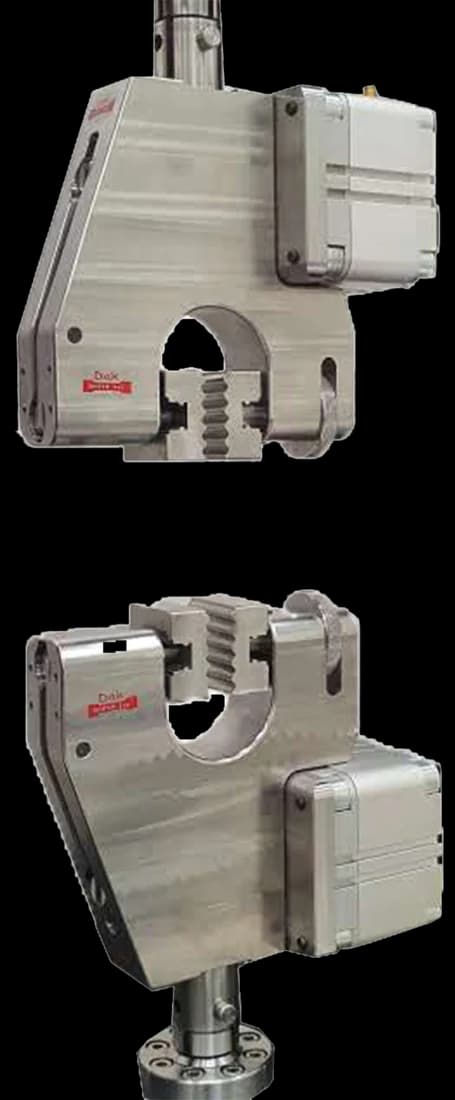
Air-driven closure applies identical pressure to every specimen, removing operator grip force as a variable across a long run of replicates.
SpecificationsDak verifies against whichever standard the method names, and where a class applies our frames sit a class tighter than it asks.
| The method asks for | Dak supplies | |
|---|---|---|
| Capacity | Because only a 25 mm band is clamped, grab breaking forces sit well below full-width strip values — most apparel, upholstery and nonwoven fabrics break between about 100 N and 1,2 kN, and a 500 N to 1 kN capacity satisfies most buyer specifications; heavy coated and industrial fabrics take the demand toward 5 kN. | Load cells from 1 kg to 60 ton on the Series 7200, and 0.5 to 100 kN on the Series 9000 |
| Force accuracy | ASTM D76, Specification for Tensile Testing Machines for Textiles — the machine specification named in this method's referenced documents | ISO 7500-1 Class 0.5, verified to ASTM E4, DIN 51221 and BS 1610 |
| Gripping | Grab clamps with 25 × 25 mm front and 25 × 50 mm rear jaw faces at 75 mm separation | Our vice-action grips, built to the specimen |
| Environment | conditioned to Practice D1776/D1776M, named in this method's referenced documents; the retrievable D1776 record prints no temperature or humidity figures, so none are quoted here | 3009 series chambers, −150 °C to +400 °C — temperature only |
04Run the test
05Calculate, report and interpret
F = peak force, in newtons
Reported as a FORCE, not a stress. There is no meaningful cross-sectional area for a fabric, and dividing by one would import a thickness measurement nobody trusts.
E = (extension at peak / gauge length) × 100
Jaw breaks dominate: the fabric fails at the clamp line rather than in the free band, usually from over-tightening or worn facings, and the recorded force is low. Slippage is the mirror fault — the fabric creeps out under load, inflating elongation and flattening the curve. Off-centre mounting puts the 25 mm band away from the marked line, so the surrounding yarns share load unevenly. Fabrics stretching beyond about 11 % fall outside the method's recommended scope, and the result loses meaning rather than merely losing precision.
06Compare methods and find answers
Two fabric tensile methods that give different numbers on the same cloth, on purpose.
| ASTM D5034 grab | ASTM D5035 strip | ISO 13934-1 strip | |
|---|---|---|---|
| Specimen width | 100 mm | Cut to width | 50 mm |
| Held width | 25 mm central band | Full width | Full width |
| Load path | Shared through the weave | Only the clamped yarns | Only the clamped yarns |
| Result | Higher | Lower | Lower |
| Represents | Fabric as used, load spreading | Yarn strength in the strip | Yarn strength in the strip |
A grab figure and a strip figure are not two measurements of one property. The grab test lets surrounding fabric share the load, which is closer to how a garment or geotextile actually carries force — and it is why the two must never be compared or substituted in a specification.
It is the ASTM grab tensile test for fabrics. A 100 mm wide strip is clamped by jaw faces only 25 mm wide and pulled until it ruptures, and the method reports grab breaking force in newtons and elongation at that force, separately for the warp and filling directions.
The jaw faces are narrower than the specimen. Only a 25 mm central band is actually held, so the fabric on either side contributes through the weave rather than being clamped. That is deliberate: it represents how a fabric shares load in use, where a tear or a point load is resisted by more cloth than is directly stressed.
Because the surrounding fabric helps. In a strip test only the clamped yarns carry the load; in a grab test the yarns beside the jaw faces are pulled in through the weave and take a share. On the same cloth the grab figure is therefore higher, and the two are not interchangeable in a specification.
Because a fabric has no meaningful cross-sectional area. Dividing by a thickness would import a measurement that varies with how hard the gauge presses and would make the result less repeatable, not more. Textile methods report force per specimen or force per width for exactly this reason.
Because a woven fabric is anisotropic and the two rarely match — often by a wide margin. A single averaged figure describes neither direction. The gap between them is also diagnostic: a filling-direction drop after a finishing change points at fibre damage in the range.
Because replicates that contain the same warp ends are not independent measurements. If one yarn is weak, several specimens inherit it, and the standard deviation understates the real variability of the fabric. Spacing specimens across the width is what makes the statistics mean anything.
Discuss your specimen, test requirements and reporting needs with DAK engineering.
This page describes the method as practised. The governing text is the current edition from the issuing body. Tell us what you are testing and we will answer with the machine, the fixture and a quotation.