Standard 25 mm
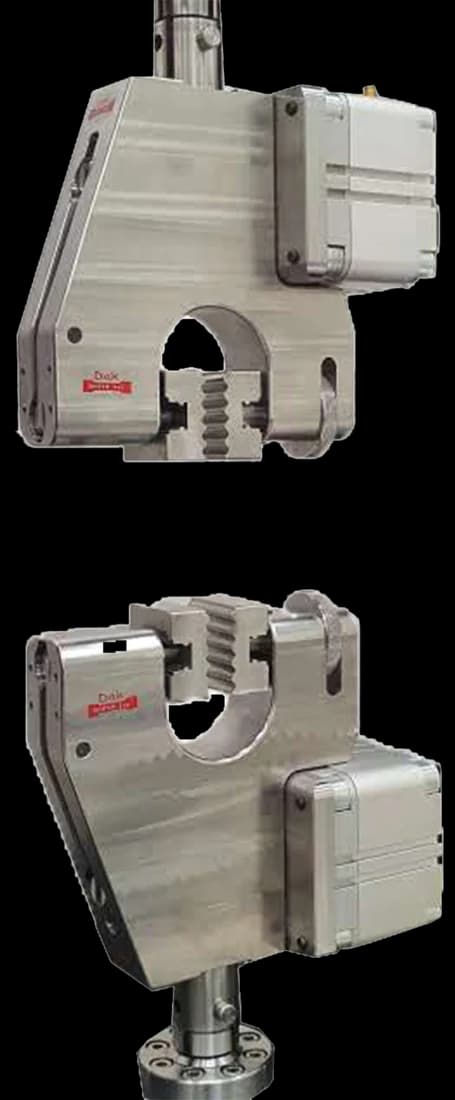
Pneumatic Vice Action Grip
Pneumatic vice action grips clamp the full strip width at a constant, even pressure, which is what stops one side of the fabric slipping or tearing before the other.
Specifications
Testing standard
Standard Test Method for Breaking Force and Elongation of Textile Fabrics (Strip Method)
Written and technically reviewed by Dak System Inc. engineeringLast reviewed
ASTM D5035 measures the breaking force and elongation of a textile fabric using the strip method. A strip of specified width is clamped across its whole width and pulled to break, so every yarn in the specimen carries load. It contrasts with the grab method, where a narrower jaw grips only part of a wider specimen.
From the test method to your testing system
Explore the DAK machines already listed for ASTM D5035, then review the grips, measurement and setup requirements below.
 Universal Testing MachineSeries 7200Explore the machine →
 Universal Testing MachineSeries 9000Explore the machine →
01Understand the method
A strip of fabric is cut oversized and then ravelled down to the test width — commonly 25 or 50 mm — so that only whole yarns remain across it. For fabrics that cannot be ravelled, such as nonwovens, felts and coated goods, a cut strip is used instead. The strip is clamped across its entire width in flat-faced grips over a gauge length of about 75 mm, given a small pretension to remove slack, and pulled at a rate that breaks it in roughly twenty seconds. Force is recorded against grip separation. Warp and weft directions are tested separately and reported separately.
The outputs are breaking force and elongation at break, for a stated strip width and direction. Because the grips hold the full width, every yarn carries its own share of the load, which makes this the more direct measure of a fabric's intrinsic tensile strength. It is used to specify and accept woven and nonwoven fabrics across apparel, technical textiles, geotextiles and industrial goods, and to verify that a fabric will survive making-up, installation and service. Elongation matters alongside force, because a fabric that reaches its breaking load with very little give behaves quite differently in use from one that stretches.
02Prepare the specimen and test settings
The strip method's defining feature is that the grips hold the entire width. That makes edge preparation part of the measurement rather than tidying up.
Strip and grab results are not interchangeable. In the strip method every yarn carries load; in the grab method the yarns beside the jaw help their neighbours, which raises the recorded force. A grab result is normally higher and the two must not be compared.
03Build the test setup on a DAK machine
Force measurement across a range from tens of newtons for light apparel fabric to several kilonewtons for industrial textiles, and a crosshead offering enough rates to achieve a twenty-second break on fabrics ranging from a few per cent elongation to several hundred. Grips must be at least as wide as the specimen and clamp evenly across it, which in practice favours pneumatic jaws over screw-tightened ones. Face selection is a real variable: smooth faces slip on coated goods while aggressive serrations cut fine fabrics. The retrievable ASTM record for D5035 names no accuracy class and no machine specification, so none is quoted here. The laboratory needs the textile standard atmosphere.
Pneumatic vice action grips clamp the full strip width at a constant, even pressure, which is what stops one side of the fabric slipping or tearing before the other.
SpecificationsDak verifies against whichever standard the method names, and where a class applies our frames sit a class tighter than it asks.
| The method asks for | Dak supplies | |
|---|---|---|
| Capacity | Low to moderate — from tens of newtons on light apparel fabric to several kilonewtons on industrial textiles | Load cells from 1 kg to 60 ton on the Series 7200, and 0.5 to 100 kN on the Series 9000 |
| Force accuracy | ASTM D76, Specification for Tensile Testing Machines for Textiles — the machine specification named in this method's referenced documents | ISO 7500-1 Class 0.5, verified to ASTM E4, DIN 51221 and BS 1610 |
| Gripping | Flat-faced grips at least as wide as the specimen, with faces chosen to hold without cutting the fabric | Wedge, vice-action, pneumatic and hydraulic grips, built to the specimen |
| Environment | conditioned to Practice D1776/D1776M, named in this method's referenced documents; the retrievable D1776 record prints no temperature or humidity figures, so none are quoted here | 3009 series chambers, −150 °C to +400 °C — temperature only |
04Run the test
05Calculate, report and interpret
The maximum force recorded, in N
Reported for the stated strip width. It is not normalised to a stress, because fabric thickness is not a meaningful denominator.
ε = ΔL / L₀ × 100
Grip problems dominate, and they come in two opposite forms — slippage on slick fabrics and jaw breaks on delicate ones — with the cure in both cases being the face material rather than more pressure. Testing in the wrong atmosphere is a systematic error that a laboratory handling both plastics and textiles makes easily. Comparing strip results with grab results is the most consequential reporting mistake, since the two give different numbers on the same fabric and no fixed factor converts between them. On loose weaves, measuring rather than counting the ravelled width introduces an avoidable spread.
06Compare methods and find answers
| Strip (D5035) | Grab (D5034) | |
|---|---|---|
| Specimen width | Equals the clamped width | Wider than the clamped width |
| Load carried by | Every yarn in the specimen | Clamped yarns, assisted by their neighbours |
| Typical result | Lower | Higher |
| Better represents | The fabric's intrinsic strength | Fabric in use, where surrounding material helps |
Neither is more correct; they answer different questions and give different numbers on the same fabric. A specification naming one is not satisfied by the other, and the difference between them is not a fixed factor that can be applied to convert.
It is the ASTM strip method for the breaking force and elongation of textile fabrics. A strip of specified width — ravelled to width for woven fabrics — is clamped across its entire width and pulled to break, so every yarn in the specimen carries load. Warp and weft are tested and reported separately.
In the strip method the grips hold the whole specimen width, so each yarn carries its own load. In the grab method, ASTM D5034, a narrower jaw grips the middle of a wider specimen, and the yarns beside the jaw help carry load through the fabric structure. That assistance makes grab results higher on the same fabric. Neither is more correct — they answer different questions, and the difference is not a fixed factor you can convert with.
Because cutting through a woven fabric leaves partly severed yarns along both edges that cannot carry their full share of load. Ravelling removes those edge yarns entirely, so the strip that remains consists only of whole yarns. For nonwovens, felts and coated fabrics there are no yarns to ravel, and a cut strip is used instead — which is noted in the report.
Because fabric thickness is not a meaningful denominator. A woven fabric is mostly air, its measured thickness depends on the pressure used to measure it, and dividing by it would produce a number that varies with the gauge rather than the material. Breaking force for a stated strip width is unambiguous, and it is what fabric specifications are written in.
The public ASTM record for D5035 prints no atmosphere and names no conditioning practice, so no figure is published here. The requirement still matters. Natural and regenerated fibres change strength appreciably with moisture regain — cotton gets stronger as it takes up moisture, viscose weaker — so testing in the wrong atmosphere produces a consistent bias. It is one of the easiest mistakes for a general-purpose laboratory to make.
The grip faces before the pressure. Smooth faces slip on coated and slick fabrics, while aggressive serrated faces cut fine ones and cause jaw breaks instead. Matching the face to the fabric solves most cases — rubber-faced or lightly textured jaws for slippery goods, softer faces for delicate ones. Raising the pressure on a smooth face usually just crushes the fabric at the jaw line.
That the yarns are breaking progressively rather than together — a few give way, load redistributes, then a few more. It is common in fabrics with variable yarn strength or uneven tension in the weave. The peak force is still the breaking force, but the shape carries information the number does not: a fabric that fails in one clean drop has more uniform yarns than one that steps its way down.
Discuss your specimen, test requirements and reporting needs with DAK engineering.
This page describes the method as practised. The governing text is the current edition from the issuing body. Tell us what you are testing and we will answer with the machine, the fixture and a quotation.