Rigidly fixedTJ-146
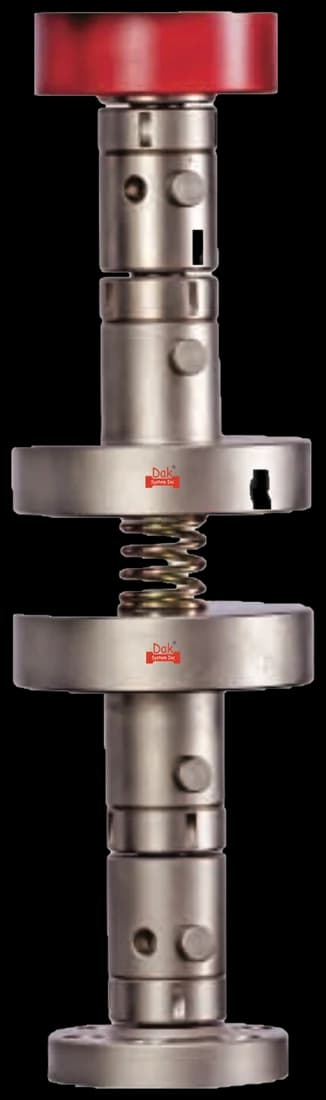
Compression Anvils
Hardened parallel anvils holding a fixed separation for hours. Stability over time is the requirement here rather than capacity.
Specifications
Testing standard
Standard Test Methods for Creep Relaxation of a Gasket Material
Written and technically reviewed by Dak System Inc. engineeringLast reviewed
ASTM F38 measures creep relaxation of a gasket material — how much of the bolt load a gasket loses over time. The specimen is compressed to a specified stress, the platens held at fixed separation, and the falling force watched. The result is the percentage of the original load still there after a stated period, often at temperature.
From the test method to your testing system
Explore the DAK machines already listed for ASTM F38, then review the grips, measurement and setup requirements below.
 Universal Testing MachineSeries 7200Explore the machine →
 Universal Testing MachineSeries 9000Explore the machine →
01Understand the method
A gasket specimen is compressed between platens to a specified stress and held there while the load is monitored, either at room temperature or at an elevated one. Nothing moves after the initial compression: the platens are held at fixed separation and the force the gasket exerts is watched as it decays. The test reports how much of that force is left after a stated time.
The result is creep relaxation — the percentage of the original bolt load a gasket loses over the test period. It is the single most useful gasket property for a bolted flange, because a joint does not fail when the gasket is crushed; it fails when the residual load falls below what the internal pressure needs. A material with excellent compressibility and poor relaxation resistance will seal on assembly and leak after a thermal cycle, which is exactly the field failure this test predicts.
The figure is read against the joint rather than against the material. A flange bolted to a given preload has a residual load below which the internal pressure will lift the seal, and creep relaxation says how quickly the gasket walks the joint toward that point. Two materials with identical compressibility can behave entirely differently here, because relaxation is governed by the binder and the reinforcement rather than by how readily the sheet compresses.
02Prepare the specimen and test settings
03Build the test setup on a DAK machine
The binding requirement is holding a fixed displacement while measuring a falling force — a stiff frame, a load cell stable over hours, and no drift in the displacement control. Elevated-temperature work needs a heated platen arrangement or a chamber, held closely enough that the temperature is not itself the variable being measured. Force capacity is modest; stability over time is everything.
There is no crosshead rate here, but the method is not silent on speed: it fixes how quickly the load goes on, in the units it works in. Method A takes the gasket to an initial stress of 13,8 ± 0,3 MPa (2 000 ± 50 psi) at a uniform rate such that the stress is reached at the end of 10 ± 2 s — about 1,4 MPa per second — with readings then at 10 s, 1 min, 6 min, 30 min, 1 h, 5 h and 24 h, at 20 to 30 °C. Method B applies the stress in one continuous motion with a maximum loading time of 3 s, or 5 s where the specimen is thicker than 0,8 mm, and the assembly then sits for 22 h at 100 ± 2 °C before the final reading. A slow tightening quietly spends relaxation before the clock starts.
The demand is stability rather than capacity. The load cell must hold its calibration over the whole measurement period, the displacement control must not drift, and the frame itself must not creep — because every one of those failures unloads the specimen and is recorded as gasket relaxation. Running a rigid dummy through the same schedule is the practical way to establish how much of the observed decay belongs to the machine before any material result is trusted.
Hardened parallel anvils holding a fixed separation for hours. Stability over time is the requirement here rather than capacity.
Specifications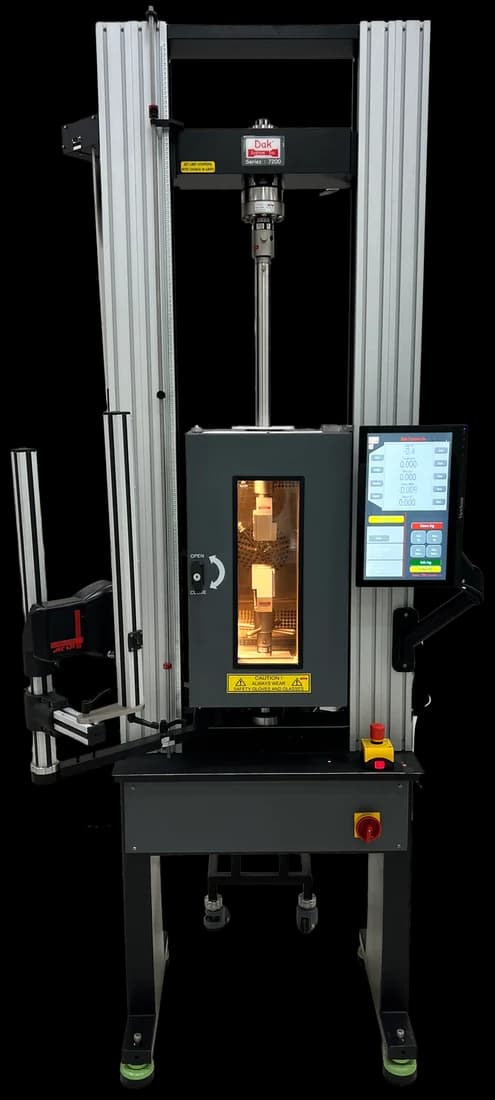
A controlled enclosure for elevated-temperature relaxation, held closely enough that the temperature is not itself the variable being measured.
SpecificationsDak verifies against whichever standard the method names, and where a class applies our frames sit a class tighter than it asks.
| The method asks for | Dak supplies | |
|---|---|---|
| Capacity | Modest force, but held for hours. Stability of the load cell over time matters more than its capacity. | Load cells from 1 kg to 60 ton on the Series 7200, and 0.5 to 100 kN on the Series 9000 |
| Force accuracy | unknown — ASTM E4 is not among this method's referenced documents, which name no force-verification standard and no accuracy class | ISO 7500-1 Class 0.5 — the method sets no class of its own |
| Gripping | Flat parallel platens holding a fixed separation, heated where elevated-temperature relaxation is required. | Our compression anvils, built to the specimen |
| Environment | Ambient or elevated. Temperature is held throughout and reported with the result. | 3009 series chambers, −150 °C to +400 °C — temperature only |
04Run the test
05Calculate, report and interpret
CR = ((F₀ − F_t) / F₀) × 100
The percentage LOST. A low number is the good result — it means the gasket is still doing the job the bolts set it up to do.
Frame relaxation is mistaken for gasket relaxation more often than anything else: a frame that creeps under load unloads the specimen, and the recorded decay belongs to the machine. Insufficient soak time before the measurement period starts inflates the apparent relaxation. And reporting a room-temperature figure against a specification written for elevated temperature is a substitution that looks reasonable and is not.
Elevated-temperature work adds its own traps. Thermal expansion of the load train changes the effective compression as the assembly heats, so a test started before the temperature is stable measures expansion as well as relaxation. And a specimen that has dried out or absorbed moisture during a long soak is no longer the material that was specified, which is why the conditioning atmosphere is held rather than merely established at the start.
06Compare methods and find answers
| ASTM F38 | ASTM F36 | |
|---|---|---|
| Measures | Load lost over time | Compressibility and recovery |
| Timescale | Hours, often hot | Minutes |
| Answers | Will it stay loaded? | Will it conform and spring back? |
| Failure it predicts | A leak after a thermal cycle | A poor initial seal |
A bolted flange does not fail because the gasket was crushed. It fails when the residual load falls below what the internal pressure needs — which is what this test measures and F36 does not.
It is the ASTM test method for creep relaxation of a gasket material. The specimen is compressed to a specified stress, the platens are held at a fixed separation, and the force the gasket exerts is monitored as it decays. The result is the percentage of the original load lost over a stated period.
Because a bolted joint does not fail when the gasket is crushed — it fails when the residual load falls below what the internal pressure requires. Relaxation is the mechanism that gets it there, so a material that holds its load is the one that keeps sealing through thermal cycles and time.
Because a gasket material relaxes far faster while its temperature is still changing. Starting the clock during warm-up records the heating alongside the creep, and the reported relaxation comes out high for a reason that has nothing to do with the material's long-term behaviour.
By checking the frame first. A frame that creeps under sustained load unloads the specimen, and that decay is recorded as gasket relaxation. Running the test with a rigid dummy in place of the gasket, over the same period, shows how much of the fall belongs to the machine.
No. Relaxation is strongly temperature-dependent, and a material that loses a few percent at ambient can lose a great deal more at service temperature. Substituting the easier test is a common shortcut and it produces a figure that will not hold up when the joint is hot.
Method B's own default is 22 h at 100 ± 2 °C, and Method A takes readings at 10 s, 1 min, 6 min, 30 min, 1 h, 5 h and 24 h. Beyond that it runs as long as the specification requires, and the period is part of the result — a twenty-two-hour figure and a hundred-hour figure describe different amounts of decay in the same material. Longer runs discriminate better between materials because relaxation slows with time, so most of the difference between compounds has emerged by the end of a long test and not by the end of a short one.
It will give a number and the number will flatter the gasket. Relaxation is strongly temperature-dependent, so a material that loses a few per cent at ambient can lose several times that at service temperature. Where the specification names a temperature, testing below it is not a conservative simplification — it is the wrong test.
Discuss your specimen, test requirements and reporting needs with DAK engineering.
This page describes the method as practised. The governing text is the current edition from the issuing body. Tell us what you are testing and we will answer with the machine, the fixture and a quotation.