Uniform momentTJ-165
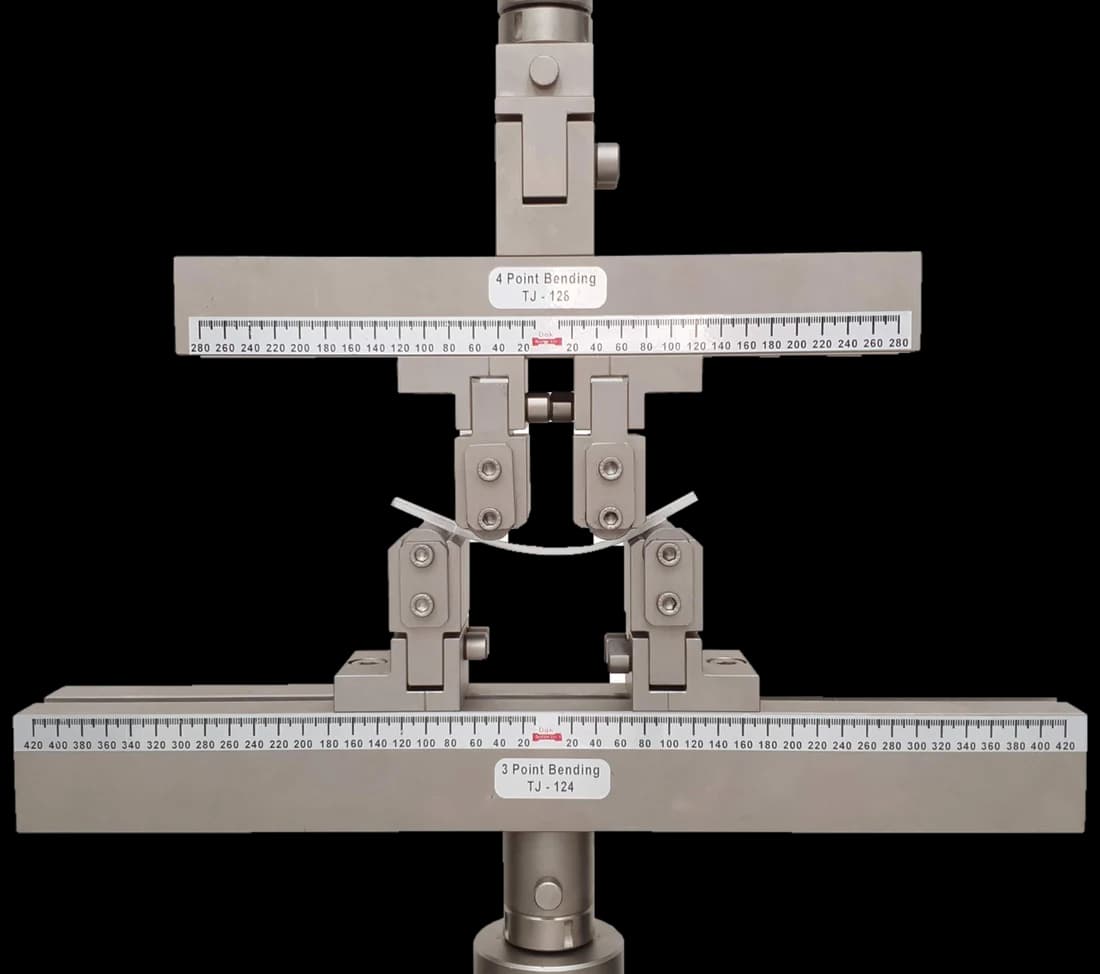
Four Point Bend Fixture
Force enters at two positions along the span and is reacted outboard of them, so a defined length of the bar carries equal bending moment rather than a single contact line.
Specifications
Testing standard
Standard Test Method for Flexural Properties of Unreinforced and Reinforced Plastics and Electrical Insulating Materials by Four-Point Bending
Written and technically reviewed by Dak System Inc. engineeringLast reviewed
ASTM D6272 measures the flexural properties of plastics and electrical insulating materials in four-point bending. A bar rests on two supports and two loading noses press down on it, so a length of the specimen carries equal bending moment rather than a single line beneath one nose. It reports flexural strength, flexural stress at 5 % strain and flexural modulus.
From the test method to your testing system
Explore the DAK machines already listed for ASTM D6272, then review the grips, measurement and setup requirements below.
 Universal Testing MachineSeries 7200Explore the machine →
 Universal Testing MachineSeries 9000Explore the machine →
01Understand the method
A rectangular bar of plastic or insulating board rests unclamped on two parallel rollers. Two further rollers descend onto its upper face, each set an equal distance from its nearest support, and bend the bar. Force and mid-span deflection are recorded continuously until the bar ruptures or reaches 5.0 % outer-fibre strain, whichever comes first.
The method reports flexural strength — the modulus of rupture — flexural stress at 5.0 % strain for bars that never break, and flexural modulus. Modulus is a direct design input for the stiffness of a moulded rib, an enclosure wall or a laminate panel, and feeds finite-element models. Strength figures drive lot release and grade selection, and qualify electrical insulating boards. Because two noses spread peak stress across a length of material rather than concentrating it under one point, the result reflects the weakest section within that region.
02Prepare the specimen and test settings
Four-point bending has one geometry that three-point does not: the load span, meaning the distance between the two upper noses. Which one you use changes the stress equation, and it is the detail that goes wrong most often.
Record which load span you used. Swapping one-third and one-half rollers without changing the stress equation puts every result out by a fixed factor — and because the curve still looks normal, nothing on the screen will tell you.
As with three-point bending, the standard names a strain rate and the crosshead speed is calculated from the specimen. The formula differs from D790's because the loading geometry differs.
R = 0.185 · Z · L² / d
The 0.185 coefficient belongs to the one-third load span. A different load span needs the coefficient from the standard's own text.
03Build the test setup on a DAK machine
Four-point loading splits the force between two noses, so reaching the same outer-fibre stress takes roughly twice the total force of a three-point test on the same bar. Expect tens of newtons for soft unreinforced grades and up to about 2–3 kN for stiff reinforced bars, so resolution at the low end matters more than headline capacity. The force system must be verified to ASTM E4.
Rate is fixed by procedure: Procedure A uses a strain rate of 0.01 mm/mm/min for small deflections and is preferred for modulus, Procedure B uses 0.10 mm/mm/min for large deflections and strength. Crosshead speed follows the standard's formula — for a one-third load span, R = 0.185·Z·L²/d — giving roughly 1.5 mm/min and 15 mm/min respectively for the 3.2 mm bar on a 51.2 mm span. Plastics are rate-sensitive, so the procedure used must be reported alongside the number.
Deflection or strain must be captured cleanly across 0–5 % outer-fibre strain; ASTM E83 is the referenced classification, with the required class set by the standard's text. The fixture is two supports and two loading noses, all parallel hardened cylinders — commonly 4, 6 or 10 mm diameter, seated in vee-grooves so they rotate rather than drag. Rollers that cannot turn add friction to the measured load. Testing away from the standard atmosphere needs an environmental chamber.
Force enters at two positions along the span and is reacted outboard of them, so a defined length of the bar carries equal bending moment rather than a single contact line.
Specifications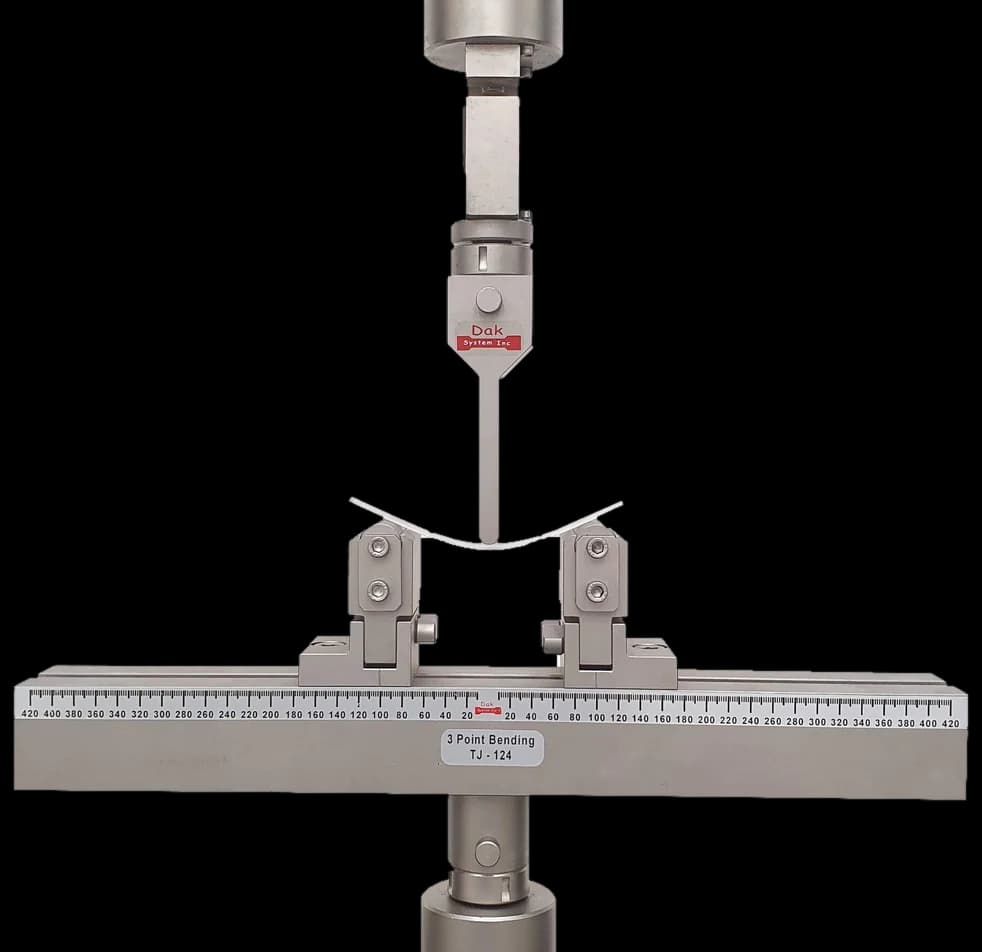
The three-point fixture, for the ASTM D790 comparison runs that usually sit beside this method on the same frame.
SpecificationsDak verifies against whichever standard the method names, and where a class applies our frames sit a class tighter than it asks.
| The method asks for | Dak supplies | |
|---|---|---|
| Capacity | Because the load is shared between two noses, four-point testing needs roughly twice the total force of three-point for the same outer-fibre stress: expect tens of newtons for soft grades up to about 2-3 kN for stiff reinforced bars. | Load cells from 1 kg to 60 ton on the Series 7200, and 0.5 to 100 kN on the Series 9000 |
| Force accuracy | ASTM E4 | Verified to ASTM E4, and to ISO 7500-1 Class 0.5 |
| Strain measurement | An extensometer to ASTM E83 is a referenced document but the required class is unknown from public sources (D790's companion requirement is Class B-2 for modulus, Class C otherwise), gauge length n/a — flexure; the governing dimensions are the support span (51.2 mm for the standard 3.2 mm bar at 16:1) and the load span, either one-third (17.1 mm) or one-half (25.6 mm) of it | Certified to ASTM E83 and ISO 9513 Class 1 — non-contact video, clip-on and high-elongation |
| Gripping | Four-point bend rig — two supports plus two loading noses set at one-third or one-half of the support span | Our bend fixtures, built to the specimen |
| Environment | Ambient: Practice D618 standard laboratory atmosphere, 23 ±2 degC and 50 ±10 % RH | 3009 series chambers, −150 °C to +400 °C — temperature only |
04Run the test
05Calculate, report and interpret
TWO STRESS EQUATIONS, AND THE LOAD SPAN CHOOSES BETWEEN THEM. Using the wrong one is the single most consequential error in this method, and it is silent.
σf = P L / (b d²)
σf = 3 P L / (4 b d²)
Three quarters of the one-third-span value for the same force. Apply the wrong one and every result in the batch is out by that ratio.
EB from the initial slope of the force–deflection curve
The full expression depends on the load span and is given in the standard. As in three-point bending, depth is cubed, so modulus is the most dimension-sensitive figure the method produces.
If the two noses are not coplanar, one contacts first and the bar sees a three-point condition until it seats, softening the initial slope and depressing modulus. A bar with non-parallel faces twists on the supports and loads a corner, scattering strength. Ductile grades often never rupture: the run ends at 5.0 % strain, and the figure reported is stress at 5.0 % strain, not strength. Swapping one-third and one-half load-span rollers without changing the stress equation puts every result out by a fixed factor.
06Compare methods and find answers
The same bar, the same materials, two loading geometries — and they answer slightly different questions.
| ASTM D6272 (four-point) | ASTM D790 (three-point) | |
|---|---|---|
| Peak stress occurs | Along the whole length between the noses | Under the single loading nose |
| What failure finds | The weakest section within that length | The material beneath the nose |
| Typical strength result | Commonly lower | Commonly higher |
| Force for equal outer-fibre stress | Roughly twice the total | Half as much |
| Local indentation risk | Lower — force is split across two noses | Higher on soft or thin bars |
| Fixture | Two supports, two noses | Two supports, one nose |
Four-point commonly returns lower strength than three-point on the same material, because more material is exposed to the peak stress and failure finds the weakest part of it. That is a real difference, not a discrepancy — but it means the two sets of numbers must never be pooled.
It is the ASTM method for the flexural properties of unreinforced and reinforced plastics and electrical insulating materials in four-point bending. A bar rests on two supports while two loading noses press down on it, and the method reports flexural strength, flexural stress at 5 % strain and flexural modulus.
The loading geometry, and what it exposes. D790 loads under a single nose, so peak stress occurs on one line of material. D6272 loads at two positions, so a defined length carries equal bending moment and failure finds the weakest section within it. Four-point commonly returns lower strength for that reason. The results are not interchangeable and must not be pooled.
The distance between the two upper loading noses, and it is either one-third or one-half of the support span. On the standard 51.2 mm span that is 17.1 mm or 25.6 mm. It matters because each choice has its own stress equation and its own rate formula — using the wrong equation puts every result out by a fixed factor with nothing on the curve to reveal it.
It specifies a strain rate and the crosshead speed follows from the specimen. For a one-third load span the rate is R = 0.185·Z·L²/d, where Z is 0.01 per minute for Procedure A and 0.10 for Procedure B — roughly 1.5 and 15 mm/min for a 3.2 mm bar on a 51.2 mm span.
Because the force is split between two noses, so reaching the same outer-fibre stress takes roughly twice the total load of a three-point test on the same bar. That said, the absolute forces stay modest — tens of newtons for soft unreinforced grades and up to about 2 to 3 kN for stiff reinforced bars — so resolution at the low end matters far more than headline capacity.
The usual cause is that the two loading noses are not coplanar. If one touches first, the bar is in a three-point condition until it seats, and that early part of the curve — exactly the part modulus is taken from — is softer than the material really is. Checking that both noses contact together before each session removes it.
Yes. All four are seated so they can turn, because a roller that drags across the specimen adds friction to the force the load cell records. The measured strength then includes work done against the fixture rather than against the material, and the error grows with deflection.
Many ductile grades reach the 5.0 % outer-fibre strain limit intact. When that happens there is no flexural strength to report for that material under this method, and the correct output is the flexural stress at 5 % strain — reported as such, not quietly recorded as a strength.
Discuss your specimen, test requirements and reporting needs with DAK engineering.
This page describes the method as practised. The governing text is the current edition from the issuing body. Tell us what you are testing and we will answer with the machine, the fixture and a quotation.