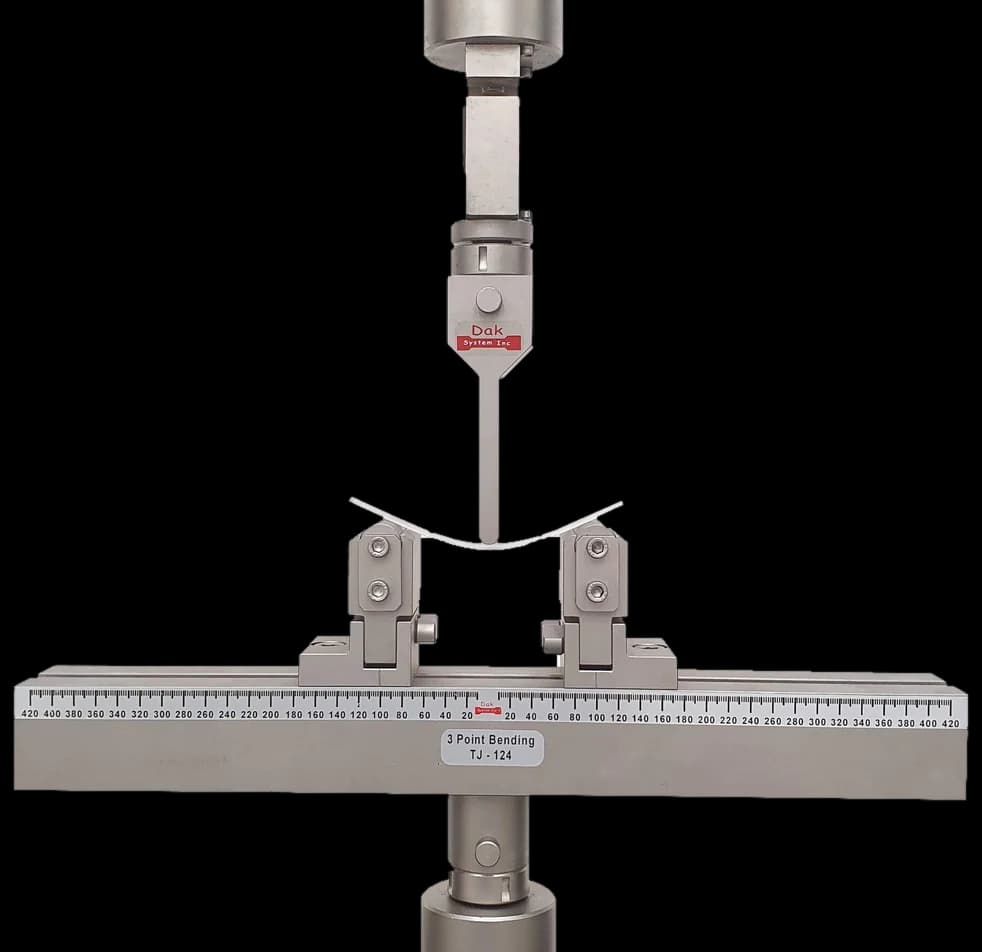
Adjustable spanTJ-124
Three Point Bend Fixture
Procedure A, and the adjustable span this method needs — 32:1 on a 4 mm laminate is a 128 mm span, far longer than a plastics flexural test uses.
Specifications
Testing standard
Standard Test Method for Flexural Properties of Polymer Matrix Composite Materials
Written and technically reviewed by Dak System Inc. engineeringLast reviewed
ASTM D7264 measures the flexural properties of polymer matrix composites. A laminate coupon is bent on a short span — three-point in Procedure A, four-point in Procedure B — and the method reports flexural stress at failure, flexural strain, and chord modulus between 0.001 and 0.003 strain. The span-to-thickness ratio is part of the result, not a setting.
From the test method to your testing system
Explore the DAK machines already listed for ASTM D7264, then review the grips, measurement and setup requirements below.
 Universal Testing MachineSeries 7200Explore the machine →
 Universal Testing MachineSeries 9000Explore the machine →
01Understand the method
A flat rectangular laminate coupon is laid across two hardened steel support cylinders — not gripped at all. The crosshead drives a loading nose down onto the middle of the beam (Procedure A, three-point) or two noses onto the quarter points (Procedure B, four-point) at a constant rate. Force and midspan deflection are recorded continuously until the beam fails.
The method reports flexural stress at failure, flexural strain, and flexural chord modulus taken between 0.001 and 0.003 strain. Strength is used for incoming-lot acceptance of prepreg and cured panels, because a bend coupon catches resin cure, void content and fibre wetting faster than a tensile coupon. Modulus feeds panel stiffness calculations and laminate models. Flexure loads the outer plies hardest, so the figures rank processing quality and support failure investigations rather than serving directly as design allowables.
02Prepare the specimen and test settings
The governing dimension here is the SPAN, not a gauge length. Change the ratio and you change the balance between bending and interlaminar shear, and therefore the number.
03Build the test setup on a DAK machine
Forces are modest. A 13 mm by 4 mm laminate on a 128 mm span typically peaks between a few hundred newtons and about 2 kN in three-point loading, and roughly twice that in four-point for the same outer-fibre stress, so a 5 kN frame is ample — but the load cell must resolve the early elastic region cleanly, because chord modulus is computed from data between 0.1 % and 0.3 % strain, near the bottom of the range. Force indication is verified to ASTM E4.
Crosshead rate is 1.0 mm/min [0.05 in./min] for both procedures, an order of magnitude slower than D790 on a comparable coupon; polymer matrices are rate-sensitive, so a faster run inflates both strength and modulus.
Midspan deflection must be read at the centre of the support span. A deflectometer working upright against the underside of the beam gives the true sag; crosshead travel is permitted but includes fixture and frame compliance. No public source consulted states a required ASTM E83 class for the deflectometer.
The fixture is a long-beam bend rig with hardened cylindrical supports and loading noses of parallel axis, commonly 5 mm radius, fixed, rotatable or rolling. Procedure B uses quarter-point loading — the load span exactly half the support span, and unlike D6272 third-point loading is not permitted. Non-parallel or undersized noses crush the surface plies and end the test early. Elevated- or low-temperature work needs an environmental chamber around the span.
Procedure A, and the adjustable span this method needs — 32:1 on a 4 mm laminate is a 128 mm span, far longer than a plastics flexural test uses.
Specifications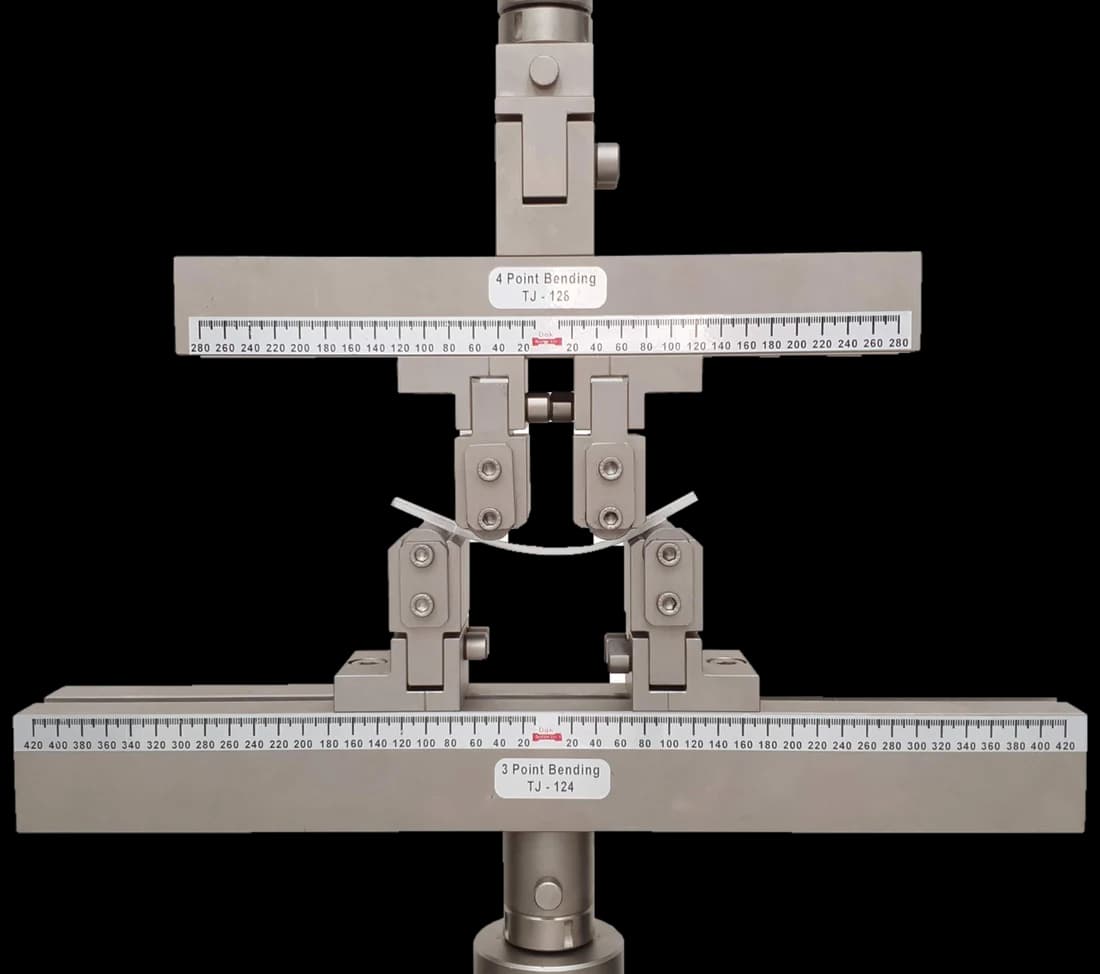
Procedure B, where the peak stress is spread across a length of the coupon rather than concentrated beneath a single nose.
SpecificationsDak verifies against whichever standard the method names, and where a class applies our frames sit a class tighter than it asks.
| The method asks for | Dak supplies | |
|---|---|---|
| Capacity | A standard 13 mm wide, 4 mm thick laminate on a 128 mm span typically peaks between a few hundred newtons and about 2 kN in three-point loading, with four-point (quarter-point) loading needing roughly twice that for the same outer-fibre stress. | Load cells from 1 kg to 60 ton on the Series 7200, and 0.5 to 100 kN on the Series 9000 |
| Force accuracy | ASTM E4 | Verified to ASTM E4, and to ISO 7500-1 Class 0.5 |
| Gripping | Long-beam three- or four-point bend rig at 32:1 span-to-thickness; quarter-point loading for Procedure B | Our bend fixtures, built to the specimen |
| Environment | Ambient laboratory conditions as standard; the method is routinely run inside a chamber at the intended service temperature, and moisture conditioning is referenced to Practice D5229/D5229M | 3009 series chambers, −150 °C to +400 °C — temperature only |
04Run the test
05Calculate, report and interpret
σ = 3 P L / (2 b h²)
Ef = Δσ / Δε between 0.001 and 0.003 strain
A fixed interval, as in D3039 — 0.1 % to 0.3 % strain — rather than the steepest region of the curve.
Interlaminar shear failure is the standard trap: too short a span and the beam fails by plies sliding, giving a low number that is not a flexural strength. Loading-nose crushing does the same locally on soft-matrix or thin-faced laminates. Delamination initiating from a sawn edge drops strength with no visible cause. At long spans, large deflections make the simple beam equations non-conservative, so strain and stress are overstated unless the run is kept within the method's limits.
06Compare methods and find answers
| ASTM D7264 | ASTM D790 | ASTM D6272 | |
|---|---|---|---|
| Subject | Polymer matrix composites | Plastics and insulation | Plastics and insulation |
| Loading | Three- or four-point | Three-point | Four-point |
| Standard span ratio | 32 : 1 | 16 : 1 | 16 : 1 |
| Rate | 1.0 mm/min fixed | Strain-rate derived | Strain-rate derived |
| Modulus | Chord, 0.001–0.003 strain | Initial tangent | Initial tangent |
The longer span is the point. At 16:1 a stiff laminate fails in interlaminar shear rather than in the tension face, and the recorded number is not a flexural strength at all — which is exactly the failure D790 warns about for reinforced materials.
It is the ASTM method for flexural properties of polymer matrix composites. A laminate coupon is bent on a short span, in three-point loading under Procedure A or four-point under Procedure B, and the method reports flexural stress at failure, flexural strain and flexural chord modulus.
Because a stiff laminate on a short span fails by interlaminar shear rather than in the tension face, and a shear failure is not a flexural strength. Lengthening the span reduces the shear stress relative to the bending stress, so the coupon fails the way the method intends. That is also why the ratio has to be reported with the result.
The loading geometry. Procedure A uses a single nose at midspan; Procedure B uses two noses at the quarter points, spreading peak stress across a length of the coupon so failure finds the weakest section within it. They do not give the same number and the procedure used must be stated.
1.0 mm/min against roughly 1.4 or 13.7 mm/min. Polymer matrices are rate-sensitive, and a faster run inflates both strength and modulus. The slower fixed rate makes results comparable between laboratories without each having to derive a speed from the specimen.
By looking at the coupon, not at the curve. A specimen that failed by interlaminar shear between the plies, or crushed under the loading nose, has not produced a flexural strength — and the force-deflection trace can look entirely normal in both cases. Failure mode is recorded for every coupon for this reason.
No. Flexure loads the outer plies hardest, so the numbers rank processing quality — cure, void content, fibre wetting — and support failure investigations. They are excellent at catching a bad panel quickly, which is why they are used for incoming-lot acceptance, but design allowables come from tension, compression and shear coupons.
Discuss your specimen, test requirements and reporting needs with DAK engineering.
This page describes the method as practised. The governing text is the current edition from the issuing body. Tell us what you are testing and we will answer with the machine, the fixture and a quotation.