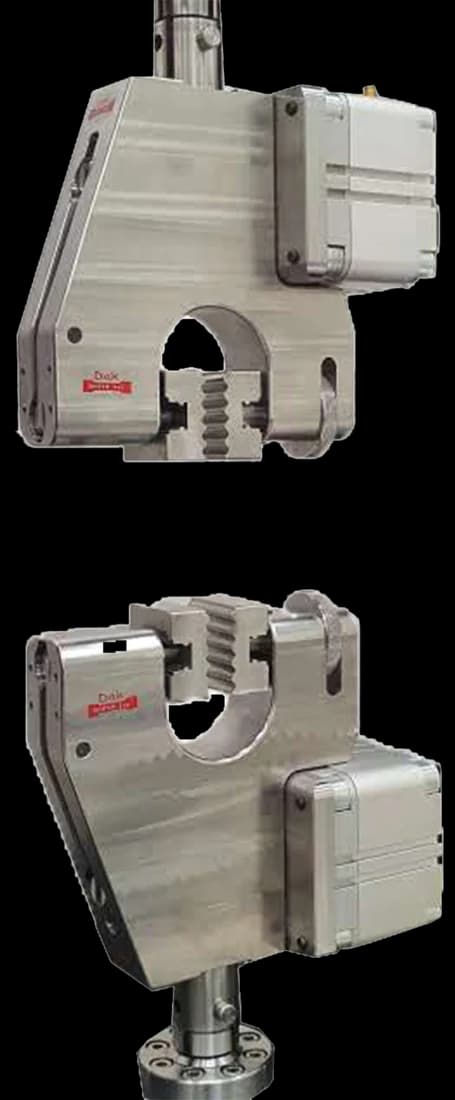
Standard 25 mm
Pneumatic Vice Action Grip
Pneumatic vice action grips give a constant clamping force across the full strip width, which is what stops a paper strip tearing from one side of the jaw.
Specifications
Testing standard
Standard Test Method for Tensile Properties of Paper and Paperboard Using Constant-Rate-of-Elongation Apparatus
Written and technically reviewed by Dak System Inc. engineeringLast reviewed
ASTM D828 measures the tensile properties of paper and paperboard. A strip of defined width is pulled at a rate chosen so it breaks in about twenty seconds, and the method reports tensile strength, stretch at break and tensile energy absorption. Results depend heavily on grain direction, so machine and cross directions are always tested and reported separately.
From the test method to your testing system
Explore the DAK machines already listed for ASTM D828, then review the grips, measurement and setup requirements below.
 Universal Testing MachineSeries 7200Explore the machine →
 Universal Testing MachineSeries 9000Explore the machine →
01Understand the method
A strip of paper of defined width — commonly 15 or 25 mm — is clamped across a span of about 180 mm in flat-faced grips. The crosshead separates at a rate chosen so the specimen breaks in roughly twenty seconds, and force is recorded against grip separation to break. Strips are cut and tested in both the machine and the cross direction, and the two sets of results are reported separately. From the force-elongation curve the method derives tensile strength as force per unit width, stretch at break as a percentage of the span, and tensile energy absorption as the area under the curve.
The three outputs describe different things a paper has to do. Tensile strength governs whether the web survives the pull of a converting machine, a printing press or a bag-filling line — a break on a fast press is expensive and immediate. Stretch describes how much the sheet gives before it goes, which matters wherever paper is formed, wrapped or drawn. Tensile energy absorption combines both and is the property that predicts how a sack or carrier bag survives being dropped, where the ability to absorb a shock matters more than any peak force. Because all three vary strongly with grain direction, the pair of directions is what actually characterises the sheet.
02Prepare the specimen and test settings
Paper is anisotropic, moisture-sensitive and easily nicked. All three show up in this test, and all three are handled by preparation rather than by the machine.
An MD figure and a CD figure describe the same sheet and are not interchangeable. A single tensile strength quoted for a paper without its direction is incomplete to the point of being misleading.
03Build the test setup on a DAK machine
Low forces measured accurately — many papers break between a few newtons and a few hundred — so the load cell must resolve well at the bottom of its range rather than merely tolerate the test. A crosshead whose rate can be set to achieve a twenty-second break across papers of widely differing stretch is needed, which in practice means a range of available speeds rather than one. Grips must clamp evenly across the full strip width: a strip held harder at one side tears from that side, and pneumatic grips hold a more consistent pressure across the width than screw-tightened jaws. The laboratory needs paper-grade humidity control.
Pneumatic vice action grips give a constant clamping force across the full strip width, which is what stops a paper strip tearing from one side of the jaw.
Specifications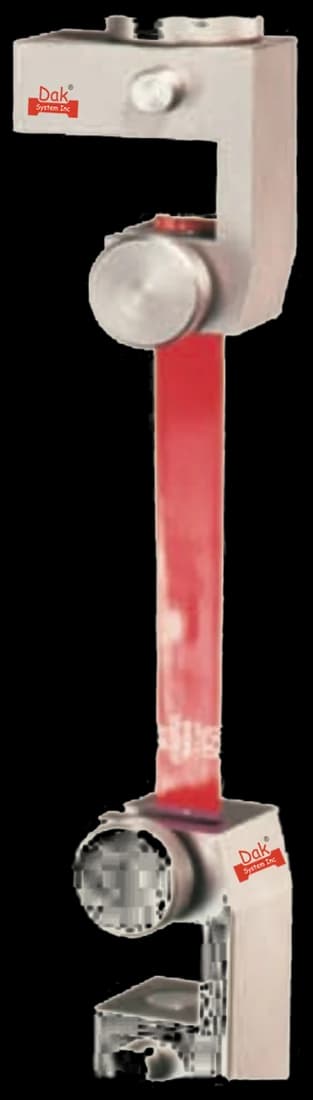
A 25 mm square vice grip suits the narrower strip widths where a wide jaw is unnecessary.
SpecificationsDak verifies against whichever standard the method names, and where a class applies our frames sit a class tighter than it asks.
| The method asks for | Dak supplies | |
|---|---|---|
| Capacity | Low — commonly 5 N to 500 N on a 15 mm or 25 mm wide strip | Load cells from 1 kg to 60 ton on the Series 7200, and 0.5 to 100 kN on the Series 9000 |
| Force accuracy | unknown — ASTM E4 is not among this method's referenced documents, which name no force-verification standard and no accuracy class | ISO 7500-1 Class 0.5 — the method sets no class of its own |
| Gripping | Flat-faced line-contact or vice grips of the specified width, aligned so the strip is loaded squarely | Our vice-action grips, built to the specimen |
| Environment | 23 ± 1 °C and 50 ± 2 % RH per TAPPI conditioning practice; paper strength is strongly moisture-dependent | 3009 series chambers, −150 °C to +400 °C — temperature only |
04Run the test
05Calculate, report and interpret
Tensile strength = Fmax / w
Reported as force per unit width — kN/m — rather than as a stress, because paper thickness is poorly defined and compressible.
ε = ΔL / L₀ × 100
Tensile index = tensile strength / grammage
Normalises for basis weight, so papers of different grammage can be compared on fibre quality and bonding.
TEA = area under the force-elongation curve, per unit area of specimen
Edge nicks produce the low outliers that dominate most data sets, and they are preventable with a sharp cutter and an edge inspection. Jaw breaks are the next problem — they measure the clamping rather than the paper and must be discarded rather than averaged in. Creases from handling the specimen across its span behave exactly like nicks. Away from the bench, the most common reporting failure is quoting a tensile strength without its grain direction, which loses the single largest variable in the measurement. Humidity drift biases results consistently and quietly, which makes it harder to catch than any of these.
06Compare methods and find answers
| ASTM D828 | ISO 1924-2 | |
|---|---|---|
| Loading | Constant rate of elongation | Constant rate of elongation |
| Rate basis | Break in about 20 s | 20 ± 5 mm/min for the standard span |
| Span | 180 mm typical | 180 mm |
| Outputs | Strength, stretch, TEA | Strength, stretch, TEA, tensile index |
The two are close and often produce comparable numbers, but the rate is defined differently — a time to break in one and a fixed elongation rate in the other. On papers with unusual stretch that difference is real, so the certificate should name the method run.
It is the ASTM method for the tensile properties of paper and paperboard using constant-rate-of-elongation apparatus. A strip of defined width is pulled over a defined span at a rate giving break in about twenty seconds, and the method reports tensile strength per unit width, stretch at break and tensile energy absorption.
Because paper thickness is poorly defined and compressible — measured caliper depends on the pressure applied to measure it, so a stress calculated from it would inherit that uncertainty. Force per unit width, in kN/m, avoids the problem entirely. Where papers of different basis weight must be compared, tensile index — strength divided by grammage — normalises for weight without invoking thickness at all.
Because paper is strongly anisotropic. Fibres align with the direction of travel as the sheet is formed, so machine direction strength is commonly one and a half to three times the cross direction value, while cross direction stretch is higher. A single tensile figure quoted without its direction is incomplete to the point of being misleading, and the ratio between the two is itself a useful process indicator.
It is the area under the force-elongation curve — the work needed to break the strip. It matters most where a paper has to survive a shock rather than a steady pull: sack papers, carrier bags, and any packaging that gets dropped or jerked. A strong but brittle paper and a weaker but stretchier one can have very different TEA values, and the stretchier one often performs better in service.
Because papers vary enormously in stretch — some break below 2 % elongation and others well above 5 %. A single fixed crosshead speed would break the low-stretch papers very quickly and the high-stretch ones slowly, at quite different strain rates. Setting the rate to achieve a break in about twenty seconds puts every paper on a comparable footing.
Almost always a nick in the cut edge. Paper is notch-sensitive, and a small defect from a blunt cutter or careless handling is a stress raiser that the specimen breaks from at a fraction of its proper strength. Inspecting the edges before testing, and handling strips only by their ends so no crease crosses the span, removes most of these outliers.
More tightly than for most materials. Paper takes up and gives off moisture quickly, and its strength changes measurably with moisture content — enough that a strip left out of the conditioned atmosphere for a while during preparation will read differently from one tested promptly. The 23 ± 1 °C and 50 ± 2 % RH atmosphere is standard for paper testing, and it applies during the test as well as before it.
Discuss your specimen, test requirements and reporting needs with DAK engineering.
This page describes the method as practised. The governing text is the current edition from the issuing body. Tell us what you are testing and we will answer with the machine, the fixture and a quotation.