
Testing standard
ASTM E488 Strength Testing of Anchors in Concrete
Standard Test Methods for Strength of Anchors in Concrete Elements
Written and technically reviewed by Dak System Inc. engineeringLast reviewed
ASTM E488 pulls or shears an anchor installed in a concrete test member until it fails. It is a family of methods rather than one procedure, covering tension and shear, cast-in-place and post-installed anchors, and members made of cracked or uncracked concrete, under quasi-static, seismic, fatigue or shock loading. The useful output is the failure load together with the failure mode that produced it.
At a glance
- Test type
- Shear
- Published by
- ASTM
- Edition
- E488/E488M-22
- Material
- Wood, concrete & ceramics
- Runs on
- Series 7200 and Series 9000
From the test method to your testing system
Explore DAK equipment for ASTM E488, then review the specimen and setup requirements below.
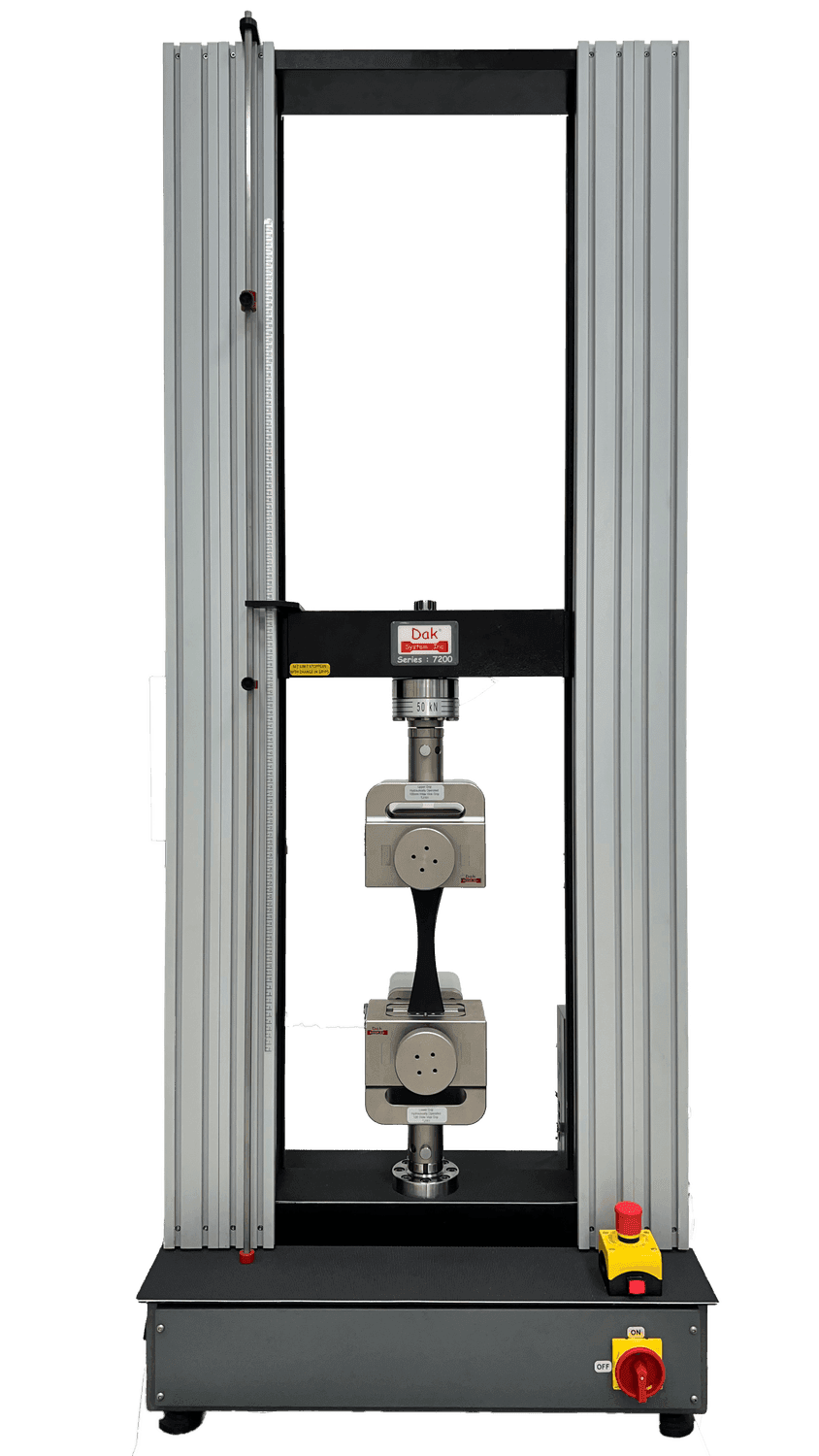 Universal Testing MachineSeries 7200Explore the machine →
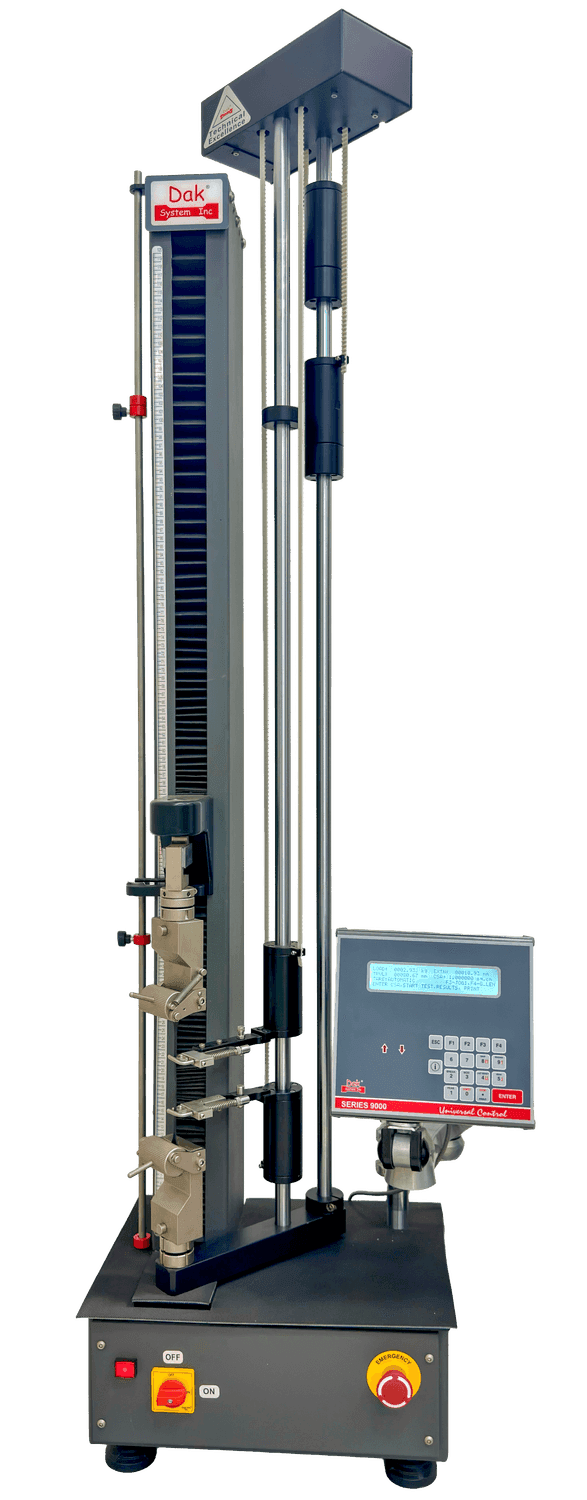 Universal Testing MachineSeries 9000Explore the machine →
Jump to a specific section
01Understand the method
What the test does
An anchor is installed in a concrete test member and pulled or sheared until it fails, and the load it reached is recorded. The plural in the title is deliberate: E488 is a family of methods rather than a single procedure, covering tensile strength and shear strength, cast-in-place anchors and post-installed ones, and test members made of either cracked or uncracked concrete.
The loading regime matches the question. Quasi-static gives the basic strength. Seismic asks what the anchor does under reversed cycling; fatigue asks how many cycles it survives at a fraction of that strength; shock asks what happens when load arrives faster than the concrete can redistribute it. The methods also cover anchors exposed first to freezing and thawing or to corrosion, so a figure can be reported for an anchor in the state it will be in years into service.
Anchors are tested as designed for installation perpendicular to a plane surface of the test member. Both inch-pound and SI units are covered by the standard.
What it measures, and why it matters
The number is a failure load, but the useful output is the failure mode beside it. A well-embedded anchor in sound concrete usually ends with the steel yielding. Reduce the embedment and the same anchor pulls a cone of concrete out instead, at a lower load governed by the concrete rather than the steel. A bonded anchor can fail at the adhesive, sliding out with the concrete intact. Three modes, three design consequences, and a load figure that carries none of it alone.
Cracked concrete is the reason the methods are written the way they are. Real structures crack — that is what reinforcement is for — and an anchor sitting in a crack has far less capacity than the same anchor in a sound block. Testing in cracked members is what makes the resulting data usable for design rather than optimistic.
Section 4.1 states the purpose plainly: the methods are intended to provide reproducible data from which acceptance criteria, design data and specifications can be developed. That is what the results are for — an anchor manufacturer's published capacities, and the approvals that let a specifier use them, rest on tests of this kind.
02Prepare the specimen and test settings
Specimen and installation
The concrete member is as much the specimen as the anchor is, and for a post-installed anchor the installation itself is part of what is being tested.
- Test member
- Concrete, cracked or uncrackedScope section 1 covers both. An anchor sitting in a crack has far less capacity than the same anchor in a sound block, which is why the distinction is built into the methods rather than left to the laboratory.
- Anchor type
- Post-installed or cast-in-placeBoth are in scope. A cast-in-place anchor is placed before the pour; a post-installed one goes into a drilled hole, which brings hole preparation into the result.
- Orientation
- Installed perpendicular to a plane surfaceThe methods address anchors designed for installation perpendicular to a plane surface of the test member.
- Embedment
- Set by the anchor and the test planEmbedment decides whether the steel or the concrete governs failure. It is not a fixed number in the method — it is the variable being characterised, which is why anchor manufacturers publish capacity against embedment rather than a single figure.
Test speed
Four regimes are in scope, and they answer different questions about the same anchor.
- Quasi-static
- 5 % pre-load, then load applied gradually over about 30 s and held 10 sLoad is not dumped on the anchor. A pre-load at 5 % settles the fixture, the test load is brought on gradually over roughly half a minute, and it is then held so the anchor is seen under sustained rather than momentary load.
- Seismic
- Reversed cyclic loadingAsks what the anchor does under load reversal rather than a single monotonic pull.
- Fatigue
- Cycling at a fraction of static strengthAsks how many cycles the anchor survives below its static capacity.
- Data capture
- At least one point per second, minimum 120 points per instrument per testThis is what makes the output a continuous load-displacement curve rather than a peak reading, and it sets a floor under how quickly a test may be run — 120 points at one per second is a two-minute test at minimum.
- Shock
- Rapid load applicationAsks what happens when the load arrives faster than the concrete can redistribute it.
03Build the test setup on a DAK machine
What the machine must be capable of
Force well above the anchor's expected capacity, and a reaction arrangement that does not itself change the answer. A tensile test reacts against the same concrete the anchor is anchored in, so the support ring has to be placed far enough from the anchor that it does not confine the failure cone — a support set too close inflates the load, and does so silently.
Shear testing needs load applied close to the surface and square to the anchor axis, with the fixture free to move without cocking. Cyclic and shock regimes need control that holds a waveform rather than ramps, and displacement measured on the anchor rather than inferred from crosshead travel.
Running ASTM E488 on the Series 7200 and Series 9000
Dak verifies against whichever standard the method names, and where a class applies our frames sit a class tighter than it asks.
| The method asks for | Dak supplies | |
|---|---|---|
| Capacity | Set by the anchor, not the method: from a few kilonewtons for small post-installed anchors to well over 100 kN for large cast-in-place ones | Load cells from 1 kg to 60 ton on the Series 7200, and 0.5 to 100 kN on the Series 9000 |
| Force accuracy | unknown — no force-verification class is named in the retrievable ASTM record for this method | ISO 7500-1 Class 0.5 — the method sets no class of its own |
| Gripping | Reaction ring or frame bearing on the concrete member, clear of the failure cone; shear fixture bearing close to the surface | Our a fixture built for this method, built to the specimen |
04Run the test
How the test runs
- Prepare the concrete test member in the condition being characterised — cracked or uncracked.
- Install the anchor: cast in place before the pour, or into a drilled and cleaned hole for a post-installed type.
- For a bonded anchor, inject the adhesive and allow the specified cure before loading.
- Set the reaction support clear of the expected failure cone, so it does not confine the failure.
- Mount displacement measurement on the anchor itself, not on the crosshead.
- Load to failure under the chosen regime, recording load against anchor displacement.
- Record the failure mode — steel, concrete cone or bond — alongside the peak load.
05Report and interpret
What travels with an E488 result
A load figure on its own is not usable. These travel with it.
- The failure mode, beside the load. A load without it is not a usable number.
- The concrete condition — cracked or uncracked — and the concrete strength.
- Anchor type, size and embedment.
- For post-installed anchors, the hole preparation and, for bonded systems, the adhesive and its cure.
- The loading regime used.
- Where the reaction support bore, relative to the anchor.
What goes wrong in practice
A reaction support placed too close to the anchor is the classic error and produces a confident, repeatable overestimate.
Measuring displacement at the crosshead is the second. The load path includes the test member, the reaction frame and the fixture, and all of them move.
Poor hole preparation is the third, and it transfers straight to site. An uncleaned hole is a real installation condition, so a test on one is not invalid — but it must be recorded as such rather than reported as the anchor's capacity.
Finally, quoting a strength figure without the failure mode and the concrete condition beside it. A load from an uncracked block and a load from a cracked one are not the same number in different circumstances; they answer different questions.
06Compare methods and find answers
Tension or shear
Both are in scope and they fail differently, so a single strength figure for an anchor is always incomplete.
| Tension | Shear | |
|---|---|---|
| Load direction | Along the anchor axis, pulling out | Across the axis, close to the surface |
| Typical failure | Steel break, concrete cone, or bond slip | Steel shear, or concrete edge breakout |
| What the fixture must not do | Confine the failure cone with the reaction support | Cock the anchor by loading away from the surface |
| Governed by | Embedment and concrete condition as much as the steel | Edge distance as much as the anchor |
A reaction support set too close to the anchor in tension inflates the recorded load, and does so repeatably — so the error looks like good data.
Related and equivalent standards
E488 is the test method; the acceptance criteria that use its data are published separately by approval bodies. ASTM E1512 covers tension testing of chemically bonded anchors specifically. For the concrete itself, compressive strength to ASTM C39/C39M is normally reported alongside anchor results, since anchor capacity in every concrete-controlled failure mode scales with it.
Questions we are asked about this test
What is ASTM E488?
It is the ASTM family of test methods for the strength of anchors in concrete elements, published as E488/E488M-22. It covers tensile and shear strength of post-installed and cast-in-place anchors in cracked or uncracked concrete, under quasi-static, seismic, fatigue and shock loading.
Why does the title say Test Methods rather than Test Method?
Because it is a family rather than one procedure. Tension and shear, two anchor types, two concrete conditions and four loading regimes are all inside the one designation, and a result is only meaningful once you say which combination was run.
Why test in cracked concrete?
Because real structures crack — that is what reinforcement is for — and an anchor in a crack has far less capacity than the same anchor in a sound block. Data from uncracked members alone gives design figures that are optimistic in exactly the condition that matters.
Why does the failure mode matter as much as the load?
Because three different modes give three different design consequences. Steel failure means the anchor is developing its full capacity. A concrete cone means the concrete governs and embedment is the lever. Bond slip means the adhesive is the weak link. The load alone tells you none of that.
What does the reaction support have to do with the answer?
In tension the frame reacts against the same concrete the anchor is in. Set the support too close and it confines the failure cone, so the anchor records a higher load than it would in a real slab. The error is systematic and repeatable, which makes it harder to catch than noise.
Why measure displacement on the anchor rather than the crosshead?
Because the load path includes the test member, the reaction frame and the fixture, and all of them deflect under load. Crosshead travel measures all of that movement together and attributes it to the anchor.
What accuracy class does the method require?
The method sets no force-verification class of its own; it specifies the loading and the data capture instead. Dak machines are verified to ISO 7500-1 Class 0.5 and to ASTM E4, DIN 51221 and BS 1610.
Can Dak supply a machine for anchor testing?
Tell us the anchor sizes, the loading regimes and whether you need cracked-member testing, and we will answer with the frame, the reaction arrangement and a quotation.
Related
Materials tested to it
The test it standardises
Industries that test to it
Other standards explained
Planning ASTM E488 testing?
Discuss your specimen, test requirements and reporting needs with DAK engineering.
This page describes the method as practised. The governing text is the current edition from the issuing body. Tell us what you are testing and we will answer with the machine, the fixture and a quotation.