TJ-144
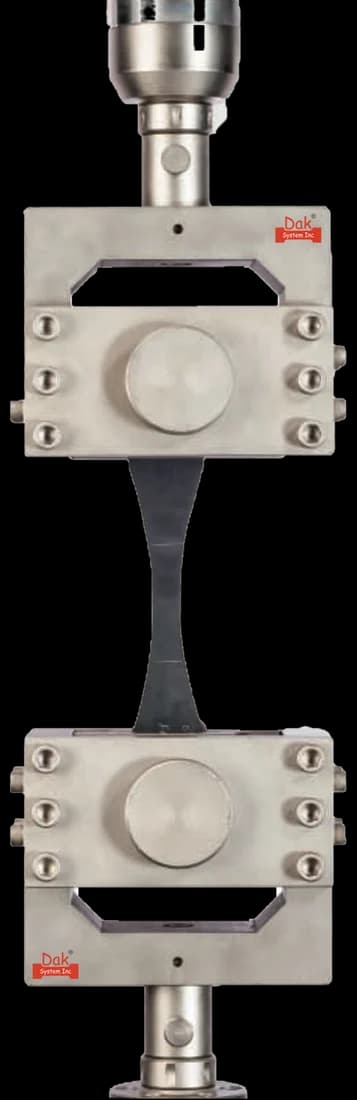
Heavy Duty Hydraulic Grips
For the shear tension coupons: flat serrated faces wide enough for the full coupon, with consistent clamping force across a long current series where the current is meant to be the only variable.
Specifications
Testing standard
Test Methods for Evaluating the Resistance Spot Welding Behavior of Automotive Sheet Steel Materials
Written and technically reviewed by Dak System Inc. engineeringLast reviewed
AWS D8.9, published as AWS D8.9M, is the automotive industry's collected set of laboratory procedures for evaluating how a sheet steel behaves when it is resistance spot welded. Its answers are curves and windows rather than single numbers: a weldability lobe, an electrode life, a hold-time sensitivity, plus shear tension and cross tension strengths. The current edition is AWS D8.9M:2022.
From the test method to your testing system
Explore the DAK machines already listed for AWS D8.9, then review the grips, measurement and setup requirements below.
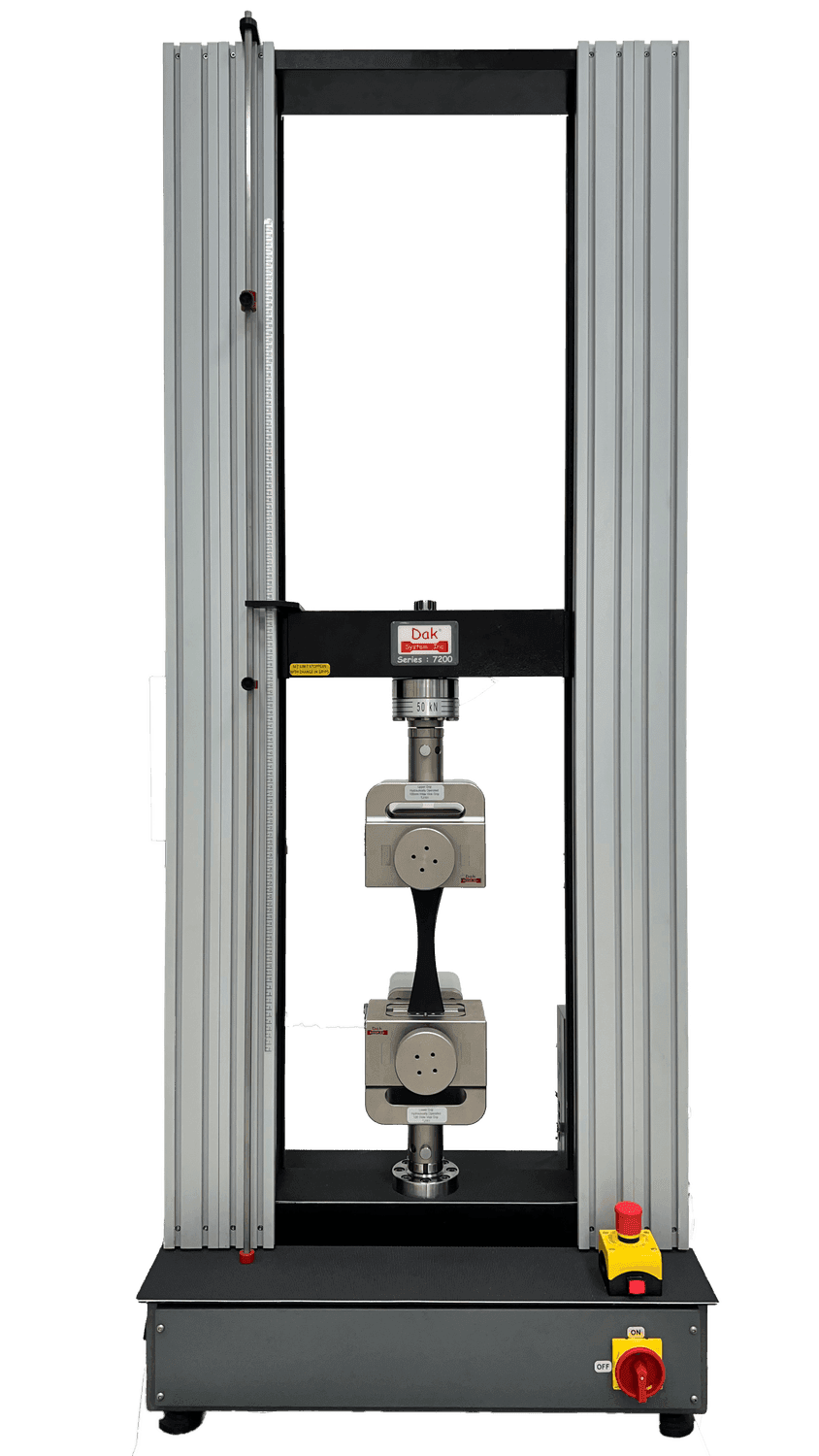 Universal Testing MachineSeries 7200Explore the machine →
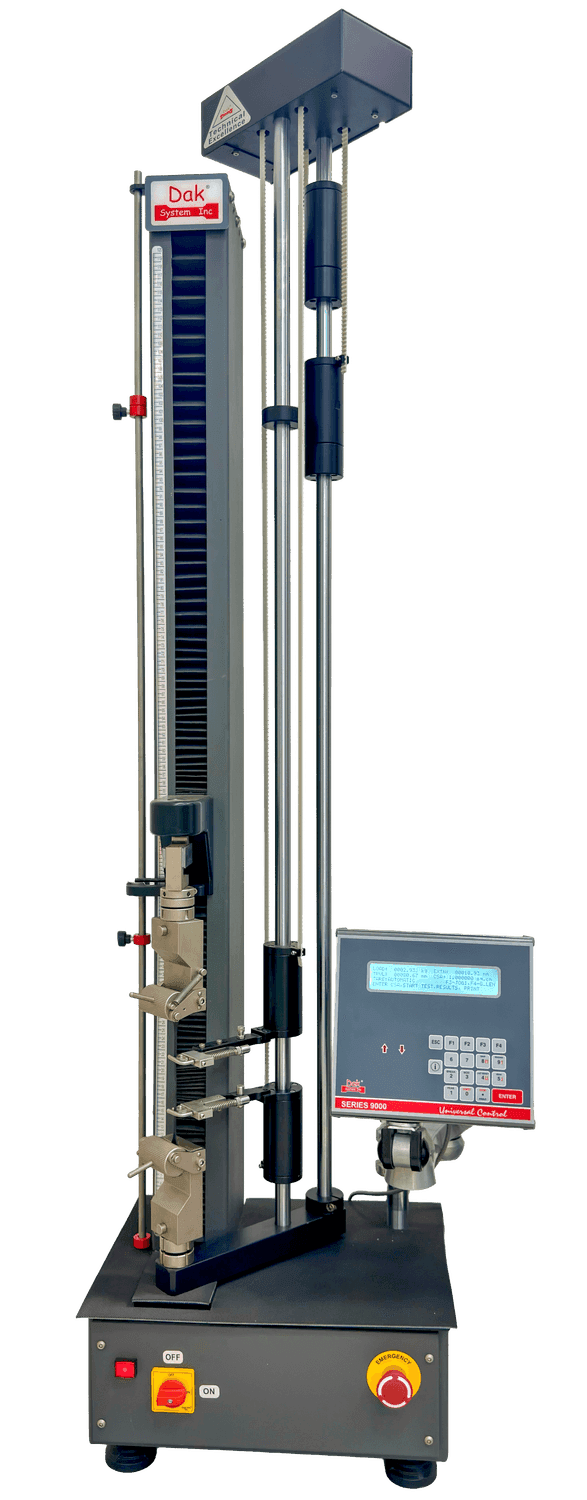 Universal Testing MachineSeries 9000Explore the machine →
01Understand the method
D8.9 is not a single test. It is the automotive industry's collected set of laboratory procedures for finding out how a given sheet steel behaves when it is spot welded, and it contains several tests that are run together to answer that question: weldability lobe determination across a range of welding current, electrode life or endurance testing, hold-time sensitivity, weld hardness, shear tension strength and cross tension strength.
The mechanical parts of it are what reach a universal testing machine. A shear tension specimen is a lap joint containing one weld, pulled along the plane of the sheets. A cross tension specimen is two strips welded in a cross and pulled apart through the thickness. Both are loaded to failure and both are reported with the failure mode.
The point of D8.9 is not a single number but a window. Welding current is stepped up while weld time and electrode force are held constant, welds are made at each current, and the resulting strengths and nugget sizes are plotted. The lower bound of the usable range is the current at which the nugget first reaches minimum acceptable size; the upper bound is the current at which expulsion begins. The gap between them is the weldability lobe, and its width is what tells a body engineer whether a steel can be welded reliably on a production line where nothing is perfectly consistent.
Hold-time sensitivity is the other result that matters commercially. Some advanced high-strength steels lose cross tension strength badly when the electrodes are held on the weld after the current stops, because the nugget quenches into hard martensite through the copper. A steel that passes on shear strength alone can fail this, and it is the sort of finding that changes which grade goes into a part.
02Prepare the specimen and test settings
The mechanical coupons are conventional. What is not conventional is the quantity: a lobe study is a population, not a set of five.
03Build the test setup on a DAK machine
Shear tension of a spot weld in automotive sheet fails in the low tens of kilonewtons at most; cross tension fails lower still. A 50 to 100 kN frame covers the mechanical work, and clean resolution at the bottom of the range matters more than capacity. D8.9M's own accuracy requirement cannot be read: both free previews end at clause 1, and clause 2.3, where the ASTM normative references sit, is not in them — so no class is published here, for the same reason the pull rate is not.
Shear tension needs flat grips with serrated faces and packing shims of the sheet thickness in both jaws, so the two sheets are pulled in line rather than being progressively peeled. Cross tension needs a dedicated jig that bolts to the four arms of the cross specimen and applies the load normal to the weld. Data rate has to be high enough to capture a peak that arrives without warning.
The pull rate is the one machine setting D8.9 does not publish: it sits in the clause on testing shear and cross tension specimens, and the free previews of both the 2012 and 2022 editions stop at the end of clause 1. Where a laboratory runs the ISO counterparts instead, the rate comes from those documents, so which one produced a figure belongs beside it. What D8.9 does fix tightly is the welding side, because that is where its answers come from: current stepped across its range while weld time and electrode force are held constant, hold time varied deliberately in the hold-time test, and the whole scheme written for sheet from 0.5 mm to 4.0 mm — the weld property tests intended for 1.2 mm and heavier, the endurance test for coated steels at or below 500 MPa and under 1.2 mm, with two endurance tests per material the recommended minimum.
The rest of D8.9 — welder, current monitor, electrode force gauge, the metallography behind nugget sizing — is welding-shop equipment rather than testing-machine equipment, and a laboratory quoting D8.9 capability should be clear about which parts it actually performs.
For the shear tension coupons: flat serrated faces wide enough for the full coupon, with consistent clamping force across a long current series where the current is meant to be the only variable.
SpecificationsA cell sized for the joint. Shear tension on automotive sheet fails in the low tens of kilonewtons and cross tension lower still, so a cell chosen for the frame throws away resolution across the whole lobe.
SpecificationsDak verifies against whichever standard the method names, and where a class applies our frames sit a class tighter than it asks.
| The method asks for | Dak supplies | |
|---|---|---|
| Capacity | Shear tension in the low tens of kN on automotive sheet; cross tension lower still | Load cells from 1 kg to 60 ton on the Series 7200, and 0.5 to 100 kN on the Series 9000 |
| Force accuracy | unknown — the free previews of AWS D8.9M end at clause 1, so the normative reference clause 2.3 could not be read and no accuracy class is published here | ISO 7500-1 Class 0.5 — the method sets no class of its own |
| Gripping | Flat serrated grips with packing shims for shear tension; a bolted cross-tension jig for cross tension | Our self-tightening serrated wedge grips, with V-jaws for round specimens or a fixture built for this method, built to the specimen |
| Environment | Ambient laboratory conditions for the mechanical tests | 3009 series chambers, −150 °C to +400 °C — temperature only |
04Run the test
Quoting one shear tension force as an AWS D8.9 result is the commonest misuse of this document. The document produces a window; a single number taken out of it carries none of the information the study was run to get.
05Calculate, report and interpret
Nugget size and strength plotted against welding current
The width of the gap is the result. It says whether the steel can be welded reliably on a line where nothing is perfectly consistent.
Cross tension strength compared across hold times
Some advanced high-strength steels lose cross tension strength badly at long hold times, because the nugget quenches into hard martensite through the copper electrodes. A grade that passes on shear strength alone can fail this.
Welds made before the nugget falls below minimum size
A count, and a commercially significant one: it sets electrode dressing intervals on the line.
Reporting a single strength figure as though it were a D8.9 result is the commonest error, because the document's answers are curves and windows rather than numbers. Missing packing shims on the shear tension specimen, uneven bolt torque on the cross tension jig, and a logger too slow for the peak are the mechanical faults, and they are the same ones the ISO methods suffer. Comparing a lobe drawn at one electrode force with a lobe drawn at another is a subtler error and a common one.
06Compare methods and find answers
They overlap in the mechanical tests and differ in what the document is for.
| AWS D8.9 | ISO 14273 / 14272 / 14270 | |
|---|---|---|
| What it is | An evaluation suite for a steel and a schedule | Three single test methods |
| Output | A weldability lobe, an electrode life, a sensitivity | A force and a failure mode |
| Mechanical tests included | Shear tension and cross tension | Shear, cross tension and peel, one per document |
| Beyond the testing machine | Welding, current monitoring, hardness, metallography | None — the weld arrives already made |
| Where it is specified | North American automotive practice | International and European automotive practice |
Coupon geometry and reporting are not identical between the two families. A shear tension force obtained to D8.9 and one obtained to ISO 14273 are close relatives and are not interchangeable numbers.
AWS D8.9, published as AWS D8.9M, is the American Welding Society's set of test methods for evaluating the resistance spot welding behaviour of automotive sheet steel. It bundles weldability lobe determination, electrode endurance, hold-time sensitivity, weld hardness, shear tension strength and cross tension strength into one document. The current edition is AWS D8.9M:2022, superseding D8.9M:2012, with the series running back through AWS/SAE D8.9M:2002 to a first edition in 1997.
The M denotes that the document is issued in metric units only. Older AWS practice published dual-unit and inch-pound editions alongside metric ones, and the suffix survives to say which this is. D8.9 and D8.9M refer to the same document in ordinary use.
It is the range of welding current over which acceptable welds can be made, with weld time and electrode force held constant. The lower bound is the current at which the nugget first reaches minimum acceptable size; the upper bound is the current at which expulsion begins. The width of that window is the practical result, because a production line varies and a narrow lobe means welds will drift out of it. Widening the lobe is what most spot-welding development work is trying to achieve.
Steels whose welds embrittle when the electrodes stay clamped after the current stops. The nugget quenches rapidly through the copper, and in some advanced high-strength grades that produces a hard martensitic nugget with poor cross tension strength. The shear strength can look entirely healthy while this is happening, which is why the sensitivity test is run in cross tension and why it sometimes changes which grade goes into a part.
Usually the mechanical part: shear tension and cross tension to failure, with peak force and failure mode recorded. The welding itself, the current monitoring, the electrode force measurement, the hardness traverses and the metallographic nugget sizing are welding-shop and laboratory work of a different kind. A supplier quoting D8.9 capability should say which clauses it performs, because the document is much wider than the testing machine.
No. The two shear tension procedures are close relatives, but the coupon geometry and the reporting requirements are not identical, and D8.9 expects the strength to sit inside a lobe study rather than to stand alone. Where a customer specification names one document, run that one and say so; substituting the other is a reporting error even when the numbers come out similar.
A 50 to 100 kN frame covers automotive sheet, with resolution at the bottom of the range mattering more than capacity. D8.9M's own accuracy requirement cannot be read — both free previews end at clause 1, and clause 2.3, the ASTM normative reference list, is not in them — so no class is quoted here. Shear tension needs flat serrated grips and packing shims of the sheet thickness in both jaws; cross tension needs a bolted jig that loads the weld normal to the sheet. In both cases the data rate must be high enough to catch a peak that arrives without warning. The pull speed is the one setting D8.9 does not publish: it is held in the clause on testing shear and cross tension specimens, and both the 2012 and 2022 free previews stop at the end of clause 1, so take it from the purchased text rather than borrowing the ISO figure.
Discuss your specimen, test requirements and reporting needs with DAK engineering.
This page describes the method as practised. The governing text is the current edition from the issuing body. Tell us what you are testing and we will answer with the machine, the fixture and a quotation.