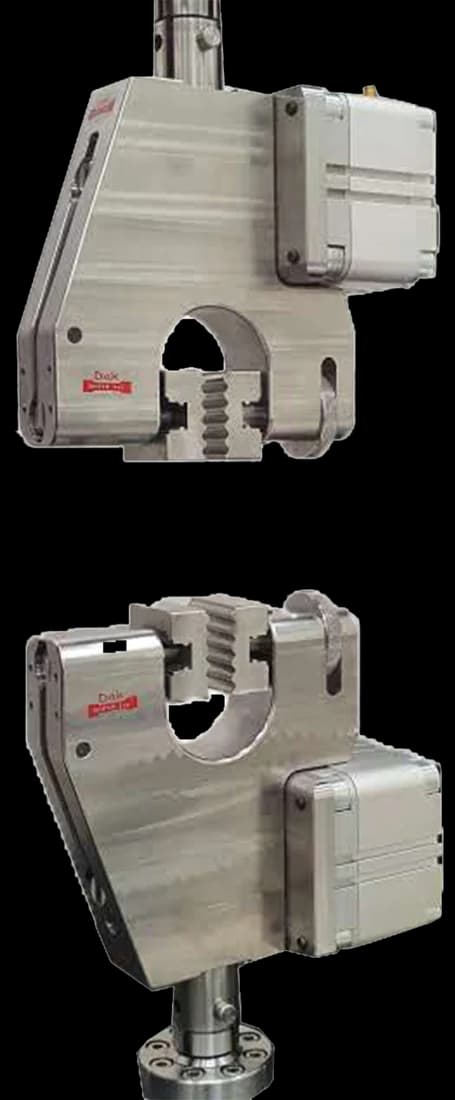
Standard 25 mm
Pneumatic Vice Action Grip
Pneumatic vice action grips clamp the full specimen width at a constant, even pressure — which is what stops one side slipping or tearing before the other.
Specifications
Testing standard
Elastomeric parts for parenterals and for devices for pharmaceutical use — Part 5: Functional requirements and testing
Written and technically reviewed by Dak System Inc. engineeringLast reviewed
ISO 8871-5 gives the functional requirements and test methods for elastomeric closures used with vials and pierced by injection needles — penetration force, fragmentation, self-sealing and, where relevant, the equivalent tests with spikes. The forces involved are small, so the load cell dominates the measurement quality.
From the test method to your testing system
Explore the DAK machines already listed for ISO 8871-5, then review the grips, measurement and setup requirements below.
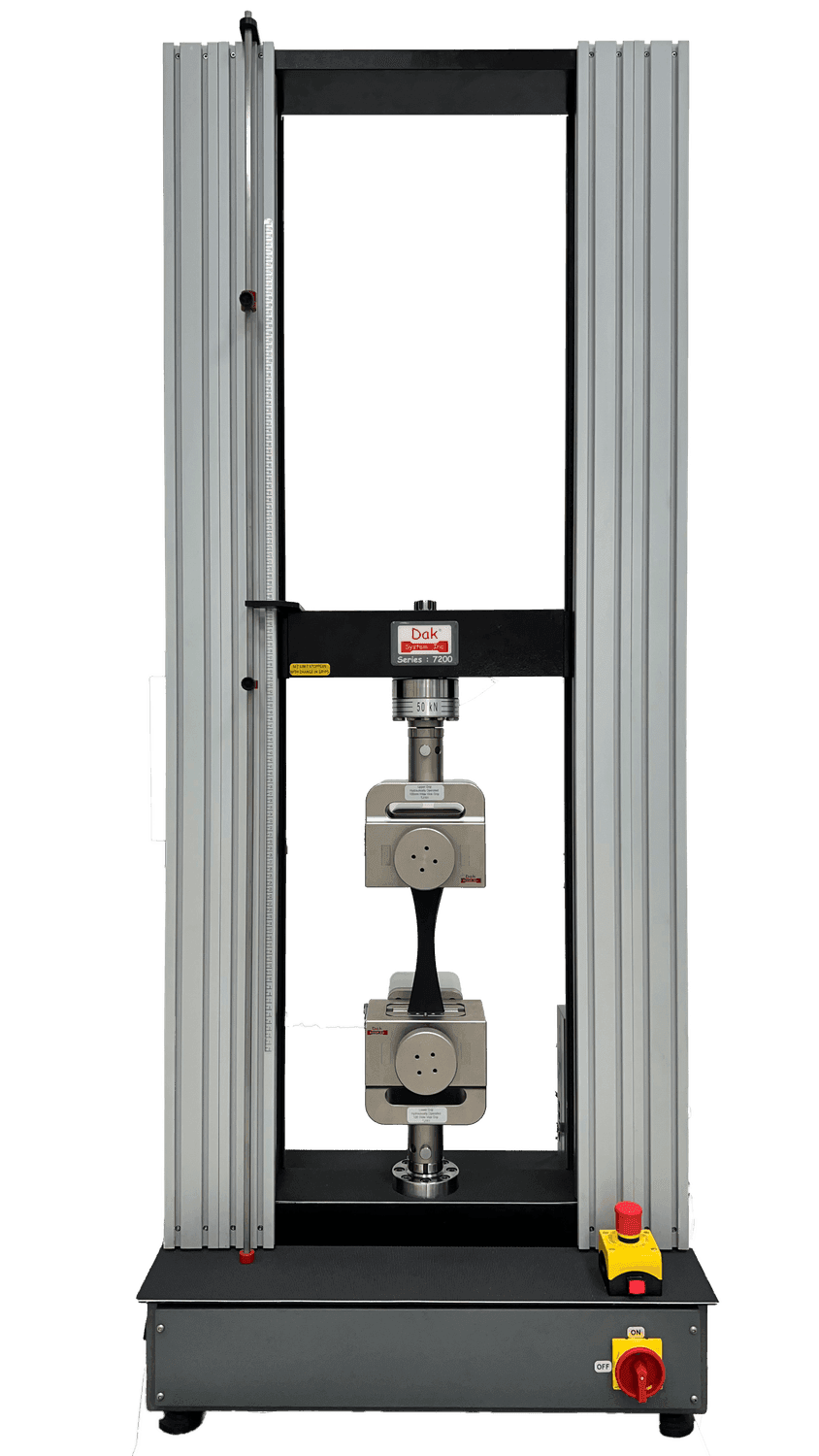 Universal Testing MachineSeries 7200Explore the machine →
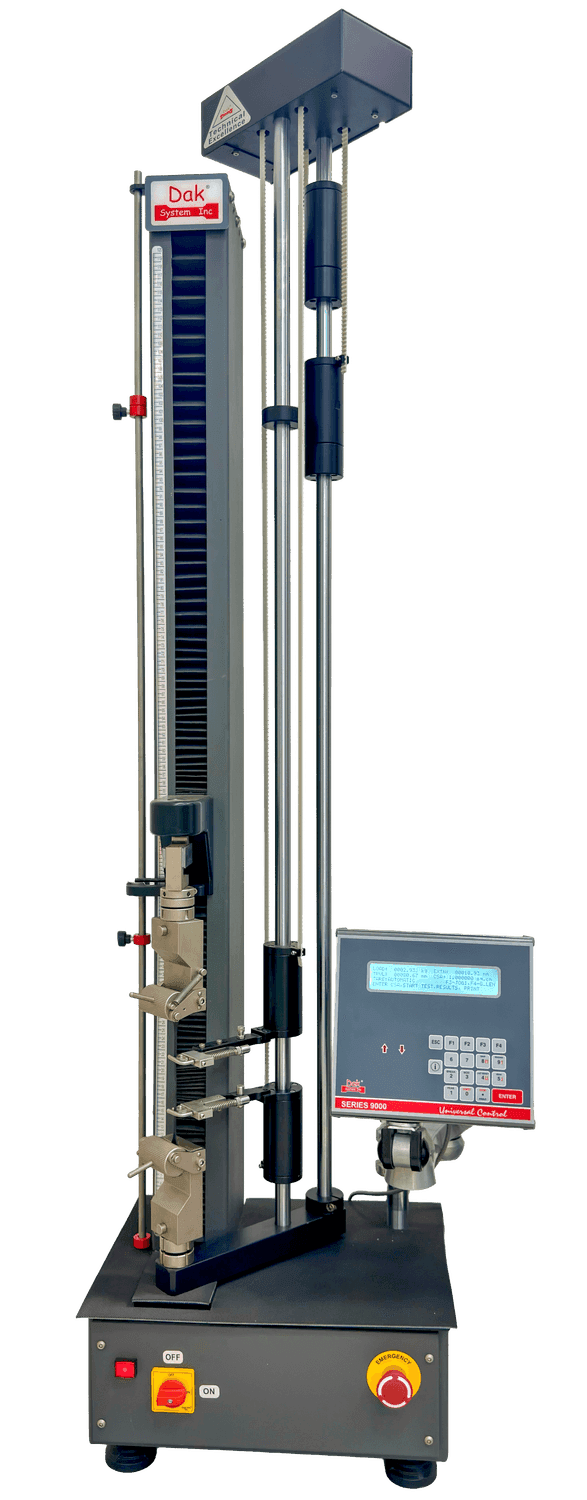 Universal Testing MachineSeries 9000Explore the machine →
01Understand the method
A closure is mounted as it is used — crimped onto a vial or held in the equivalent service geometry — and a new needle of the specified gauge is driven through it while the force is recorded, at a rate the method does not itself fix. The maximum force during piercing is the penetration force. For fragmentation the piercing procedure is repeated a prescribed number of times, the container contents are then filtered, and the rubber fragments recovered are counted. Self-sealing is assessed by withdrawing the needle and checking, by the specified means, that the closure has closed behind it.
Three separate things about the same component. Penetration force describes whether the closure can be pierced cleanly in clinical use — too high and it resists the needle, too low and it may not have the compression needed to seal. Fragmentation describes whether piercing chips rubber into the drug, which is a particulate contamination event in an injectable and therefore a regulatory finding rather than an engineering preference. Self-sealing describes whether the closure remains a barrier after the needle leaves. A closure can pass any one of the three and fail another, which is why all three are specified.
02Prepare the specimen and test settings
Three separate questions about the same closure: how hard it is to pierce, whether piercing chips it, and whether it closes again afterwards.
Fragmentation is counted, not estimated. It is a particulate contamination test wearing the clothes of a mechanical one, and the count is what a regulator will read.
03Build the test setup on a DAK machine
Very small forces measured well. Penetration forces sit at a few newtons, and an accuracy class applies only down to a stated fraction of load cell capacity — below that fraction the class no longer describes the instrument. A frame carrying a cell sized for materials testing will produce a precise-looking number with no traceability at this load, so the cell is chosen for the force. Beyond that the requirement is modest: a holder that reproduces the service geometry, and a needle mount that keeps the needle axial.
ISO 8871-5 fixes no needle speed. Annex A, the normative penetrability test, says only to pierce a closure perpendicular to its surface and record the maximum force. What it does fix are the things that decide that number: a new lubricated long-bevel needle of 0,8 mm outside diameter, bevel angle (11 ± 2)°, to ISO 7864, a fresh one for each of the ten closures, every closure crimped onto its own vial, and apparatus able to measure 10 N to ±0,25 N. The acceptance limit is 10 N per closure, and fragmentation is judged over 48 piercings — four on each of twelve closures — at no more than five fragments visible to the naked eye. Those figures are read from Annex A of ISO 8871-5:2016, the edition published in preview, and no account of the 2025 revision introduces a needle speed. Because rubber is rate-sensitive the speed still decides the number, so fix one, use it for every closure in the set and record it: the standard leaves the figure to agreement rather than supplying one.
Pneumatic vice action grips clamp the full specimen width at a constant, even pressure — which is what stops one side slipping or tearing before the other.
SpecificationsDak verifies against whichever standard the method names, and where a class applies our frames sit a class tighter than it asks.
| The method asks for | Dak supplies | |
|---|---|---|
| Capacity | Very low — needle penetration forces are typically a few newtons | Load cells from 1 kg to 60 ton on the Series 7200, and 0.5 to 100 kN on the Series 9000 |
| Force accuracy | ISO 7500-1 Class 1 — verify the class at the actual working load, which is only a few newtons | ISO 7500-1 Class 0.5 — a class tighter than the method asks |
| Gripping | Needle penetration fixture holding the closure in a vial or a defined support, with a mounted needle | Our compression anvils, built to the specimen |
| Environment | 23 ± 2 °C standard laboratory atmosphere | 3009 series chambers, −150 °C to +400 °C — temperature only |
04Run the test
05Calculate, report and interpret
The maximum force recorded while the needle passes through the closure
A measured force compared against a requirement, not a derived quantity.
Number of visible rubber fragments recovered per number of piercings
Reported as a count against a limit. It is a particulate result, and it is why the piercing procedure is prescribed so tightly.
Reusing needles is the most damaging error, because a needle blunts after a single pass through rubber and a blunt point both raises the penetration force and cores far more readily — inflating two results at once, progressively, through a test series. Oversized load cells are next. Mounting the closure in a convenient fixture rather than in its container changes how it deforms. And driving the needle at an uncontrolled rate makes penetration forces incomparable between operators, since elastomers respond to rate directly.
06Compare methods and find answers
| Part 5 | Other parts | |
|---|---|---|
| Covers | Functional requirements and testing | Extractables, identification, and other properties |
| Questions asked | Penetration, fragmentation, self-sealing | Chemical and physicochemical behaviour |
| Equipment | A low-capacity testing machine | Analytical laboratory |
| Read with | The container standard for the vial or spike | The same |
Part 5 is the mechanical part of a series that is otherwise largely chemical, which is why it is the one that reaches a testing machine at all.
It is Part 5 of the ISO 8871 series covering elastomeric parts for parenterals and pharmaceutical devices, and it holds the functional requirements — penetration force, fragmentation and self-sealing for closures pierced by an injection needle, together with the equivalent assessments where a spike is used instead.
Because a rubber fragment released into a vial by the needle is particulate contamination in an injectable product, and that is a regulatory matter rather than an engineering opinion. Counting the fragments recovered after filtration turns it into a number that can be compared with a limit and audited, which a subjective assessment of the closure surface could never be.
Because a needle blunts measurably after even one pass through an elastomer. A blunted point needs more force to penetrate and is far more likely to core — to punch out a plug of rubber rather than part it. Reusing a needle therefore inflates the penetration force and the fragment count together, and does so progressively through a test series, which corrupts both results at once.
The size of it. Penetration forces sit at a few newtons, and an accuracy class applies only down to a stated fraction of load cell capacity. A frame fitted with a kilonewton-scale cell is working far below the range its calibration certificate covers, so the reading may be precise-looking and untraceable. Choosing the cell for the force rather than for the frame is the whole of the problem.
Because the support conditions determine how the rubber deforms under the needle. A closure crimped onto a vial is in compression and constrained at its flange; the same closure held loosely in a fixture is free to move and pierces differently. Since the requirement describes the closure in service, the test has to reproduce the service geometry to mean anything.
None. Annex A of ISO 8871-5:2016 fits a hypodermic needle to the force-measuring apparatus, pierces the closure perpendicular to its surface, records the maximum force, and says nothing about the rate. What it does fix is the needle — lubricated, long-bevel, 0,8 mm outside diameter, bevel angle (11 ± 2)° to ISO 7864, a new one for each of the ten closures — apparatus able to read 10 N to ±0,25 N, and a limit of 10 N per closure. Rubber is rate-sensitive all the same, so agree a rate, hold it across the whole set and put it in the report; results run at different speeds are not comparable even though both are compliant.
The standard for the container or device the closure serves — ISO 8362 for injection vials and their closures, ISO 8536 for infusion equipment where a spike rather than a needle is used. Part 5 supplies the functional test methods; those standards supply the context and often the specific requirement values the closure has to meet.
Discuss your specimen, test requirements and reporting needs with DAK engineering.
This page describes the method as practised. The governing text is the current edition from the issuing body. Tell us what you are testing and we will answer with the machine, the fixture and a quotation.