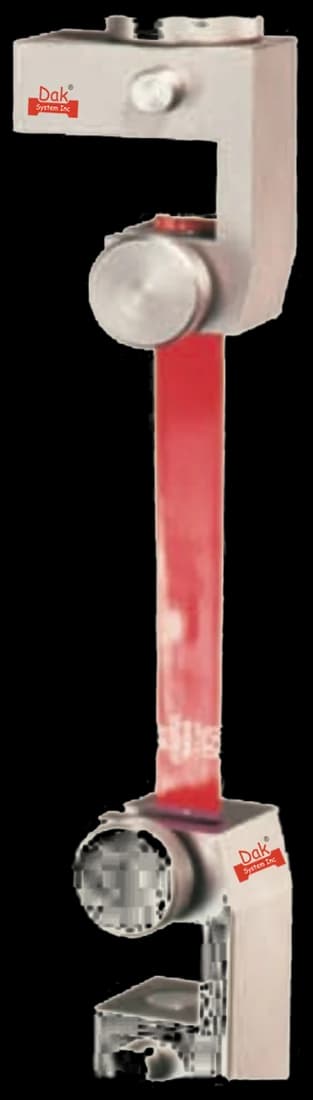
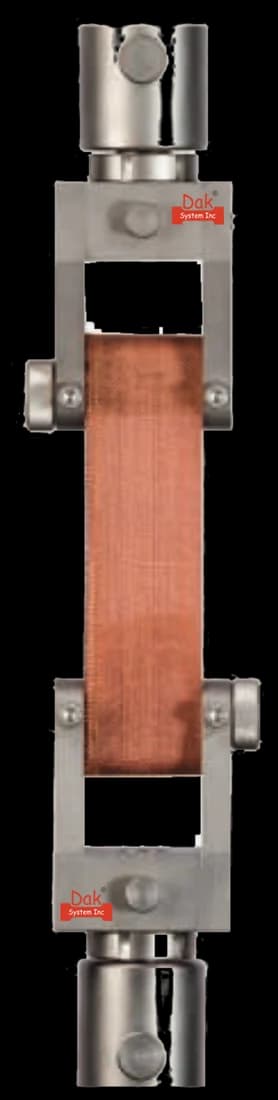
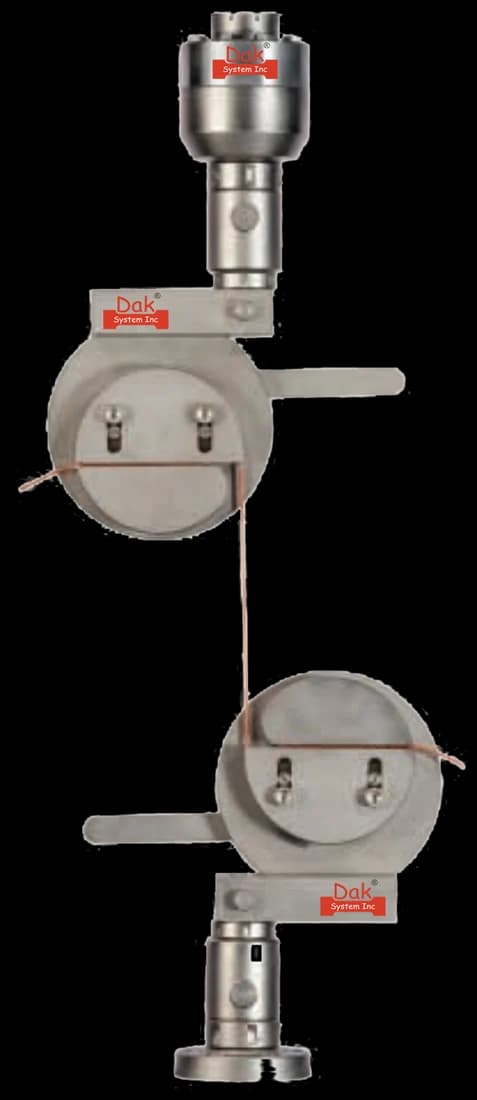
Split Capstan Grips
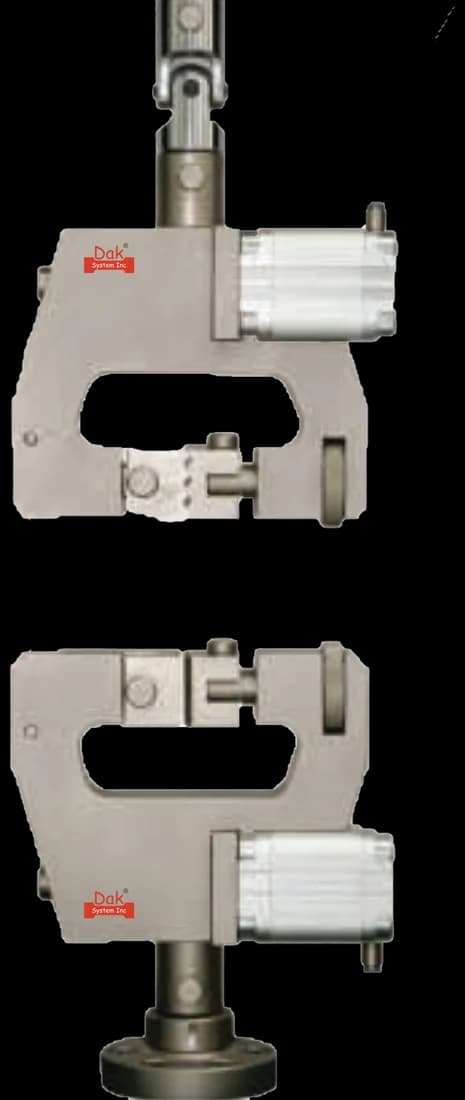
Split capstan grips wrap the yarn around a curved surface so tension decays around the wrap — a flat jaw would crush the bundle at a single line and the yarn would break there.
SpecificationsTesting standard
Textiles — Yarns from packages — Determination of single-end breaking force and elongation at break using constant rate of extension (CRE) tester
Written and technically reviewed by Dak System Inc. engineeringLast reviewed
ISO 2062 determines the breaking force and elongation at break of a single yarn drawn from a package, using a constant rate of extension tester. The yarn is held on capstan grips, pretensioned, and pulled until it breaks. Tenacity — force divided by linear density — is what makes yarns of different counts comparable.
A single yarn is drawn from a conditioned package and mounted between capstan or bollard grips over a defined gauge length. The yarn wraps each capstan a specified number of turns, so it is held by friction distributed around a curve rather than crushed between flat faces. A defined pretension, calculated from the yarn's linear density, removes slack and crimp without stretching the specimen. The crosshead then separates at a rate chosen so the yarn breaks in roughly twenty seconds, recording force against grip separation. Because yarn is variable, the test is repeated across many specimens sampled from different parts of the package.
The method reports breaking force, elongation at break, and tenacity — the breaking force normalised by linear density. Tenacity is what allows yarns of different counts to be compared at all, and it is the figure a spinner is judged on. Elongation matters alongside it because weaving and knitting apply repeated shock loads rather than a steady pull, and a strong yarn with little give will stop a loom more often than a slightly weaker one that stretches. The spread across specimens matters as much as the average, since it is the weakest place in a yarn that causes an end-break.
A yarn is a bundle of fibres held together by twist. Anything that crushes it, or lets the twist run out, changes what is being measured.
Breaking force alone compares only yarns of the same count — a thicker yarn is stronger because there is more of it. Tenacity is the comparable quantity, and it requires a measured linear density.
The maximum force recorded, in N or cN
Tenacity = breaking force / linear density
In cN/tex. This is the quantity that compares yarns of different counts, and the reason linear density must be measured rather than assumed.
ε = ΔL / L₀ × 100

Split capstan grips wrap the yarn around a curved surface so tension decays around the wrap — a flat jaw would crush the bundle at a single line and the yarn would break there.
Specifications
A quick release bollard gives the same wrapped hold with faster loading, which matters when a yarn programme means tens of breaks per sample.
SpecificationsVery small forces measured accurately. Fine spun yarns break below a newton, and a load cell sized for fabric or film will report them as noise, so the cell has to be matched to the yarn count and accurate to ISO 7500-1 Class 1 over that range rather than at full scale. The crosshead must offer a range of rates, since achieving a twenty-second break across yarns from a few per cent elongation to well over a hundred cannot be done at one speed. Capstan or bollard grips are effectively mandatory, and because elongation is taken from grip separation, machine compliance matters at these low forces.
Jaw breaks and slippage account for most rejected specimens, and they have opposite signatures — a jaw break gives a low force, while slippage gives a normal force with an inflated elongation, because the slip is counted as extension. Both are cured by capstan wraps and correct pretension rather than by heavier clamping. Testing in the wrong atmosphere is a systematic error a plastics-oriented laboratory makes easily and rarely notices. Sampling one continuous length instead of across the package understates variability, which is precisely the information the single-end method exists to provide.
| ISO 2062 | ASTM D2256/D2256M | |
|---|---|---|
| Approach | Single end, CRE tester | Single strand, CRE tester |
| Grips | Capstan or bollard | Capstan or bollard |
| Atmosphere | 20 or 21 °C / 65 % RH per the edition | 21 °C / 65 % RH |
| Outputs | Breaking force, elongation, tenacity | Breaking force, elongation, tenacity, work of rupture |
Close in approach and often treated as interchangeable. They remain separate documents with their own details, so the certificate should name the one actually run.
It is the ISO method for the single-end breaking force and elongation at break of yarn taken from a package, using a constant rate of extension tester. The yarn is held on capstan grips, pretensioned, and pulled to break. Tenacity is derived by dividing the breaking force by the measured linear density.
Because a yarn clamped between flat faces is crushed along a single line, and the fibres break there rather than in the gauge length. A capstan wraps the yarn around a curved surface so tension decays gradually around the wrap and load transfers over a long contact. Without it, nearly every specimen would produce a jaw break.
Tenacity is breaking force divided by linear density, in cN/tex. Breaking force alone only compares yarns of the same count, because a thicker yarn is stronger simply for having more material in it. Tenacity removes that and compares the fibre and the spinning, which is why linear density must be measured on the yarn actually tested rather than taken from the label.
Because a longer specimen contains more opportunities for a weak place, and a yarn breaks at its weakest point. Increasing the gauge length therefore lowers the average breaking force — a real statistical effect rather than an artefact. That is why gauge length is always reported and why results from different gauge lengths cannot be compared directly.
Considerably more than for a moulded plastic. Yarn varies along its length and between packages, so this normally means tens of breaks rather than five, with the coefficient of variation reported beside the mean. That variability is itself the useful information — a yarn with a good average and a wide spread will still stop a loom.
By the elongation. A specimen that slipped through the capstan shows an unusually high elongation with an otherwise ordinary breaking force, because the slip is counted as extension. If a set shows a few points with markedly higher elongation and no matching strength increase, add a wrap to the capstan and check the pretension.
Very close in approach — both are single-end tests on a CRE machine with capstan grips, and both report breaking force, elongation and tenacity. They remain separate documents with their own details, so a certificate should name the method actually run rather than describing the family, since a customer specifying one will not accept the other without being told.
Dak verifies against whichever standard the method names, and where a class applies our frames sit a class tighter than it asks.
| The method asks for | Dak supplies | |
|---|---|---|
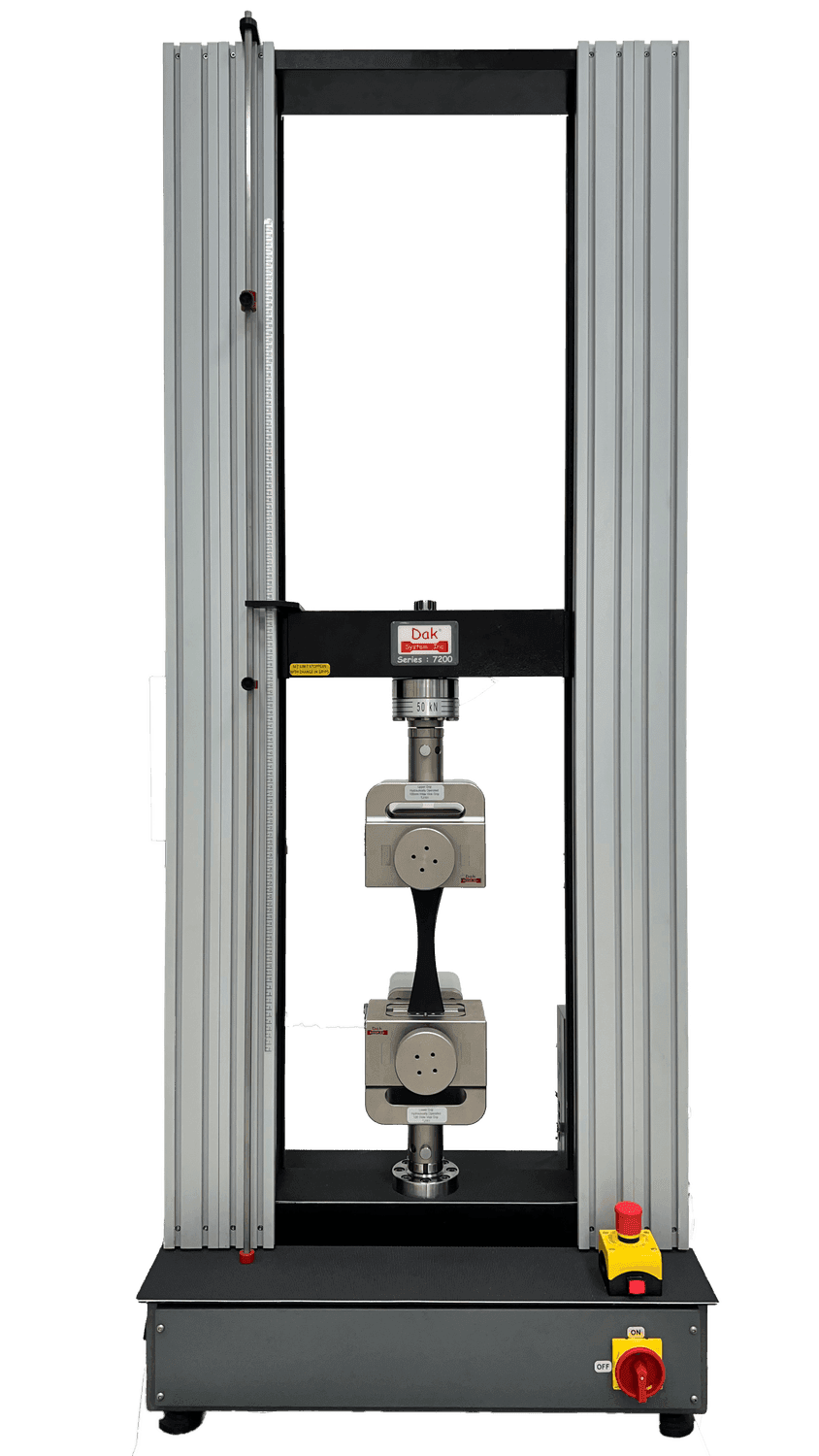
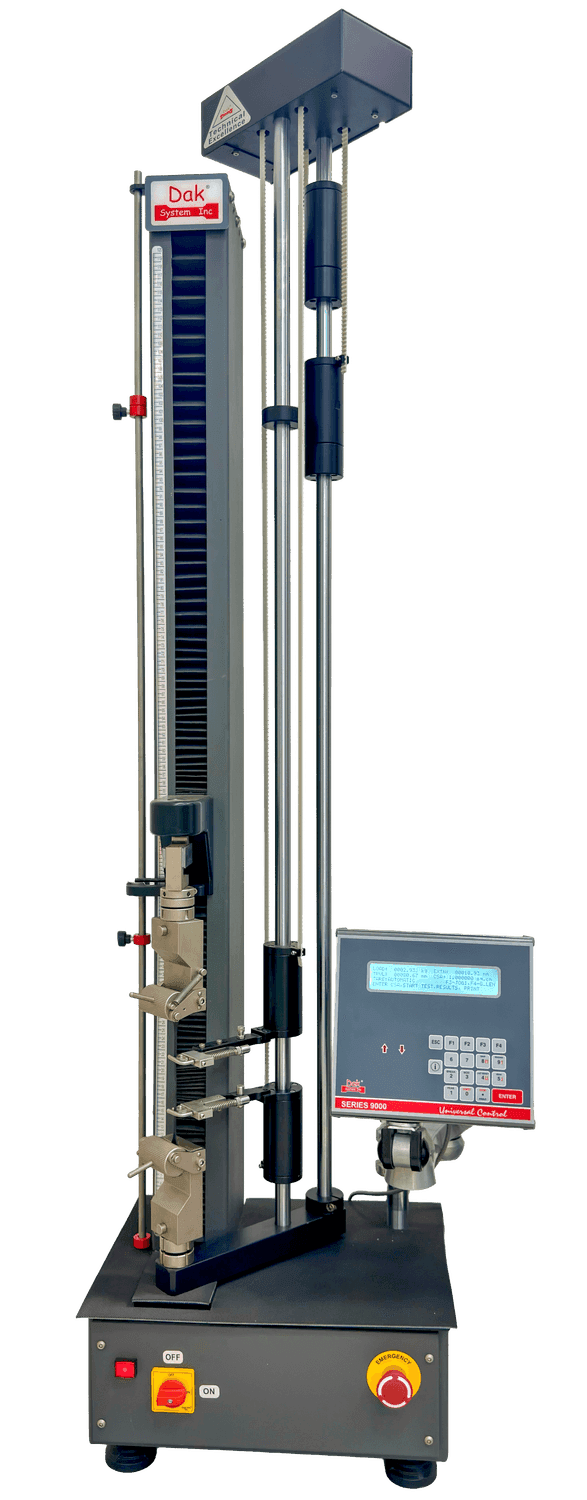
| Capacity | Very low — fine spun yarns break below 1 N; industrial filament reaches a few hundred | Load cells from 1 kg to 60 ton on the Series 7200, and 0.5 to 100 kN on the Series 9000 |
| Force accuracy | ISO 7500-1 Class 1 over the working range | ISO 7500-1 Class 0.5 — a class tighter than the method asks |
| Gripping | Capstan or bollard grips that wrap the yarn around a curve rather than clamping it at a line | Our split capstan grips, built to the specimen |
| Environment | 21 ± 1 °C and 65 ± 2 % RH — the textile standard atmosphere, not the 23/50 used elsewhere | 3009 series chambers, −150 °C to +400 °C — temperature only |
This page describes the method as practised. The governing text is the current edition from the issuing body. Tell us what you are testing and we will answer with the machine, the fixture and a quotation.