TJ-144
Heavy Duty Hydraulic Grips
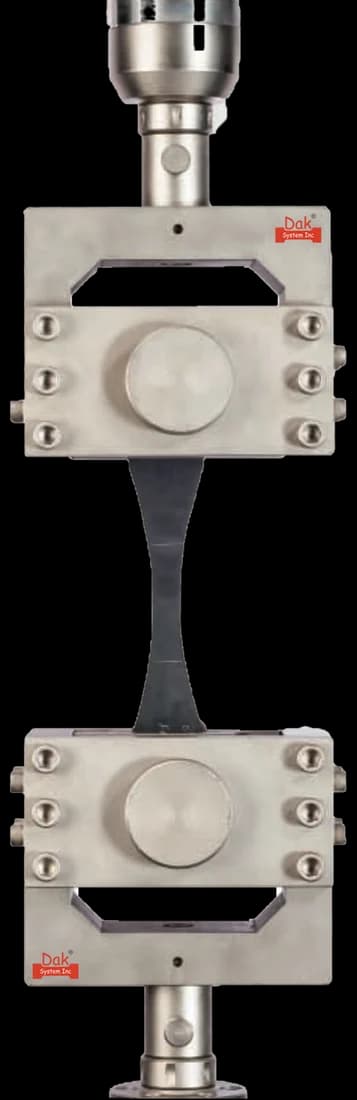
Hydraulic wedges apply an even clamping pressure across a tabbed end — enough to hold a stiff laminate without the point loading that starts a tab failure.
Specifications
Testing standard
Plastics — Determination of tensile properties — Part 4: Test conditions for isotropic and orthotropic fibre-reinforced plastic composites
Written and technically reviewed by Dak System Inc. engineeringLast reviewed
ISO 527-4 supplies the specimen geometries and test conditions for tensile testing of isotropic and orthotropic fibre-reinforced composites within the ISO 527 series. Part 1 gives the principles and equations; this part says what coupon to cut and how to test it. For an orthotropic laminate the direction tested is part of the result.
From the test method to your testing system
Explore the DAK machines already listed for ISO 527-4, then review the grips, measurement and setup requirements below.
 Universal Testing MachineSeries 7200Explore the machine →
 Universal Testing MachineSeries 9000Explore the machine →
01Understand the method
Part 4 supplies the specimen geometries and test conditions for fibre-reinforced composites within the ISO 527 series. A straight-sided or dumb-bell coupon, depending on the reinforcement, is gripped at both ends and pulled along its axis until it breaks, with strain taken from an extensometer over the marked gauge length rather than from crosshead travel.
It reports tensile modulus, stress and strain at break, and where the material yields, yield stress and strain — the same quantities as the rest of the series, measured on a material whose properties depend on fibre orientation. For isotropic reinforcement such as chopped-strand mat the result describes the laminate in any in-plane direction; for orthotropic laminates the direction tested is part of the result and a single figure describes nothing.
For an orthotropic laminate the series of directional results is the property, not any one of them. A quasi-isotropic lay-up tested at 0, 45 and 90 degrees produces three quite different curves, and a designer needs all three to build the laminate model. Reporting the strongest direction alone is the common commercial temptation and it produces a datasheet that overstates the material for every application that is not aligned with the fibres.
02Prepare the specimen and test settings
03Build the test setup on a DAK machine
Forces are higher than for unreinforced plastics — a glass-reinforced laminate coupon can reach several tens of kilonewtons — so frame capacity follows the reinforcement rather than the polymer. Grips must hold a stiff, hard coupon without crushing it, which usually means hydraulic wedges and tabs. Modulus is taken over the same narrow 0.05 % to 0.25 % strain interval as the rest of the series, so an extensometer to ISO 9513 Class 1 is required.
Force capacity follows the reinforcement rather than the resin, so a frame sized for unfilled plastics will be the constraint the first time a glass-reinforced coupon is tested. Grips must apply high clamping force across a tabbed end without crushing it, which is where hydraulic wedges earn their place over manual ones. Alignment matters more than for unreinforced plastics, because a stiff coupon does not yield locally to accommodate a misaligned load path.
Hydraulic wedges apply an even clamping pressure across a tabbed end — enough to hold a stiff laminate without the point loading that starts a tab failure.
Specifications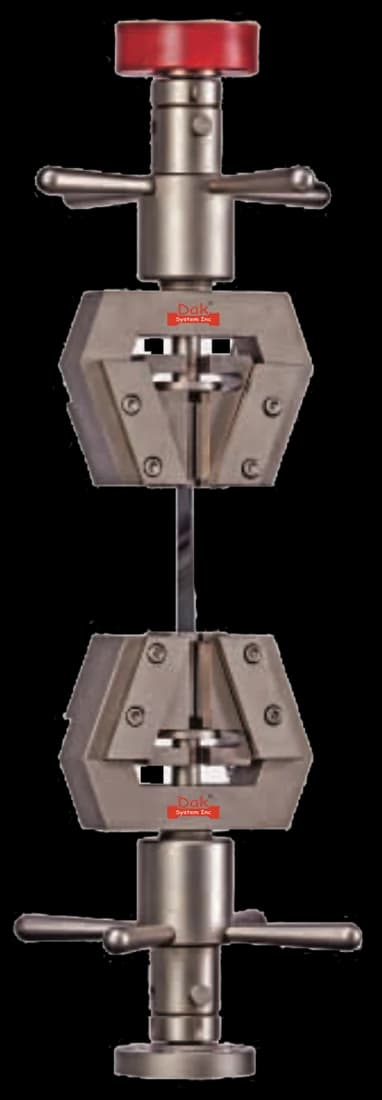
Parallel wedges with interchangeable faces for thinner coupons and lower-strength architectures.
SpecificationsDak verifies against whichever standard the method names, and where a class applies our frames sit a class tighter than it asks.
| The method asks for | Dak supplies | |
|---|---|---|
| Capacity | Higher than unreinforced plastics — a glass-reinforced coupon can reach several tens of kilonewtons. | Load cells from 1 kg to 60 ton on the Series 7200, and 0.5 to 100 kN on the Series 9000 |
| Force accuracy | ISO 7500-1 Class 1 | ISO 7500-1 Class 0.5 — a class tighter than the method asks |
| Strain measurement | An extensometer to ISO 9513 Class 1 — modulus is a secant between 0.05 % and 0.25 % strain | Certified to ISO 9513 Class 1 and ASTM E83 — non-contact video, clip-on and high-elongation |
| Gripping | Wedge grips, with bonded end tabs where the grip would otherwise damage the coupon. | Our self-tightening serrated wedge grips, with V-jaws for round specimens, built to the specimen |
| Environment | Ambient: ISO 291 standard atmosphere, 23 degC and 50 % RH. | 3009 series chambers, −150 °C to +400 °C — temperature only |
04Run the test
05Calculate, report and interpret
σ = F / A
Et = (σ2 − σ1) / (ε2 − ε1)
The same fixed 0.05–0.25 % secant the whole series uses — which is why an ISO composite modulus and an ASTM D3039 chord modulus over 1000–3000 microstrain are different quantities.
Failure at the grip is the recurring problem with stiff laminates, and it is answered with tabs and controlled clamping rather than with more grip pressure. Testing an orthotropic laminate without recording the direction produces a number nobody can use. And taking modulus from crosshead travel over a 0.2 % strain interval measures the machine.
Coupons cut with a worn saw carry edge delamination that initiates failure early, and it is not always visible without magnification. Tabs bonded with an adhesive that is stiffer than the laminate transfer load abruptly at their edge rather than gradually. And a modulus taken over the specified narrow strain interval on a coupon that was not properly seated in the grips includes the take-up of that slack, which reads soft.
06Compare methods and find answers
| ISO 527-4 | ISO 527-5 | ASTM D3039 | |
|---|---|---|---|
| Reinforcement | Isotropic and orthotropic | Unidirectional | All, with tabs |
| Coupon | Type 1B or Type 3 | Type A or B | Straight-sided, tabbed |
| Modulus | 0.05–0.25 % secant | 0.05–0.25 % secant | 1000–3000 microstrain chord |
| Interchangeable | No | No | No |
The modulus intervals differ between the ISO and ASTM routes, so the two are different quantities rather than two measurements of one. A datasheet that does not name its method cannot be used for acceptance against the other.
It is the part of the ISO 527 series covering tensile test conditions for isotropic and orthotropic fibre-reinforced plastic composites. Part 1 supplies the principles and equations; Part 4 supplies the specimen geometries and the conditions for testing them.
Type 1B is a dumb-bell and suits isotropic reinforcement such as chopped-strand mat, where a waist does not sever a continuous fibre path. Type 3 is a straight-sided tabbed strip for orthotropic laminates, where cutting a waist would sever load-bearing fibres and the coupon would fail at the radius rather than in the gauge.
Because an orthotropic laminate has different properties in different directions — often by a large factor. A tensile strength quoted without its direction describes nothing, and averaging results from two directions produces a number that applies to neither. For isotropic reinforcement the requirement is less critical but still recorded.
Both test composite coupons in tension, but the modulus definitions differ: ISO takes a secant between 0.05 % and 0.25 % strain, ASTM a chord between 1000 and 3000 microstrain. Those intervals do not coincide, so the two moduli are different quantities. Coupon geometries differ too, and results are not interchangeable.
Because a stiff laminate concentrates stress where the clamping load is introduced. Tabs spread that load, but a poorly bonded tab transfers it abruptly at its edge, and excessive grip pressure crushes the end. A failure at or inside the tab is invalid under the method and the coupon is replaced.
No, and unnecessary tabs add cost and a bonding step that can itself fail. They are needed where the grip would otherwise damage the coupon — high-strength unidirectional lay-ups and thin, hard laminates. The practical test is where failures occur: repeated breaks at or inside the grip say the coupon needs tabbing or the clamping needs reducing.
At least the two principal ones, and 45 degrees where shear behaviour matters to the application. A single direction characterises the laminate only for loads aligned with it, and reporting the strongest one alone overstates the material for every other case. What the designer needs is the set, because that is what the laminate model consumes.
Discuss your specimen, test requirements and reporting needs with DAK engineering.
This page describes the method as practised. The governing text is the current edition from the issuing body. Tell us what you are testing and we will answer with the machine, the fixture and a quotation.