TJ-144
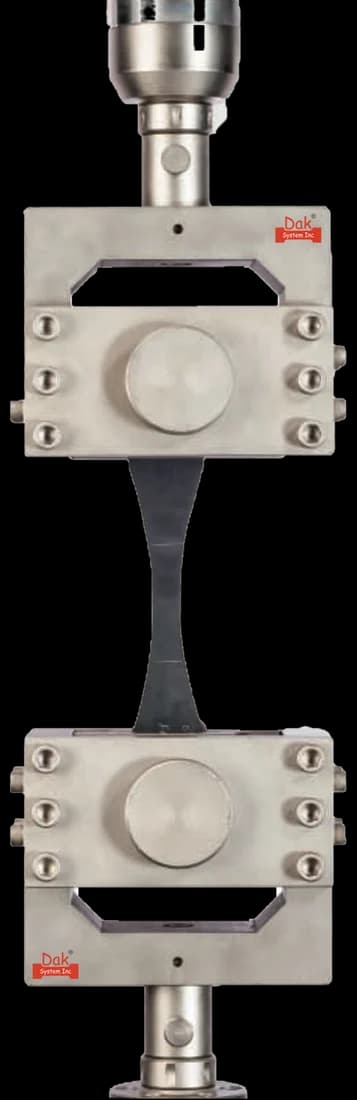
Heavy Duty Hydraulic Grips
Heavy hydraulic wedges hold the steel anchor tubes, not the bar. The bar itself is never gripped — the anchors are the specimen preparation and the grips only hold them.
Specifications
Testing standard
Standard Test Method for Tensile Properties of Fiber Reinforced Polymer Matrix Composite Bars
Written and technically reviewed by Dak System Inc. engineeringLast reviewed
ASTM D7205 determines the quasi-static longitudinal tensile strength and elongation of fibre-reinforced polymer matrix composite bars used as tensile elements in reinforced, prestressed and post-tensioned concrete. The bar is anchored rather than gripped.
From the test method to your testing system
Explore the DAK machines already listed for ASTM D7205/D7205M, then review the grips, measurement and setup requirements below.
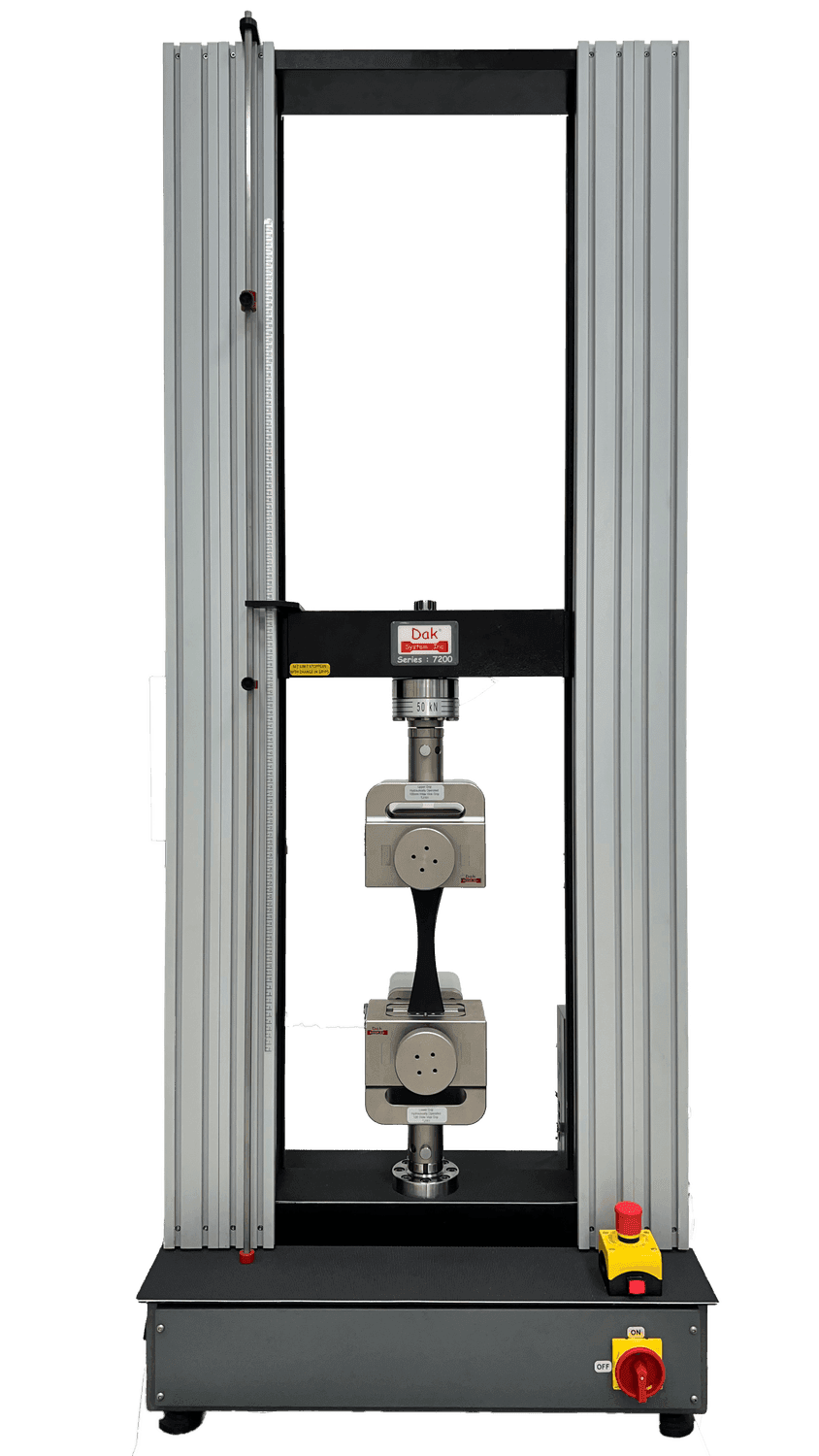 Universal Testing MachineSeries 7200Explore the machine →
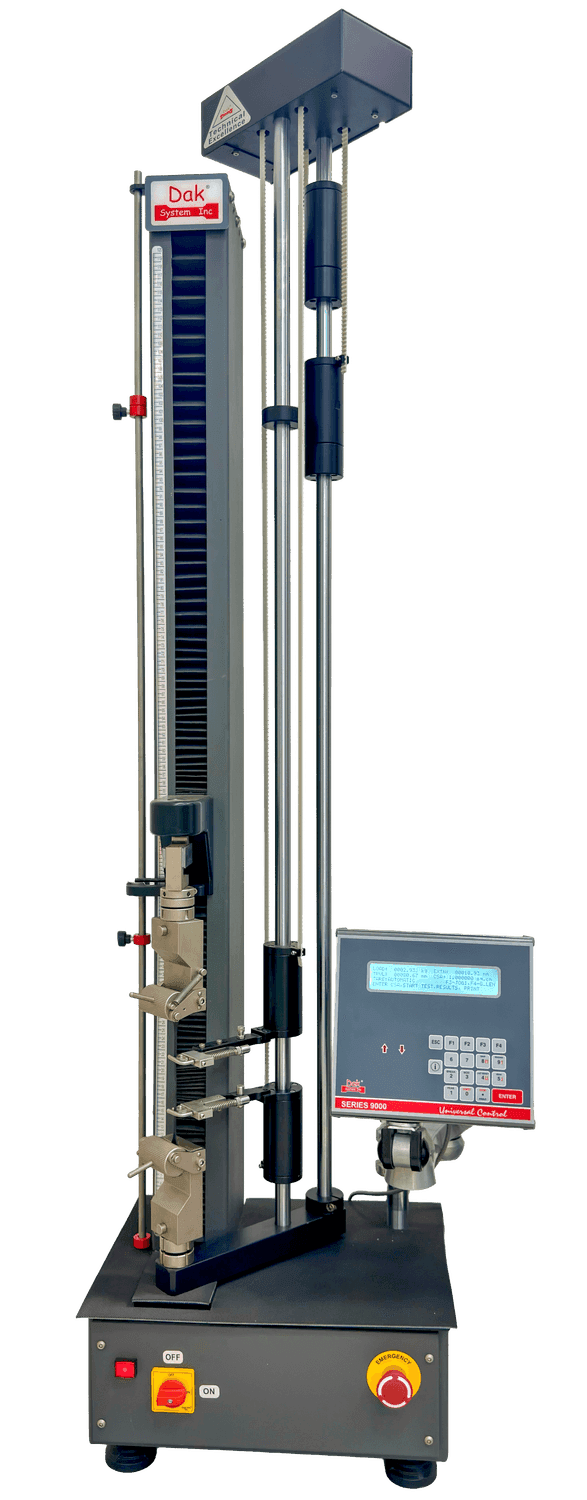 Universal Testing MachineSeries 9000Explore the machine →
01Understand the method
A bar is cut to allow the specified free length plus two terminations, and a steel anchor tube is bonded to each end with grout or resin and left to cure fully. The assembly is mounted so the bar hangs axially, with the machine's wedges gripping the anchor tubes rather than the bar, and an extensometer is fitted to the free length well clear of both anchors. The bar is then loaded to failure at the rate set out below. Tensile strength is calculated on the area basis the method states, and elongation on the measured free length.
The strength and stiffness of FRP reinforcement as a product, for use in reinforced, prestressed and post-tensioned concrete. What the numbers have to carry is that FRP behaves quite unlike steel: it is linear elastic to failure with no yield plateau, so it gives no warning and redistributes nothing. Steel rebar yields and lets a structure shed load; an FRP bar carries elastically and then breaks. Strength and elongation at failure are therefore both design-critical, and the tensile-to-yield ratio that governs seismic steel has no counterpart at all.
02Prepare the specimen and test settings
An FRP bar is strong along the fibres and weak across them. A wedge that holds the load crushes the resin and shears the fibres before the bar reaches its strength.
Anchor design is the test. A laboratory that cannot make anchors which survive the bar cannot measure the bar, and the failure looks like a weak product rather than a weak termination.
03Build the test setup on a DAK machine
Substantial force, since a large-diameter bar can exceed two hundred kilonewtons, and enough daylight for the free length plus two anchor tubes, which are not small. Extensometry has to reach the free length clear of the anchors, because the bar draws into the termination as load rises and the bonded region is stiffened by the medium. Guarding is a real consideration: an FRP bar releases its stored elastic energy suddenly and completely, having no yield to absorb any of it beforehand.
The rate is written as a time to failure rather than a speed, so it has to be worked out for the bar in hand. Failure must occur between one and ten minutes after force is first applied, and the suggested standard strain rate is 0.01 per minute — one per cent of the free length each minute. Without strain control the crosshead simply runs at 0.01 per minute times the free length, and the free length is itself fixed: not less than 380 mm and not less than forty bar diameters. Multiply through and the settings are ordinary — 3.8 mm/min on the 380 mm minimum, 4.8 mm/min on the 480 mm a 12 mm bar needs, 6.4 mm/min on the 640 mm a 16 mm bar needs. The alternative for stress control is a suggested 300 MPa/min. Either way, a failure outside the one-to-ten-minute window means the rate was wrong.
Heavy hydraulic wedges hold the steel anchor tubes, not the bar. The bar itself is never gripped — the anchors are the specimen preparation and the grips only hold them.
SpecificationsDak verifies against whichever standard the method names, and where a class applies our frames sit a class tighter than it asks.
| The method asks for | Dak supplies | |
|---|---|---|
| Capacity | High — a large-diameter FRP bar can exceed 200 kN | Load cells from 1 kg to 60 ton on the Series 7200, and 0.5 to 100 kN on the Series 9000 |
| Force accuracy | ASTM E4 over the working range | Verified to ASTM E4, and to ISO 7500-1 Class 0.5 |
| Strain measurement | An extensometer of the class the method specifies | Certified to ISO 9513 Class 1 and ASTM E83 — non-contact video, clip-on and high-elongation |
| Gripping | Steel anchor tubes bonded to each end of the bar; the bar itself is never gripped | Our a fixture built for this method, built to the specimen |
| Environment | 23 ± 2 °C standard laboratory atmosphere | 3009 series chambers, −150 °C to +400 °C — temperature only |
04Run the test
05Calculate, report and interpret
Maximum force divided by the cross-sectional area on the method's stated basis
Which area basis was used must be reported. FRP bars are commonly specified on a nominal area, and a measured one gives a different number.
From extension measured on the free length between anchors
Never from crosshead travel: anchor draw-in and machine compliance are a large share of it.
Linear elastic to failure, with no yield plateau
An FRP bar does not yield. It carries load elastically and then breaks, which is why elongation at failure and the strength are both design-critical and why there is no equivalent of a steel yield point.
Anchor failures, the commonest wasted specimen in FRP bar testing and always low. Testing before the anchor medium has fully cured, which produces them. Reporting a strength without saying which cross-sectional area basis it used, when a deformed bar has no single measurable diameter and nominal and measured areas differ materially. And taking elongation from the crosshead, which folds anchor draw-in and machine compliance into what is supposed to be bar strain. A last one is treating an FRP bar as though it had a yield point: it has none, so any number presented as one was read off a curve that never bent.
06Compare methods and find answers
| ASTM D7205 | ISO 10406-1 | |
|---|---|---|
| Family | ASTM | ISO |
| Product | FRP bars for concrete reinforcement | FRP bars and grids |
| Termination | Bonded anchors | Bonded anchors |
| Cite | Whichever the specification names | Whichever the specification names |
Both exist because the same physical problem has to be solved — an FRP bar cannot be gripped — and both put the solution in the specimen rather than in the machine.
It is the ASTM tensile test for fibre-reinforced polymer matrix composite bars — the FRP rebar, rods and tendons used as tensile elements in reinforced, prestressed and post-tensioned concrete. It determines quasi-static longitudinal tensile strength and elongation. The current designation is ASTM D7205/D7205M-26.
Because it is strong along the fibres and weak across them. A wedge grip applies transverse pressure, and the pressure needed to hold a bar that fails at a couple of hundred kilonewtons crushes the resin and shears the fibres at the jaw line long before the bar reaches its own strength. Bonded steel anchor tubes spread that load into shear along a length instead, which is the same reasoning that socketing a wire rope solves.
The specimen is void and should be rejected. A fracture at or inside an anchor reports the quality of the termination — the bond, the grout, the cure — rather than the strength of the bar, and it invariably reads low. It is the commonest wasted specimen in FRP bar testing, which is why anchor design is treated as part of the method rather than as laboratory housekeeping.
The one the method states, and the basis has to be reported. A deformed FRP bar has no single measurable diameter — callipers give a different answer depending on whether they land on a rib — so the area comes from a defined basis rather than from measurement. FRP bars are often specified on a nominal area, and a strength calculated on a measured one is a different number.
Because the bar draws slightly into the anchor as load rises, and the region near the termination is stiffened by the bonding medium. Extension measured across either of those mixes anchor behaviour into bar strain. Fitting the gauge well inside the free length keeps the measurement to the bar.
It is linear elastic to failure with no yield plateau. Steel rebar yields, redistributes load and gives visible warning; an FRP bar carries load elastically and then breaks. That is why both the strength and the elongation at failure are design-critical, why there is no FRP equivalent of a steel yield point, and why the tensile-to-yield ratio that matters so much for steel has no counterpart here.
More than people expect. A large-diameter FRP bar can exceed two hundred kilonewtons, and the frame also needs the daylight for the free length plus two anchor tubes, which are substantial. Guarding matters as well: an FRP bar releases its stored elastic energy suddenly and completely, having no yield to absorb any of it first.
Discuss your specimen, test requirements and reporting needs with DAK engineering.
This page describes the method as practised. The governing text is the current edition from the issuing body. Tell us what you are testing and we will answer with the machine, the fixture and a quotation.