
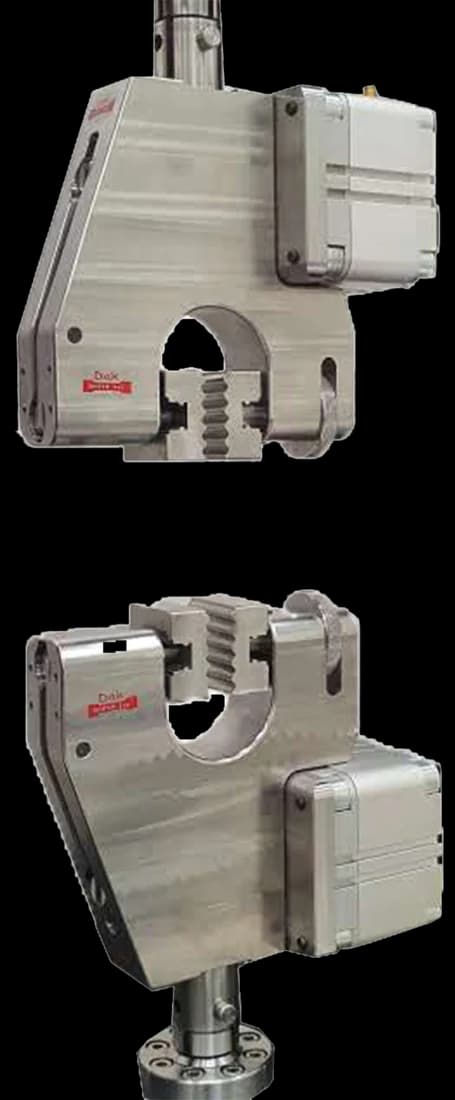
Standard 25 mm
Pneumatic Vice Action Grip
Holding the barrel square without crushing it — a thin-wall polypropylene barrel deforms under a hard jaw and the added friction is recorded as plunger force.
Specifications
Testing standard
Sterile hypodermic syringes for single use — Part 1: Syringes for manual use
Written and technically reviewed by Dak System Inc. engineeringLast reviewed
ISO 7886-1 sets the requirements and test methods for single-use manual hypodermic syringes. The most-run procedure measures the force to operate the plunger in an axial compression test at a constant 100 mm/min, reading the breakaway force, the maximum glide force and the average glide force from a single trace, alongside checks on plunger-stopper separation, leakage under pressure and nozzle fit. The current edition is ISO 7886-1:2017.
From the test method to your testing system
Explore the DAK machines already listed for ISO 7886-1, then review the grips, measurement and setup requirements below.
 Universal Testing MachineSeries 7200Explore the machine →
 Universal Testing MachineSeries 9000Explore the machine →
01Understand the method
Part 1 carries a set of mechanical tests on a finished syringe rather than one method. The plunger is driven along the barrel at a constant 100 mm/min while force is recorded, so the effort a clinician applies is measured directly. Annex E sets the arrangement out: the syringe is filled with water and connected through 500 mm ± 5 mm of 2,7 mm ± 0,1 mm bore tubing to a 1,2 mm (18 G) needle about 40 mm long, then compressed axially while breakaway force, maximum glide force and average glide force are read from one trace. Separate procedures check that the plunger stopper does not separate under a specified force, that barrel and nozzle hold pressure, and that the nozzle fits a conical fitting.
The headline figure is the force to operate the plunger — breaking free from rest, then moving steadily. A syringe that is stiff, or that judders, makes accurate dosing difficult and small-volume delivery unreliable. Plunger-stopper separation force guards against the stopper pulling off inside the barrel during aspiration, and the leakage tests against dose loss and contamination. None is a material property: they are product performance requirements.
The forces are small enough to dismiss and consequential enough that the standard fixes them. A plunger needing a high force to break free delivers its first increment as a jerk rather than a flow — for a small dose, the difference between the intended amount and a visible overshoot. Glide force matters differently: it is what a clinician feels over a long injection, and an uneven one is the usual complaint behind a syringe rejected on the ward rather than in the laboratory.
02Prepare the specimen and test settings
03Build the test setup on a DAK machine
Forces are small — often a few newtons — so a low-capacity load cell with clean resolution matters far more than frame capacity, and the trace must resolve the breakaway peak as well as the steadier glide force. Alignment is the real requirement: the plunger has to run along the barrel axis, so a fixture holding the barrel square while the plunger travels freely is what makes results repeatable.
The frame must also hold 100 mm/min smoothly over a long travel, because stick-slip in the crosshead drive is recorded as if it were the syringe. At that rate a 60 mm stroke takes about 36 s, and the breakaway peak occupies a fraction of a second of it — so data capture wants a few hundred readings per second, not a few. As the test runs on a sterile product taken from its pack, the fixture must hold the barrel without marking it: the same specimens may be needed for the leakage checks afterwards.
Holding the barrel square without crushing it — a thin-wall polypropylene barrel deforms under a hard jaw and the added friction is recorded as plunger force.
Specifications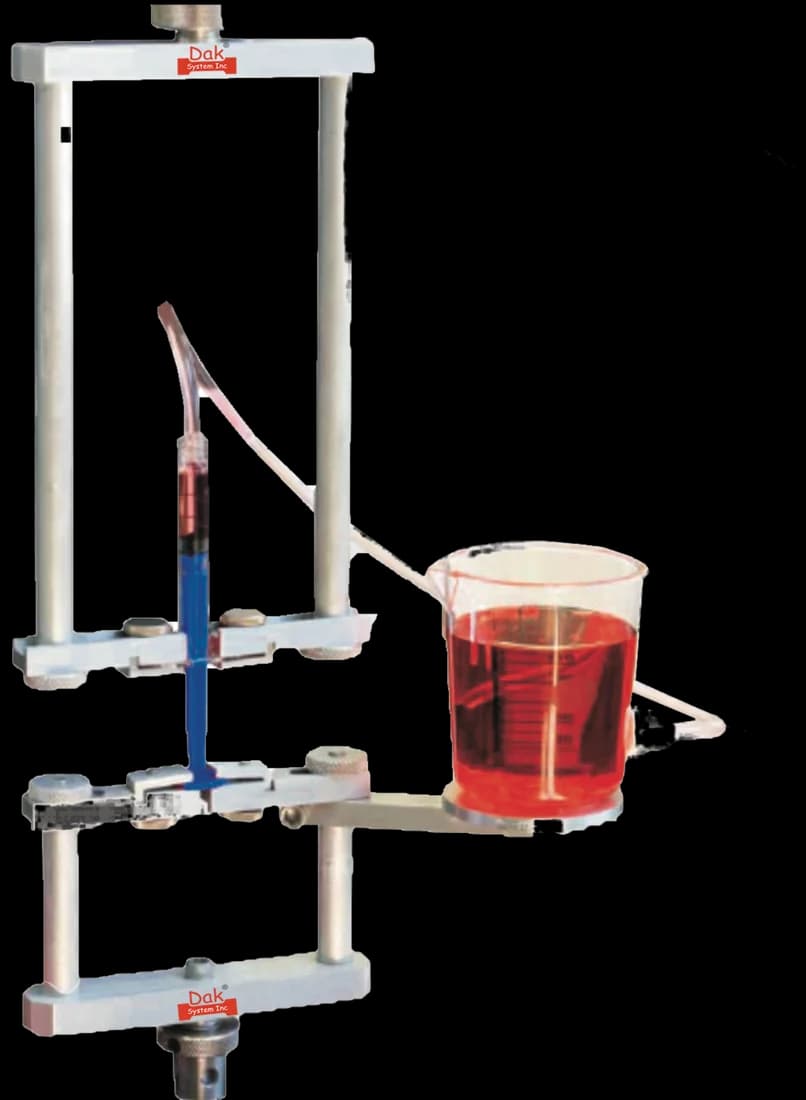
A fixture built for syringe work, holding the body while the plunger is driven along the barrel axis.
SpecificationsDak verifies against whichever standard the method names, and where a class applies our frames sit a class tighter than it asks.
| The method asks for | Dak supplies | |
|---|---|---|
| Capacity | Very low — often a few newtons. A low-capacity cell with clean resolution is what the method needs. | Load cells from 1 kg to 60 ton on the Series 7200, and 0.5 to 100 kN on the Series 9000 |
| Force accuracy | ISO 7500-1 Class 1 | ISO 7500-1 Class 0.5 — a class tighter than the method asks |
| Gripping | A holder gripping the barrel square so the plunger travels along the barrel axis with no side load. | Wedge, vice-action, pneumatic and hydraulic grips, built to the specimen |
| Environment | As the specification states. Lubricant viscosity is temperature-dependent. | 3009 series chambers, −150 °C to +400 °C — temperature only |
04Run the test
05Calculate, report and interpret
Peak force to start the plunger moving from rest, N
Usually the higher of the two. A high break-free force is what makes small-volume dosing jerky.
Average force over the steady portion of travel, N
Side load from a misaligned fixture is the commonest error, and it inflates every force — usually a fixture gripping the barrel flange rather than the barrel, letting the body tilt as the plunger advances. Temperature is next: silicone lubricant thins as it warms, so a warm laboratory reports lower forces than the specification intends, consistently and invisibly. Cycling a syringe once before the recorded run lowers the breakaway force, which is why the measurement is taken on the first movement. And reporting one figure without saying whether it is the breakaway peak, the maximum glide force or the average glide force makes the number ambiguous — Annex E produces all three from a single run at 100 mm/min, and they are not interchangeable.
06Compare methods and find answers
| Plunger force | Stopper separation | Leakage | |
|---|---|---|---|
| Protects against | Inaccurate dosing, clinician difficulty | The stopper coming off inside the barrel | Dose loss and contamination |
| Measured as | A force | A force | Pass or fail under pressure |
| Changes with age | Yes — lubricant and set | Yes | Less so |
None of these is a material property. They are product performance requirements on a finished device, which is why the specimen is the syringe as it leaves the pack rather than a coupon of its polymer.
It is the international standard for sterile single-use hypodermic syringes for manual use. It sets requirements and test methods covering the force to operate the plunger, plunger-stopper separation, leakage under pressure and nozzle fit — all measured on the finished syringe rather than on its materials.
Because aspiration matters as much as delivery. A syringe that is stiff to draw up makes it difficult to take an accurate dose from a vial, and a plunger that judders on withdrawal can pull air in. The two directions do not necessarily give the same force.
Because handling and time both change the result. Silicone lubricant migrates within the barrel and the rubber stopper takes a compression set against the barrel wall, so a syringe cycled once already will not read the same. Testing from the pack keeps the measurement representative of what a clinician receives.
Because any side load between plunger and barrel adds friction that belongs to the fixture rather than the syringe. The forces here are only a few newtons, so a small misalignment can be a large proportion of the reading — and it inflates every result in the same direction.
No. Every requirement is a product performance requirement on the finished device. The polymer grade, the lubricant and the stopper compound all matter, but only through how the assembled syringe behaves — which is why the specimen is the syringe as supplied.
The limit comes from the standard and scales with syringe size — a larger barrel has more sealing surface and legitimately needs more force. What matters as much as the number is which force it is: Annex E's run at 100 mm/min yields a breakaway force, a maximum glide force and an average glide force, and a figure quoted without saying which cannot be checked. Smoothness matters too — a syringe within its limit that judders through the stroke is harder to dose accurately than one slightly higher and steady.
Not this part. ISO 7886-1 covers syringes for manual use supplied empty. A prefilled glass syringe is a different construction with a different set of mechanical requirements, covered by the ISO 11040 series, and the plunger force behaves differently because the barrel material and the siliconisation are different.
Discuss your specimen, test requirements and reporting needs with DAK engineering.
This page describes the method as practised. The governing text is the current edition from the issuing body. Tell us what you are testing and we will answer with the machine, the fixture and a quotation.