
Testing standard
ISO 8339 Tensile Extension-to-Break Testing of Building Sealants
Building construction — Sealants — Determination of tensile properties (Extension to break)
Written and technically reviewed by Dak System Inc. engineeringLast reviewed
ISO 8339 extends a bead of building sealant, bonded to two parallel substrate faces, until it breaks. It reports the secant modulus at a chosen elongation and the elongation at break, at both 23 °C and −20 °C. The current edition is ISO 8339:2005; it is confirmed and current, but is marked for revision and a draft successor is in development.
At a glance
- Test type
- Tensile — the specimen is pulled apart
- Published by
- ISO
- Edition
- ISO 8339:2005
- Material
- Adhesives, tapes & bonded joints
- Runs on
- Series 7200 and Series 9000
From the test method to your testing system
Explore DAK equipment for ISO 8339, then review the specimen and setup requirements below.
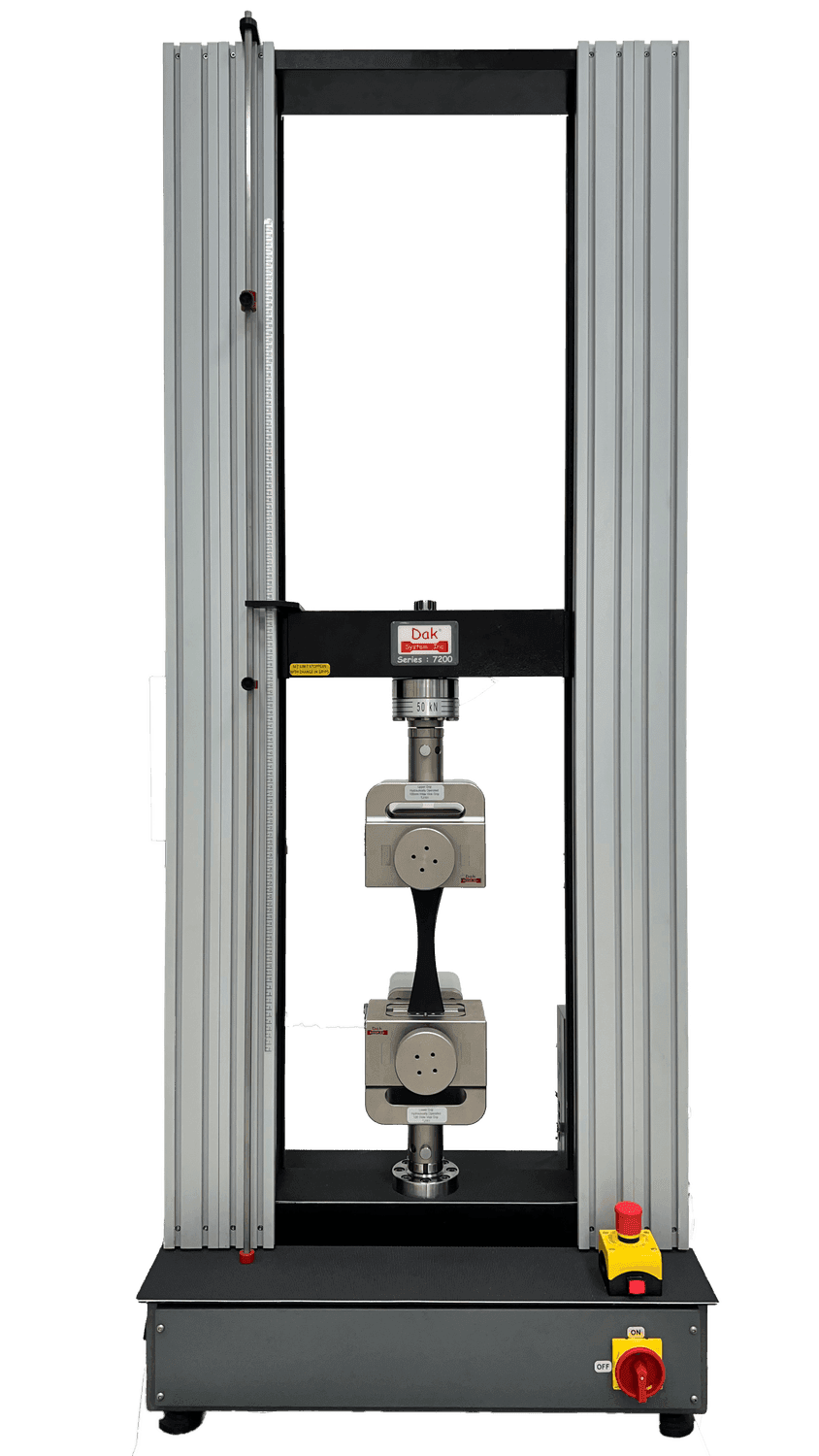 Universal Testing MachineSeries 7200Explore the machine →
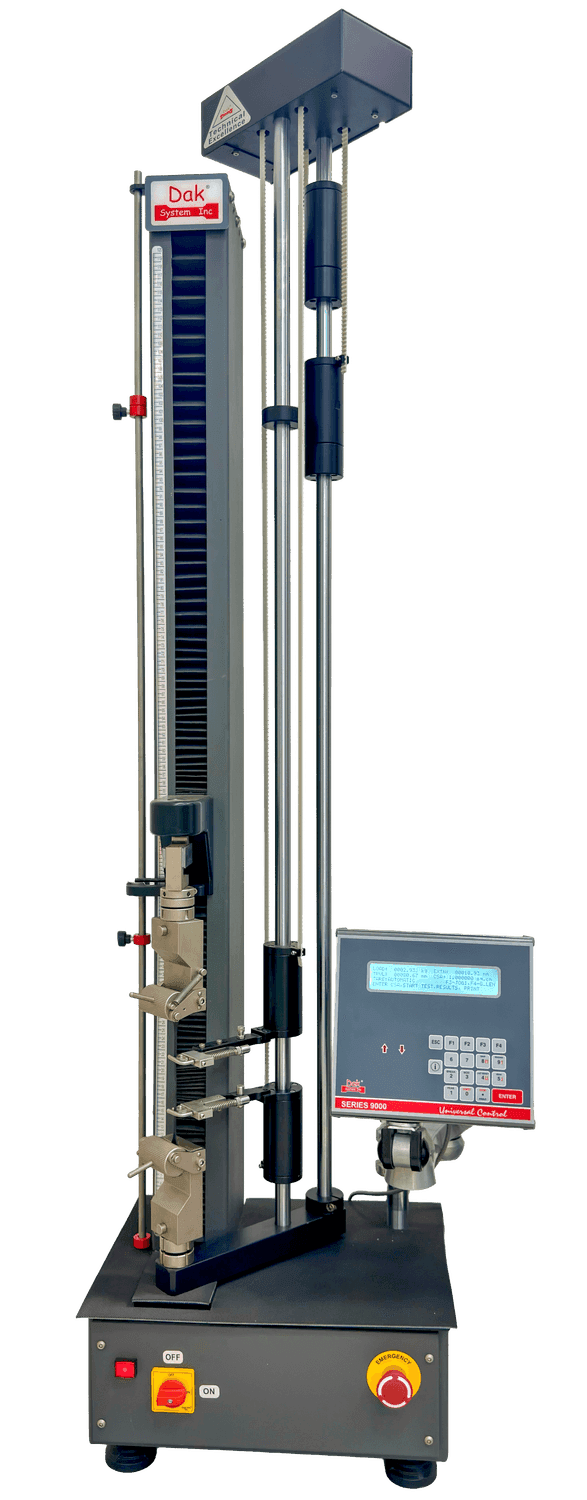 Universal Testing MachineSeries 9000Explore the machine →
Jump to a specific section
01Understand the method
What the test does
A bead of sealant is formed between two parallel substrate faces, exactly as it would sit in a building joint, and then pulled apart until it breaks. Two substrate pieces and two spacers of 12 mm by 12 mm cross-section are assembled on an anti-adherent backing, the cavity between them is filled with sealant, and the surface is trimmed flush. After curing and conditioning the spacers are removed, leaving a free-standing bead bonded on two opposite faces. The specimen is extended at (5,5 ± 0,7) mm/min until rupture and the force–extension diagram is recorded.
What it measures, and why it matters
Two things: the secant modulus at a chosen elongation, and the elongation at break. Modulus is calculated as the force at that elongation divided by the initial cross-sectional area of the bead, rounded to 0,01 N/mm², and reported at 100 %, at 60 %, or at whatever elongation the parties agree. Elongation at break is calculated from the change in joint width and expressed to the nearest 5 %.
Those two numbers answer the question a facade joint actually asks. A joint has to take thermal and structural movement for decades without either tearing or pulling off its substrate, so the sealant must be extensible enough to absorb the movement and soft enough not to load the substrate while doing it. A high modulus on a weak substrate is how joints pull mortar off the face of a building. The failure mode is recorded for every specimen and classified as adhesion, cohesion, or both, and that classification is often more useful than the number beside it: a cohesive break says the sealant reached its own limit, while an adhesive break says the bond to that substrate, or the primer on it, did not hold.
02Prepare the specimen and test settings
The sealant joint
A bead formed between two parallel substrate faces, exactly as it would sit in a building joint.
- Substrates
- Mortar, anodised aluminium or glass, to ISO 13640Other substrates by agreement. The substrate is part of the test, because adhesion is what is being probed.
- Spacers
- 12 mm × 12 mm cross-section, anti-adherent surfaceThey form the bead and are removed before the specimen is pulled.
- Anti-adherent backing
- For example a polyethylene filmPreferably as the sealant manufacturer advises.
- Number of specimens
- Three per substrate type and per test temperature
- Assembly temperature
- Sealant and substrates brought to 23 ± 2 °C
- Filling
- No air bubbles; sealant pressed onto the inner faces; trimmed flushLaying the sealant against the substrate rather than pressing it on is how adhesive failures get manufactured.
- Conditioning, method A
- 28 days at 23 ± 2 °C and 50 ± 5 % RH
- Conditioning, method B
- Method A, then three cycles of heat and water immersionThree days at 70 ± 2 °C, one day in distilled water at 23 ± 2 °C, two days at 70 ± 2 °C, one more day in water; then 24 h back in the standard atmosphere. The standard notes that method B is not a durability test.
The spacers stay in place throughout conditioning and come out only immediately before the test. Removing them early lets the bead deform under its own weight while it is still curing.
Extension rate and test temperatures
- Rate
- (5,5 ± 0,7) mm/min
- Test temperatures
- 23 ± 2 °C and −20 ± 2 °CThree specimens at each. The cold test is run inside a refrigerated enclosure, not merely on a cold specimen.
- Cold soak
- At least 4 h at −20 ± 2 °C before the test
- Recorded quantity
- The force–extension diagram, to rupture
03Build the test setup on a DAK machine
What the machine must be capable of
Very little force, very well resolved, at a slow and steady rate. The bead is small in section and a building sealant is soft, so the forces stay low; the load cell has to be chosen for the specimen, not for the frame. The machine must hold (5,5 ± 0,7) mm/min and record force against extension throughout. Stroke matters more than capacity, because an extensible sealant may reach several times its original joint width before it breaks.
The test is run at two temperatures — (23 ± 2) °C and (−20 ± 2) °C, three specimens at each — so a refrigerated enclosure that can hold the specimen at −20 °C while it is extended is part of the apparatus, and specimens are held at that temperature for at least 4 h beforehand. A ventilated convection oven and a water container are needed only for method B.
Running ISO 8339 on the Series 7200 and Series 9000
Dak verifies against whichever standard the method names, and where a class applies our frames sit a class tighter than it asks.
| The method asks for | Dak supplies | |
|---|---|---|
| Capacity | A small bead of a soft building sealant, so the forces stay low and the load cell has to be chosen for the specimen rather than the frame. Stroke matters more than capacity, because an extensible sealant can reach several times its original joint width before it breaks. | Load cells from 1 kg to 60 ton on the Series 7200, and 0.5 to 100 kN on the Series 9000 |
| Force accuracy | none stated — the method calls only for a tensile test machine with a recording device, capable of extending the specimen at (5,5 ± 0,7) mm/min | ISO 7500-1 Class 0.5, verified to ASTM E4, DIN 51221 and BS 1610 |
| Gripping | No special fixture. The two substrate pieces of the cured specimen are held in the machine and drawn apart; the spacers that formed the bead are removed immediately before the test | Wedge, vice-action, pneumatic and hydraulic grips, built to the specimen |
| Environment | Method A: 28 days at (23 ± 2) °C and (50 ± 5) % RH. Method B: method A, then three heat-and-water cycles, then 24 h back in the standard atmosphere. Testing at both (23 ± 2) °C and (− 20 ± 2) °C, the cold specimens held at temperature for at least 4 h and extended inside a refrigerated enclosure | 3009 series chambers, −150 °C to +400 °C — temperature only |
Planning a sealant test programme? Explore sealant testing machines and fixtures.
04Run the test
How the test runs
- Bring the sealant and the substrates to 23 ± 2 °C.
- Assemble two substrates and two spacers on the anti-adherent backing.
- Follow the manufacturer's instructions on priming and on mixing multi-component products.
- Fill the cavity with sealant, avoiding air bubbles and pressing it onto the inner faces.
- Trim the surface flush with the substrates and spacers.
- Set the specimen on edge and remove the anti-adherent backing as soon as possible.
- Condition by method A or method B, with the spacers left in place.
- Remove the spacers, and for the cold test hold the specimen at −20 ± 2 °C for at least 4 h.
- Extend at (5,5 ± 0,7) mm/min until rupture, recording force against extension.
- Calculate the secant modulus and the elongation at break, and record the type of break for each specimen.
05Calculate, report and interpret
Calculations
σ = F / s
- F
- force at the chosen elongation, N
- s
- initial cross-sectional area of the specimen, mm²
Rounded to 0,01 N/mm². The elongation it is read at — 100 %, 60 %, or another agreed value — has to be stated, or the figure means nothing.
Elongation % = [(final width − original width) / original width] × 100
- original width
- the joint width before extension, mm
- final width
- the joint width at rupture, mm
Expressed to the nearest 5 %.
What the report has to contain
- Laboratory name and date of test
- Reference to ISO 8339
- Name, chemical family and colour of the sealant
- Batch of sealant used
- Substrate used
- Primer used, if any
- Conditioning method used
- Secant modulus for each specimen, at the stated elongation
- Arithmetic mean of the three secant moduli
- Elongation at break for each specimen
- Arithmetic mean of the three elongations at break
- Type of break — adhesion, cohesion, or both — for each specimen
- Any deviations from the standard
What goes wrong in practice
Testing before the sealant has properly cured, which is the commonest error and always gives a soft, extensible, flattering result. Air entrapment, which puts the break wherever the largest void is. Skipping the specified primer, then reporting an adhesive failure as a property of the sealant. Removing the spacers too early. And quoting a modulus without saying at what elongation it was read, which makes the figure meaningless.
06Compare methods and find answers
Sealant tests and where each one looks
| ISO 8339 | ISO 8340 | ASTM C794 | |
|---|---|---|---|
| Loading | Extension to break | Extension held constant | Peel |
| Question asked | How far will it stretch, and how stiffly | What happens while it is held open | Will it stay stuck to the substrate |
| Temperatures | 23 °C and −20 °C | As specified | As specified |
| Output | Secant modulus and elongation at break | Tensile properties at maintained extension | Peel strength per unit width |
ISO 8339 refers to ISO 8340 directly for the maintained-extension case. A joint sealant is asked to do both things in service — take movement, and hold it — so a specification that calls up one usually calls up the other.
Questions we are asked about this test
What is ISO 8339?
It is the ISO method for the tensile properties of building sealants, extension to break. A bead of sealant is formed between two parallel substrate faces, cured and conditioned, then extended at (5,5 ± 0,7) mm/min until it ruptures. The results are the secant modulus at a chosen elongation and the elongation at break.
Which edition is current?
ISO 8339:2005, the second edition, published in June 2005. It cancelled and replaced ISO 8339:1984, which is withdrawn, and it was reviewed and confirmed in 2020. It now sits at stage 90.92, marked for revision, with a draft successor under development as ISO/DIS 8339 under the wider title Building and civil engineering sealants.
How does ISO 8339 differ from ISO 8340?
ISO 8339 extends the specimen until it breaks; ISO 8340 holds it at a maintained extension and measures the tensile properties there. ISO 8339 refers to ISO 8340 for that case in its own scope. They answer different halves of the same question about a moving joint.
Why is the test run at −20 °C as well as 23 °C?
Because a facade joint moves most when it is coldest. Thermal contraction opens the joint in winter, exactly when the sealant is stiffest and least extensible, so a room-temperature result on its own describes the easy case. The method requires three specimens at each temperature, with the cold ones held at −20 ± 2 °C for at least four hours first and extended inside a refrigerated enclosure.
Why does the substrate matter?
Because adhesion to that specific substrate is a large part of what is being measured. The method allows mortar, anodised aluminium and glass, prepared to ISO 13640, and others by agreement, and a sealant that performs on glass may fail in adhesion on mortar. The substrate and any primer are both reported with the result.
What does the type of break tell me?
Whether the sealant or the bond gave way. A cohesive break, through the body of the bead, means the sealant reached its own limit. An adhesive break at a substrate face means the bond, or the priming of it, did not hold — and that is usually a preparation or primer problem rather than a sealant problem. The method requires the type of break to be recorded for every specimen.
What is method B conditioning for?
It puts the specimen through three cycles of heat and water immersion after the standard 28-day cure, to see how the sealant behaves once it has been through that. The standard is careful to say it is a normal conditioning procedure using heat and water and is not suitable for giving information on the durability of the sealant.
What machine does this test need?
A small, well-resolved one. The joint is formed by spacers of 12 mm by 12 mm cross-section and a building sealant is soft, so the forces stay low and the load cell must be chosen for the specimen rather than the frame. Stroke matters more than capacity, because an extensible sealant can reach several times its original joint width before it breaks, and a refrigerated enclosure is required for the cold test.
Related
Materials tested to it
The test it standardises
Industries that test to it
Other standards explained
Planning ISO 8339 testing?
Discuss your specimen, test requirements and reporting needs with DAK engineering.
This page describes the method as practised. The governing text is the current edition from the issuing body. Tell us what you are testing and we will answer with the machine, the fixture and a quotation.