
Testing standard
ISO 9895 Short-Span Compression Testing of Paper and Board
Paper and board — Compressive strength — Short-span test
Written and technically reviewed by Dak System Inc. engineeringLast reviewed
ISO 9895 determines the compressive strength of paper and board in the machine and cross directions using a short-span test. A 15 mm wide strip is clamped with a free span of only 0,7 mm and compressed until it fails, and the maximum force is recorded.
At a glance
- Test type
- Compression — the specimen is squeezed
- Published by
- ISO
- Edition
- ISO 9895:2008
- Material
- Paper, board & corrugated
- Runs on
- Series 7200 and Series 9000
From the test method to your testing system
Explore DAK equipment for ISO 9895, then review the specimen and setup requirements below.
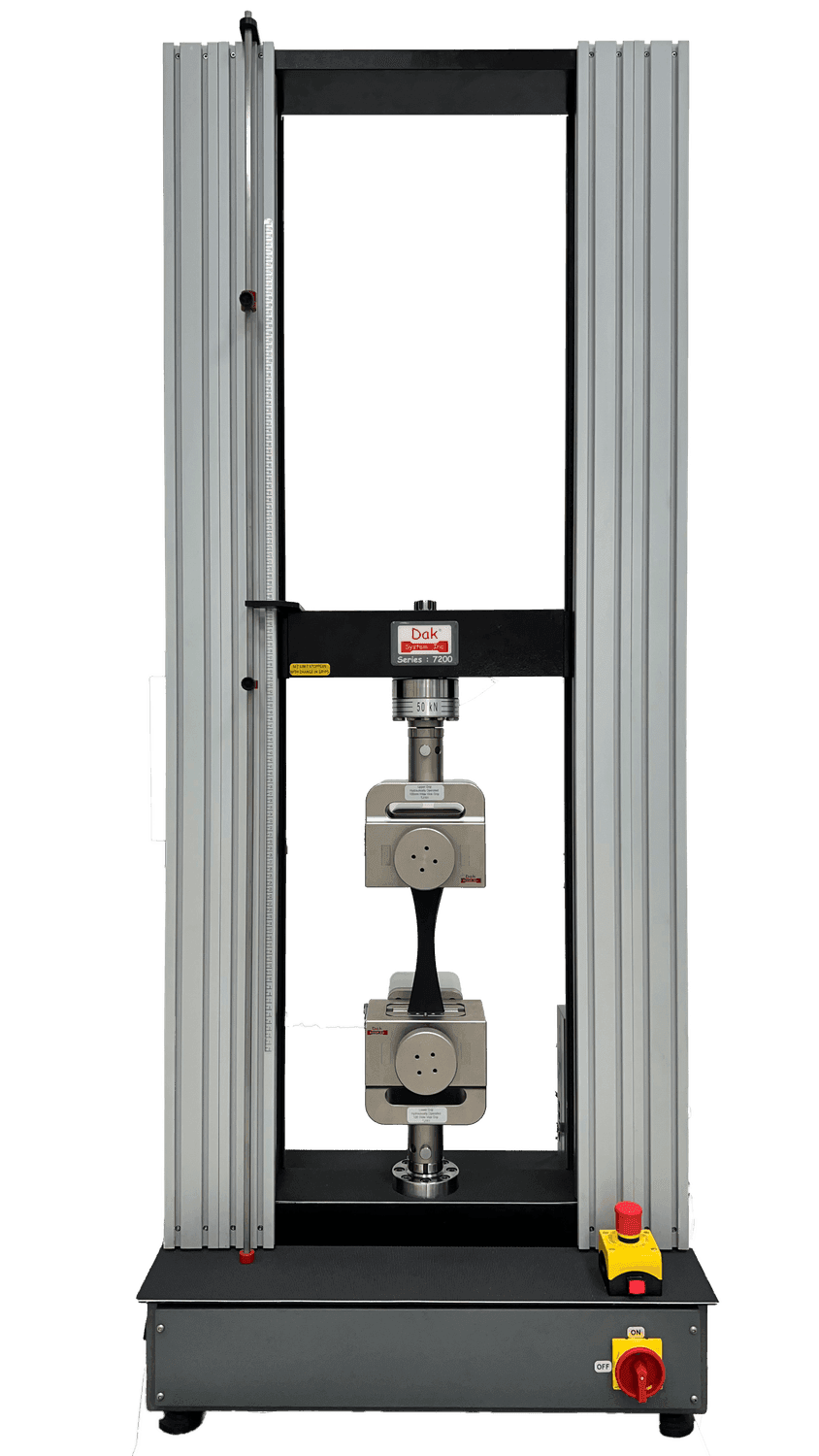 Universal Testing MachineSeries 7200Explore the machine →
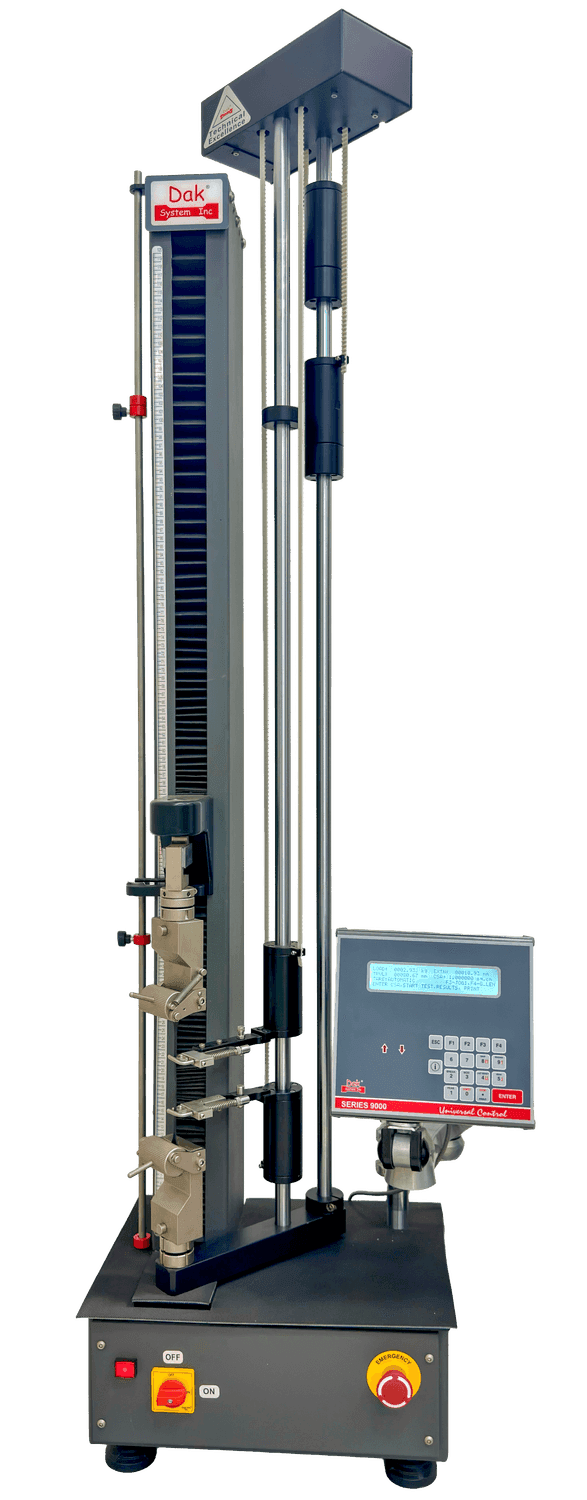 Universal Testing MachineSeries 9000Explore the machine →
Jump to a specific section
01Understand the method
What the test does
A conditioned strip 15 mm ± 0,1 mm wide is clamped along almost its whole length, leaving a free span of 0,70 mm ± 0,05 mm between the two clamps, and the clamps are then driven together at 3 mm/min ± 1 mm/min (0.12 ± 0.04 in./min) until the paper fails. The clamps hold the strip at a constant 2 300 N ± 500 N while they do it. The maximum force is recorded. Machine and cross directions are tested and reported separately, and the force is divided by the strip width and then by the grammage to give the SCT index, which is the figure a containerboard specification is usually written against.
What it measures, and why it matters
The in-plane compressive strength of the paper itself — the property that actually governs how packaging behaves. A stacked box collapses when its panels buckle, which is a compressive event, and the tensile strength of the liner describes a failure mode the box never experiences. The three properties form a chain: the paper's short-span compressive strength governs the edgewise crush resistance of the corrugated board made from it, and that governs the compression resistance of the finished box. Testing at the wrong link in that chain answers a different question from the one asked.
02Prepare the specimen and test settings
Why 0,7 mm
A strip of paper long enough to see would buckle long before it crushed. Shortening the span until buckling is impossible is what makes an in-plane compressive strength measurable at all.
- Free span
- 0,7 mm between the clampsThe defining parameter. It is short enough that the specimen cannot behave as a slender column.
- Strip width
- 15 mm
- Directions
- Machine and cross direction, separatelyCompressive strength is directional in paper, as tensile strength is.
- Grammage range
- Recommended for 100 g/m² to 400 g/m²Outside that band the method is not recommended, which is a scope limit worth checking before quoting it.
- Intended for
- Papers and boards used to make containers and boxes
- Check the span setting before every series
- DakAt 0,7 mm a small error in the span is a large proportional one, and it moves the result directly.
This is an in-plane compressive strength, not a crush of the board's structure. It describes the paper itself, which is why it predicts box performance better than a tensile figure does.
Test speed
- Rate
- 3 mm/min ± 1 mm/min (0.12 ± 0.04 in./min) of clamp approachThe clamps are driven towards each other at that speed once the test starts.
- Span and clamping force
- 0,70 mm ± 0,05 mm free span at the start; clamps hold at 2 300 N ± 500 NThe span is the whole method. A tenth of a millimetre of error in it is more than ten per cent.
- Reported
- Maximum force per unit width, and the SCT indexNormalised by grammage, as paper properties generally are.
- Directions
- Reported separately
- Watch for the strip slipping in the clamps
- DakIf the paper draws in, the free span lengthens during the test and the result reads low.
03Build the test setup on a DAK machine
What the machine must be capable of
Low force, a clamp approach held at 3 mm/min ± 1 mm/min, and above all a fixture that holds the 0,7 mm free span accurately. That span is the entire method: paper is slender enough that a strip of any visible length buckles as a column and folds at a load far below what the material carries in compression, and shortening the span until buckling is geometrically impossible is what makes a real compressive strength measurable. A tenth of a millimetre of error in it is more than ten per cent, so it is verified rather than assumed.
Running ISO 9895 on the Series 7200 and Series 9000
Dak verifies against whichever standard the method names, and where a class applies our frames sit a class tighter than it asks.
| The method asks for | Dak supplies | |
|---|---|---|
| Capacity | Low — short-span compressive strengths are commonly tens to a few hundred newtons | Load cells from 1 kg to 60 ton on the Series 7200, and 0.5 to 100 kN on the Series 9000 |
| Force accuracy | Class 1 over the working range | ISO 7500-1 Class 0.5, verified to ASTM E4, DIN 51221 and BS 1610 |
| Gripping | A short-span compression fixture: two clamps holding a 15 mm strip with a free span of 0,7 mm between them | Our a fixture built for this method, built to the specimen |
| Environment | 23 ± 2 °C standard laboratory atmosphere | 3009 series chambers, −150 °C to +400 °C — temperature only |
04Run the test
How the test runs
- Condition the paper in the standard atmosphere.
- Determine the grammage, since the index depends on it.
- Confirm the material lies in the recommended 100 to 400 g/m² range.
- Cut 15 mm wide strips in the machine and cross directions.
- Verify the free span setting on the fixture.
- Clamp the strip so that 0,7 mm is left free between the clamps.
- Compress at the specified constant rate until the strip fails.
- Record the maximum force.
- Confirm the strip did not slip in the clamps.
- Calculate strength per unit width and the SCT index.
- Report the directions separately.
05Calculate, report and interpret
Calculations
Maximum force divided by the strip width
Force per unit width, in kN/m. Not a stress, because paper thickness is compressible and gives no usable area.
Short-span compressive strength divided by grammage
The normalisation that lets boards of different substance be compared, and the figure a containerboard specification is usually written against.
A box under load fails by its panels buckling, which is an in-plane compressive event
Tensile strength describes a mode a stacked box never experiences, which is why SCT and edgewise crush are the properties that matter in packaging.
What the report has to contain
- Reference to ISO 9895 and the edition
- Paper or board identification and grammage
- Direction tested
- Conditioning atmosphere
- Free span and strip width used
- Rate of clamp approach
- Maximum force for each specimen
- Short-span compressive strength per unit width
- SCT index
- Number of specimens rejected and why
What goes wrong in practice
A span that has drifted, which reads low and looks like weak paper. Slippage in the clamps, which lengthens the free span during the test and does the same thing while leaving no trace in the record. Averaging machine and cross direction. Reporting a force without the grammage, so no index can be computed and boards of different substance cannot be compared. And reaching for tensile data when the question is about stacking, which is the commonest conceptual error in packaging specification. Handling damage belongs on the list too: a strip creased between cutting and clamping carries a fold that the clamps then close on, and the specimen fails at the crease at a load that says nothing about the paper.
06Compare methods and find answers
ISO 9895 or ISO 3037
| ISO 9895 — SCT | ISO 3037 — ECT | |
|---|---|---|
| Specimen | A single sheet of paper | Assembled corrugated board |
| Measures | The paper's own compressive strength | The board structure's edgewise crush |
| Used for | Selecting and controlling the liner or medium | Predicting box compression |
| Related | SCT feeds into ECT | ECT feeds into box compression |
These sit in a chain: the paper's SCT governs the board's ECT, which governs the finished box's compression resistance. Testing at the wrong link answers the wrong question.
Questions we are asked about this test
What is ISO 9895?
It is the ISO short-span compression test for paper and board. A 15 mm wide strip is clamped so that only 0,7 mm is free between the clamps, then compressed until it fails, and the maximum force is recorded in the machine and cross directions separately. It is intended for papers and boards used to make containers and boxes, and is recommended for grammages from 100 to 400 g/m².
Why is the free span only 0,7 mm?
Because anything longer buckles. Paper is thin and slender, so a strip of any visible length behaves as a column and folds over at a load far below what the material can actually carry in compression. Shortening the span until buckling is geometrically impossible is what converts the test from a buckling measurement into a genuine in-plane compressive strength. The span is the method.
Why does compressive strength matter for paper?
Because that is how packaging fails. A stacked box collapses when its panels buckle, which is an in-plane compressive event, and the tensile strength of the liner describes a mode the box never experiences. Short-span compressive strength and edgewise crush are therefore the properties that predict stacking performance, and tensile strength — though easier to measure — does not.
How does SCT relate to ECT and box compression?
They form a chain. The paper's short-span compressive strength governs the edgewise crush resistance of the corrugated board made from it, and the board's edgewise crush governs the compression resistance of the finished box. Testing at the wrong link answers a different question — SCT tells you about the liner you bought, ECT about the board you made, and a box compression test about the package you shipped.
Why check the span before each series?
Because 0,7 mm is a very small dimension and a small absolute error in it is a large proportional one. A span set a tenth of a millimetre long is more than ten per cent out, and it moves the result directly by letting the specimen begin to behave as a column. It is the one setting on the fixture that genuinely has to be verified rather than assumed.
What if the strip slips in the clamps?
The free span lengthens during the test, so the specimen becomes progressively more slender and fails at a lower load. The result reads low and nothing in the trace announces why. Clamping pressure has to be high enough to prevent it, which is a real constraint given the clamps grip almost the whole strip and paper crushes easily under a hard jaw.
Does the grammage range matter?
Yes, it is a scope limit. The method is recommended for grammages from 100 to 400 g/m². Below that the strip is too flimsy to handle and clamp reliably, above it the assumptions behind the geometry start to fail. Quoting the standard for material outside that band is worth flagging in the report rather than leaving unstated.
Related
Materials tested to it
The test it standardises
Industries that test to it
Other standards explained
Planning ISO 9895 testing?
Discuss your specimen, test requirements and reporting needs with DAK engineering.
This page describes the method as practised. The governing text is the current edition from the issuing body. Tell us what you are testing and we will answer with the machine, the fixture and a quotation.