5 to 400 kNTJ-125
Direct Compression Fixture
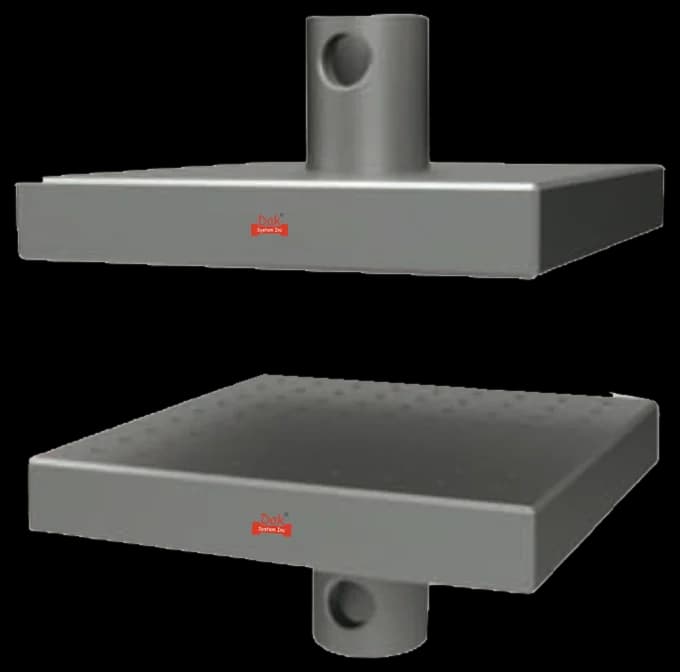
Direct compression platens. The requirement is parallelism and a clean flat face; any debris under a specimen this short becomes a local stress concentration.
Specifications
Testing standard
Corrugated fibreboard — Determination of edgewise crush resistance (non-waxed edge method)
Written and technically reviewed by Dak System Inc. engineeringLast reviewed
ISO 3037 measures the edgewise crush resistance of corrugated fibreboard — the ECT value. A short rectangle of board is stood on edge with its flutes vertical and crushed between parallel platens. It is the single most useful board property, because box compression strength follows from it, and it is measured on a piece of board rather than a whole container.
From the test method to your testing system
Explore the DAK machines already listed for ISO 3037, then review the grips, measurement and setup requirements below.
 Universal Testing MachineSeries 7200Explore the machine →
 Universal Testing MachineSeries 9000Explore the machine →
01Understand the method
A short rectangle is cut from corrugated board so that the flutes run across its height. It is stood on edge between two flat parallel platens, flutes vertical, held upright by a guide only until the load takes over. The platens close at 12.5 ± 2.5 mm/min and crush the specimen along its loaded edge. The peak force is recorded and divided by the measured specimen width to give the edgewise crush resistance in kN/m. No wax or other reinforcement is applied to the loaded edges — the method relies instead on a clean cut and a short specimen to prevent premature edge failure and buckling.
ECT is the most useful single property of corrugated board, because box compression strength follows from it. The McKee relationship estimates the compression strength of a regular slotted container from ECT together with board thickness and box perimeter, which lets a converter predict how a box will perform from a test on a piece of board rather than by making and crushing containers. That makes ECT the working basis of board specification, of supplier acceptance, and of everyday production control in a corrugating plant. It is quick, it uses very little material, and it responds directly to the liner grades and flute profile that determine board performance.
02Prepare the specimen and test settings
A piece of board standing on edge is a very short column. The method exists in several variants precisely because keeping it from buckling, without reinforcing it, is the hard part.
ECT is a property of the board, not of the box. Converting it into a box compression prediction goes through the McKee relationship and needs the box perimeter and board thickness as well — the ECT figure alone predicts nothing.
03Build the test setup on a DAK machine
Modest force and good low-end resolution: ECT specimens commonly peak between a couple of hundred newtons and a few kilonewtons, so accuracy to ISO 7500-1 Class 1 is needed over that range rather than at the top of a large cell. The crosshead must hold 12.5 mm/min. Platens must be parallel, flat and clean — on a specimen this short, debris under an edge becomes a local stress concentration. A guide is needed to hold the specimen upright until the load takes over, without restraining it once loading begins. Above all the laboratory needs humidity control tight enough to hold ± 2 % RH, which is the real barrier to producing comparable ECT data.
Direct compression platens. The requirement is parallelism and a clean flat face; any debris under a specimen this short becomes a local stress concentration.
Specifications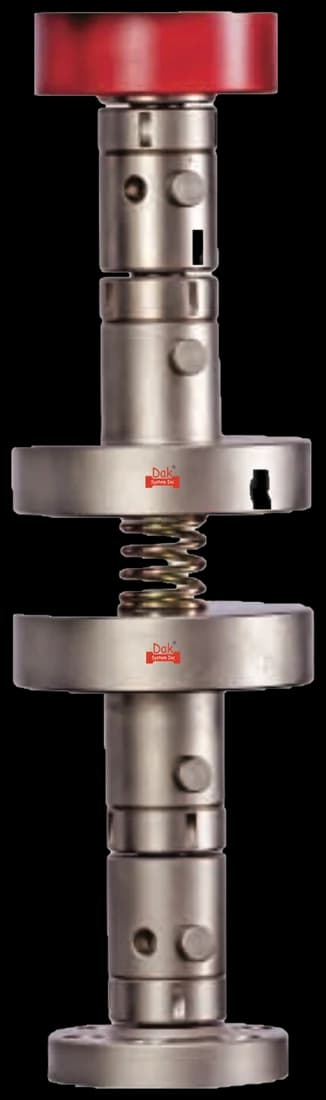
Hardened parallel anvils suit the low forces and small specimen, where a large platen is unnecessary.
SpecificationsDak verifies against whichever standard the method names, and where a class applies our frames sit a class tighter than it asks.
| The method asks for | Dak supplies | |
|---|---|---|
| Capacity | Low — commonly 200 N to 4 kN depending on board grade and specimen width | Load cells from 1 kg to 60 ton on the Series 7200, and 0.5 to 100 kN on the Series 9000 |
| Force accuracy | ISO 7500-1 Class 1 over the working range | ISO 7500-1 Class 0.5 — a class tighter than the method asks |
| Gripping | Flat parallel platens with a guide that holds the specimen upright until the load takes over | Our compression anvils, built to the specimen |
| Environment | 23 ± 1 °C and 50 ± 2 % RH — a tighter atmosphere than most, because board strength is strongly moisture-dependent | 3009 series chambers, −150 °C to +400 °C — temperature only |
04Run the test
05Calculate, report and interpret
ECT = Fmax / w
Reported in kN/m. The width used is the measured specimen width, not the nominal cutter setting.
BCT ≈ 5.87 × ECT × √(h × Z)
THE CONSTANT IS UNIT-BOUND. 5.87 is defined for ECT in lbf/in with caliper and perimeter in inches, giving BCT in lbf; an SI form needs a different constant, and substituting kN/m and millimetres into this expression gives a wrong answer. It is also only an estimate — it holds for regular slotted containers of ordinary proportions, tends to overestimate across broader data sets, and drifts badly outside them.
Edge quality accounts for the overwhelming majority of poor results, and it is visible: crushed flutes, fuzzed liners or delamination at the cut. A loupe check before testing catches most of it, and rejecting a suspect specimen costs seconds. Buckling rather than crushing is the next problem and invalidates the result — the specimen has then failed as a column. Humidity drift produces a consistent bias rather than scatter, so it hides well. And the commonest misuse sits outside the laboratory: quoting an ECT value as though it predicted box compression on its own, when the McKee relationship also needs board thickness and box perimeter.
06Compare methods and find answers
| ISO 3037 | TAPPI T811 | |
|---|---|---|
| Edge treatment | Non-waxed | Waxed edges in the classic method |
| Specimen | Plain rectangle | Rectangle, historically with waxed ends |
| Support | Guide until loading | Support blocks or guide |
| Comparability | Widely used internationally | Widely used in North America |
Waxed and non-waxed methods do not give the same number — waxing stiffens the loaded edges and raises the result. A specification citing one is not met by running the other, and mixed data sets show a step that looks like a board change.
It is the ISO method for the edgewise crush resistance of corrugated fibreboard, universally called ECT. A short rectangle of board is stood on edge with its flutes vertical and crushed between parallel platens. The peak force divided by the specimen width gives the ECT, reported in kN/m.
Because it is the board property that box compression strength follows from. The McKee relationship estimates box compression from ECT, board thickness and box perimeter, which means a converter can predict how a box will perform from a test on a piece of board rather than by making and crushing boxes. It is also far quicker and cheaper than box testing, so it is the practical basis of everyday board specification and quality control.
Older methods dipped the loaded edges in wax to stop them crushing prematurely, which let a taller specimen be used. The non-waxed method relies instead on very clean cutting and a short specimen. They do not give the same number — wax stiffens the edges and raises the result — so a specification citing one is not satisfied by the other, and mixing them produces a step in the data that looks like a board change.
Because the specimen fails at its weakest point along the loaded edge, and a crushed, fuzzed or delaminated edge is exactly that. A blunt or badly set cutter crushes the flutes at the cut, so the specimen begins the test already damaged where it will be loaded. Nearly every unexplained low ECT result has a visible edge defect behind it, and a loupe check before testing catches most of them.
Because ECT falls sharply with moisture content — more sharply than most board properties — so a small drift in humidity produces a real shift in the result. The 23 ± 1 °C and 50 ± 2 % RH atmosphere is tighter than the general laboratory standard for exactly that reason, and a laboratory that cannot hold it cannot produce comparable ECT values.
No — the McKee relationship also needs the board thickness and the box perimeter. And even with those it is an estimate that works well for regular slotted containers of ordinary proportions and drifts for unusual shapes, very tall or very flat boxes, boxes with large hand holes or windows, and heavily printed board. It is an excellent design tool and not a substitute for testing the finished container.
No. Buckling means the specimen failed as a column rather than by edge crushing, so the number describes its slenderness rather than the board. Check that the specimen height is correct, that the guide is holding it upright until the load takes over, and that the platens are parallel. A specimen that buckles is rejected and re-cut.
Discuss your specimen, test requirements and reporting needs with DAK engineering.
This page describes the method as practised. The governing text is the current edition from the issuing body. Tell us what you are testing and we will answer with the machine, the fixture and a quotation.