5 to 400 kNTJ-125
Direct Compression Fixture
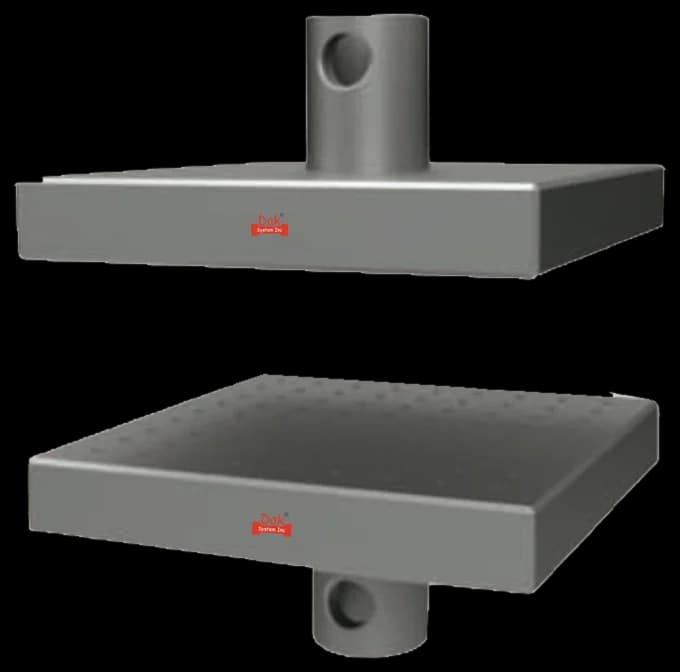
A compression arrangement carrying the ring-crush holder. The holder and its groove are what has to be made to the standard's dimensions; the frame only pushes.
Specifications
Testing standard
Paper and board — Determination of compressive strength — Ring crush method
Written and technically reviewed by Dak System Inc. engineeringLast reviewed
ISO 12192 determines the edgewise compressive strength of paper and board by the ring crush method, standing a strip on edge in a circular groove and crushing it. It applies to thicknesses from 100 µm to 580 µm, and below 280 µm the result can combine buckling with pure compression.
From the test method to your testing system
Explore the DAK machines already listed for ISO 12192, then review the grips, measurement and setup requirements below.
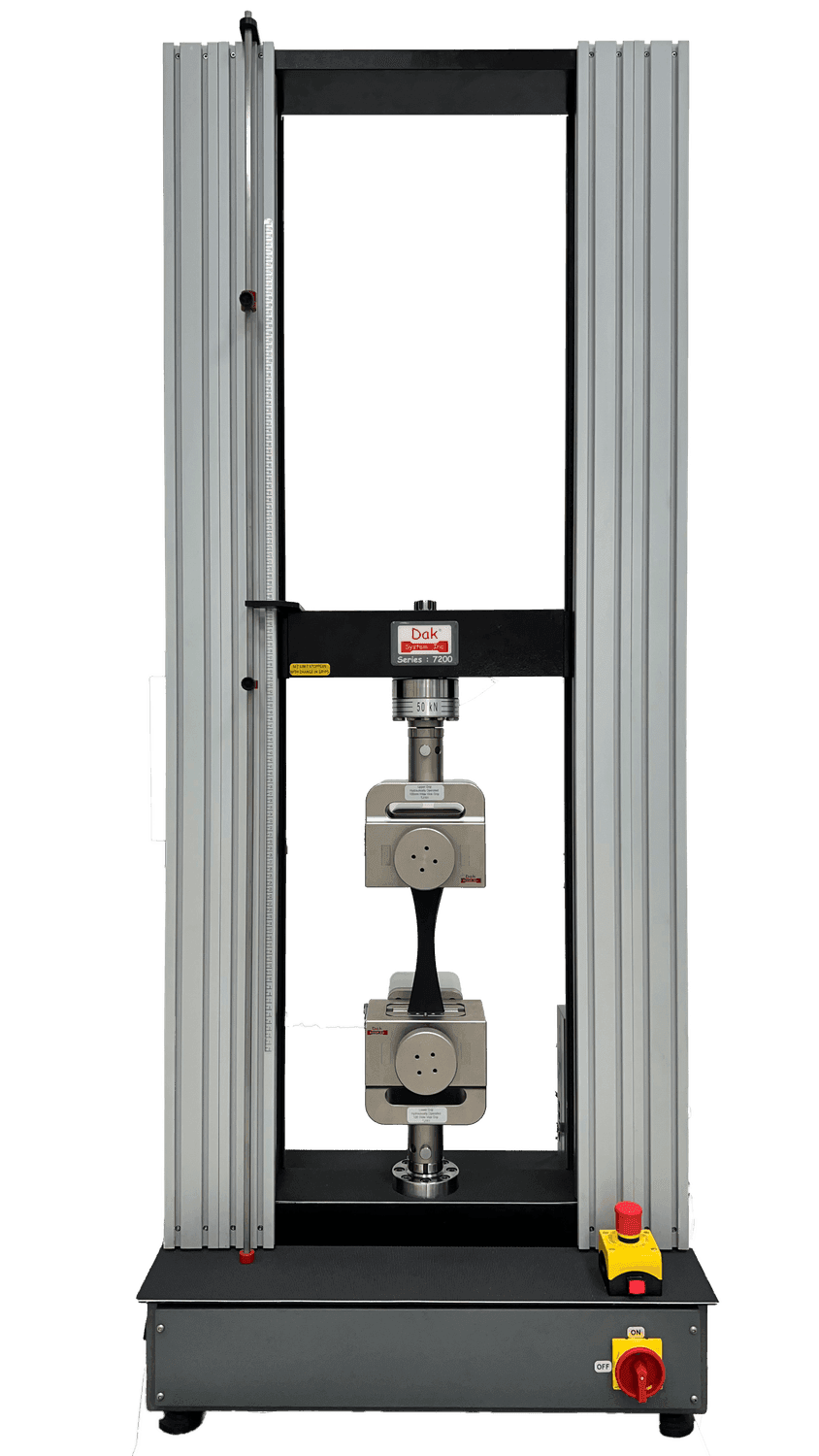 Universal Testing MachineSeries 7200Explore the machine →
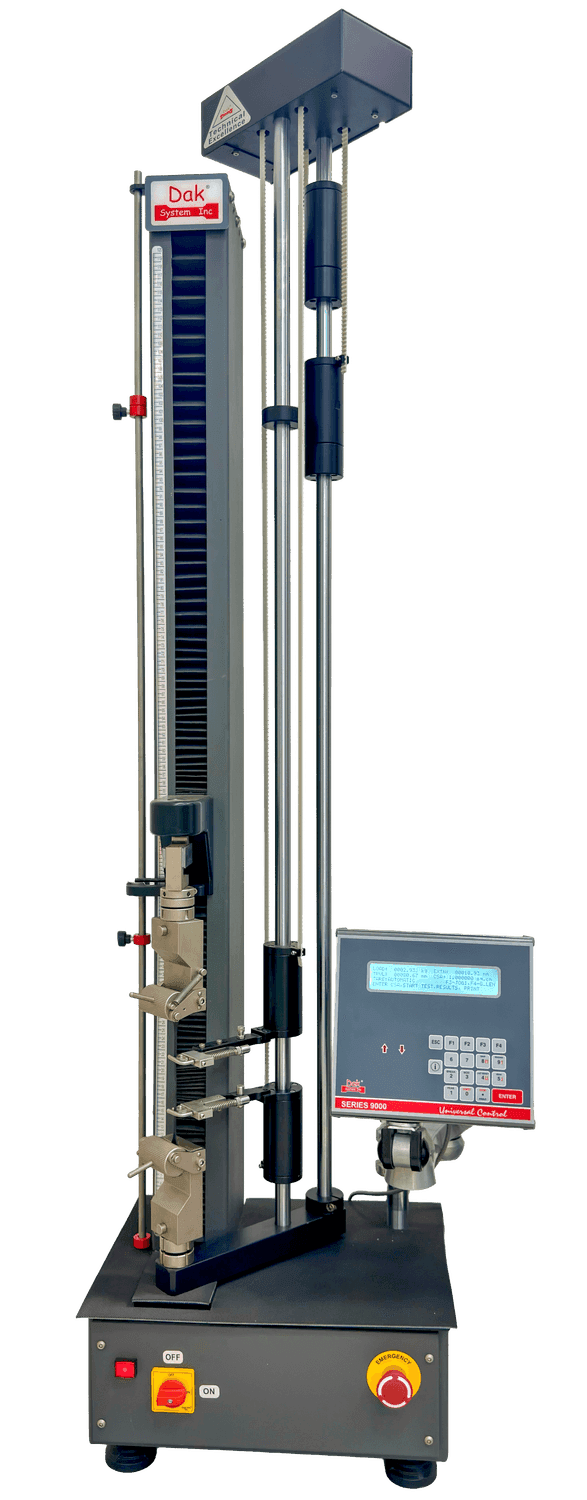 Universal Testing MachineSeries 9000Explore the machine →
01Understand the method
A conditioned strip of paper or board, cut in both principal directions, is formed into a ring and stood on edge in a circular groove in a holder. The ring is then crushed between platens closing at a constant 12,5 mm/min, and the maximum force is recorded. Where the grammage is known the force is normalised into a ring crush index. The method applies to thicknesses from 100 µm to 580 µm, and the machine and cross directions are tested and reported separately.
The edgewise compressive strength of the paper — the property that governs how a corrugated box carries a stack, since a box fails when its panels buckle rather than when its liner tears. The ring is not decoration: a flat strip of paper stood on edge folds over at a load far below what the material can carry in compression, and bending it into a ring braces it against itself while the groove supports its base. That combination lifts the buckling load above the crushing load, which is the only reason an edgewise strength can be measured at all.
02Prepare the specimen and test settings
A flat strip of paper on edge folds over instantly. Bending it into a ring in a groove braces it against itself.
The 2011 revision clarified the instrument against ISO 13820, defined the relevant terms and added a precision statement. A result quoted against the 2002 edition is not describing quite the same procedure.
03Build the test setup on a DAK machine
Low force accurately measured — ring crush values commonly run from tens to a few hundred newtons — and a platen approach held at a constant 12,5 mm/min.
ISO 12192 sets no speed of its own. It requires a motor-driven, fixed-platen crush tester conforming to ISO 13820, and it is ISO 13820 that carries the figure: two nominal speeds are in standard use, (12,5 ± 0,25) mm/min and (10,0 ± 0,25) mm/min, whichever is used must be held within ±0,25 mm/min of nominal, and the nominal speed has to be reported with the test values. Set 12,5 mm/min unless a specification names the other; it is the figure the North American ring crush method fixes and the one most ring crush data was generated at. The two are not interchangeable — ISO 13820 says plainly they should not be assumed to give the same result, which is why the speed is part of the result rather than a machine setting. The demanding part is the fixture rather than the frame: the holder groove has to be the specified width and, more importantly, has to stay that way. A worn or widened groove gives the strip room to buckle, so it folds rather than crushes and every result afterwards reads low, with nothing in the data to distinguish that from genuinely weaker board.
A compression arrangement carrying the ring-crush holder. The holder and its groove are what has to be made to the standard's dimensions; the frame only pushes.
SpecificationsDak verifies against whichever standard the method names, and where a class applies our frames sit a class tighter than it asks.
| The method asks for | Dak supplies | |
|---|---|---|
| Capacity | Low — ring crush values commonly run from tens to a few hundred newtons | Load cells from 1 kg to 60 ton on the Series 7200, and 0.5 to 100 kN on the Series 9000 |
| Force accuracy | ISO 7500-1 Class 1 at the working load | ISO 7500-1 Class 0.5 — a class tighter than the method asks |
| Gripping | A ring crush holder with a groove of the specified width, and flat platens | Our a fixture built for this method, built to the specimen |
| Environment | 23 ± 2 °C standard laboratory atmosphere | 3009 series chambers, −150 °C to +400 °C — temperature only |
04Run the test
05Calculate, report and interpret
The maximum force the ring sustains
A force, reported per the specified strip width. Paper thickness is compressible and is not a usable area.
Ring crush resistance divided by grammage
The normalisation that lets boards of different substance be compared, as with every other paper property.
Curvature plus lateral support raises the buckling load above the crushing load
The same problem ISO 9895 solves by shortening the free span to 0,7 mm. Two different answers to one question: how do you compress paper without it simply folding?
Groove wear, which biases a whole series downward invisibly. Quoting a result from material thinner than 280 µm without the standard's own caveat attached. Averaging the machine and cross directions, when a shipping container loads them differently and one of them carries the stack. Comparing a ring crush figure directly with a short-span one, which measures the same property by a different anti-buckling device and does not produce the same number. And comparing against pre-2011 data without noting that the instrument specification tightened, which does not change the physics but does change how tightly the procedure was pinned down.
06Compare methods and find answers
| ISO 12192 — ring crush | ISO 9895 — short span | |
|---|---|---|
| Anti-buckling device | Curvature and a groove | A 0,7 mm free span |
| Thickness range | 100–580 µm | Grammage 100–400 g/m² |
| Ambiguity | Below 280 µm, buckling contributes | Span error dominates if it drifts |
| Both measure | Edgewise compressive strength | Edgewise compressive strength |
Two solutions to the same problem — paper folds long before it crushes — and they do not give identical numbers. The short-span method is generally regarded as the cleaner measurement; ring crush has the longer history and is still widely specified.
It is the ISO ring crush method for the edgewise compressive strength of paper and board, particularly board used to make fibreboard shipping containers. A strip is stood on edge in a circular groove so that it forms a ring, and the ring is crushed between platens. The current edition is ISO 12192:2011, the second.
Because a flat strip of paper stood on edge folds over at a load far below what the material can carry in compression. Bending it into a ring braces it against itself, and the groove provides lateral support at the base, so the load at which it would fold rises above the load at which it crushes. The combination raises the load at which it would buckle above the load at which it crushes, which is the only way an edgewise compressive strength becomes measurable at all.
The standard says plainly that test values can result from a combination of buckling failure and pure compression. In other words, in the thin part of its range the method is not measuring one clean thing. That caveat belongs in the report alongside the number, because a reader comparing thin and thick boards is otherwise comparing two different mixtures of failure mechanisms.
They solve the same problem differently. Ring crush stops buckling with curvature and a groove; ISO 9895 stops it by shortening the free span to 0,7 mm. Both are edgewise compressive measurements and they do not give identical numbers. The short-span method is generally considered the cleaner measurement, while ring crush has the longer history and remains widely specified — so the specification decides which to run.
Because the groove is what stops the strip buckling. A groove that has worn or widened gives the strip room to move, so it starts to fold rather than crush, and the recorded force falls. Nothing in the data announces this — it looks like a run of weaker board — which is why the holder is inspected before a series rather than after a surprising result.
The instrument was clarified in accordance with ISO 13820, the relevant terms were defined, a precision statement was added and minor text corrections made. None of that changes the physics, but a result quoted against the 2002 edition was obtained under a less tightly specified instrument, which is worth knowing when comparing historic data.
Because paper is made on a moving wire and its fibres orient along the direction of travel, so its edgewise compressive strength is directional like every other property. In a shipping container the two directions do different jobs — one resists the stack load through the vertical walls — and an average would describe neither.
Discuss your specimen, test requirements and reporting needs with DAK engineering.
This page describes the method as practised. The governing text is the current edition from the issuing body. Tell us what you are testing and we will answer with the machine, the fixture and a quotation.