ASTM A125 — read the full explanation
Load–deflection & proof loadHeat-treated helical steel springs — load and permanent-set requirements.

Railway products combine metals, springs, elastomers and bonded structures, each with a different response to load. DAK testing systems help laboratories evaluate material strength, stiffness and deformation with configurations built around the specimen and the required measurement.
Tensile and bend testing support evaluation of metallic material specimens used in railway supply chains. Identify the material grade, product form and specimen orientation, and select the method for the property being reported.
Load-deflection testing shows how force changes as a spring or elastic component moves. Define the installed direction, contact arrangement and working interval for the stiffness or force-at-position result you need.
Compression testing relates the applied load to deformation of a rubber specimen or component. Geometry, contact area and loading history help distinguish material characterisation from the response of a finished pad.
Clips, pads and other fastening parts operate within a defined assembly. Identify whether you are evaluating an individual part or its response in a specified fixture, including the load direction and displacement measurement.
Tensile, compression and peel arrangements examine different parts of a bonded construction. Select the loading mode according to whether the result concerns the core, the interface or separation of bonded layers.
Tensile and elongation testing examine the mechanical behaviour of insulation and sheathing specimens. Sample preparation, cross-section and extension measurement form part of the test specification.
Include both the lowest force of interest and the highest test load. A small elastomer specimen and a stiff metal component may need different load-cell and fixture choices within a laboratory programme.
A component drawing should show how the specimen is supported and where load is applied. Include supports, fixture height and the movement required for the test, not only the external dimensions of the part.
Force at a stated deflection, a stiffness curve and strain on a material specimen are different outputs. Identify where movement is measured and which region of the response is needed for your evaluation.
Configure the universal testing machine around the material specimen or component, with the appropriate loading and measurement arrangement. Use the published machine specifications to compare force, space and test-control requirements.
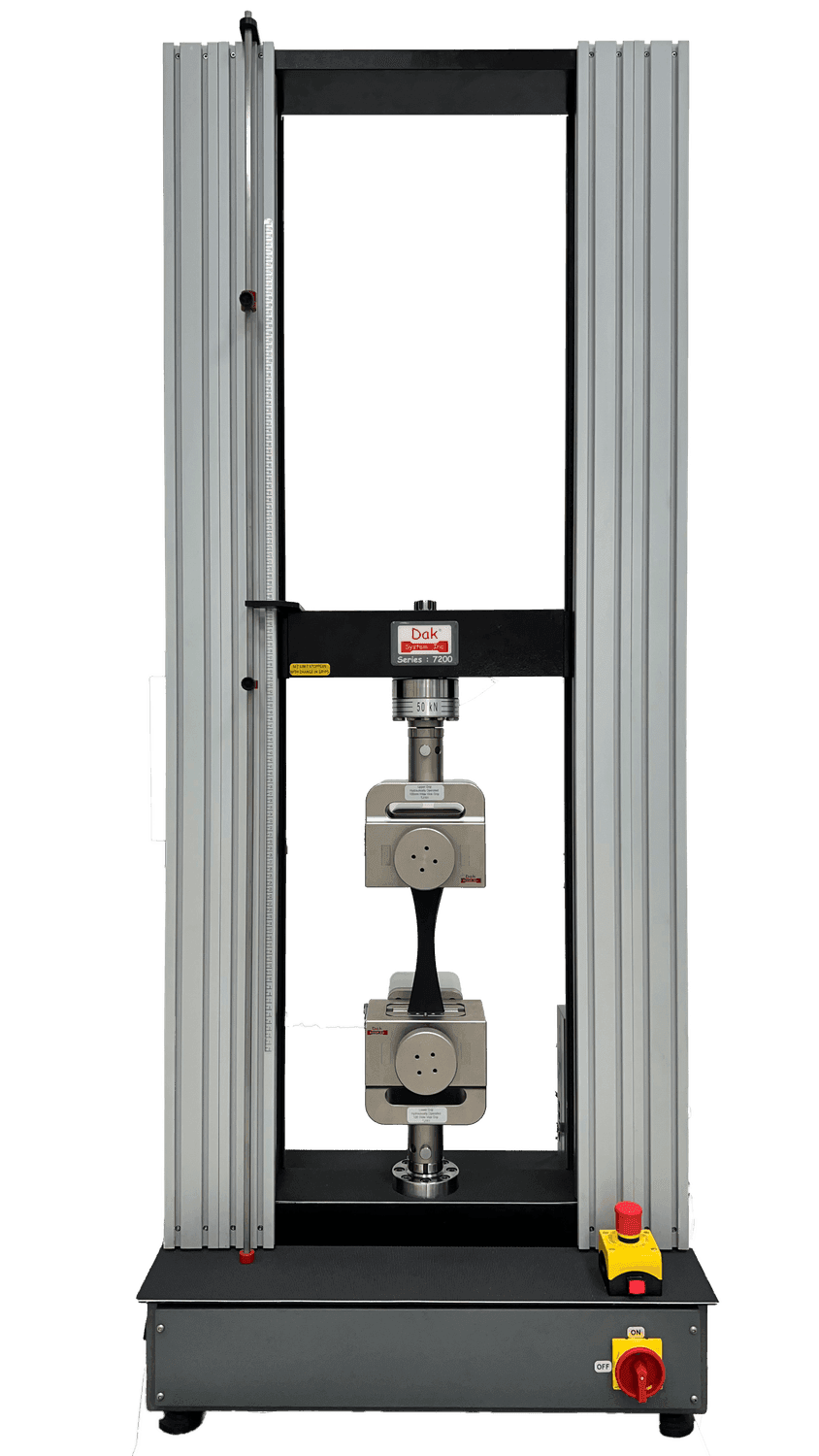
DAK flagship
DAK’s flagship universal testing platform supports a versatile laboratory workflow across material characterisation and component evaluation, bringing flexible programming and measurement together with the required tooling.
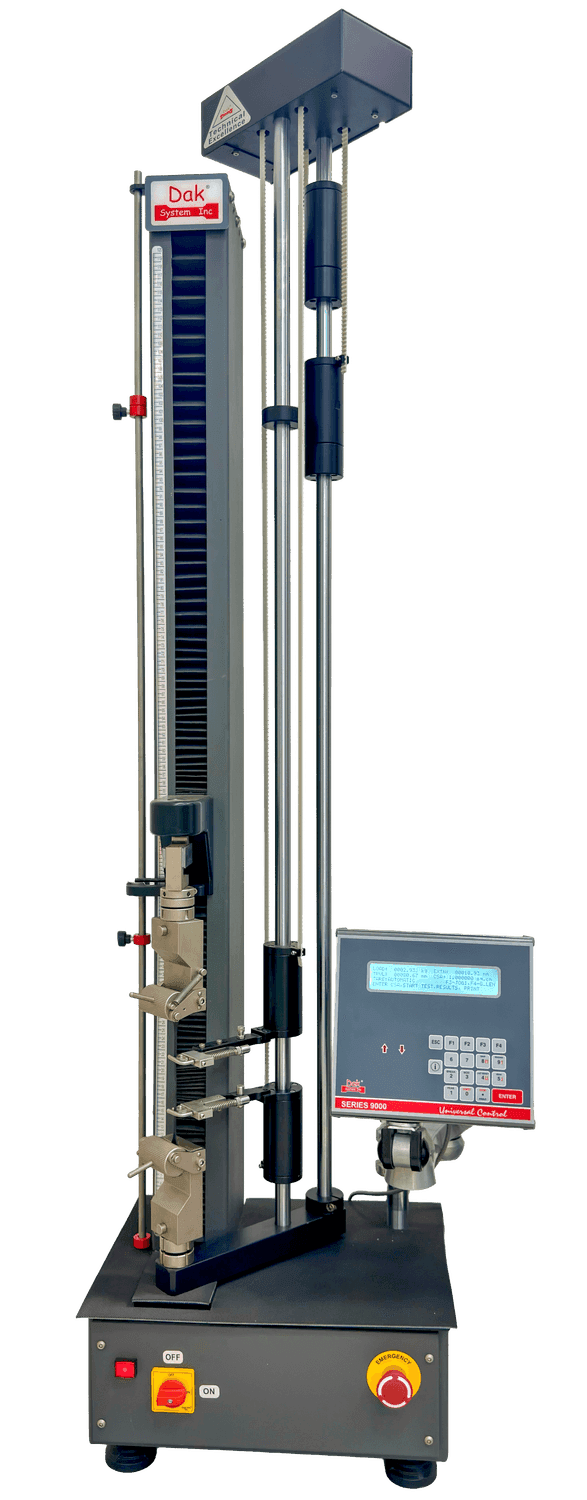
A universal testing option for defined material and component methods. Evaluate its published configuration against the force, travel and working space needed by your specimens.
Repeated loading and twisting are distinct from a static tensile or compression test. Describe the required waveform or torque-angle result when selecting the relevant fatigue or torsion platform.
Use the library to locate relevant material and component methods. Railway assembly tests and acceptance requirements should be specified for the actual product and loading arrangement.
Heat-treated helical steel springs — load and permanent-set requirements.
Flatwise tensile strength of sandwich constructions (core-to-facing bond).
Edgewise compressive strength of sandwich constructions.
Flexural strength of concrete beams — C78/C78M third-point loading is current; C293/C293M centre-point loading was withdrawn in 2025 with no replacement.
Floating roller peel resistance of adhesives (metal-to-metal bonds).
Rubber properties in compression (deflection at load / load at deflection).
Rail fastening system tests — clamping force, longitudinal restraint and pad stiffness (static methods on UTM-class frames).
European concrete sleeper and bearer testing — static and dynamic bending of monoblock sleepers.
Flat-bottom rails — tensile testing of rail steel samples for chemistry-property certification.
Pre-tensioned PSC sleepers — static bending: moment of resistance at rail-seat bottom and centre top, and failure moment (large-frame flexure).
SGCI inserts, liners and rail pads — compression, insert pull-out and stiffness verification.
Indian Standard — tensile strength and elongation of cable insulation and sheath.
Cable insulation and sheath — tensile and elongation. Equivalent to: IEC 60811-501
Indian Standard bend test for metallic materials. Equivalent to: ISO 7438
High-strength deformed steel bars (rebar) for concrete reinforcement — 0.2% proof stress, elongation, bend and rebend tests. Equivalent to: —
Reinforcement and structural steel for railway civil works — tensile and bend certification.
Toe load measurement and load-deflection characteristic of elastic rail clips.
Showing 1–8 of 17 standards
A rubber coupon, an assembled fastening system and a full rail or sleeper have different loading and space requirements. State the test level so fixture design and machine selection begin with the right scope.
A load-deflection curve describes the response during that loading sequence. A durability programme also needs the cycle pattern, force range and measurement criteria. Include both if your laboratory runs both types of work.
A clear component description and result requirement will help us focus the equipment discussion.