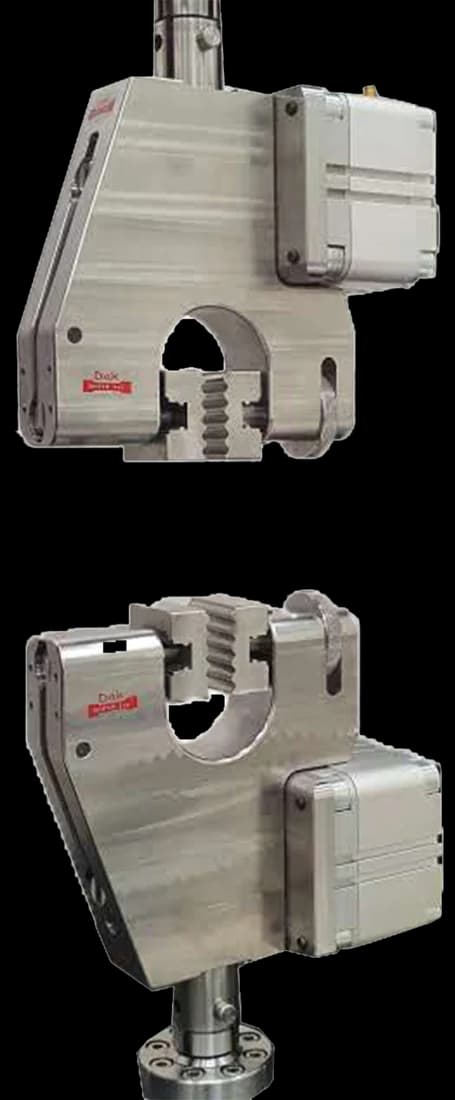
Standard 25 mm
Pneumatic Vice Action Grip
Pneumatic vice action grips clamp the full specimen width at a constant, even pressure — which is what stops one side slipping or tearing before the other.
Specifications
Testing standard
Standard Test Method for Tear-Propagation Resistance (Trouser Tear) of Plastic Film and Thin Sheeting by a Single-Tear Method
Written and technically reviewed by Dak System Inc. engineeringLast reviewed
ASTM D1938 measures the force needed to propagate an existing tear through plastic film and thin sheeting no more than 1 mm thick, using a single-tear trouser geometry. It is explicitly not applicable to materials that fail in a brittle manner during the test.
From the test method to your testing system
Explore the DAK machines already listed for ASTM D1938, then review the grips, measurement and setup requirements below.
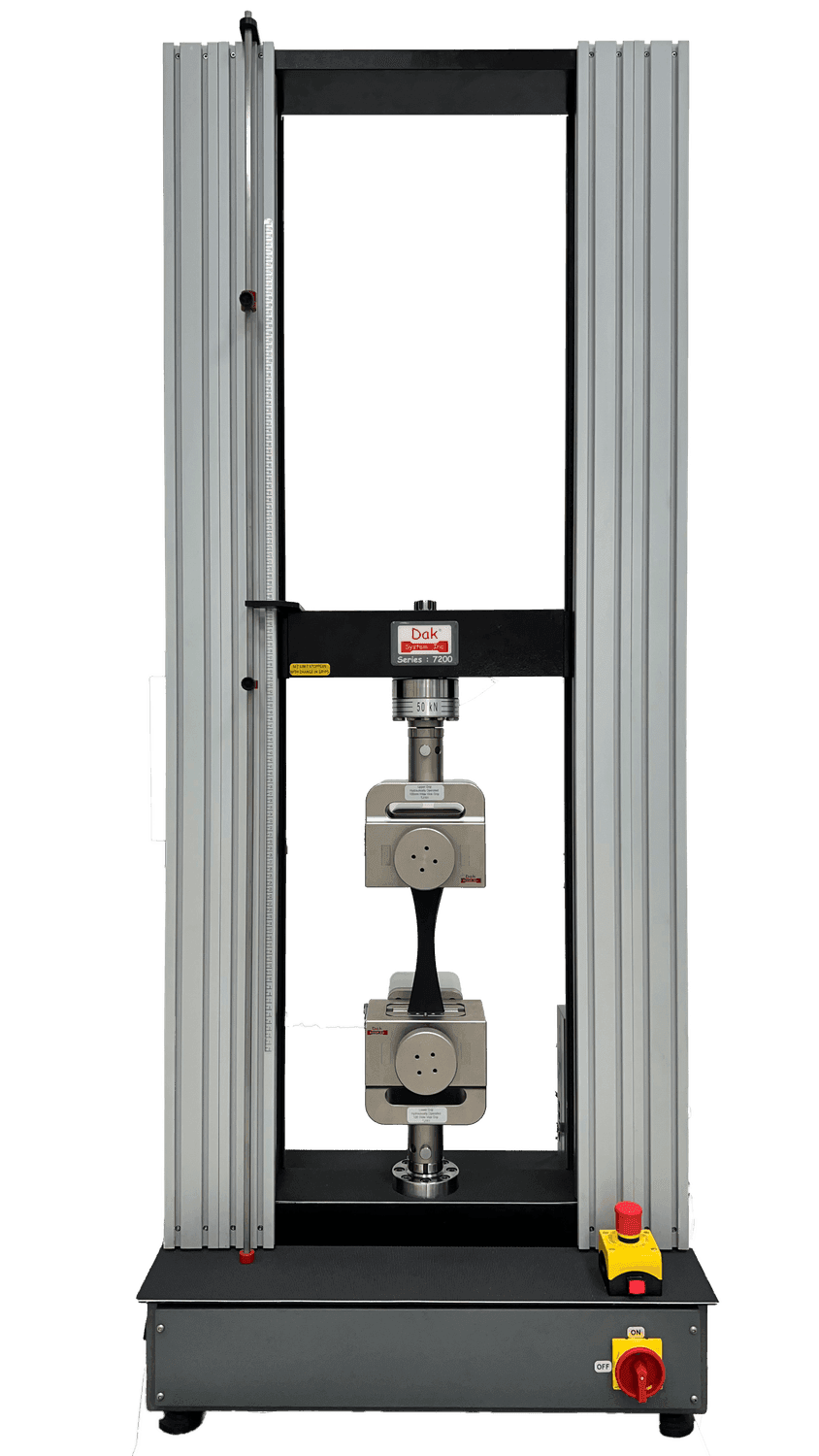 Universal Testing MachineSeries 7200Explore the machine →
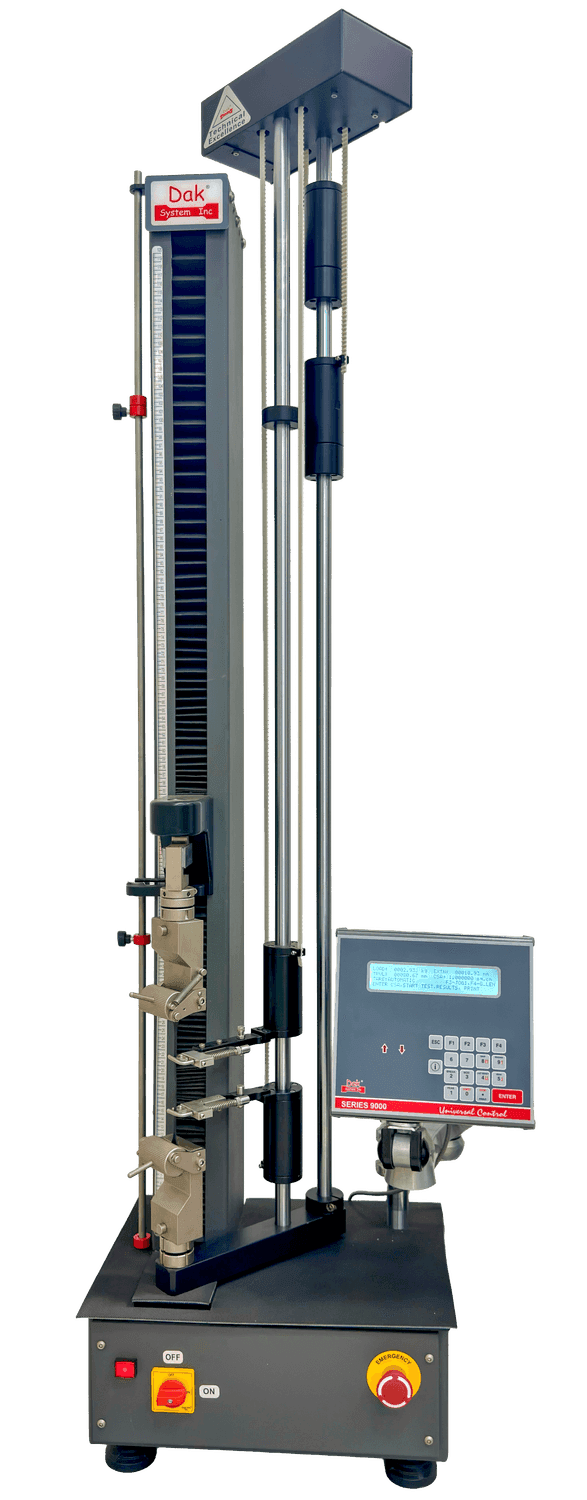 Universal Testing MachineSeries 9000Explore the machine →
01Understand the method
A conditioned specimen of film or thin sheeting no more than 1 mm thick is measured for thickness and slit to form two legs. The slit is cut with a fresh sharp blade in a single pass, because a blunt one drags and pre-damages the film ahead of the cut so the tear starts from that damage instead. One leg is gripped in each jaw and they are separated at a constant 250 mm/min — about 9.8 in./min — while the full force trace is recorded. The propagation force is read from the trace, and machine and transverse directions are tested separately.
That 250 mm/min is grip separation, not tear speed. In a trouser geometry each leg takes half the movement, so the tear front advances at roughly 125 mm/min, and on a specimen with 25 mm left to tear the whole propagation lasts about twelve seconds. Any extension in the legs comes out of that: on a very extensible film much of the grip movement goes into stretching rather than tearing, the tear runs slower still, and the deformation energy of the legs starts to dominate the tearing energy — which is the condition the method warns about rather than the rate being wrong.
How much force keeps a tear running once it exists — which is not the same question as how hard the film is to tear in the first place. The slit is cut before the test starts, so initiation is deliberately excluded. That distinction has real consequences in packaging: a film can resist starting a tear and then propagate one very easily, which is precisely the behaviour behind a bag that seems robust until someone nicks the edge, after which it opens across its whole width. Directionality compounds it, since oriented films tear far more readily along the draw direction than across it.
02Prepare the specimen and test settings
The tear already exists when the test begins. What is measured is how much force keeps it running.
Film tear is strongly directional and often dramatically so. Some oriented films tear at a small fraction of the force in one direction that they need in the other, which is a design feature in easy-open packaging and a defect everywhere else.
03Build the test setup on a DAK machine
Very low forces and steady slow travel. Propagation forces are commonly well under ten newtons, so the load cell is chosen for the film rather than for the frame — a cell sized for the machine works far below the range its accuracy class covers, and the verified range matters as much as the tolerance. Grips must hold thin, slippery film without cutting it, and hold it for the whole length of the tear rather than only at the start, since a tear runs for a considerable distance.
Pneumatic vice action grips clamp the full specimen width at a constant, even pressure — which is what stops one side slipping or tearing before the other.
SpecificationsDak verifies against whichever standard the method names, and where a class applies our frames sit a class tighter than it asks.
| The method asks for | Dak supplies | |
|---|---|---|
| Capacity | Very low — film tear propagation forces are commonly well under 10 N | Load cells from 1 kg to 60 ton on the Series 7200, and 0.5 to 100 kN on the Series 9000 |
| Force accuracy | Verified at the actual tear force, not at frame capacity | ISO 7500-1 Class 0.5, verified to ASTM E4, DIN 51221 and BS 1610 |
| Gripping | Grips taking the two legs of the trouser specimen, one in each jaw | Wedge, vice-action, pneumatic and hydraulic grips, built to the specimen |
| Environment | 23 ± 2 °C standard laboratory atmosphere | 3009 series chambers, −150 °C to +400 °C — temperature only |
04Run the test
05Calculate, report and interpret
The force required to keep the tear running, from the trace
Reported as a force in this method. ISO 6383-1 divides by thickness and reports N/mm, so the two are not directly comparable.
Energy spent deforming the legs is not energy spent tearing
On a very extensible film much of the crosshead work goes into stretching the legs, and the measured force stops describing the tear.
Quoting a value without the standard, when ISO 6383-1 divides by thickness and this method does not, so the two produce different numbers in different units on the same film. Averaging machine and transverse directions on a material engineered to be directional. Using a blunt blade for the initial slit. Averaging in specimens that failed in a brittle manner, which the scope excludes. And reading a propagation result as though it described how easily a tear begins, which is the error the companion Graves method exists to prevent.
06Compare methods and find answers
| ASTM D1938 | ISO 6383-1 | |
|---|---|---|
| Geometry | Trouser, single tear | Trouser |
| Reported | A force | Tear resistance in N/mm |
| Thickness | Up to 1 mm | Less than 1 mm |
| Directly comparable | No — one is normalised, the other is not | No |
The same geometry with different reporting. ISO divides by thickness and ASTM does not, so a figure quoted without its standard cannot be interpreted — and the numbers will not match even on the same film.
It is the ASTM trouser tear test for plastic film and thin sheeting, measuring the force needed to propagate a tear that has already been started. A slit is cut to form two legs, one is gripped in each jaw, and they are separated at a constant rate while the force is recorded. It applies to material 1 mm thick or less.
No, and the distinction matters. The slit is cut before the test begins, so what is measured is entirely how much force keeps an existing tear running. Resistance to initiation is a separate property — a film can be hard to start tearing and then run very easily, which is exactly the behaviour that makes a notched package fail dramatically once someone nicks it.
Because if the film snaps rather than tearing, the trouser geometry has stopped describing what happened. A brittle failure runs at a speed and by a mechanism the method does not model, and the recorded force is not a propagation resistance. The exclusion is a scope limit rather than a judgement about the material, and a specimen behaving that way should be reported rather than averaged in.
Because energy spent stretching the legs is energy not spent tearing. On a very extensible film, much of the work the crosshead does goes into deforming the two legs rather than advancing the tear, and the measured force stops being a clean description of tear resistance. It is the same limitation ISO 6383-1 states explicitly in its own scope.
Because blown and cast films are oriented by the process that made them — the polymer chains align along the direction of draw. Tear runs easily along that alignment and with difficulty across it, and the difference can be large. It is deliberately exploited in easy-open packaging, where a film is engineered to tear straight in one direction, and it is a defect everywhere else.
Not directly. Both use a trouser geometry, but ISO 6383-1 divides the force by the specimen thickness and reports a tear resistance in newtons per millimetre, whereas D1938 reports a force. The numbers are in different units and will not match on the same film, so the standard has to be quoted with the value.
A small one. Film tear propagation forces are commonly well under ten newtons, so a cell sized for the frame will be working far below the range its accuracy class covers. As with all low-force work, the certificate's verified range matters as much as its tolerance.
Discuss your specimen, test requirements and reporting needs with DAK engineering.
This page describes the method as practised. The governing text is the current edition from the issuing body. Tell us what you are testing and we will answer with the machine, the fixture and a quotation.