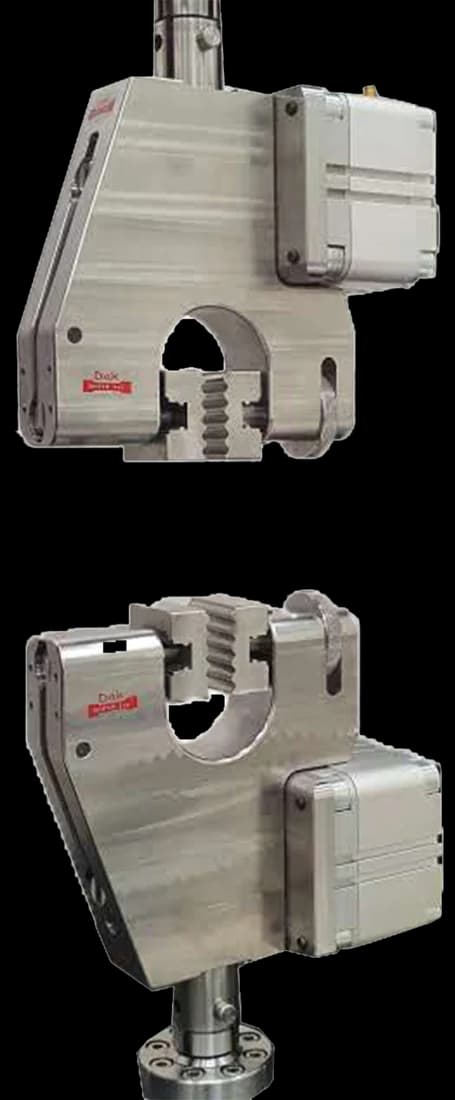
Standard 25 mm
Pneumatic Vice Action Grip
Pneumatic vice action grips clamp the full specimen width at a constant, even pressure — which is what stops one side slipping or tearing before the other.
Specifications
Testing standard
Plastics — Film and sheeting — Determination of tear resistance — Part 1: Trouser tear method
Written and technically reviewed by Dak System Inc. engineeringLast reviewed
ISO 6383-1 determines the tear resistance of plastic film or sheet less than 1 mm thick using trouser-shaped specimens. The legs are pulled apart from a 75 mm starting separation at either 200 mm/min ± 10 % or 250 mm/min ± 10 %, and the average force to tear the specimen along its length is divided by the thickness and reported in newtons per millimetre.
From the test method to your testing system
Explore the DAK machines already listed for ISO 6383-1, then review the grips, measurement and setup requirements below.
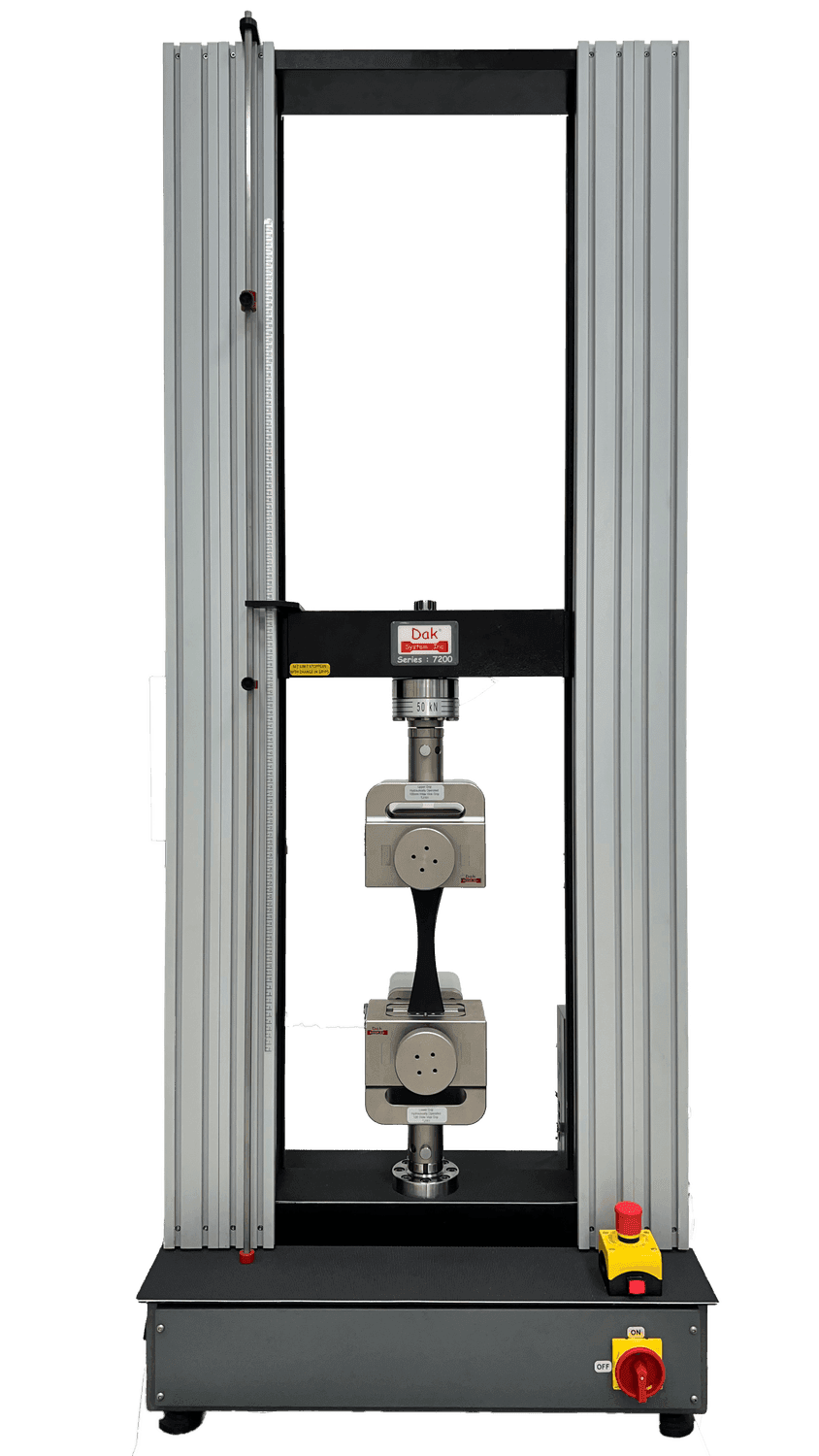 Universal Testing MachineSeries 7200Explore the machine →
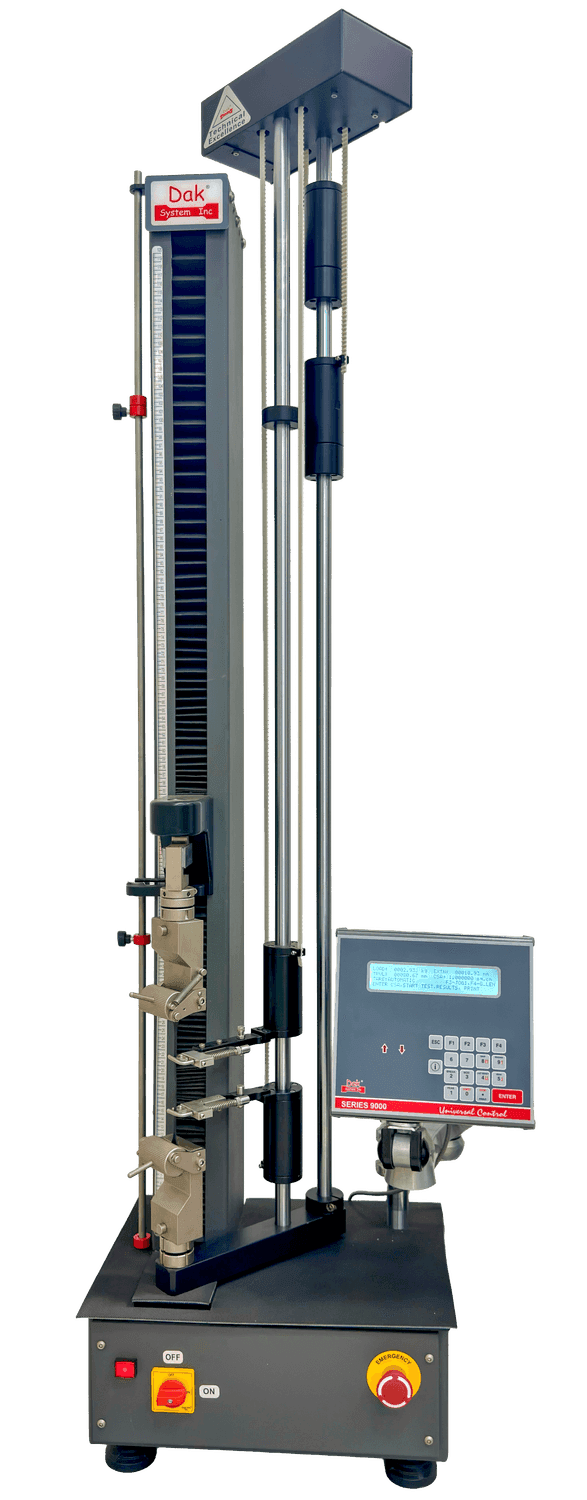 Universal Testing MachineSeries 9000Explore the machine →
01Understand the method
A rectangular specimen of film or sheet less than 1 mm thick is pre-treated and conditioned, its thickness measured at several points along the intended tear path, and a longitudinal slit cut over half its length to form two trouser legs. One leg is gripped in each jaw, the jaws starting 75 mm apart, and they are separated at 200 mm/min ± 10 % or 250 mm/min ± 10 % — clause 9 permits either, and the one used is reported — under defined temperature and humidity. The average force over the tearing portion of the trace is divided by the specimen thickness, giving a tear resistance in newtons per millimetre.
How readily a tear runs through a film, normalised so that films of different gauge can be compared. That normalisation is the practical difference from the ASTM trouser method, which reports a force and leaves the thickness out — the two therefore produce different numbers in different units on the same material, and neither converts to the other. Because thickness is the divisor here, its measurement carries as much weight as the force measurement, and film gauge varies across a web more than most people assume.
02Prepare the specimen and test settings
The standard names both limits explicitly — too rigid and it fractures, too deformable and the legs absorb the energy.
Both flexible and rigid materials are in scope — the limits are behavioural, not categorical. What matters is whether the specimen fractures or whether its legs soak up the work.
03Build the test setup on a DAK machine
Very low force, well measured, and steady travel over a long tear at either of the two rates the method allows: 200 mm/min ± 10 % or 250 mm/min ± 10 %, from an initial jaw separation of 75 mm. A note in clause 9 records that both are in common use worldwide and that a later revision might keep only 200 mm/min, so the figure to set where nothing else governs is 200 mm/min. Trouser tear forces on film are commonly a few newtons, so the load cell is chosen for the material rather than the frame. Grips must hold thin, often slippery film without cutting it and without releasing partway through. Because temperature and humidity are specified conditions rather than incidental ones, a conditioned laboratory or a chamber is part of the requirement for materials sensitive to moisture.
Pneumatic vice action grips clamp the full specimen width at a constant, even pressure — which is what stops one side slipping or tearing before the other.
SpecificationsDak verifies against whichever standard the method names, and where a class applies our frames sit a class tighter than it asks.
| The method asks for | Dak supplies | |
|---|---|---|
| Capacity | Very low — trouser tear forces on film are commonly a few newtons | Load cells from 1 kg to 60 ton on the Series 7200, and 0.5 to 100 kN on the Series 9000 |
| Force accuracy | Verified at the actual tear force | ISO 7500-1 Class 0.5, verified to ASTM E4, DIN 51221 and BS 1610 |
| Gripping | Grips taking the two legs of the trouser specimen, one in each jaw | Wedge, vice-action, pneumatic and hydraulic grips, built to the specimen |
| Environment | 23 ± 2 °C standard laboratory atmosphere | 3009 series chambers, −150 °C to +400 °C — temperature only |
04Run the test
05Calculate, report and interpret
Average tearing force divided by specimen thickness
Gives N/mm. Because the thickness is the divisor, an inaccurate gauge measurement passes into the result at full weight.
Work done stretching the legs is not work done tearing
The standard states this as a scope condition rather than leaving it to judgement, which is unusual and useful.
Mixing ISO and ASTM trouser results in one data set, when one is normalised by thickness and the other is not. Measuring thickness at a single point when it is the divisor and the film varies. Averaging in specimens that fractured brittly or whose legs stretched substantially, both of which the scope excludes. And reporting a value without the speed, temperature and humidity, which for a rate- and moisture-sensitive polymer leaves the number uncheckable. Direction is the last of them: an oriented film tears far more readily along the draw than across it, and a result that does not say which way the specimen was cut describes the process as much as the material.
06Compare methods and find answers
| Part 1 — trouser | Part 2 — Elmendorf | |
|---|---|---|
| Principle | Force to propagate a tear | Energy to tear, by pendulum |
| Machine | A testing machine | A pendulum instrument |
| Reports | N/mm | Energy or force from pendulum swing |
| Comparable | No | No |
Two parts measuring tear by fundamentally different means. Part 1 is a controlled slow propagation on a testing machine; Part 2 is a rapid pendulum event. They do not rank films identically and neither converts to the other.
It is the ISO trouser tear method for plastic film and sheeting less than 1 mm thick. A rectangular specimen with a longitudinal slit over half its length is pulled apart by its two legs under defined conditions of pre-treatment, temperature, humidity and speed, and the average force to tear it is divided by the thickness to give a tear resistance in newtons per millimetre.
To make films of different gauge comparable. A thicker film tears at a higher force for that reason alone, so normalising by thickness isolates the material's behaviour from its gauge. The consequence is that the thickness measurement matters as much as the force one — it is the divisor, so an error in it passes into the result at full weight, and film gauge varies across a web more than people expect.
The standard names both, which is unusually explicit. If the material is so rigid that brittle fracture occurs during the test, the trouser geometry has stopped describing what happened. If it is so deformable that the energy used stretching the legs is significant compared with the energy used tearing, the measured force is no longer a clean tear resistance. Both limits are behavioural rather than categorical — flexible and rigid materials are otherwise both in scope.
Not directly. Both use a trouser geometry, but this method divides by thickness and reports newtons per millimetre while D1938 reports a force. The two are in different units and will not agree on the same film. Whichever was used has to be quoted with the value, and a data set should not mix them.
Fundamentally. Part 1 is a slow, controlled propagation on a testing machine, measuring the force to keep a tear running. Part 2 is the Elmendorf pendulum, a rapid event measuring the energy absorbed as a swinging arm tears through the specimen. They do not rank films identically, because rate-sensitive polymers behave differently at the two speeds, and neither result converts to the other.
The standard says it may not be suitable. A cellular structure tears by crushing and collapsing cells rather than by propagating a crack through a continuous solid, so the trouser geometry's assumptions weaken and thickness becomes an especially poor divisor. If a cellular material must be characterised, that limitation should be stated in the report rather than left implicit.
Because many films are sensitive to both. Moisture plasticises some polymers and changes their tear behaviour substantially, and residual stress from processing relaxes over time. The method therefore fixes all four conditions together: conditioning at 23 °C and 50 % relative humidity to ISO 291 (or 23 °C alone where the material is known not to be humidity-sensitive), a starting grip separation of 75 mm, and a speed of testing of either 200 mm/min ± 10 % or 250 mm/min ± 10 %. That combination is what makes results reproducible between laboratories, and omitting any of them from the report leaves the value uncheckable.
Discuss your specimen, test requirements and reporting needs with DAK engineering.
This page describes the method as practised. The governing text is the current edition from the issuing body. Tell us what you are testing and we will answer with the machine, the fixture and a quotation.