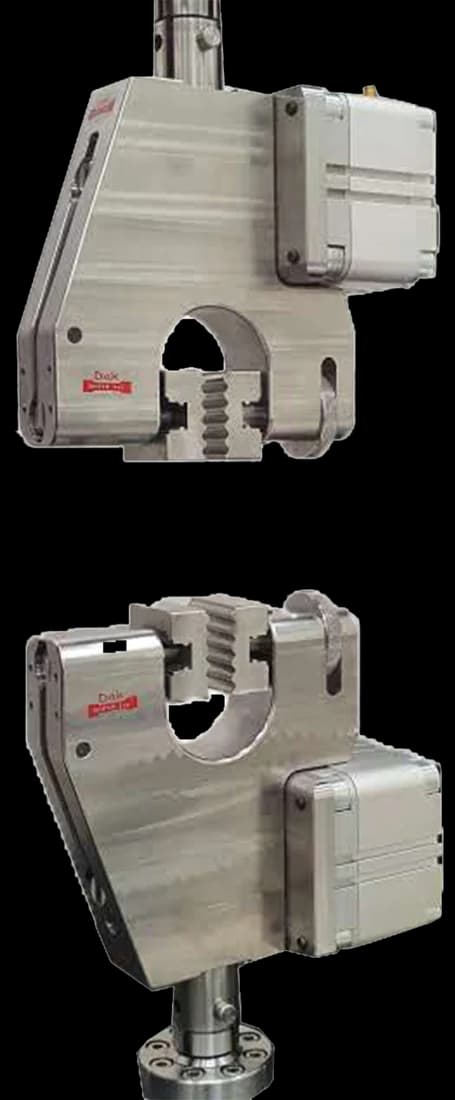
Standard 25 mm
Pneumatic Vice Action Grip
Pneumatic vice action grips clamp the full specimen width at a constant, even pressure — which is what stops one side slipping or tearing before the other.
Specifications
Testing standard
Standard Test Method for Trapezoid Tearing Strength of Geotextiles
Written and technically reviewed by Dak System Inc. engineeringLast reviewed
ASTM D4533/D4533M measures the force needed to continue a tear across a woven or nonwoven geotextile using the trapezoid method. It describes itself as an index test — a way of ranking and specifying products, not a prediction of how a geotextile will behave under a bulldozer track.
From the test method to your testing system
Explore the DAK machines already listed for ASTM D4533/D4533M, then review the grips, measurement and setup requirements below.
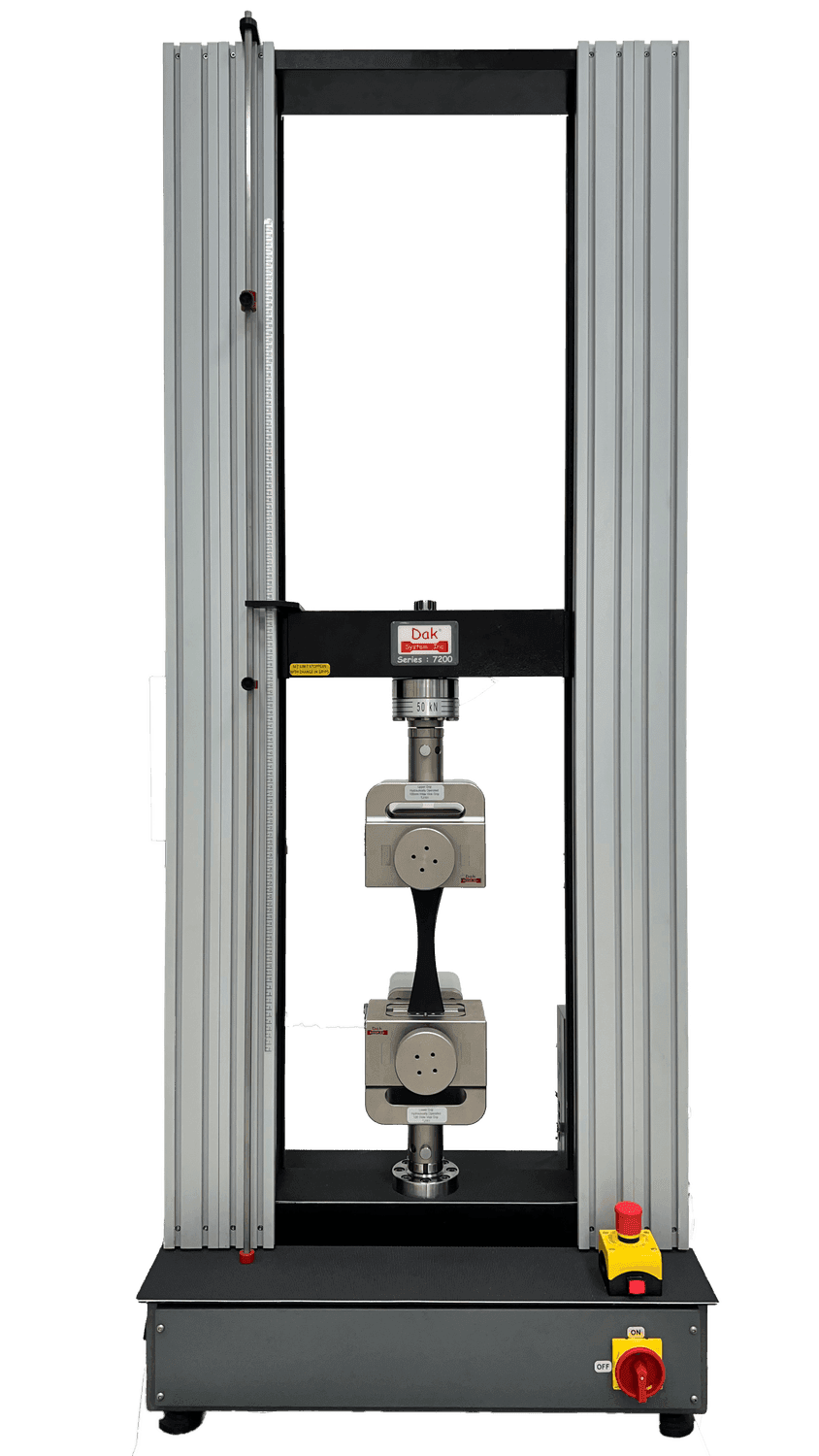 Universal Testing MachineSeries 7200Explore the machine →
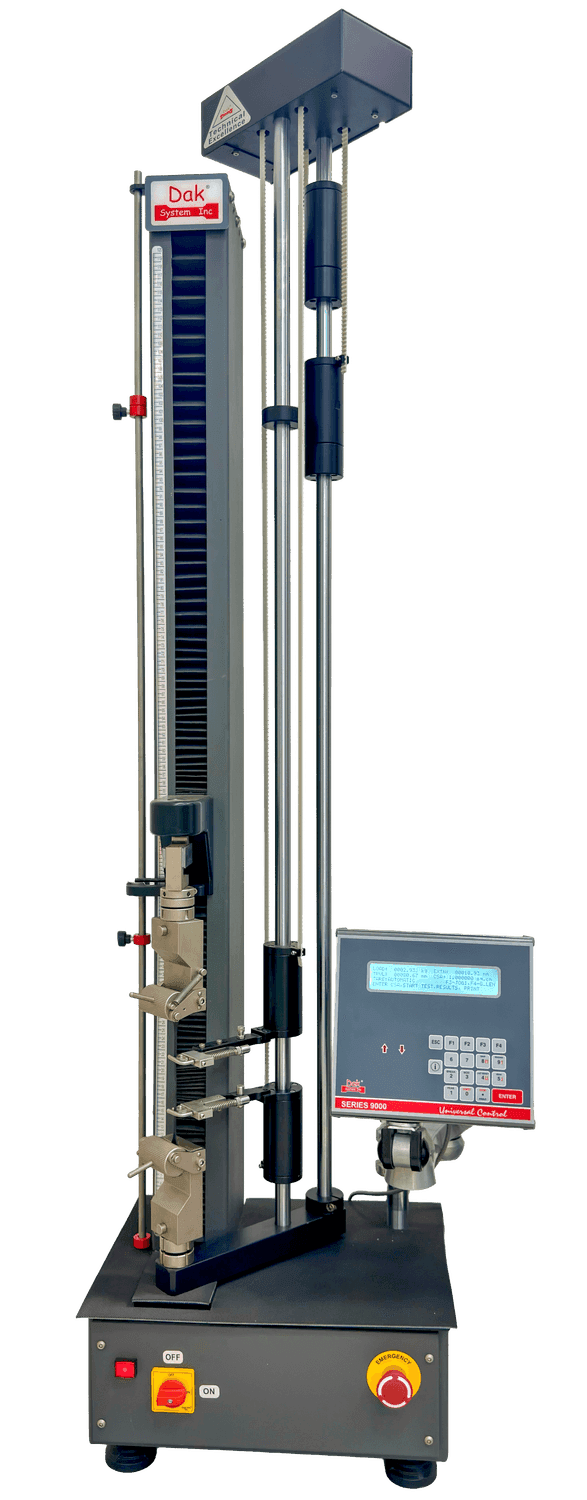 Universal Testing MachineSeries 9000Explore the machine →
01Understand the method
A rectangular specimen is conditioned and an isosceles trapezoid is marked on it. A slit is cut at the midpoint of the shorter parallel side to start the tear. The specimen is then clamped along the two non-parallel sides of the marked trapezoid, so the short side sits between the jaws, and pulled at 300 ± 10 mm/min (12 ± 0.5 in./min) with the clamps starting 25 ± 1 mm apart. The rate is fixed outright rather than expressed as a percentage of gauge length, which is why it looks fast beside a wide-width tensile test: on that 25 mm separation it is a very high nominal strain rate, and the figure is set by the tear having to run rather than by the fabric having to stretch. As the jaws separate, stress concentrates at the slit and the tear runs progressively across the specimen towards the wider end. The force required to keep it running is read from the trace and reported, with machine and cross-machine directions kept separate.
The resistance of a geotextile to a tear that has already started — which is the relevant question, because geotextiles rarely fail from an unblemished sheet. A stone, a plant tool or a fold creates the initial damage, and what determines whether the sheet survives is how readily that damage propagates. The standard is explicit in its own scope that this is an index test: it ranks products and supports a specification under controlled conditions, and does not predict installation survivability, which involves puncture, abrasion and multi-directional loading that no single tear force can describe.
02Prepare the specimen and test settings
An isosceles trapezoid is marked on a rectangular specimen and the grips clamp along its non-parallel sides. That geometry is what makes the tear travel.
The standard calls this an index test in its own scope. It ranks products and supports a specification; it does not predict survivability during installation, which is what the damage is usually done by.
03Build the test setup on a DAK machine
Modest force — trapezoid tear forces on geotextiles commonly run from tens of newtons up to around a kilonewton — with grips wide enough to clamp along the full sloping sides at an even pressure that holds the fabric without cutting it. The clamping geometry is part of the method rather than a convenience, so the grip faces have to accommodate the marked lines. The data system needs to capture a jagged trace faithfully, since the tear advances yarn by yarn and the record is a saw-tooth rather than a smooth curve — and at 300 mm/min a whole specimen can be through in a few seconds, so the sampling rate matters more than the frame does.
Pneumatic vice action grips clamp the full specimen width at a constant, even pressure — which is what stops one side slipping or tearing before the other.
SpecificationsDak verifies against whichever standard the method names, and where a class applies our frames sit a class tighter than it asks.
| The method asks for | Dak supplies | |
|---|---|---|
| Capacity | Low to moderate — geotextile trapezoid tear forces commonly run from tens of newtons to around a kilonewton | Load cells from 1 kg to 60 ton on the Series 7200, and 0.5 to 100 kN on the Series 9000 |
| Force accuracy | ASTM D76 requirements for textile testing machines | ISO 7500-1 Class 0.5, verified to ASTM E4, DIN 51221 and BS 1610 |
| Gripping | Wide grips clamping along the non-parallel sides of a trapezoid marked on the specimen | Wedge, vice-action, pneumatic and hydraulic grips, built to the specimen |
| Environment | 23 ± 2 °C standard laboratory atmosphere | 3009 series chambers, −150 °C to +400 °C — temperature only |
04Run the test
05Calculate, report and interpret
The force required to propagate the tear, from the recorded trace
Read according to the method's rule for the trace, which for a geotextile is not simply the highest point of a smooth curve — tearing produces a jagged record as individual yarns give way.
Machine direction and cross-machine direction reported separately
Never averaged. A woven geotextile can differ substantially between the two, and the average describes neither.
Averaging the two directions, which produces a figure a specification can be written against and a product can meet while failing in one direction. Clamping square to the specimen instead of along the marked sides, which stops the tear propagating as intended. A ragged starting slit. Reading the single highest point of a saw-tooth trace when the method asks for something else. And discarding specimens whose tear ran off the path without recording how many — a high discard rate is itself information, usually about clamping or directional bias.
06Compare methods and find answers
| ASTM D4533/D4533M | ASTM D5587 | |
|---|---|---|
| Written for | Geotextiles | Textile fabrics generally |
| Method | Trapezoid | Trapezoid |
| Used in | Geosynthetic specifications and acceptance | Apparel and industrial fabric specification |
| Nature | Index test, stated in scope | Index test |
The same geometry serving two industries. Cite the one your specification names, because geosynthetic acceptance documents call up D4533 specifically and a D5587 result will be queried even where the principle is identical.
It is the ASTM trapezoid tearing strength test for geotextiles. An isosceles trapezoid is marked on a rectangular specimen, a slit is cut at the midpoint of its shorter parallel side, and the grips clamp along the non-parallel sides, 25 ± 1 mm apart, so that the tear propagates across the specimen as the jaws separate at 300 ± 10 mm/min (12 ± 0.5 in./min). It applies to woven, nonwoven, knitted and layered geotextiles and to felts.
That the standard itself limits what the number can be used for. An index test ranks products against each other and supports a purchase specification under controlled conditions. It does not predict how a geotextile will survive being unrolled over a stony subgrade and driven on, because that damage involves puncture, abrasion and multi-directional loading that no single tear force describes. Specifications use it precisely because it is reproducible, not because it is a field prediction.
Because that geometry is what makes the tear travel. Clamping along the non-parallel sides of the trapezoid means the shorter parallel side is closest to the jaws and carries load first; as the crosshead moves, the stress concentrates at the slit and the tear runs progressively towards the wider end. Clamping squarely would simply stretch the specimen, and the tear would either not start or would jump unpredictably.
Because the slit is the tear's origin, and a ragged or repeatedly cut one has already broken yarns beyond the intended length. The tear then starts from damage rather than from the defined point, and the recorded force reads low. Cutting it with a sharp blade in a single pass, to the specified length, is one of the few preparation steps in this method that materially moves the answer.
Because they can differ substantially, particularly in a woven geotextile where the machine and cross-machine yarns are different counts or under different tension from manufacture. An average of two dissimilar figures describes neither the warp nor the weft behaviour, and a specification written against it would be met by products that fail in one direction. The method reports them separately for that reason.
Because the tear advances yarn by yarn. Each yarn resists, then gives way, and the load drops before building again against the next — so the record is a saw-tooth rather than the smooth rise and fall of a tensile break. That is why the method specifies how to read the tearing force from the trace, and why simply taking the single highest point is not necessarily what is being asked for.
The specimen is not valid. A tear that turns into a grip or leaves the edge has not propagated across the width in the way the geometry intends, so the force is not comparable with specimens that tore correctly. Discarding it and recording how many were discarded is honest practice — a high discard rate is itself information, usually about clamping or about a fabric with strong directional bias.
Discuss your specimen, test requirements and reporting needs with DAK engineering.
This page describes the method as practised. The governing text is the current edition from the issuing body. Tell us what you are testing and we will answer with the machine, the fixture and a quotation.