
Testing standard
EN 354 Fall Protection Lanyard Testing
Personal fall protection equipment — Lanyards
Written and technically reviewed by Dak System Inc. engineeringLast reviewed
EN 354:2010 is the European standard for lanyards used in personal fall protection — the flexible connecting element between a harness and an anchor or energy absorber. It sets a static strength of at least 22 kN for any lanyard containing textile and 15 kN for one made entirely of metal, both after conditioning that includes immersion and freezing. Lanyards with a length adjustment device additionally face a 50 mm slippage limit and a drop test. The 2 m maximum length that many references still quote was removed in the 2010 edition.
At a glance
- Test type
- Tensile — the specimen is pulled apart
- Published by
- EN
- Edition
- EN 354:2010
- Runs on
- Series 7200 and Series 9000
From the test method to your testing system
Explore DAK equipment for EN 354, then review the specimen and setup requirements below.
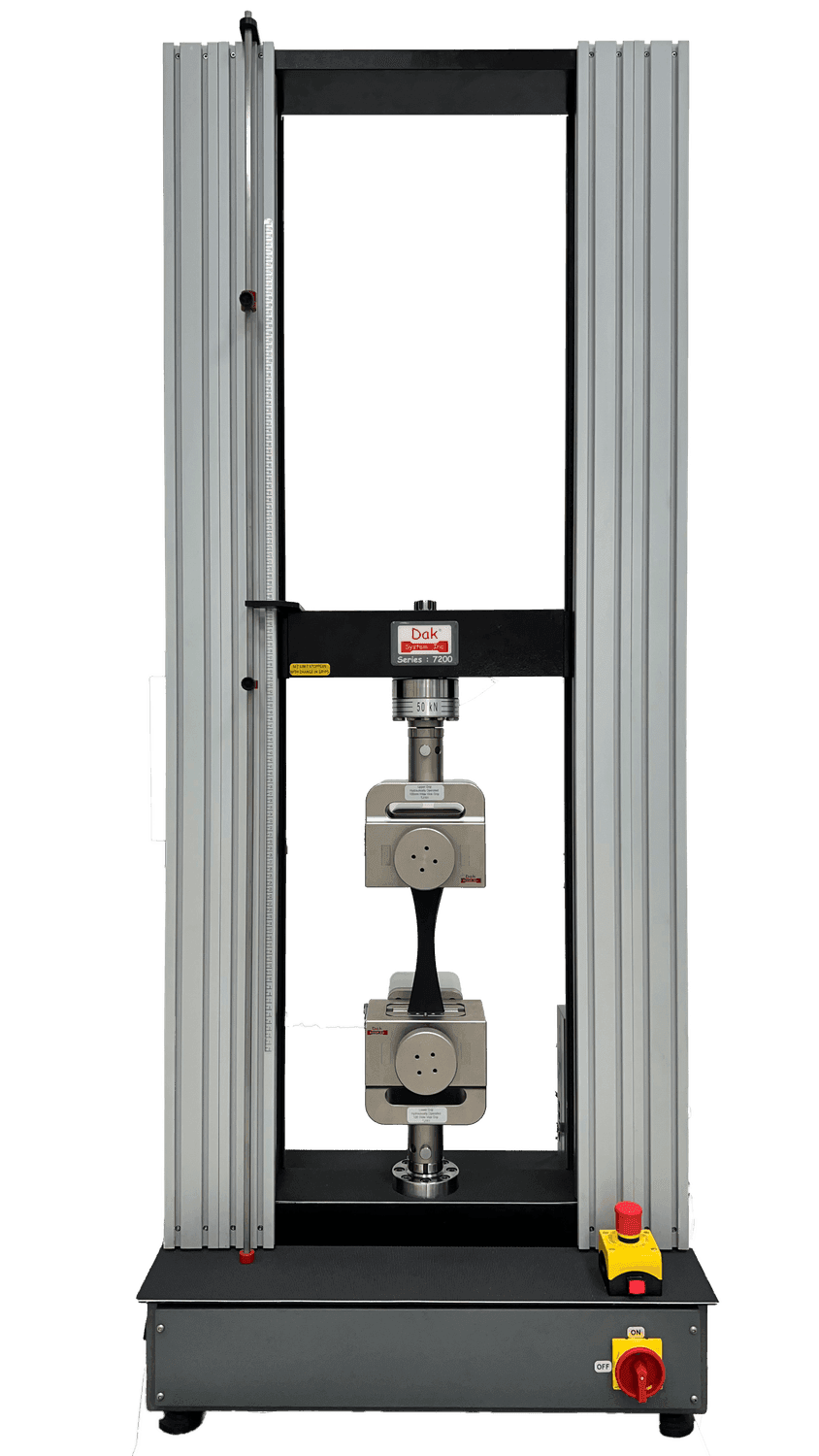 Universal Testing MachineSeries 7200Explore the machine →
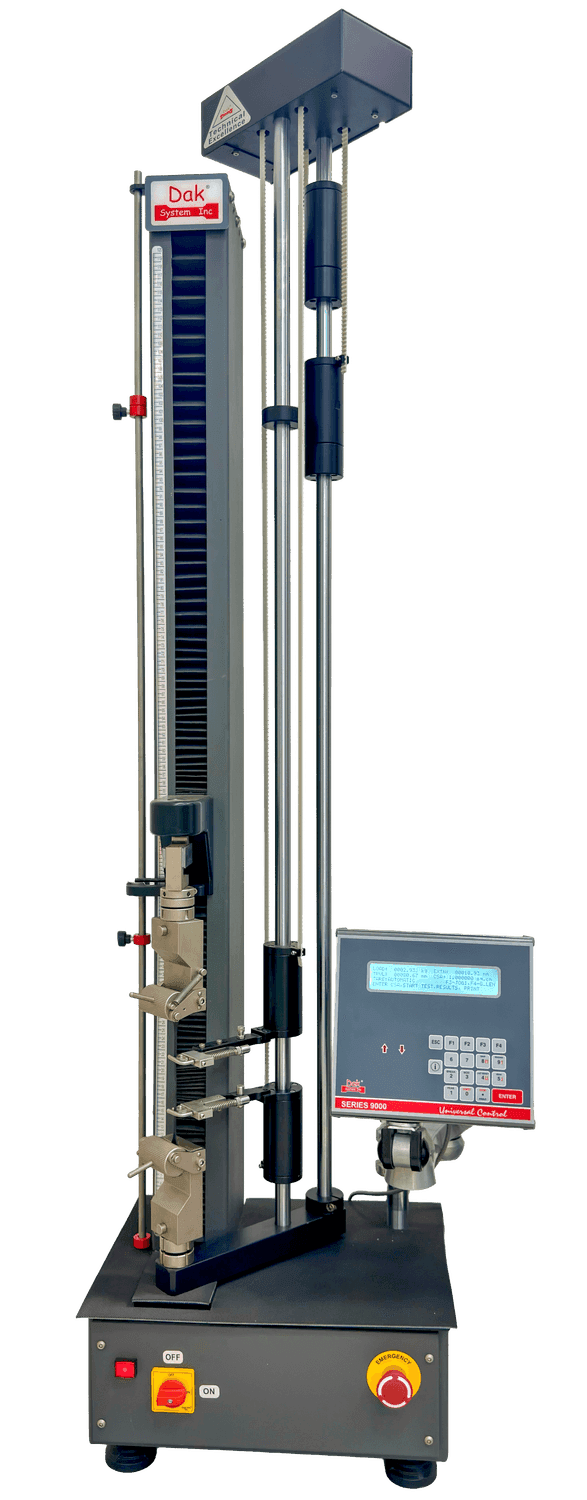 Universal Testing MachineSeries 9000Explore the machine →
Jump to a specific section
01Understand the method
What the test does
EN 354 specifies requirements, test methods, marking, manufacturer's information and packaging for lanyards — flexible connecting elements with at least two terminations, with or without a length adjustment device, made from synthetic fibre rope, webbing, wire rope or chain. Round slings are included.
Acceptance rests on a static strength pull, a slippage test and a dynamic test for adjustable lanyards, and a corrosion check, all after specified conditioning.
The scope widened in 2010. The 2002 edition covered lanyards used in fall arrest systems and pushed other types to EN 358; the 2010 edition covers restraint, work positioning, rope access, fall arrest and rescue systems alike.
What it measures, and why it matters
Static strength is the headline and it splits by material. A lanyard containing any textile element must sustain at least 22 kN; one made entirely of metallic elements must sustain at least 15 kN. Both values are unchanged from 2002.
Lanyards with a length adjustment device carry two further requirements. Slippage through the device must not exceed 50 mm. And the dynamic test is not a force measurement at all: the lanyard must retain the test mass clear of the ground, after which it must withstand a residual 3 ± 0.3 kN for three minutes. A plain lanyard with no adjustment device has no dynamic requirement.
The material clauses matter more than they look. Synthetic fibres must have a breaking tenacity of at least 0.6 N/tex, sewing thread must be a contrasting colour so inspection is possible, a knotted termination must still show a 100 mm tail after the static test, and eye terminations on wire rope must not use U-bolt clamps.
02Prepare the specimen and test settings
Sample, conditioning and materials
Conditioning is part of the method rather than preparation for it, and the material clauses are requirements in their own right.
- Test temperature
- 23 ± 5 °C
- General conditioning
- ≥24 h at 23 ± 5 °C and 65 ± 5 % humidity
- Wet and cold conditioning
- ≥1 h immersed in fresh water, then ≥4 h at −4 °CThe transfer from water to refrigerated chamber must happen within 90 seconds. The chamber tolerance is 0 to −2 °C.
- Very cold conditioning
- ≥2 h at the claimed minimum, bounded at −30 ± 2 °COnly where the manufacturer claims use below −30 °C.
- Length measurement
- Under a 10 ± 0.1 kg mass held 60 ± 15 s, read to 0.01 mApplied without shock, with an adjustable lanyard extended to maximum. Where there are more than two terminations, measure the longest combination the manufacturer allows.
- Synthetic fibre tenacity
- At least 0.6 N/texMust be known, not assumed.
- Wire rope
- Steel; non-stainless galvanized to ISO 2232
- Chain
- At least the 6 mm chain requirements of ISO 1835
- Sewing thread
- Contrasting shade or colourSo that stitching can be inspected visually.
- Knotted termination
- Secured against opening without a tool; ≥100 mm tail after the static test
- Wire rope eyes
- Not to be made with U-bolt clamps
- Connectors
- Conform to EN 362
- Corrosion
- No corrosion of the base metalTarnishing and white scaling are acceptable.
Forces and hold times
EN 354 sets no ramp rate. What it sets are forces and the times they are held for.
- Static strength, textile
- At least 22 kNAny lanyard including textile material or textile elements — synthetic fibre rope or webbing.
- Static strength, all-metallic
- At least 15 kN
- Static hold time
- At least 3 minutesPracticeReported by SATRA. Not seen in the primary text, so it is attributed to them rather than to the standard.
- Residual strength after the drop
- 3 ± 0.3 kN for 3 minutesThe one hold time confirmed verbatim in the primary text. Applies to lanyards with a length adjustment device.
- Slippage limit
- Not more than 50 mmThrough the length adjustment device. SATRA report the assessment follows a 6 kN load held 3 minutes; that load is theirs, not confirmed from the standard.
- Dynamic pass criterion
- Retain the test mass clear of the groundNot a force measurement at all.
- Length tolerance
- ±5 % of the marked lengthClause 4.1.6, the 2010 edition's replacement for the old 2 m cap.
03Build the test setup on a DAK machine
What the machine must be capable of
Force capacity is set by the 22 kN textile requirement plus a margin, so a frame of 50 kN covers lanyard work comfortably. Apparatus for the static test conforms to EN 364, which EN 354 has deferred to since 2002.
The dynamic test is not a tensile test at all. It is a drop, needing a rigid anchor, a test mass and the fall geometry EN 364 sets out, with the criterion that the mass is retained clear of the ground. A laboratory equipped only for tension can run the static, slippage and residual-strength parts and not the dynamic one.
Lanyards are pulled through their own terminations onto pins or shackles rather than gripped, so the fixture question is one of adaptors rather than jaws.
Running EN 354 on the Series 7200 and Series 9000
Dak verifies against whichever standard the method names, and where a class applies our frames sit a class tighter than it asks.
| The method asks for | Dak supplies | |
|---|---|---|
| Capacity | 22 kN for any lanyard containing a textile element and 15 kN for one made entirely of metallic elements, so a 50 kN frame covers the work with margin. | Load cells from 1 kg to 60 ton on the Series 7200, and 0.5 to 100 kN on the Series 9000 |
| Force accuracy | unknown — EN 354 defers the apparatus to EN 364 and no class was confirmed | ISO 7500-1 Class 0.5 — the method sets no class of its own |
| Gripping | The lanyard is loaded through its own terminations onto pins or shackles rather than gripped, so the requirement is adaptors and a rigid anchor per EN 364. The dynamic test needs a drop rig with a test mass, which a tensile frame cannot provide. | Wedge, vice-action, pneumatic and hydraulic grips, built to the specimen |
| Environment | Tests at 23 plus or minus 5 degrees Celsius. General conditioning 24 hours at 23 plus or minus 5 degrees Celsius and 65 plus or minus 5 percent humidity. Wet and cold conditioning is 1 hour immersed in fresh water then at least 4 hours at minus 4 degrees Celsius, the transfer within 90 seconds. A lanyard claimed below minus 30 degrees Celsius gets 2 hours at the claimed minimum. | 3009 series chambers, −150 °C to +400 °C — temperature only |
04Run the test
How type approval runs
- Condition samples for 24 hours at 23 ± 5 °C and 65 ± 5 % humidity.
- For the wet and cold route, immerse a sample for at least an hour, then move it within 90 seconds to a chamber at −4 °C for at least four hours.
- Measure the lanyard length under a 10 kg mass and check it against the marking, within ±5 %.
- Connect the sample to the apparatus through its own terminations, per EN 364.
- Pull to 22 kN for a lanyard containing textile, or 15 kN for an all-metallic one, and hold.
- For a lanyard with a length adjustment device, measure slippage through the device and confirm it does not exceed 50 mm.
- For the same lanyard, run the dynamic test and confirm the test mass is retained clear of the ground.
- Apply a residual 3 ± 0.3 kN to that lanyard for three minutes.
- Inspect metallic elements for corrosion of the base metal; tarnishing and white scaling do not fail.
- Check the knot tail length on any knotted termination — at least 100 mm after the static test.
The dynamic test and the slippage test apply ONLY to lanyards with a length adjustment device. A plain lanyard is not subject to either in the 2010 edition, and applying them to one is over-testing rather than diligence.
05Report and interpret
What the report has to carry
- Reference to EN 354:2010
- Lanyard construction — synthetic fibre rope, webbing, wire rope or chain
- Whether a length adjustment device is fitted
- Marked length, and the measured length under the 10 kg mass
- Conditioning route used, with temperatures, humidity and durations
- Static force sustained and the hold time
- Slippage through the adjustment device, where applicable
- Dynamic test outcome and the residual strength result, where applicable
- Corrosion assessment
- Connector conformity to EN 362
- Knot tail length after the static test, where a knot forms a termination
What goes wrong in practice
The two-metre rule is the error worth naming, because it is widely repeated and now wrong. EN 354:2002 clause 4.2.1 did state that the length of a lanyard including energy absorber and terminations shall not exceed 2 m. The 2010 edition sets no maximum length in its requirements. What it has instead is clause 4.1.6: the length shall be within ±5 percent of the figure on the marking, measured by the 10 kg procedure above. A cap became a labelling tolerance.
Two cautions. Only clauses 4 and 5.1 to 5.4 of the 2010 edition were read, so the safe claim is that it sets no maximum length in its requirements, not that 2 m appears nowhere in the document. And the common assertion that the limit "belongs to EN 355" was not confirmed — the sources making it are quoting EN 354:2002 word for word. What is established for EN 355 is a maximum deployment of 1.75 m and a maximum arrest force of 6 kN.
The second recurring error is assuming every lanyard faces the dynamic test. It applies only to lanyards with a length adjustment device.
06Compare methods and find answers
What changed between EN 354:2002 and EN 354:2010
The 2002 edition said openly that it was an interim reissue and that a comprehensive revision would follow. This is that revision.
| EN 354:2002 | EN 354:2010 | |
|---|---|---|
| Title | Personal protective equipment against falls from a height — Lanyards | Personal fall protection equipment — Lanyards |
| Scope | Lanyards in fall arrest systems; other types pushed to EN 358 | Restraint, work positioning, rope access, fall arrest and rescue systems |
| Maximum length | 2 m, including energy absorber and terminations (clause 4.2.1) | No maximum in the requirements |
| Length requirement instead | — | Within ±5 % of the marked length (clause 4.1.6) |
| Static strength, textile | 22 kN | 22 kN |
| Static strength, metallic | 15 kN | 15 kN |
The 2 m figure is the one to be careful with. It was real, it was in clause 4.2.1 of the 2002 edition, and it is not in the requirements of the current one. Only clauses 4 and 5.1 to 5.4 of the 2010 edition were read, so the accurate statement is that it sets no maximum length in its requirements. The common claim that the 2 m limit moved to EN 355 was not confirmed: the sources making it reproduce the EN 354:2002 sentence word for word.
Which standard covers which part of the system
| Component | Standard |
|---|---|
| The system as a whole | EN 363 |
| Anchor device | EN 795 |
| Lanyard | EN 354 |
| Energy absorber | EN 355 — maximum deployment 1.75 m, maximum arrest force 6 kN |
| Connector | EN 362 |
| Test apparatus and methods | EN 364 |
| Instructions, marking, inspection | EN 365 |
A lanyard on its own is a connecting element, not a fall arrest system. Whether an energy absorber is needed, and what total length is permissible, is a question for EN 363 and EN 355 rather than for EN 354.
Related and equivalent standards
EN 364 supplies the test apparatus and methods EN 354 calls up. EN 362 governs the connectors in a lanyard and EN 363 the systems a lanyard becomes part of. EN 355 covers energy absorbers, a different component with their own deployment and arrest force limits. EN 795 covers the anchor device at the other end. EN 365 sets general requirements for instructions, marking and inspection, and EN ISO 9227 the salt spray method behind the corrosion clause.
Questions we are asked about this test
What is EN 354?
It is the European standard for lanyards used in personal fall protection — the flexible connecting element, with at least two terminations, that joins a harness to an anchor, an energy absorber or another component. It covers synthetic fibre rope, webbing, wire rope and chain, and it includes round slings. The current edition is EN 354:2010.
Does EN 354 limit a lanyard to 2 metres?
Not any more. EN 354:2002 clause 4.2.1 did state that the length of a lanyard including energy absorber and terminations shall not exceed 2 m, and that sentence is still widely quoted. The 2010 edition sets no maximum length in its requirements. In its place, clause 4.1.6 requires the lanyard length to be within ±5 percent of the length given on the marking, measured under a 10 kg mass. A cap became a labelling tolerance.
Did the 2 metre limit move to EN 355?
That claim could not be confirmed, and the sources making it turned out to be reproducing the EN 354:2002 sentence word for word. What is established for EN 355, the energy absorber standard, is a maximum deployment of 1.75 m and a maximum arrest force of 6 kN. If you need a total system length limit, take it from EN 363 and the manufacturer's instructions rather than from a remembered figure.
What force must a lanyard withstand?
At least 22 kN if it contains any textile material or textile element, and at least 15 kN if it is made entirely of metallic elements. Those two figures are unchanged from the 2002 edition. SATRA report that the force is held for at least three minutes, though that duration was not found in the primary text.
Does every lanyard get a dynamic test?
No. In EN 354:2010 the dynamic requirement applies only to lanyards fitted with a length adjustment device, and so does the 50 mm slippage limit. A plain lanyard with fixed terminations faces neither. The dynamic test is also not a force measurement — the criterion is that the lanyard retains the test mass clear of the ground, after which the same lanyard must withstand a residual 3 ± 0.3 kN for three minutes.
What conditioning does EN 354 require before testing?
General conditioning is at least 24 hours at 23 ± 5 °C and 65 ± 5 percent humidity. The wet and cold route immerses the sample in fresh water for at least an hour and then, within 90 seconds, places it in a refrigerated chamber for at least four hours at −4 °C. If the manufacturer claims use below −30 °C, the sample additionally spends at least two hours at that claimed minimum, bounded at −30 ± 2 °C. The tests themselves run at 23 ± 5 °C.
How is lanyard length actually measured?
By a defined procedure, not with a tape. One end is fixed, an adjustable lanyard is extended to its maximum, and a 10 ± 0.1 kg mass is applied without shock to the other end and held for 60 ± 15 seconds. Within ten seconds, and with the load still applied, the length between the extremity load bearing points is read to the nearest 0.01 m. Where a lanyard has more than two terminations, the longest combination the manufacturer permits is the one measured.
What machine do I need to test to EN 354?
For the static strength, slippage and residual strength parts, a tensile frame comfortably above 22 kN — 50 kN gives sensible margin — with apparatus conforming to EN 364 and adaptors to take the lanyard's own terminations rather than grips. The dynamic test is a drop, not a pull, and needs a rigid anchor, a test mass and the fall geometry EN 364 specifies. A laboratory with only a tensile frame can do most of EN 354 but not that part.
Related
Materials tested to it
The test it standardises
Industries that test to it
Other standards explained
Planning EN 354 testing?
Discuss your specimen, test requirements and reporting needs with DAK engineering.
This page describes the method as practised. The governing text is the current edition from the issuing body. Tell us what you are testing and we will answer with the machine, the fixture and a quotation.