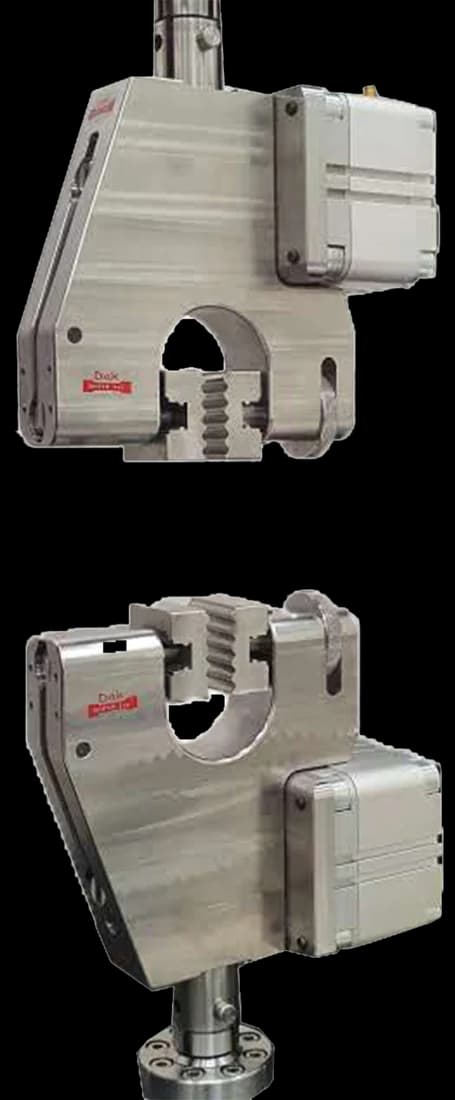
Standard 25 mm
Pneumatic Vice Action Grip
Pneumatic vice action grips clamp the full specimen width at a constant, even pressure — which is what stops one side slipping or tearing before the other.
Specifications
Testing standard
Nonwovens — Test methods — Part 3: Determination of tensile strength and elongation at break using the strip method
Written and technically reviewed by Dak System Inc. engineeringLast reviewed
ISO 9073-3 determines the tensile strength and elongation at break of nonwovens by the strip method, in which the full specimen width is clamped. Two specimen widths are offered — 25 mm as Option A, pulled at 300 mm/min on a 75 mm gauge, and 50 mm as Option B, pulled at 100 mm/min on a 200 mm gauge — and both conditioned and wet states are covered.
From the test method to your testing system
Explore the DAK machines already listed for ISO 9073-3, then review the grips, measurement and setup requirements below.
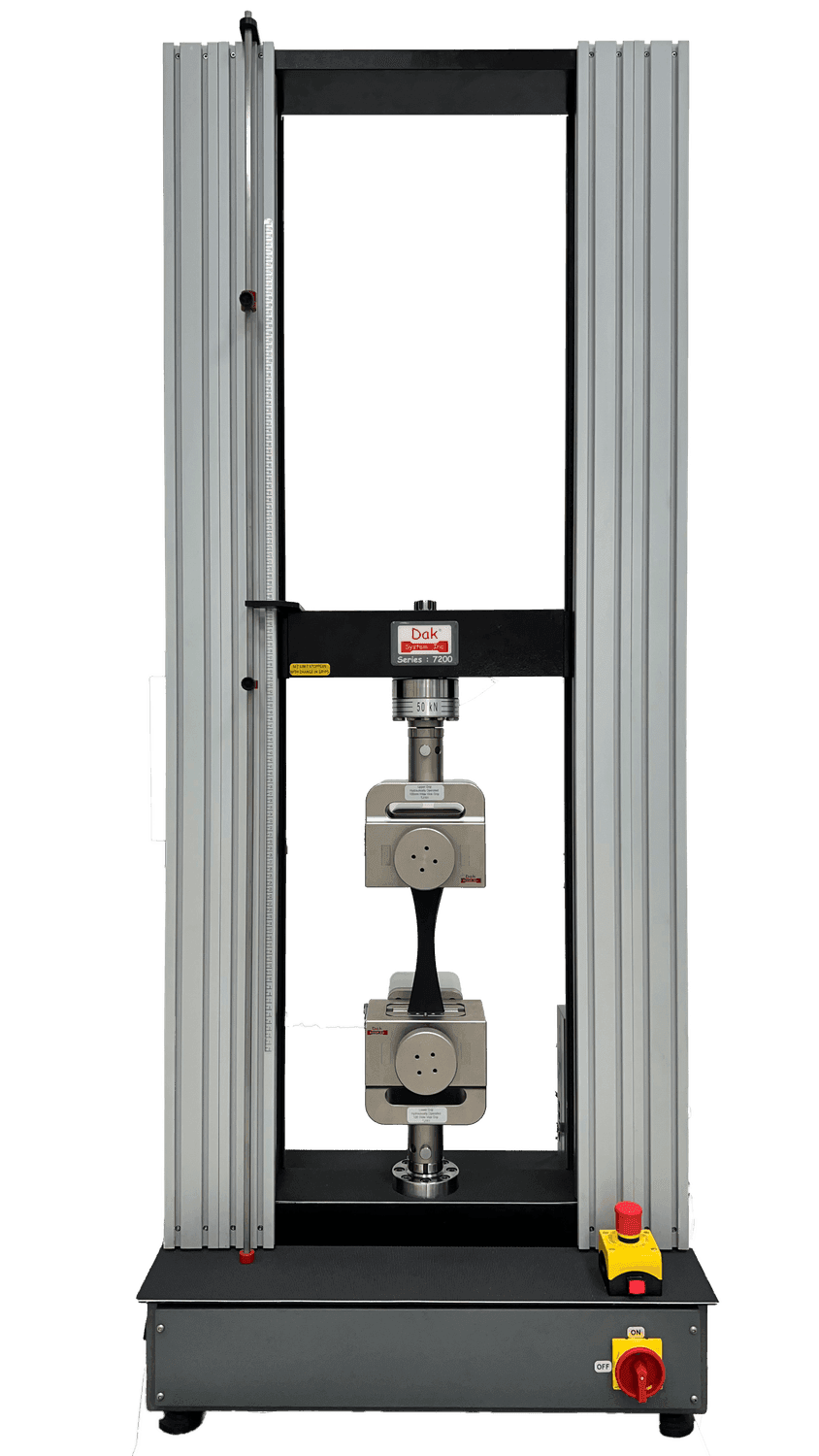 Universal Testing MachineSeries 7200Explore the machine →
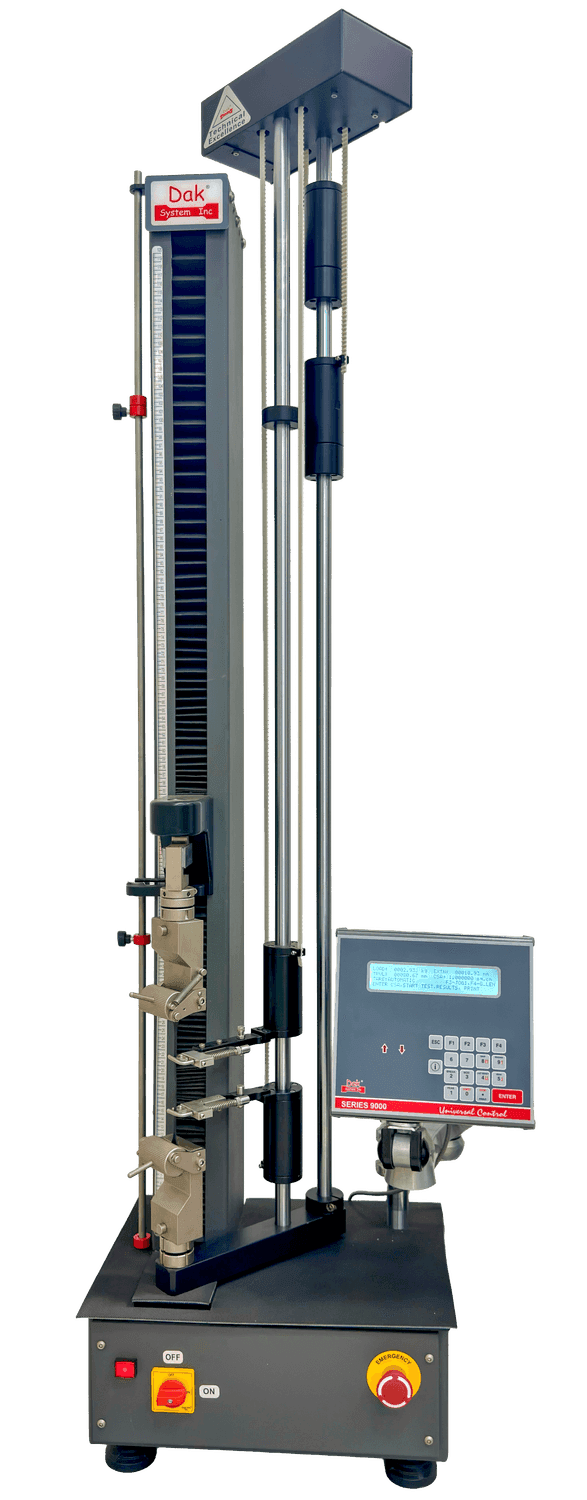 Universal Testing MachineSeries 9000Explore the machine →
01Understand the method
A strip of nonwoven is cut to one of two widths — 25 mm under Option A or 50 mm under Option B — conditioned in the standard atmosphere or prepared wet, and clamped across its full width in a constant rate of extension machine. It is then extended to break, and the maximum force and the elongation at break are recorded. Machine and cross-machine directions are tested and reported separately, and the option used is stated with every value, because results from the two widths are not comparable with one another.
How much load a nonwoven web carries before it comes apart, and how far it stretches getting there. Both matter in use: a wipe or a medical drape has to survive handling, and a filter medium has to survive the pressure differential across it. The strip geometry is what makes the number interpretable — the full width is clamped, so every fibre in the section is loaded, and the result belongs to a defined width rather than to whatever portion of the material the grips happened to recruit. The figure is a force for that width, not a stress, because a lofty web's thickness depends mostly on how hard it is measured.
02Prepare the specimen and test settings
Option A is 25 mm wide, Option B is 50 mm. They are alternatives, not a progression, and the results are not comparable.
Nonwovens are not weaves. There is no yarn to redistribute load around a flaw, so edge quality and specimen width matter more here than they do on a woven fabric.
03Build the test setup on a DAK machine
Small forces, measured properly, at one of two speeds. The method sets a rate of extension of 100 mm/min for Option B — the 50 mm strip, run on a 200 mm gauge — and 300 mm/min for Option A's 25 mm strip on a 75 mm gauge, each held to ±10 %, with jaw separation settable to either gauge within ±1 mm. Most nonwovens break between a few newtons and a few hundred, so the load cell is chosen for that range rather than for the frame. Grips must hold the full strip width at a pressure that does not cut a bonded web, since anything the jaw damages is simply lost from the section, and each jaw face is at least 10 mm wider than the strip. Elongation is normally taken from grip separation, which is acceptable on these materials because nonwoven elongations are large enough that take-up is a small proportion of them.
Pneumatic vice action grips clamp the full specimen width at a constant, even pressure — which is what stops one side slipping or tearing before the other.
SpecificationsDak verifies against whichever standard the method names, and where a class applies our frames sit a class tighter than it asks.
| The method asks for | Dak supplies | |
|---|---|---|
| Capacity | Low — most nonwovens break between a few newtons and a few hundred newtons | Load cells from 1 kg to 60 ton on the Series 7200, and 0.5 to 100 kN on the Series 9000 |
| Force accuracy | ISO 7500-1 Class 1 at the working load, which for a light nonwoven is small | ISO 7500-1 Class 0.5 — a class tighter than the method asks |
| Gripping | Wide flat grips holding the full strip width, with faces that do not cut a bonded web | Wedge, vice-action, pneumatic and hydraulic grips, built to the specimen |
| Environment | 23 ± 2 °C standard laboratory atmosphere | 3009 series chambers, −150 °C to +400 °C — temperature only |
04Run the test
05Calculate, report and interpret
The maximum force recorded before break, for the stated specimen width
A force for a defined strip width. Nonwoven thickness is highly compressible, so nothing is divided by an area.
Eb = (ΔL / L₀) × 100
Normally from grip separation on these materials, which is acceptable because nonwoven elongations are large enough that grip take-up is a small share of them.
Reporting a strength without naming the option, which makes it uncomparable. Averaging the machine and cross-machine directions, when a web laid on a moving belt is oriented by the process and the two commonly differ several-fold. Scissor-cut specimens. And testing only conditioned material for a product used wet — wipes, hygiene articles, medical drapes and filters all work saturated, and webs relying on hydrogen bonding lose most of their strength when they are.
06Compare methods and find answers
| ISO 9073-3 | ISO 9073-18 | |
|---|---|---|
| Method | Strip — full width clamped | Grab — part of the width clamped |
| Gives | Strength and elongation | Strength and elongation |
| Specimen | 25 mm or 50 mm wide | Grab geometry |
| Comparable | No | No |
Two parts of the same series covering the same property by different clamping. Neither converts into the other, and a specification names one.
It is Part 3 of the ISO 9073 series of nonwoven test methods, covering tensile strength and elongation at break by the strip method — the full specimen width is clamped, so every fibre in the section carries load. The current edition is ISO 9073-3:2023, the second, published in June 2023 and replacing the 1989 first edition.
Whichever the specification names, and it must be stated in the report because the two are not comparable. Option A uses a 25 mm specimen and Option B a 50 mm one. The wider option tends to suit light or open webs, where a 25 mm strip contains too few bonds across its section to represent the material — the result then swings with where the strip happened to be cut.
Because there are no yarns. In a woven fabric a damaged edge yarn sheds its load into its neighbours through the weave, so a slightly ragged cut is partly forgiven. A nonwoven is a bonded web, and a torn or crushed edge is simply a notch with nothing to arrest a tear once it starts. Cutting with a sharp die or template rather than scissors removes an entire class of low results.
Because a large share of nonwovens are used wet — wipes, hygiene products, medical drapes and filters — and many lose most of their strength when saturated, particularly those relying on hydrogen bonding rather than thermal or chemical bonds. Reporting only the conditioned value would describe a property the product does not have at the moment it matters.
Because a nonwoven web is laid down on a moving belt, and the process orients the fibres along the direction of travel to a degree that depends on how it was formed. The machine direction is commonly several times stronger than the cross direction. Averaging them would produce a figure describing neither, and would let a product pass a specification while being weak across the web.
Normally yes on these materials, and the method accommodates it. Nonwoven elongations at break are often large — tens of per cent — so grip take-up and machine compliance are a small share of the total and the error they introduce is proportionally minor. That reasoning does not carry over to stiff, low-elongation materials, where an extensometer is required.
Because nonwoven thickness is not a usable area. A lofty web compresses substantially under the pressure needed to measure it, so a stress computed from that thickness would depend mostly on how hard the gauge pressed. Reporting the breaking force for a stated strip width keeps the measurement honest, which is also why the option used has to accompany every value.
Discuss your specimen, test requirements and reporting needs with DAK engineering.
This page describes the method as practised. The governing text is the current edition from the issuing body. Tell us what you are testing and we will answer with the machine, the fixture and a quotation.